The Changing Face of Election Campaigns
Jenny Hu / photos Vincent Chang / tr. by Robert Taylor
December 1993


"Once upon a time, the Monkey King Sun Wu-kung stole ginseng fruit from Wu Chuang Kuan taoist temple on Wan Shou Mountain. This magical fruit ripens only once in 3000 years, and must not be allowed to touch the ground, for if it touches the ground it will disappear without trace. So the Monkey climbed up the tree, and wrapping his tail round the trunk for support, he tapped three of the fruit from the branch with his golden staff in his right hand, while with his left hand he deftly lifted a corner of his jacket to catch them. Thus he easily stole away the treasure on which the great immortal Chen Yuan depended for his magic, and triumphantly made his escape."
When analyzing overall campaign strategy, Chuang Wen-hua, a veteran of electoral campaigns in Taiwan, loves to make this analogy: the ginseng fruit are the electoral seats over which the various parties are battling; the branch on which they support themselves is their campaign strategy; the turned-up jacket is the organized mobilization of grass-roots supporters; and that versatile golden staff, the weapon with which election campaigners fight for "command of the skies," is the written word.
The media campaign for this year's elections of city and county chief executives started with the Democratic Progressive Party (DPP) using the subject of old-age pensions to blast the ruling National Party (KMT) over gaps in the social welfare system. The KMT hit back by accusing the DPP of "wanting to give with one hand and take back with the other," while both parties proclaimed themselves upholders of "social justice." As the campaign progressed, the DPP accused the KMT of "ten great scandals" and denounced "the fake Mr. Clean image of ten corrupt high officials." Not to be outdone, the KMT not only made an emotional appeal by publishing advertisements expressing respect for senior citizens and housewives, but also grappled the DPP in print with the accusation that "the DPP is betraying the country," and denounced the shortcomings of DPP rule in the seven counties and cities which it controls. At the same time the KMT called for stability and loudly proclaimed, "We want prosperity, not conflict." To add extra interest, this year the Chinese New Party (CNP) has joined the fray, touting itself as the spokesman of ordinary people and invoking the spirit of the Father of the Nation, Sun Yat-sen. They have fought a guerilla campaign under the guns of the two larger parties, printing leaflets attacking both the big boys as "bad apples."
Every day when voters open their newspapers, as well as seeing long reports on the state of the election campaign, they are confronted with halfpage or full-page advertisements from political parties and candidates ingratiatingly trying to win their support, and every letterbox is stuffed with leaflets and handbills. The budgets the parties allocate to media campaigning give the best idea of the importance they attach to it. This year, the KMT's Department of Cultural Affairs budgeted the tidy sum of NT$40 million for newspaper advertizing alone, while DPP headquarters' total budget for campaign publicity materials was NT$20 million; the amounts spent locally by the individual candidates are almost impossible to calculate.

34 years separate these two election handbills from Wang Yu-yun and Wang Shi-hsiung, the famous father-and-son duo of Kaohsiung City politics, but they differ little in format and design concept. Only the printing technology used has changed beyond all recognition. (posters courtesy of Chuang Wen-hua)
The age of organized campaigns:
Local government elections in Taiwan began in 1950. At that time, the island was still an agricultural society, and most voters were neither well educated nor well informed, so that it was only a few country gentry and figures of popular trust in local communities who were interested in getting involved in local affairs. "In those days, there just wasn't any need for a printed campaign. There weren't even that many people who could read and write, and candidates mainly used their relationships with friends and family to gather votes. There were no major policy differences or ideological demands then either; few people had strong political views, and there was no need to rely on a special printed campaign. Addressing public meetings was the most effective way of getting your views across," recalls Chuang Wen-hua, who has over 20 years' experience as a candidate and campaign assistant in local elections, having first got involved in election campaigning in 1968 as a campaign assistant for Kaohsiung City mayor Yang Chin-hu, and having later himself been elected as a Kaohsiung city councillor.
In those days, under martial law, multi-parter elections were not allowed, and the keys to success in KMT elections were the ability to procure the support of local party members whose advice people would follow when voting and who could therefore allocate blocks of votes to candidates, and the ability to mobilize the local party organization and control local factions. The function of candidates' printed materials was merely to "inform," and most commonly took the form of "visiting card" type handbills printed with the candidate's basic details plus phrases like "earnestly requests your vote" or "respectfully asks for your support."
In those days, the non-KMT "independent" candidates had rather more tricks up their sleeves. Apart from distributing handbills covered densely with printed or brush-written characters explaining their views, they also made effective use of mobile advertisements in the form of vehicles plastered with posters.
Kuo Kuo-chi has been active in politics since shortly after Taiwan returned from Japanese to Chinese rule, and was one of the "Five Tiger Generals" of the early years of the Taiwan Provincial Assembly. His quick reactions and hard-hitting style earned him the epithet "Cannon Kuo" in political circles and the media. Once when beset by political rumors, he painted in large characters on old newspapers: "Treacherous court officials are out to get the Cannon. Save him! Save him!" He pasted the newspapers onto a tricycle ricks have and rode through the streets earnestly appealing to the electorate. This was probably the embryonic form of the later election cars. Later, when motor vehicles made their appearance, Kuo would always fix a model cannon on top of his car, along with the slogan: "Give me the honor to die at my post!" This is a classic example of how the written word was used in early election campaigns in Taiwan.
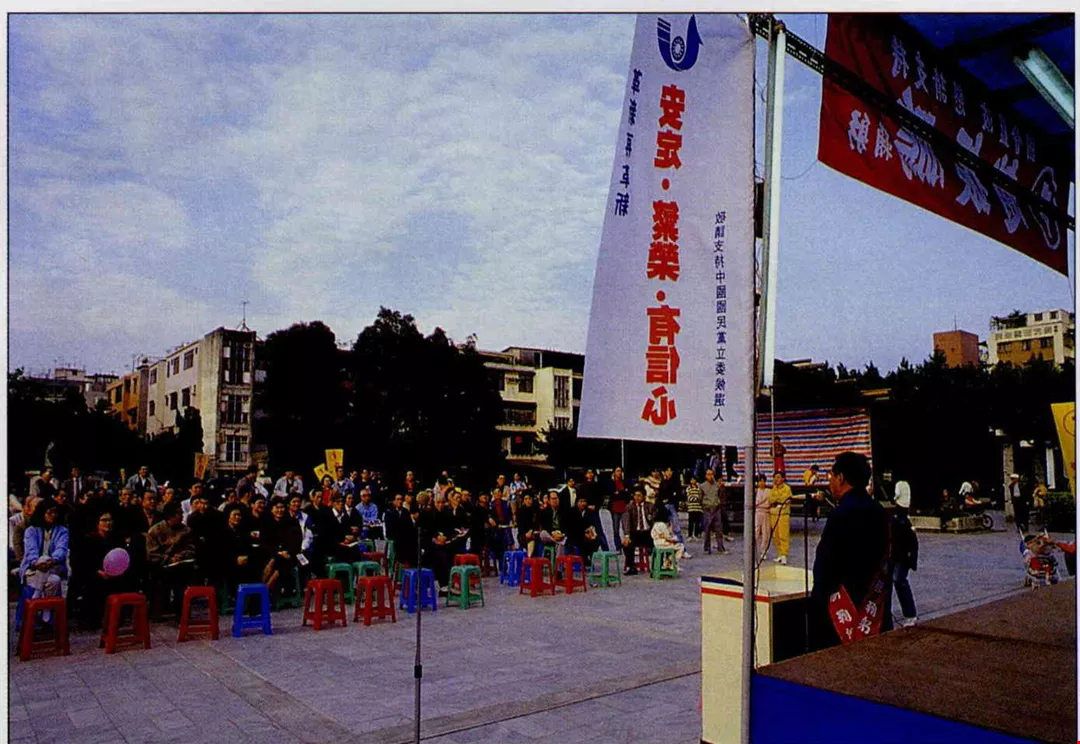
For the last 40 years, campaign meetings have been the main stage on which candidates build their power base, while printed campaign materials have been seen merely as a supporting publicity instrument. (photo by Pu Hua-chih)
New talent, new ideas:
By the 1970s, handbills and election cars were in general use as propaganda instruments. In 1977, when Hsu Hsinliang was campaigning in Chungli for election as chief executive of Taoyuan County, he used large numbers of posters, including large-character wall newspapers. Their content mainly consisted of denunciations of malpractice and exposes of political corruption. Each day, the moment the latest handwritten poster went up on "democracy wall," it would attract a large crowd of readers from among the electorate. This was the start of the use of "large-character posters."
From the end of the 1970s, political magazines independent of the KMT began to flourish and in the early 1980s the "Non-KMT Editors' Association" was set up and began to train editorial staff. In the 1980s the Association became a source of talent, providing writers of election campaign materials for the whole non-KMT camp. In reaction to this, the KMT also upgraded its training of campaign writers. Thus from the beginning of the 1980s, the use of the written word in election campaigns gradually became prevalent.
In the 1983 elections to expand the Legislative Yuan, the Taipei branch of the KMT broke away from the former stereotyped dogmatic approach, and for the first time used the techniques of commercial advertising to present a packaged image in straightforward, accessible language. This also marked the first time that a commercial advertising agency was brought across the divide into political advertising.

Today's elections are accompanied by a plethora of campaign materials. A stream of souvenir badges, stamp albums, video tapes and the like sell well to an inquisitive public. (photo by Hsueh Chi-kuang)
Propaganda as art:
That year, the KMT's Taipei City branch collaborated with Ginger Advertising Agency to produce a boldly innovative series of image adverts on the theme of love for one's homeland. The five posters in the series included Thinking of . . ., modelled by Chen Ta, a singer of local-flavor songs; A Little Bigger Every Day, based on sculptor Hou Chin-shui's piece Mother and Child; The Rain Won't Last Forever, which took its title from Hung Jung-hung's hit song; and Same Moonlight, Different Moods and An Asian Orphan--dedicated to all who care about our country's future, modelled by singers Su Jui and Luo Tayou respectively. When the posters appeared, they elicited a tremendous response from a surprised and delighted public, who rushed to get copies. The series was later printed as cards and bookmarks, which is a measure of how well it was received. The first and second posters in the series even received the bronze medal in that year's China Times advertising awards. The success of this ad campaign was seen as one of the main factors behind the KMT's resounding election victory in Taipei City that year.
In 1985, in preparation for the campaign for that year's elections of county and city councillors and chief executives, the KMT held a "Gongs and Drums Camp" to train large numbers of postgraduate students and people from advertising and the media. Non-KMT groups also organized a series of "practical seminars" to bring together and train participants recommended by candidates. Zany cartoons, innuendo and political jokes designed to give a flash of insight were widely used. Campaign leaflets became more and more attractively printed, wall calendars were a big hit with voters, and that effective weapon of the non-KMT groups, the campaign newspaper, quickened the rhythm of the war drums.
However, the historical turning point at which elections in Taiwan can be said to have really entered the age of free expression and open competition did not come until 1989. The three elections that year--for the Legislative Yuan, county and city chief executives and the Provincial Assembly--were to be the first major elections after the ban on organizing political parties was lifted, and they were all hotly contested.

If posters and handbills don't do the trick, why not get support from a TV star? Having the just magistrate Pao Ching-tien on your side must surely be worth some extra votes. (photo by Li Chin-hua)
After the thaw:
Out on the streets, walls of multiple TV screens and video cars caught the eye and the ear everywhere, and honking buses and taxis carried the images of smiling and waving candidates through the streets. All the mass media apart from TV and radio were chock full of adverts from parties and candidates. Back in the days of independent candidates there had already been slogans calling for "self-determination for Taiwan residents," or "new parties to save Taiwan," but when in 1989 the DPP brashly called for "a new country and a new legislature," and the DPP's "County and City Executive Election Alliance" used media advertisements to publicly call on people to "vote the ruling party out of office," it really was something quite unprecedented.
For the 1991 elections to the Second Session of the National Assembly, both the KMT and the Chinese Social Democratic Party used "corporate identity system" concepts to design new party logos. With the end of the ban on TV advertising for political parties, film directors and corporate image experts were brought in to begin making political advertising films, and television viewers were treated to a free viewing of several experimental films.
In terms of election demands, as the climate grew more open opinions of every political color were aired, and later the same year the DPP's central standing committee passed its "Draft Constitution for Taiwan," and proposed "founding an independent country." The KMT, seizing on Taiwan's middle classes' collective fear of disorder and desire for stability, defined its position as one of "renewal, stability and prosperity," while lambasting the DPP as the party of "violence and revolution." In the ensuing war of words, the electorate showed a clear preference for "stability."
Learning its lesson from this setback, in 1992 the DPP adopted a markedly more pragmatic stance with their "Three oppositions"--opposing money power, privilege and military involvement in government--and "Three demands"--demanding lower taxes, direct presidential elections and national sovereignty--as a counter to the KMT's "Constant renewal, stability, prosperity and confidence." The DPP's "Three oppositions and three demands" slogan and their powerful and majestic military-style theme song swept through Taiwan's towns and villages, making the whole of the KMT's campaign appear insipid by comparison. "This built on the propaganda experience the DPP had gained in the early years producing independent political magazines. They were better than the KMT at grasping the most important points and appealing straight to people's hearts," observes Associate Professor Cheng Tzu-lung of the Department of Advertising at National Chengchih University.
But the KMT has not been content to be the one always taking the blows and trailing behind, and in their campaign strategy this year, they have begun to develop a more robust approach: "We must not fail to attack anything that should be attacked, and must not prevaricate over any point that needs immediate clarification." Thus the media campaign for this year's elections has become a "battle of exposes."
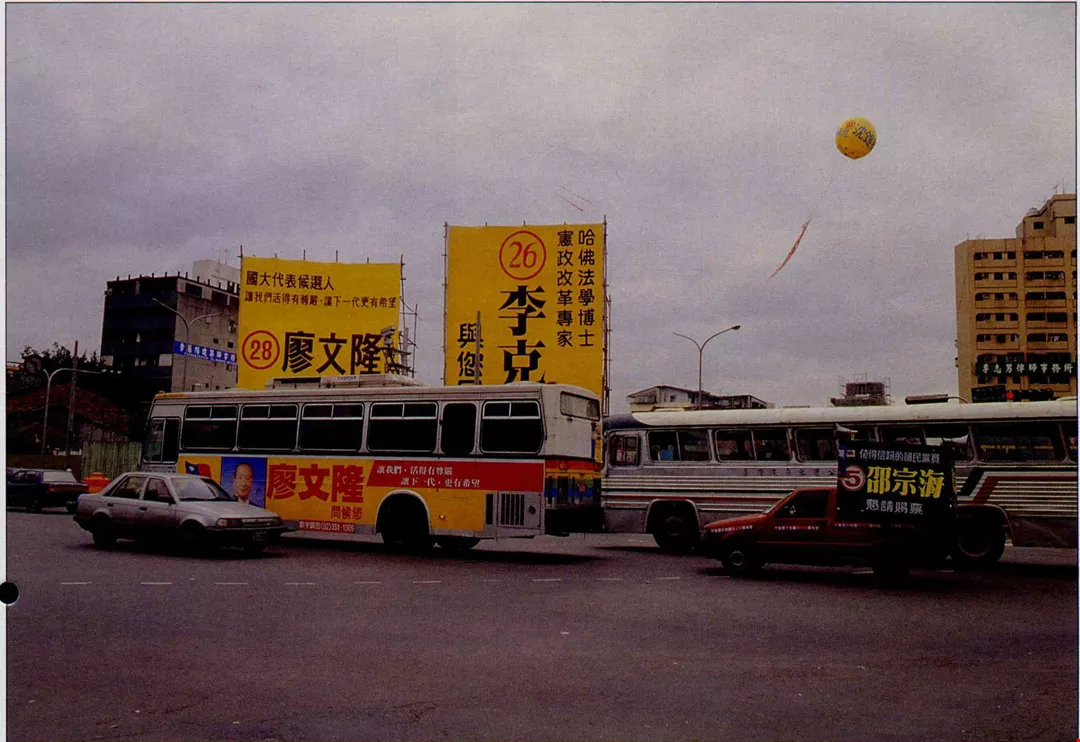
When elections come around, candidates scramble for advertising space on "golden mile" buses and billboards. (photo by Diago Chiu)
High-tech campaigning:
Since the lifting of martial law in 1988, the electorate's independence of mind has grown ever stronger, and the old methods of arranged block votes, canvassing on the basis of personal relationships and vote buying have become less and less viable. Today, as people's reliance on the mass media increases, the media campaign is gaining ever greater importance.
In addition to the traditional medium of print, which still has its place, as technology advances candidates are making great use of some new electronic devices. For instance, this year saw the use of automatic computer voice-synthesis systems for telephone canvassing, while computerized fax systems send candidates' opinions to fax machines everywhere. Even personal pagers with Chinese language displays have become part of candidates' campaign armory.
So if one day at election time your pager sounds and you look down and see the message "Please support candidate X," don't be too surprised: the age of electronic electioneering is upon us.
[Picture Caption]
p.28
34 years separate these two election handbills from Wang Yu-yun and Wang Shi-hsiung, the famous father-and-son duo of Kaohsiung City politics, but they differ little in format and design concept. Only the printing technology used has changed beyond all recognition. (posters courtesy of Chuang Wen-hua)
p.29
For the last 40 years, campaign meetings have been the main stage on which candidates build their power base, while printed campaign materials have been seen merely as a supporting publicity instrument. (photo by Pu Hua-chih)
p.29
Today's elections are accompanied by a plethora of campaign materials. A stream of souvenir badges, stamp albums, video tapes and the like sell well to an inquisitive public. (photo by Hsueh Chi-kuang)
p.30
If posters and handbills don't do the trick, why not get support from a TV star? Having the just magistrate Pao Ching-tien on your side must surely be worth some extra votes. (photo by Li Chin-hua)
p.31
When elections come around, candidates scramble for advertising space on "golden mile" buses and billboards. (photo by Diago Chiu)
p.32
In the age of pluralism and democracy, all voices must be heard. In the campaign for November's county and city chief executive elections, the KMT used the slogan "Ability, patriotism, honesty and a better future" to counter the DPP's "Clean politics, efficient government and love for our homeland." Meanwhile the New Party blasted both as "bad apples."
p.32
(courtesy of KMT, DPP and the Chinese New Party)
p.33
Faced with an electorate of every social background and every walk of life, candidates rack their brains to devise all kinds of canvassing activities and publicity materials, in the hope of winning people's hearts and gaining their votes.

In the age of pluralism and democracy, all voices must be heard. In the campaign for November's county and city chief executive elections, the KMT used the slogan "Ability, patriotism, honesty and a better future" to counter the DPP's "Clean politics, efficient government and love for our homeland." Meanwhile the New Party blasted both as "bad apples.".

(courtesy of KMT, DPP and the Chinese New Party)


@List.jpg?w=522&h=410&mode=crop&format=webp&quality=80)


@List.jpg?w=522&h=410&mode=crop&format=webp&quality=80)
