

What different impressions of the Sino-Japanese War exist among the people of Taiwanese and mainland Chinese origin who lived through the war years, the middle-aged generation who were born and grew up in Taiwan after the war, and the "New New Youth" for whom the conflict is no more than a distant shadow? Will answering this question help us to understand each other better? We hope our opinion poll can clear up some of the doubts which perhaps many people share.
Our telephone survey was conducted from 10 to 12 August 1995 by calling numbers chosen at random from the Greater Taipei telephone directory. 199 valid responses were collected. To enable interviewees to express themselves fully, most questions were of an "open response" type. In the course of our interviews, we did indeed find that many members of the public had a great deal to say about many of our questions--some so much, in fact, that we could hardly get them to put down the phone. But there were also many interviewees who, without a choice of ready-made responses to guide them, hesitated and did not know how to answer. In particular, middle-aged, less-educated women and housewives, on hearing that we wanted to ask them about "the war," hurriedly refused, saying "I've had no schooling, I don't know anything about it!" or "You'd better ask my husband!" This is borne out by the large imbalance between male and female respondents (62.8% to 37.2%). On the other hand, a few old mainlanders who boasted that they had "fought the whole eight years of the war against Japan from start to finish" spoke with a heroic air, and their answers to our questions seemed less like an interview than as if they were giving us "youngsters" a robust history lesson. With the open response style of the questions, it took us 10 to 15 minutes to complete each interview. Thus at four hours per evening each interviewer could only get through 15 to 20 interviews per session. Nonetheless we felt we had really gained something.
Because the open style of our questions elicited a wide variety of opinions, expressed in an even greater variety of ways, for ease of statistical presentation we have combined the answers into various broad categories such as positive, negative or neutral, while reflecting the more detailed content in narrative form. We hope in this way we can present the information in a form which is easy to grasp, yet still lively and complete.
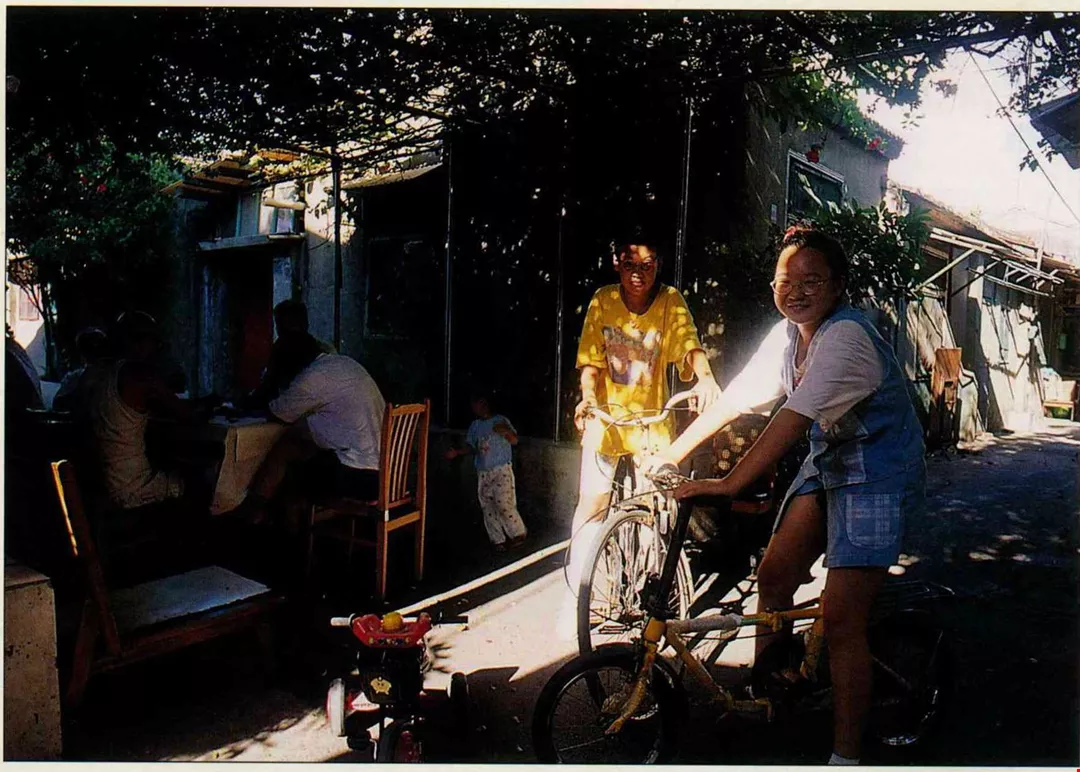
The "Sabre Song" and "Exile Trilogy" were typical songs of the early post war years in military dependents' villages. But as memories of the war fade, what impressions do the villages' second generation have of Japan? (photo by Pu Hua-chih)
The war means nothing to me?!
In our first question we asked people their image of Japan and the Japanese. We found that around half (50.7%) of the respondents had a positive opinion of present-day Japan, while almost as many (44.6%) had a negative opinion. Analyzing the replies more closely, we discovered that the positive opinions were mainly centered on such aspects as Japan's good infrastructure and its people's unity, law-abiding nature and efficiency, while negative opinions were mainly to do with the Japanese being aggressive, cruel, treacherous and materialistic. Both sets match closely with common stereotypes.
With further cross-analysis, we found that party political allegiance and provincial origin are two variables which correlate with attitudes towards the Japanese: more than half of KMT supporters (55.7%) had negative opinions of Japan--higher than DPP supporters at 45.0% and people who stated no party allegiance at 39.2%. Meanwhile almost six out of ten respondents of mainland ancestry (58.3%) had negative opinions of Japan, again higher than people of Taiwanese descent at 38.4%.
When we asked people whether the Sino-Japanese war had a "special significance" for them compared with other wars, only two-fifths (41.2%) replied that it had, while almost three-fifths (58.3%) rejected this idea. Of these, older people said one should "let bygones be bygones," while those born since the war said things like "I don't have any real feelings about it," "I didn't experience it," or "It was too long ago." For those members of the older generation who fought in that life-and-death struggle, this outcome must be a matter for regret. It also reveals that many members of the public have been unmoved by the fiftieth anniversary of the end of the war, despite the extensive media reports which have accompanied it.
The third question asked after the causes behind the Sino-Japanese war. A majority (72.9%) ascribed it to factors connected with Japan. Most of these interviewees directly blamed Japan's aggressive ambitions, but there were also a minority who took the view that as an island nation with limited resources, Japan had little choice but to expand overseas, and their tone suggested some understanding and sympathy for the Japanese. There were also 6.5% who thought that China brought disaster on herself by her weakness and inertia. It is worth noting that almost a fifth (18.2%) of those asked said that they "didn't know" or "had forgotten" the causes of the war. Especially in the oldest age bracket, those born before 1941, of the 14 interviewees of Taiwanese origin, seven--50%--answered in this way. This seems to reveal the conflicting feelings of older Taiwanese: furthermore, when one considers the powerful propaganda of the Japanese media of the time, and the way in which the real state of affairs was hidden from the populace, this situation has its causes.
As for the reasons for the end of the Sino-Japanese war, more than half (57.8%) of interviewees put it down to the might of the US atom bombs; only 11.1% felt that victory was won by the Chinese themselves.
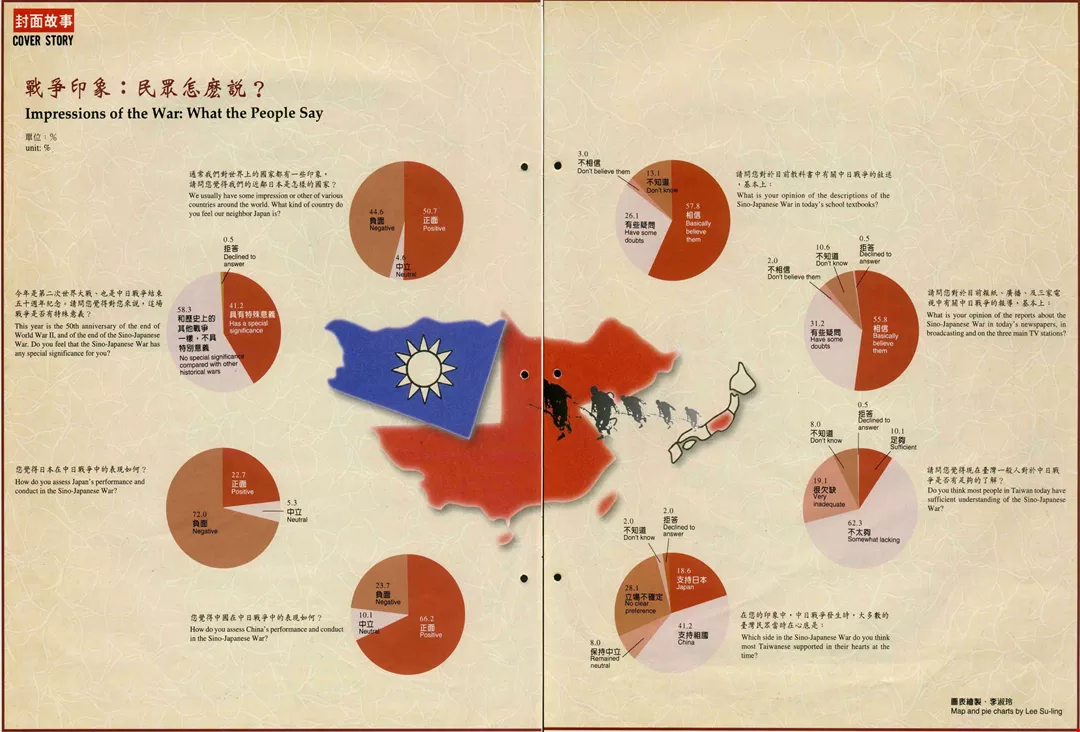
Map and pie charts by Lee Su-ling.
Disparate views of China's performance
Next we asked interviewees their assessment of China's and Japan's performance and conduct in the war. We found that 72.0% of respondents gave a negative assessment of Japan's war record. Their answers centered on the Japanese invasion and atrocities, and on their high-handedness and arrogance. But 22.7% of respondents assessed Japan's performance positively, especially the valor and loyalty of the Japanese army.
Analyzing the content of the replies, in fact the positive and negative replies do not contradict each other. In other words, almost all our interviewees acknowledged that the Japanese army was both "brave and loyal" (towards Japan) and "cruel and ruthless" (towards the countries they invaded). The only difference was in whether they personally tended to like the Japanese for this, or despise them. Quite a number of interviewees replied: "Japan's performance in the war was top-notch, but I still won't give them the slightest praise!" Replies to this question were scarcely affected by interviewees' provincial background or party allegiance.
So what of China's performance in the war? For a victorious country, it can only be described as "just passable": 66.2% of interviewees gave a positive assessment, while 23.7% were critical. But unlike assessments of the Japanese, where people agreed on what that nation's traits were but differed in which they chose to highlight, opinions of China's performance were directly at odds with respect to the same criteria. For instance, those who gave good marks described China's wartime performance as brave, indomitable, sincere and united, whereas those who gave a negative assessment thought the Chinese showed themselves to be cowardly, incompetent and divided. So were the Chinese really cowardly or valiant, united or split? It seems that like the blind men feeling the elephant, the public in Taiwan today are unclear, hesitant and undecided in their impressions.
The seventh question concerned one of the greatest atrocities of the war, the Rape of Nanjing. As many as 85.4% of interviewees said they are still "intensively grieved" by this event. Those who were "not especially grieved," were "not concerned," didn't know or declined to answer totalled 14.6%.
Our next few questions were intended to reveal the sources from which members of the public get their information about the Sino-Japanese war. The results showed that only 2.5% gained their impressions from their own personal experience of fighting in the war. A further 34.2% of interviewees had relatives or friends who fought in the war, while the remaining 63.4% had no one close to them who took part, and were consequently relatively less familiar with this topic. Of this group, more than four-fifths (52.8% of all interviewees) had little opportunity in their day-to-day lives to talk about the war, and this proportion rises as the age of interviewees falls, showing that the younger people are, the less interest they tend to show in this war.
Apart from personal contacts, we asked interviewees what they thought of the descriptions of the Sino-Japanese war in school textbooks and in the mass media. 57.8% and 55.8% respectively of interviewees indicated they basically "believe" them; those who "have some doubts" or "do not believe" them totalled 29.1% for textbooks and 33.2% for the media, suggesting that the public have slightly more faith in textbooks' credibility than in that of the media.
Food for thought
After the intensive media reports accompanying the recent fiftieth anniversary of the end of the war, has the public gained a clearer perception of the eight-year conflict with Japan? The results do not look encouraging: as many as 81.4% of interviewees expressed the view that most Taiwan residents' understanding of the war is "somewhat lacking" (62.3%) or "very inadequate" (19.1%). Only one in ten believed that people here sufficiently understand the war.
How can Chinese not understand the eight-year War of Resistance against the Japanese? Many cited reasons such as "I didn't experience it," "It was too long ago, it's been forgotten," or "I don't have enough information." But some people said bluntly: "It was between the Kuomintang and the Japanese, it had nothing to do with Taiwan," or "I only know about the Japanese occupation of Taiwan, I don't know about their invasion of China." Answers such as these to some extent reflect the detached attitude of the Taiwanese, who 50 years ago were far away from the front lines.
Interestingly, while quite a few older Taiwanese interviewees opined with implied regret that "young people today aren't the slightest bit interested in finding out about those events," some younger respondents took a diametrically opposed view: "We of the younger generation have read our history books, we know what happened. The old generation lived under colonial rule, and the Japanese deceived them about many things. . . ." So who really understands, and who doesn't? What kind of understanding is right? It seems that today, fifty years after the war ended, there are still many question marks.
The question which revealed most about the public's ambivalent attitudes towards the war with Japan was the last one: "Which side in the Sino-Japanese war do you think the people of Taiwan supported in their hearts at the time?" On hearing this question, quite a number of interviewees hesitated for a long time, unable to make up their minds. In the end those who thought the Taiwanese "probably" supported China were the largest group at 41.2%, while 18.6% believed the Taiwanese supported Japan; meanwhile a total of 36.1% thought they were neutral or undecided.
After cross-comparison of valid replies, we found that the proportion of DPP supporters taking the view that the Taiwanese supported China was the smallest (18.6%), and there was a large gap between this group and KMT supporters (46.2%), New Party supporters (40.0%) and those who stated no allegiance (43.4%). Furthermore, the younger the age band interviewees belonged to, the larger the proportion believing that Taiwanese of the time probably supported China: of those born before 1941, 35.5% chose "supported Japan"; of those born since 1966, only 10.6% chose this answer. Among those of Taiwanese descent, this disparity grows to 53.8% against 1l.3%. How there could be such a difference of view between two generations of the same section of the community is a question which provides much food for thought.
[Picture Caption]
p.31
In recent years Taiwanese who were forced to go to war as soldiers in the Japanese army have broken their long silence, and taken their aging bodies onto the streets to demand overdue justice from the Japanese government. (photo by Hsing Ting-wei)
p.33
The "Sabre Song" and "Exile Trilogy" were typical songs of the early post war years in military dependents' villages. But as memories of the war fade, what impressions do the villages' second generation have of Japan? (photo by Pu Hua-chih)
p.34
Impressions of the War.What the People Say
We usually have some impression or other of various countries around the world. What kind of country do you feel our neighbor Japan is?
This year is the 50th anniversary of the end of World War II, and of the end of the Sino-Japanese War. Do you feel that the Sino-Japanese War has any special significance for you?
How do you assess Japan's performance and conduct in the Sino-Japanese War?
How do you assess China's performance and conduct in the Sino-Japanese War?
What is your opinion of the descriptions of the Sino-Japanese War in today's school textbooks?
What is your opinion of the reports about the Sino-Japanese War in today's newspapers, in broadcasting and on the three main TV stations?
Do you think most people in Taiwan today have sufficient understanding of the Sino-Japanese War?
Which side in the Sino-Japanese War do you think most Taiwanese supported in their hearts at the time?
Map and pie charts by Lee Su-ling


@List.jpg?w=522&h=410&mode=crop&format=webp&quality=80)


