Remembering Yoichi Hatta, Father of Chianan Irrigation
Coral Lee / tr. by Jonathan Barnard
June 2008


Every year on May 8 a ceremony is held to honor Japanese engineer Yoichi Hatta (1886-1942) at his grave near Wushantou Reservoir. Those who solemnly pay their respects to "the father of the Chianan Irrigation Waterworks" amid copious offerings of flowers and fruits include both Chianan farmers and admirers who make the trip all the way from Japan. They keep coming year after year-even now, 66 years after Hatta's death.
Why do both Taiwanese and Japanese still fondly remember Hatta more than six decades after he passed away?
This year's memorial service was a little bit different, since it included some remarks by Ma Ying-jeou just 12 days before he commenced his term as ROC president. Ma's attendance greatly enlivened the atmosphere at the grave.
Ma used the Japanese term "isshokenmei" to describe how Yoichi Hatta devoted his life to a noble cause: transforming the Chianan Plain from a barren wasteland to fertile farmland by constructing the irrigation system known as the Chianan Waterworks. Noting Hatta's great skill in building dams and his deep friendship with the people of Taiwan, Ma conveyed his gratitude to Yoichi Hatta for his enormous contributions to Taiwan.
Tokomitsu Shinsei, general manager of the Japanese-owned Kagaya Beitou Hotel and the director of the Taiwan affairs office of the Mr. and Mrs. Yoichi Hatta Memorial Foundation and Taiwan Friendship Association, explains that the association has no connections with President Ma. That Ma would come to pay his respects on his own initiative greatly moved the Japanese people, and all of the major Japanese media outlets covered it.

A handsome, talented youth
In truth, Yoichi Hatta's experiences in Taiwan after he arrived in 1910 and the esteem in which Taiwanese farmers still hold him so many years after his death are even more moving.
In 1910, not long after he graduated with a degree in civil engineering from Tokyo Imperial University, Hatta boarded a boat for Taiwan to work in the civil engineering department at the Office of the Governor-General. Back then tropical diseases such as malaria and cholera were rampant on the island, and sanitation was poor. William K. Burton, a Brit, had been hired to oversee the establishment of water and sewage facilities. Unfortunately, he ended up contracting malaria himself and died sailing back home to Britain. Burton's responsibilities were passed to his Japanese protege Mishiro Hamano. When Yoichi Hatta first came to Taiwan, he was assigned to work under Hamano as a water engineer at the colonial administration's office in Tainan. The job provided Hatta with opportunities to venture deep inside Tainan Prefecture in the countryside around the Tsengwen River and to gain experience with water engineering.
The Office of the Governor-General later assigned Hatta to design and build Taoyuan's irrigation network, which provided water to 20,000 hectares of rice paddies. Before that job was completed, Hatta's outstanding performance caused his superiors to move him to a more challenging assignment.
The price of rice in Japan was rocketing due to insufficient supply, and the government made increasing production in its colony of Taiwan official policy. The head of Chiayi Prefecture suggested building a dam specifically for irrigation on the Kueichung River, located in today's Tungshan Township, Tainan County. Hatta was sent to carry out a survey. In the process, he discovered a plain of over 100,000 hectares that possessed great potential for growing wet-field rice.
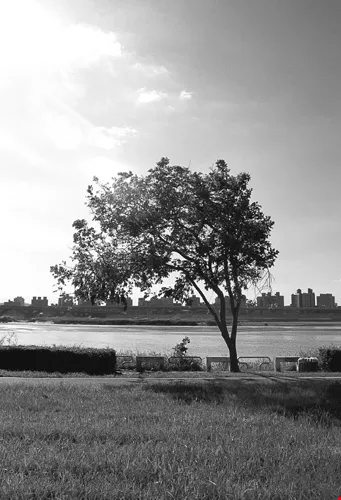
A barren wasteland
This vast plain extends 90 kilometers north to south and more than 30 kilometers east to west. It lies between two rivers: the Chuoshui and the Tsengwen. Back then, some land was under cultivation there, but most of it was planted with peanuts, sweet potato and other dry-field crops. And the soil near the coast had high salinity and couldn't be cultivated at all. The land had three strikes against it: the lack of a reliable water supply, frequent flooding, and high salt content. But Hatta was a visionary. He realized that irrigation and drainage channels were all that was needed to turn this barren wasteland into fertile fields.
At first, the exuberant Hatta, who was only in his early 30s, proposed a budget for the project equivalent to the tax revenue collected by the Office of the Governor-General over the course of a year (¥42 million). Because the colonial government was under great financial strain, the proposal was very controversial. But the rice shortages in Japan were intensifying and causing riots, and with the strong support of Horoshi Shimomura, chief secretary of civil affairs, the project was finally approved after three years. Hatta was put in charge of a team of over 80 engineers.
Work began in 1920. Major parts of the project included the Wushantou Dam and 16,000 kilometers of irrigation and drainage channels. This dense web of channels connects all of the rivers in the Chianan area. If laid out in a straight line, the channels would stretch halfway around the world. The network includes open channels, culverts, surface drainage channels, flumes and so forth. Although building the network was complicated and difficult, work proceeded smoothly. On the other hand, work on the Wushantou Reservoir, which is the major source of water for the network, encountered one obstacle after another. The reservoir took ten years to complete.
First of all, the reservoir's location far upstream on the Kuantien River posed difficulties. More than 1,200 meters long and 66 meters high, its dam required 5 million cubic meters of sand. A dam of this size was unprecedented in Asia, and the Japanese had no experience with the semi-hydraulic fill method used to build it. The only place you could find previous examples of construction by this method was in America. And for water to enter the reservoir from the Tsengwen River, a three-kilometer tunnel had to be drilled through Mt. Wushan, which created all kinds of problems.
After detailed research, Hatta grew 99% certain that the plans he had drawn up would work, but he nevertheless asked the Office of the Governor-General to send him on a research and observation trip to America, where he could purchase the expensive heavy equipment needed for the project. His American journey in 1922 left him confident that the innovative methods he had planned based on his theoretical understanding and knowledge of local conditions would work.
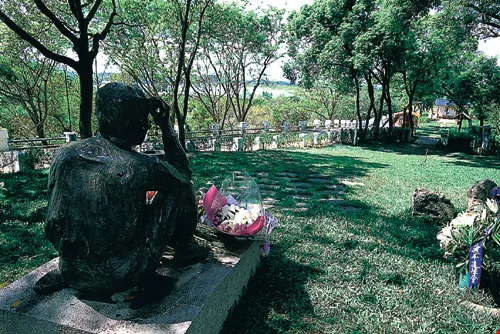
Lost in thought, Hatta sits on the ground, his elbow resting on his knee, serving as a silent lookout for the Wushantou Reservoir. This statue, completed before he died, faithfully captures his everyday appearance.
One challenge after another
Not long after he returned to Taiwan, a major explosion occurred during the drilling of the Wushan Ridge Tunnel when a contractor ignored an oil leak. Over 50 people died. For Hatta, who always showed as much concern for those under him as for himself, it was a heavy blow. "Hatta kept vigil with family members of the deceased, and didn't sleep for three or four days," wrote Tokomitsu Shinsei in his biography of Hatta. Hatta thought long and hard about suspending operations but finally decided to press on. At several points major changes were instituted to overcome various obstacles to building the tunnel.
But as a Chinese idiom describes, disasters never come singly. Three years after work had started, Japan experienced an earthquake that measured 7.9 on the Richter scale. More than 150,000 people died. The destruction hit the Kanto Plain and was centered around Tokyo. It dealt a tremendous blow to the Japanese government and society, as well as to national finances. Taiwan's Office of the Governor-General was ordered to send relief funds to Japan. That led to a budget crisis in Taiwan, and even funds for building the Chianan Waterworks were greatly cut.
Hatta was pressured to extend the time and narrow the scope of the project. In making his staff cuts, he surprisingly decided to cut the workers who had performed best, which caused an uproar in many departments. "The most outstanding workers will find new work with ease, whereas the less able would have had a much harder time. Their whole families might have ended up on the streets. As for the workers I have kept on, I must ask all managers to give them extra training...." After he laid off the workers with tears in his eyes, Hatta scurried around helping them find suitable new jobs.
"What makes people recall Mr. Hatta with great fondness is not only the construction of the Chianan Waterworks, but also the importance he placed on human resources, and the concern he showed for Taiwanese workers," says Hsu Jin-shi, chairman of the Chianan Irrigation Association. So that the more than 2000 workers on the Chianan Waterworks could settle down, he built a residential area in the wilderness, and, unprecedentedly, allowed the workers to bring their families. At the same time, he built schools, hospitals, and entertainment and athletics facilities, establishing an entirely new town. To lessen the hardships and deprivations of life in the mountains, he also tried to accommodate the people's customs, arranging for shows by Taiwanese Opera companies, hand puppet theater troupes and other performance groups.
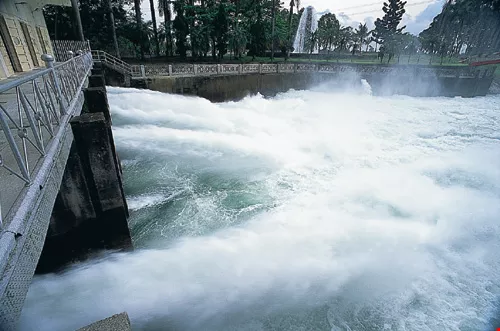
After WWII Hatta's wife Toyoki, distressed by her husband's death and the prospect of being forced to return to Japan, tragically jumped to her death from the top of the Wushantou Reservoir's spillway gate.
Ever flowing
Hatta's emphasis on equality and fairness is what draws the most praise. It was his idea to put the water supply on a three-year revolving cycle. The waterworks could only supply enough water for wet-field rice production in about a third of the land reached by the irrigation network (some 50,000 hectares). To prevent a situation where some farmers would grow wealthy planting rice paddies, whereas others, without water, could barely eke out a living, he split the 150,000-hectare Chianan Plain into three zones, which would plant rice, sugar cane and miscellaneous crops in rotation.
In fact, revolving the supply on a three-year cycle not only spread wealth more evenly among the farmers. By rotating crops, it also improved soil quality. Only four years after the waterworks opened, Tainan Prefecture (today's Yunnan, Chiayi and Tainan Counties) became the new granary of Taiwan, with annual production of rice, sugar cane and other crops increasing from 20,000 tons to 80,000.
In 1942, during World War II, Hatta was assigned to a conduct a survey of irrigation systems in the Philippines. He died on the way there when his ship was sunk by American bombers. His body was cremated and his ashes were brought back to Wushantou, which became his final resting place. At the end of the war in 1945, when the ROC government took control of Taiwan, his wife chose to throw herself into the reservoir spillway rather than to be forced to leave. People would later build a tomb for them both at the reservoir. It marks a tragically moving story.
"Oh! The Tsengwen River gurgles and flows, ceaselessly contributing irrigation water. As long as this verdant supply continues uninterruptedly, their legacy will remain." These are words that Hatta left on a stone tablet to remember those who lost their lives building the Chianan Waterworks, but they also capture the sentiments of the people of Chianan toward Hatta himself.



@List.jpg?w=522&h=410&mode=crop&format=webp&quality=80)
