Day Sheng--tong-Happily Stuck Between Two Generations
Chang Chiung-fang / photos Chuang Kung-ju / tr. by Robert Green
August 2004


At the mention of Day Sheng-tong, people might immediately think of his public successes. Aside from managing the San Sun Hat and Cap Co., he is also chairman of the National Association of Small and Medium-Size Enterprises, and a national policy advisor to the Office of the President.
Aside from his professional work, Day has also developed quite a reputation for management of his family life, so much so that it has become quite a legend in professional circles.
"Whether it's regarding my parents or my children, what I give to them is what they need, not whatever I feel like giving," says Day, revealing in a word the secret of household management.
"Every year on the first day of the Lunar New Year," Day says, "the first thing I say to my father is 'We're another year older!' On hearing this greeting, he always starts laughing happily. I hope I can greet him with the same words every year on into eternity."
Day's parents are both 81 years old. It's hard to believe that every weekend for a couple of decades this successful nearly 60-year-old entrepreneur has driven the two-and-a-half hours from Taipei to Chingshui in Taichung County to show his devotion to his parents.
Last week, Day accompanied his eldest son and his daughter-in-law, who had just returned from the factory they set up in the Caribbean nation of Haiti, to visit Hualien, so he couldn't go home to see his parents. They wasted no time calling him to protest: "Have you had enough of us?"
Day says that fathers of his generation require split personalities-using different modes of communication with the older generation and the younger generation. "I adopt a traditional Chinese approach in caring for my parents," he says, "but more open Western educational methods for the children."
A bond between old comrades
This kind of close family bond across three generations wasn't forged in a day. Unflaggingly for 20 years, Day's father habitually gave his son an allowance just as Day was about to head north from Chingshui after the weekend. The amount slowly grew over the years from NT$1,500 to 3,000. His father stopped the allowance only after the Day family divided their assets ten years ago. "In reality, the money, especially in the later years, didn't even cover the transportation costs," says Day. "But it came to represent the deep emotional bonds between us."
In recent years when Day visits his parents it's not convenient to take them out as a diversion or even to take them out to eat because of their advanced age, so they have to settle for his own cooking. "They are always so happy, though, just because I'm doing the shopping and preparing meals for them," Day says. Filial piety isn't difficult; one just needs to cater to another's pleasures. His father, for example, loves to eat a traditional salted pork dish, so Day practiced until he learned the techniques for making it, mastering each step, from choosing the right cut of meat to the actual cooking and dressing of the meat. He's now something of an expert on the dish.
Day's relationship with his father is really very special. He describes it as "a bond between old comrades."
"My father and I started our company with six employees, and we forged ahead at full speed," he says. "Today San Sun Hat and Cap is a large-scale international corporation with more than 2,000 employees." Day describes how when the family divided up their assets ten years ago, his father said: "I'm giving the company to you, and I hope that when you give it to your son it'll be even more successful!"
Although his father has already been out of the business for a decade, Day still keeps in his office the large table that his father used to use. Every few months, his father makes the trip from Chingshui to Taipei to visit the office. When he arrives, his son throws the company's no-smoking rule out the window, closes his door, lights his father a cigarette, and amid the curls of smoke enjoys the deep feelings they have for each other.
Some people tell Day that his combination of friendship and filial piety for his father can serve as a model for his own children, who in the future might treat him with the same level of respect. But he takes exception to the notion: "If I do it with ulterior motives, then it's meaningless!" he says.
A father with a heart
As a busy entrepreneur, in fact Day Shen-tong had little time to spend with his children while they were growing up, yet he believes that "quality is more important than quantity." Giving children your full attention while you are there is even more important than the amount of time you spend with them, he says. "If you are drunk every day but together with your kids, well that's not much use is it?"
It's the same for a couple. For a quite some time, Day and his wife lived in different places, one in the north and one in the south. Only recently did his wife follow him north. But the couple's feelings for each other and trust in each other weren't diminished in the least. "My wife has never called me late at night to check up on me," Day says with a chuckle. "She says I have a good heart, and couldn't possibly do anything bad."
As for his children, in 30 years Day has never yelled at them even once, much less raised a hand. "The older generation didn't spare the rod when it came to making us obedient," he says. But when it comes to my own children I prefer Western methods, such as trying to talk things through.
In order to help his sons develop foreign-language abilities and an international perspective, Day decided early on to send them abroad for college. But he insisted that they stay in Taiwan through high school. "After all, they're Chinese," he says. "If they can't even understand simple Tang-dynasty poems, their education will have been in vain."
Perhaps because they aren't pressured to be the best in school, the two children have developed their own interests outside of the classroom. The older son began playing the huqin-a two-stringed Chinese violin-early on in high school. Not only did he win fifth prize in the senior-high school group, but he also designed a related website, the "Huqin Practice Room." The second son loves to play pool. Day accepts his son's interest, but warned him: "Make sure you can run faster than your instructor!" (To avoid being given an admonition.) Today, his skill makes him unbeatable, at least among his friends.
"My children have never received any academic awards," Day says, and he is not at all strict about them doing their homework. In fact, he told them that it's not necessary to be among the top-ten students and that if their grades are too good they will develop a superiority complex. But he does request that they don't fall to the bottom of their class either. If their grades are really bad, he believes, then they will fall by the wayside. "Just manage to stay in the middle!" he says.
Although he's never scolded his children, Day requires that they accept a healthy dose of discipline. When it comes to Taiwan's obligatory military service, for example, Day believes that the children shouldn't be pampered and that they must accept the rigors of military training.
Once while serving in the military, the older son really wanted to find a way out. He complained to his father that he couldn't adjust to life in the barracks, where the soldiers in the bunks around him were all swearing and chewing betel nut. Day told his son: "Life at the top of the pyramid isn't good for one. You should learn to make friends with all kinds of people!" His son took the advice to heart. One day his commander summoned him. He was worried to death that he had done something wrong, but his commander only asked: "How do you get such a shine on your shoes?" The answer: A friend in the next bunk over used to paint cars. One day he hit upon an idea-he used metallic paint to coat his shoes. So bright were they that you could see your reflection. As a favor, this friend fixed up Day's son's shoes as well.
As of today, both sons have received master's degrees from universities in Britain. One after another, the two brothers then entered San Sun Hat and Cap "They had only one special privilege and that was being hired," Day says. "After that they were treated the same as any other employee." They started at the same basic salary of a little over NT$30,000, but they had to have a greater sense of responsibility than other employees.
In order for his older son to gain practical experience, Day sent him to Haiti, one of the world's most troubled nations, to set up a factory. His son lived up to his father's expectations, getting the factory up and running in six months. Day pulls out a picture of the factory in Haiti and unable to conceal his satisfaction exclaims: "This is the most beautiful building in all of Haiti!"
Day was satisfied with his son's performance, but because of the political unrest, all the factories in the area were seized. Day had no choice but to shut down the factory for the time being. Yet because Day dispatched his son to the unstable area, he got a serious dressing down from his own father. Day couldn't stop himself from replying: "Who told him to be my son!"
Although he calls his own generation the "split-personality generation," Day feels that he is the luckiest man alive. "To be able to provide the living link between my parent's generation and my children's," he says, "is the greatest blessing one could have!"
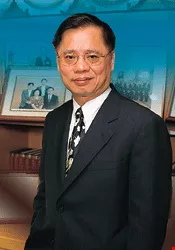
A father and a son--Day Sheng-tong says he is of a "split-personality generation." He doesn't want to expose his family to the media, but you can make out a picture of the happy family in the background.


@List.jpg?w=522&h=410&mode=crop&format=webp&quality=80)


