Saving the Military Dependents' Villages
Chang Meng-jui / photos Hsueh Chi-kuang / tr. by Chris Nelson
December 2006


That year she moved away from the military dependents' village to the new community on the edge of the big city, a place with few mainlanders and many Taiwanese, a place with people from all walks of life. Like a river coursing into the sea she instantly lost her identity and ties with her former home...."--Chu Tien-hsin, In Remembrance of My Brethren in the Military Dependents' Village.
Wang Chi-hsin, head of the governing association of Air Force Village 1 in Sanchung, is busy moving. He's a second-generation resident of a so-called military dependents' village, and has lived there over 50 years, amassing many cherished memories over that lengthy span. Now, the first time he has ever relocated, Wang has two homes to move: one is for his own sake--he will be assigned to the Chienhua New City public residence in Panchiao upon the scheduled demolition of his village; the other is for history's sake: as the bulldozers advance, he is fighting to transform Air Force Village 1 into a cultural park, trying to "replicate" the vanishing culture of the military dependents' villages.
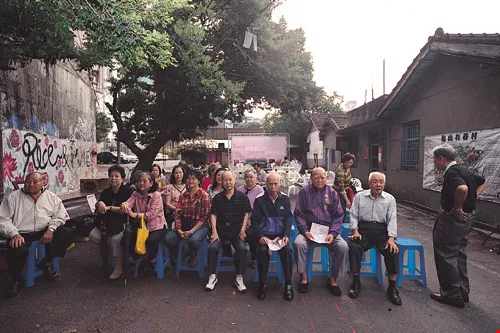
The Taoyuan County Cultural Affairs Bureau is devoted to preserving the culture of these villages, and has organized a series of related events. On November 11, former Hsienkuang Village 2 residents returned to their erstwhile homes to hobnob with their old neighbors once again.
Rustic bliss
In early 2005, Wang and a group of enthusiasts making up the Sanchung City Veteran Village Cultural Park Planning and Design Camp unveiled a series of events on the city's historical and cultural development. They plan to throw open the gates of the military dependents' village to showcase its distinctive culture to outsiders, hoping to transform Air Force Village 1 from a closed community into an open and diverse public space where one can learn about an important and unique way of life that people reminisce about in film and fiction.
At 7 p.m. on October 14, 2006, Air Force Village 1 hosted a pre-relocation farewell dinner. It was a full mobilization of the village; even former residents attended. Amid toasts, they belted out Mandarin and Taiwanese songs in a variety of accents from throughout the Chinese provinces--the scene was intimate yet sorrowful.
People like Wang who lived most of their lives in a military dependents' village are common in Taiwan. According to the National Women's League, there were 879 military dependents' villages in Taiwan in 1982, containing over 100,000 households. Figuring five people per household, that makes about half a million residents. Four fifths lived in northern Taiwan; the rest were distributed throughout the rest of Taiwan and Penghu.
Concerned about the dependents of military personnel and recognizing that the squat, grubby and jumbled environs were an obstacle to urban renewal, the Ministry of National Defense announced the Act for Rebuilding Old Quarters for Military Dependents in February 1996, budgeting over the years to replace all of Taiwan's military dependents' villages with modern housing.
Over the following decade, more than 700 military dependents' villages were reduced to rubble, becoming things of the past; now only about 170 are left. The shocking speed of their disappearance drew the notice of numerous historical and cultural workers. To keep the unique culture stemming from this special heritage from vanishing in this way, people from all walks of life are joining the salvage effort.
As it stands, most military dependents' villages in Taiwan are about to be demolished with the consent of the residents. A small number of villages remain, locked in disputes, struggling for preservation through act of law or policy intervention. With the Rebuilding Act extended until 2009, the remaining villages are set to be demolished over the next few years.
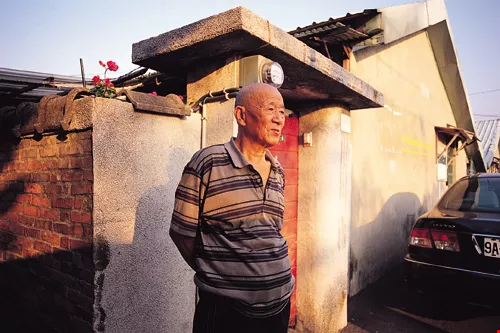
An old man strolls alone in the afternoon in one of the villages, his lonesome expression lamenting the loss of the congenial village scene of bygone days.
Enclaves
Military dependents' villages are a peculiar facet of Taiwan's war-torn history. With their sloping, black-tiled roofs, earthen walls and bamboo fences, plus the common profession of the residents, and languages and living habits that differed from those of local residents of Taiwan, the villages acquired their own style. In the course of over half a century, the residents made Taiwan their home, got married and had children, and gradually assimilated into Taiwan's multifarious culture. But outsiders still harbor a sense of curiosity about their mystique.
The story of the military dependents' villages began in 1949 and 1950, when the Nationalist government, beset by civil war, withdrew its institutions and troops to Taiwan, the accompanying military personnel and their dependents numbering more than a million. In the turmoil of war, the government's finances were in dire straits, with no surplus resources to provide for the soldiers' families. Accordingly, the government set aside public land near military encampments, and with the crudest building materials the troops built large quantities of tile-roofed houses for them to live in. To the mainland Chinese troops, who had been hastened to Taiwan and had no one to turn to, these residences were enough to settle down in and re-establish their lives.
Although these villages' residents came from different provinces around China, with their disparate living habits, dialects and cuisines, they were all passionate and united in their loyalty toward the authority of the KMT and Chiang Kai-shek, and in their belief that they would retake and restore the mainland. They believed that the hardship and crowded conditions they endured at that moment were merely temporary, that they were just sojourners on this small island who would soon be returning home. They were strangers in a strange land, refugees from remote realms; their camaraderie made them more unified and tolerant toward one another.
Says Wang, recalling the circumstances of those years, "When one family fried meat, three others would smell it." This is the perfect portrait of the tight-knit, cordial life in a dependents' village. Usually, when the Wang family cooked a tasty meal, they would share it with their neighbors. Likewise, the Li family would prepare dumplings and steamed buns, then bring them out for everyone to sample. Neighbors would drop by each other's houses for any reason and mind each other's children.
"Back then the soldiers had meager incomes, lots of kids, and hard lives. When it came time to pay tuition or buy furniture or appliances, and you didn't have enough money, you could borrow from a community credit club. You could even join several credit clubs, borrowing from one to invest in another. On the bidding day, the women of the village would bring their bidding forms and gather at the house of the club trustee, gossiping and chattering. It was exciting," Wang recalls. The young men of the village loved playing basketball; some even formed gangs, loitering and fighting. The girls were trendy and sociable. This was outlandish in the eyes of the conservative locals at that time, and outsiders did not enter the villages lightly.
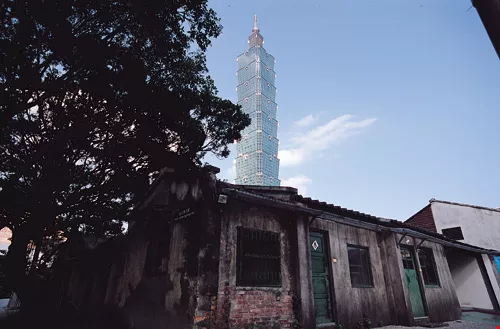
44 South Village, located in Taipei's Hsinyi District, is the earliest military dependents' village in Taiwan, and has been preserved as a historic site. Its image contrasts with that of nearby Taipei 101, symbolizing memories of different eras of this tract of land.
Hard times
Recalling those confused times, Wang says his most vivid memory is of when Typhoon Gloria hit Taiwan in 1963. The strong winds and heavy rains forced an emergency release of water from the Shihmen Reservoir, and this happened just when the Tanshui River estuary was at high tide, resulting in the flooding of the Sanchung area. Wang's village was inundated by the muddy flow, except for a few houses on higher ground in the rear of the village that escaped the deluge, promptly becoming places of refuge. The children were carried to a dining-room table in the middle of one of the houses, and the adults stood soaking in the water, holding the table with all their might to keep it from being swept away. They kept at this until the sun rose and the water receded before going home.
After this cataclysm, the homes were pretty much ruined. Only the inner layers of woven bamboo in the walls of the houses were left intact, the earthen coating washed clean away by the floodwaters. In later years several other strong typhoons came, often swamping the painstakingly repaired houses. The hardship was truly unspeakable. But Sanchung's flooding problems were eliminated with the 1984 completion of the Erhchung Floodway, and life gradually returned to normal.
The earliest military dependents' villages were built with funds raised mainly by the National Women's League, headed by the First Lady, Soong May-ling. Later, they were funded by ad hoc donations of various kinds, and most of the land was either public or managed by the Ministry of Education, disbursed free of charge, and the village residents had no land ownership rights.
The houses of the villages had been built as a stopgap measure, so they eventually became too small to live in when the children grew up. The only way to build larger houses on the same land was to expand upward. Most village residents looked forward to the reconstruction program because of their inadequate living environment. But respecting both residents' rights and historical value became an ongoing bone of contention.
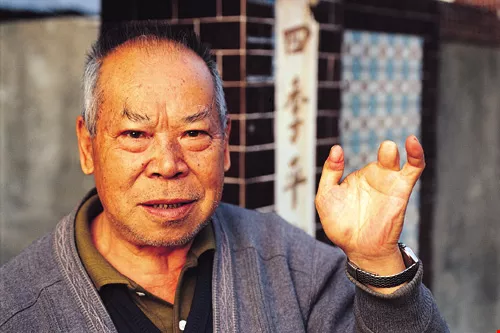
Touching stories of the past are everywhere in these humble villages. Mr. Tzeng of Kinmen New Village in Yangmei once served as a navy diver on the offshore islands. He lost some fingers to a premature detonator explosion during a demolitions run.
The taste of plain noodles
Well-known TV producer Wang Wei-chung is from Chienkuo Village 2 in Chiayi, with over 100 households and a rich variety of mainland Chinese eateries. Chiayi's famous "square pastries" were developed here. The area was even listed in official tourism brochures as a must-see spot, attracting numerous sightseers.
In June 2005, Chienkuo Village 2 faced demolition, and Wang set aside his work to bring his daughter on a trip down memory lane. On the outskirts of the village was a long, narrow open-air market that Chiayi Senior High School students passed by every day on the way to school. The steamed buns, sesame cakes, crullers and plain noodles in the market became their favorites.
"The plain noodles weren't in the least bit plain, especially with a dollop of shaozi (a Yunnanese meat sauce). The firm texture and the different condiments... delectable! And people made special trips out here to try it." But the village was suddenly demolished. Nothing was left. Later Wang searched high and low for the noodles he remembered, wishing someone had told him where the noodle vendor from the old village had moved to.
Huang Luo-fei, chief executive of the Association of Mainlander Taiwanese, says the Ministry of National Defense, in carrying out the reconstruction programs, cares only about construction and resident rights and "relocating people from low-rise communities into high-rises," not caring enough about history, culture or the memories of common folk. It's unknowable how much basic information about the military divisions, architectural styles and distribution of the villages over the past 60 years has been relegated into oblivion. Out of a construction fund of more than NT$100 billion, the MND only allocated NT$800,000 into investigating the villages in 2005. With so little money or manpower, it seems there's not much that can be done against the looming army of bulldozers.
Faced with the hasty disappearance of the villages, like-minded cultural workers, NGOs and government agencies from all quarters are taking action to preserve the villages. Tung Chun-jen is one of them.
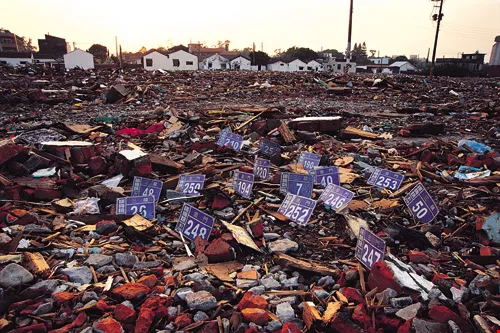
Of over 800 military dependents' villages, less than 200 remain after recent demolitions. Their distinctive culture is rapidly vanishing. Pictured here, the rubble of Chengkung New Village in Yangmei, Taoyuan County.
A local kid's emotional bond
Tung was born and raised in Sanchung, but not in a military dependents' village. He cares about the villages because he wants to improve his hometown, break down inter-ethnic barriers and promote mutual understanding and tolerance.
According to Tung's analysis, the mention of Sanchung conjures up impressions of flooding, overcrowding, squalor and gangs. On the political maps in those early days, Sanchung was considered an oasis of multiparty sentiment, a hallowed ground for democracy. But few knew that Sanchung also contained military dependents' villages filled with patriotic KMT loyalists.
"After meeting the residents of Air Force Village 1, I found these mainlanders loved Sanchung more than we locals did. This came as a shock to me." So Tung and his partner Wu Tung-ming from Nantou organized a construction workgroup, founding the Sanchung Veterans' Village Cultural Park, to preserve the village's culture and serve as a base for community planning.
In April 2006, the workgroup, aided by Wang Chi-hsin of the village's governing association, gathered old photos and narratives from village residents, many of whom opened boxes and cabinets to find hidden treasures, and compiled them into a book in the style of a school yearbook. This was Taiwan's first record of village history completed by a dependents' village governing association. A real treasure!
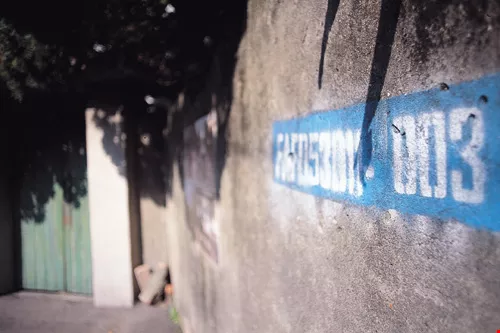
During a time of scarce resources, the military built these collective residences, forming unique yet closed communities that have often been stigmatized with the tide of localization. Pictured here is Air Force Village 1 in Sanchung, Taipei County, its decaying exterior walls still bearing serial numbers showing it to be military property.
A woman warrior stands guard
As for Taoyuan County, with its large concentration of mainland military personnel, a lot of effort has been devoted to preserving the villages.
Of 84 dependents' villages in the county, 90% have been torn down. The TV drama Forbidden Love was filmed in Matsu New Village in Chungli's Lungkang area. Though the residents have long since moved away, it is now protected by its designation as a historic building cluster, preserved as a cultural park of nearly two hectares. Behind the efforts is Hsieh Hsiao-yun, director of the Taoyuan County Cultural Affairs Bureau. So as not to allow this village, known as the best military dependents' village in Taiwan, to slip into history like the other 700, Hsieh has spared no effort in engaging the MND.
Hsieh says she initially also planned to preserve Chingchung Village 5, but unfortunately they didn't take action in time. It was totally dismantled. Afterwards she quietly sought experts to work with, who confirmed that some other villages had historical value, then immediately issued a legal protection statement. But she never expected that the MND, after learning about it, would send the Corps of Engineers to quickly tear down more than ten villages. They then handed the land over to the National Property Bureau, and three days later it was auctioned off online.
Although there's no law governing the demolition of historic buildings, Hsieh took on the MND, aiming to stop the government from ordering the demolition of historic buildings. This bold move caused the MND to yield; they agreed to place Matsu New Village under Taoyuan County Government trusteeship for five years. Taoyuan's actions in securing the village's preservation promptly became a benchmark for other counties' similar efforts. But some problems remained.
Hsieh discloses that the biggest difficulty Taoyuan County has faced in preserving the cultural heritage of the villages is that the Rebuilding Act prevents the buildings being altered. But some buildings had long been in states of disrepair and were in desperate need of restoration, so they couldn't wait for the law to be amended. Furthermore, according to the Rebuilding Act, local governments are responsible for land use fees: to preserve Matsu New Village, Taoyuan County must pay the MND over NT$300 million a year in compensatory fees. This is quite a burden.
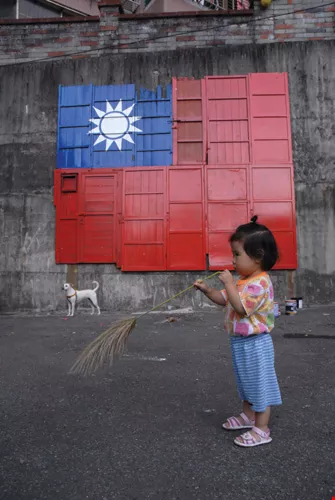
A group of artists entered Hsienkuang Village 2 in Taoyuan and made a national flag from old wooden doors and paint, symbolizing the unswerving patriotism of the village veterans.
Partial preservation
With the devoted efforts of cultural societies and the bipartisan coordination of legislators Lee Wen-chung and Chu Feng-chih, the Council for Cultural Affairs decided to intervene and help in allotting funds to survey the villages, and in preserving them as cultural parks, village story centers, local culture centers or civic assembly halls.
In early May 2006, amendments to the Rebuilding Act put forward by the National Defense Committee of the Legislative Yuan passed their first reading in the Legislative Yuan: in addition to funding the construction of new homes, caring for former villagers and lower-income residents, and helping local governments secure land for public facilities to improve the urban landscape, one of the official goals will be to preserve village culture.
To prevent potential disputes that would stall the construction program and harm urban planning and the rights of residents, the National Defense Committee passed a motion for an amendment that future cultural preservation work could be partial instead of full, clearly stating that one or two typical villages in each of Taiwan's northern, central, southern, eastern and offshore island regions should be chosen for preservation. Although restoration costs will be borne by local governments, they must be subsidized by a village reconstruction fund, and future maintenance costs will be subsidized by the MND.
In July 2006, a Taipei County committee for assessing historic sites and buildings resolved to register all of Sanchung's Air Force Village 1 as historic buildings, setting a precedent for the full protection of dependents' villages and establishing a starting point for the Sanchung City Veteran Village Cultural Park. Besides this, Shuichiao Veterans' Village Cultural Park in Tainan City, Matsu New Village in Chungli, Taoyuan County, and Hsienkuang Village 2 in Kuishan Township, Taoyuan County, were designated as historic sites for posterity.
Worth reflection is that there's now hope for these villages' preservation, and a possibility of escaping the land and funding problems. Next, how should their preservation as cultural parks or other entities be realized? After designation as historic buildings, what kinds of problems are in store? How should collection and identification of village artifacts be conducted? How can a management system be designed for the reuse of these villages? Regarding these numerous follow-up issues, civic organizations have no experience and public bodies are still in the dark. There is still a ways to go before the pertinent entities can prevent such cultural centers from becoming neglected, idle property.
At present there's one example of village reconstruction that can serve as a reference: it's the partially preserved 44 South Village, located in the Hsinyi Planning District of Taipei City. 44 South Village is known as the earliest military dependents' village in Taiwan's history. Its residents were mainly soldiers, technicians and their dependents who moved here from the Shenyang and Hanyang Arsenals. The village was built in 1948, before the Nationalist government withdrew to Taiwan, so it is filled with historical value.
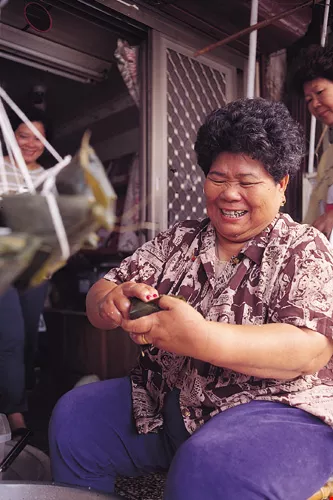
Some local women married into these villages, giving comfort to the exiled veterans and enriching the already-diverse Chinese culinary culture. It was the epitome of cultural integration.
Rebuilding a living culture
In 1999, following the completion of the shopping malls and fancy downtown apartments of the Hsinyi Planning District, the residents of the squat, crumbling 44 South Village were relocated to newly built homes. Half the village was incorporated into Hsinyi Elementary School; as for the rest, thanks to the efforts of cultural and community workers, the city government in the end chose to preserve four of the houses, converting them into a civic assembly hall and designating them as historic buildings.
Although 44 South Village was partially preserved, it triggered dissatisfaction among some social groups and cultural workers who considered the proportion preserved to be too low, lamenting the loss of the vibrant village atmosphere of days past and its transformation into a dead cultural specimen. As to how to make the most effective use of the buildings in the future, private and public institutions have their disagreements.
When preserving military dependents' villages, preserving the buildings themselves is not difficult, but the hometown flavor of old is fading, the children who grew up there are scattered far and wide. Can we turn back time and bring it all together again? Time passes like flowing water: perhaps we can only achieve that goal in our dreams....


@List.jpg?w=522&h=410&mode=crop&format=webp&quality=80)


@List.jpg?w=522&h=410&mode=crop&format=webp&quality=80)
