Do the Rights Thing:A Look at Human Rights for Kids in Taiwan
Chang Chiung-fang / photos Pu Hua-chih / tr. by Phil Newell
February 2001


Are people taking out their frustration at the economic downturn by beating their children? Perhaps not, but stories of child abuse carried in the media seem to be getting more appalling each year.
In mid-January, the Chinese Fund for Children and Families (Taiwan) released its list of the top ten stories for the year 2000 related to child abuse and to welfare issues. In the former category, the dubious "winner" was: "Children at the Sanpao Buddhist Monastery testify that they were sexually abused by the abbot." In the latter, it was: "Children's rights indicators fail to meet the required standards in Taiwan for the fourth consecutive year."
What are children's rights? Why is it that Taiwan, which has always emphasized education and which has even been seen as a society that spoils its children, is considered not to be making the grade? Is there something wrong with the environment in which Taiwan's children grow up? If so, how can it be improved on behalf of those who will be its future masters?
Are children in Taiwan happy?
In 1999, the Child Welfare League Foundation (CWLF) did a survey of fifth- and sixth-graders and discovered that nearly 90% of the respondents often or sometimes felt troubled over excessive homework, inadequate time and space for play, insufficient respect for their individuality, and inadequate guarantees of their safety.
In addition, last year the CWLF did a survey of "family warmth indicators," and found that one out of every three children in Taiwan wants to leave home.
What are kids so stressed about? Why do they want to get away from home? What is the connection to the overall children's rights situation in Taiwan?
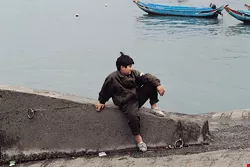
Does anybody know how I really feel? Surveys show that 90% of children are troubled at times, and one out of three would like to leave home. Is anybody out there listening?
International orphan
Human rights have gotten increasing global attention since World War II. A major watershed came in 1948, when the United Nations adopted the Universal Declaration of Human Rights.
Action on human rights for children followed somewhat later. The United Nations issued its Declaration on the Rights of the Child in 1959, and in 1989 passed the Convention on the Rights of the Child. This declares that every child in the world is entitled to his or her rights "without discrimination of any kind, irrespective of. . . race, color, sex, language, religion, political or other opinion, national, ethnic or social origin, property, disability, birth or other status."
The Convention is the first comprehensive set of norms governing children's rights, and more than 190 countries have inked the document. Indeed, this Convention has support from more countries than any other UN treaty related to human rights. Sadly, because of political factors, the ROC has not been allowed to sign.
Lee Li-feng, secretary-general of ECPAT-Taiwan, a group dedicated to eradicating child prostitution, says that in the absence of accession to the Convention, Taiwan is unable to participate in multilateral efforts to stop the commercial exploitation of children or to take legal action against trans-national procurers or patrons of prostitution.
Last year, more than 20 groups in Taiwan, including the Taiwan Association for Human Rights, the Human Rights Education Foundation, and the Garden of Hope, formed an alliance aimed at promoting Taiwan's accession to the Convention. The alliance director, legislator Lai Chin-lin, says that while there is still a long way to go before Taiwan can participate in the UN, in this case the process is more important than the outcome: "Our real purpose is to call on the people of Taiwan to better understand and recognize children's issues, and to monitor the government so that it unequivocally guarantees the rights of children."
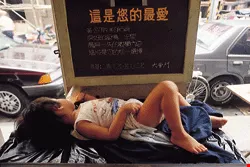
It is natural for parents to love their children, but that doesn't mean that all children get proper care. Many parents are too busy to give their kids enough attention. (photo by Diago Chiu)
The "discovery" of children
What falls under the rubric of "the rights of the child"? Do Taiwan's children enjoy their human rights to the full?
The Chinese Association for Human Rights (CAHR) began tracking "human rights" indicators in 1989. Four years ago they added "children's rights indicators" as well, and commissioned the CWLF to do an annual survey of this aspect of human rights.
The CAHR/CWLF survey uses 14 indicators divided into four categories: basic human rights, social rights, education, and health. These indicators basically follow the spirit of the UN Convention on the Rights of the Child, with some minor adjustments as needed to meet the unique conditions of Taiwan's society.
CWLF executive director Joyce Yen Feng relates that the survey targets more than 100 leading members of society, including academics in the realm of child welfare, government social affairs officials, social workers, legislators, and figures from the fields of medicine, education, law, and media. In the opinion of these experts, children in Taiwan are getting neither the respect nor the equal rights to social participation that they deserve. Nor do they enjoy the personal safety or social welfare that are called for under the doctrine of "child protectionism."
Some have responded that these experts' opinions are not a valid reflection of reality, since the elites selected are bound to be the most critical. So last year, the CAHR, working with tTimes.com.tw, added an Internet survey for the general public. The result was that the "scores" for all categories of children's rights were even lower than those given by the surveyed elites! CAHR head Chai Sung-lin says: "In other words, ordinary people feel that things are even worse than the experts do!"
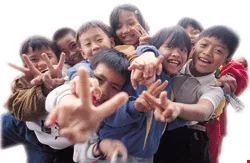
Children are the hope of the future. Only with happy children can we have happy adults and a healthy society. So to all you parents out there: Give us some hope for the future!
Social rights at the bottom rung
In the CAHR/CWLF surveys, "social rights" have finished at the bottom each time.
Indicators under the heading "social rights for children" include: (1) access to social welfare and protection from harm, (2) justice within the legal system, (3) opportunities for participation in society, and (4) social equality. Some of these involve government functions, while others touch on attitudes and entrenched social mechanisms.
Joyce Yen Feng points out that in the area of social services, in fact the relevant laws and regulations already meet the standards required. But laws that are not obeyed and not enforced are meaningless. In particular, assistance to unwed mothers or single parents is inadequate.
What about the judicial system? Does Taiwan give adequate respect, protection, and just sentences to children accused of breaking the law? Kenneth Chiu, an attorney and a member of the National Human Rights Commission, points out that under the law minors are entitled to the same rights as adults, but implementation is poor.
Last July, a first year middle school student at Kuang Ming Junior High School in Taichung carelessly tossed a tennis ball onto a nearby sidewalk. A startled pedestrian brought a prosecutor to the school, where, in the company of the school police officer, they went and pulled the child out of class and began an interrogation. Eventually the child was sentenced to parole by a juvenile court.
While the full story is a bit more complicated than this sketch, it was nonetheless appalling to many rights activists that legal officials could invade a classroom and remove a 12-year-old, all for throwing one tennis ball.
Joyce Yen Feng notes that last year, when the juvenile crime law was amended, particular emphasis was given to the idea of "redirection." This basically means that resolution of incidents involving young people should not go through the criminal justice system unless there has been serious consequences. But in this particular case, the adults involved simply wanted to make an example of this child. Sadly, their approach could inflict extreme harm and have long-lasting after-effects.
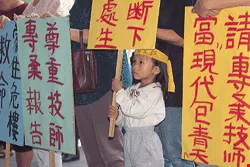
Children learn more from their parents' example than from their preaching. It is not uncommon for children to be present at protest events. Let's hope children are drawing the correct lessons from what they see. (photo by Vincent Chang)
R-e-s-p-e-c-t
Moving on to the question of a child's right to opportunities for social participation, the main problem here is attitudes.
To get an idea of the degree to which Taiwan society considers human rights for children important, last October the New Frontier Foundation commissioned the public opinion survey center of the Democratic Progressive Party to undertake the first-ever poll on the subject of children's rights. The results were revealing.
Lee Wen-ying, director of the DPP's Department of Social Development, notes that the survey found that there is especially little respect for a child's right to privacy. Almost three-fourths of respondents (73%) agreed with the statement "Adults have the right to inspect children's bookbags and correspondence," while nearly 94% agreed with the statement "Adults should carefully screen the friends a child makes."
"Society makes different assumptions about and uses different standards for adults and children," contends Joyce Yen Feng. Adults tend to think that young people are not truthful, or can't express themselves, and all those who set norms-parents, teachers, the government-just impose their own ideas on children, without giving kids any opportunities to participate and learn.
"Taiwan 'infantilizes' children, and degrades their capabilities. This has been going on for a long time," says human rights lawyer Kenneth Chiu. It is adults who decide that children should study more (and so they create programs, allegedly for kids, like "children's reading year") or that children should have certain gender or sexual values (so they pour their own values into kids' heads).
Tang Mei-ying, a professor at Taipei Municipal Teachers College (TMTC) and an active participant in the promotion of human rights education in schools, says that as far as most parents are concerned, children lack the ability to do things on their own, so it is up to the parents to take charge. As a result, it is common to see parents making decisions for their children or doing things that their children should be doing instead as part of growing up and making their own way.
Tang points to her own students as a case in point. In Taiwan, when high school students take the university entrance exams, they make a preference list of the departments to which they would most like admission; Tang says that for many TMTC students, the parents actually filled out the preference list. From the parents' point of view, a primary school teacher is a desirable match in the marriage market, and a child with such a career has time to look after the family. So they push their child along this career path. The result is that some students who never wanted to be teachers in the first place end up being miserable at school.
"It may be quicker and easier if a parent chooses, but then the child will lose an opportunity to learn how to make decisions," says Tang. Such children remain indecisive when they grow up, dependent on authority figures. Life is full of choices, so they end up letting their fate be decided by others, even by fortune tellers or what they believe to be divine intervention.
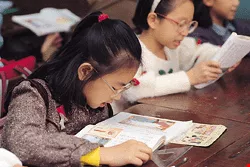
Many parents fear that their kids will fall behind, so they impose heavy burdens on them, thereby endangering their health. That pupils spend all day in cram schools is old news in Taiwan, and the incidence of myopia continues to rise. (photo by Huang Li-li)
You make me sick!
For four years running in the children's rights survey, the highest scores have been in the category of "the right to health." Society is after all wealthy, and much progress has been made in medical care, nutrition, and public health. Yet Taiwan's children are still exposed by society to health threats-without adults even being aware of the problems they are creating.
The mother of a junior high school student says that her son has to be at school every morning by 7:30 or face disciplinary measures. "He hasn't even got time for a good breakfast, so where is his 'right to health' now?"
When schools declare that the time has come for their "new seasonal fashions," once the switch is made to new uniforms, they stay on regardless of the actual weather, so that kids sometimes find themselves wearing their winter uniforms during a hot spell or their summer uniforms on a chilly day.
Moreover, many parents, trying to ensure that their child does not fall behind his or her peers, spare nothing-not even their child's health.
In late 2000 the Department of Health issued its five-yearly national survey of student near-sightedness. It stated that over the previous five years the incidence of myopia in first-graders had increased from 12% to 20.4%, which means that one child in five is already near-sighted even when just starting primary school.
In response to these numbers, the DOH's Bureau of Health Promotion and Protection is asking parents to ease up on the kids: don't make nursery school children learn Chinese characters; don't allow children under ten to use a computer; don't force pre-school kids to pore over sheet music or "art class" materials; don't let children watch TV more than one hour per day. Only if such steps are taken can Taiwan reverse the trend toward creating more and more "four-eyed" kids at ever-younger ages.
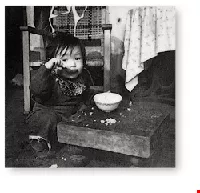
"I didn't do it on purpose!" Experts advise parents to understand each phase of a child's development; sometimes children make mistakes because they're being asked to do something that's beyond their abilities. (courtesy of Anna Wang)
TV kills
The CAHR/CLWF 2000 report on indicators of children's rights draws special attention to the impact of the mass media on kids. As Joyce Yen Feng declares: "Improving children's rights starts with rejecting the media trap!"
According to the CLWF, the most common so-called "parent-child activity" today-as reported by 78% of children-is "watching TV." Unfortunately, this is far from a healthy activity for kids.
In his article "The Impact of the Mass Media on Children," Yang Shou-jung, a professor at Soochow University, suggests that typical mass media outputs adversely affect children in at least five important respects: they distort attitudes about sex and violence; they appeal to crudity and the lowest common denominator; they encourage poor eating and drinking habits; they provide a vehicle for cultural imperialism; and they distort values in general (Yang specifically argues that in Taiwan children are increasingly selfish, materialistic, status-conscious, and likely to evaluate everything only in terms of monetary value).
In an article entitled "The Effect of Television Violence on Children," National Taiwan Normal University professor Fang Yi-yun says children are watching more TV as parents increasingly rely on the tube as a babysitter or diversion for their kids. Exposure to TV violence can have three negative effects: (1) It encourages children to habitually adopt an aggressive attitude. (2) It increases fear and pessimism about the non-TV world. (3) It desensitizes children to violence in the realms of both reality and fantasy.
Besides encouraging perverse ideas about violence and sex, TV promotes superficiality, crudity and superstition. Things shown in the media often deviate sharply from what children are taught in school or need to know in real life. "It's really worrying that a lot of nonsense which is meant merely to be for the entertainment of adults becomes accepted as authoritative by minors," says Joyce Yen Feng.
The impact of the value system transmitted to children by the media is perhaps already visible. ECPAT's Lee Li-feng points out that the main reason why young girls in Taiwan turn to prostitution is not poverty, but a misguided value system. "When the media devotes so much attention to fashion and blind ambition, when it reports that some star has spent hundreds of thousands of NT dollars just getting attired for a single awards show, it's hard to put all the blame on the vanity of the kids."
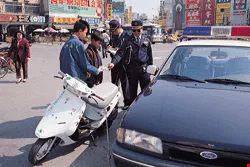
Taiwan society still heavily values formal educational attainment. What does that leave for children who perform poorly in class-nothing but drag racing? (photo by Hsueh Chi-kuang)
Making implements without pounding
Another serious threat to the rights of children in Taiwan, which periodically gets major media attention, is abuse.
According to the Children's Bureau of the Ministry of the Interior, in 1999 there were 5,353 reported cases of child abuse. That's an average of 15 cases per day.
Tang Mei-ying notes that many people like to quote an old Chinese saw to the effect that "you cannot make a tool without hammering the metal." But little thought is given to how one might make implements without pounding.
Joanna Feng, executive director of the Humanistic Education Foundation (HEF), criticizes corporal punishment of children on the grounds that it causes kids to confuse love and violence, creating a contradictory value system.
The issue of corporal punishment in the schools has received considerable attention these past few years. It is generally believed that the situation has greatly improved, but that is not necessarily the case. In a survey of primary and secondary pupils conducted two years ago, the HEF found that 98% of children had been subjected to direct or indirect corporal punishment. In a similar survey taken last year, 45% said they had suffered direct corporal punishment. Feng sighs: "All the effort over the last ten years has only led to slight improvement, merely that teachers perhaps are less likely to consider corporal punishment appropriate and may think twice before using it."
"Corporal punishment represents control," says Joanna Feng. Many people have a gut feeling that they should not hit children, but don't know any alternative ways to interact with the kids.
Child abuse is not limited to beatings, berating, and sexual abuse. There are many forms of neglect or mistreatment that can have far-reaching harm.
Take for example a case that came to light in Kaohsiung last October involving three brothers aged 12, 13, and 15. For more than a decade the mother had mistakenly treated the boys as chronically ill, going to countless hospitals, temples, and shrines, trying Western and Chinese medicine, acupuncture, and herbal medicine, and even giving overdoses of medication that caused the kids to wind up in the emergency room.
In addition, emotional and verbal abuse, though they leave no visible scars, can have a profound impact on a child's psychological health. For example, a study by two scholars at the National Central Police University, Huang Fu-yuan and Huang Tsui-wen, notes that a child who is witness to domestic violence, even if not directly victimized, can suffer serious psychological and behavioral problems later on.
Paradise?
Among the many rights specified in the UN Convention on the Rights of the Child, one is the right to education. In this respect, Taiwan already makes the grade in terms of the percentage of school-age children in school. But beyond simple attendance, what are pupils actually learning? What kind of children does the education system produce?
Chen Chin-lien, director of educational affairs at Fulin Primary School, says that primary school children these days are scary, and they fight or insult each other at the drop of a hat. She believes that adults often make a hash of family education, and set a bad example with protests and demonstrations.
What is to be done? Do kids enjoy too many "human rights" in school, or too few? "Human rights is a rather sensitive subject in schools," says Chen Chin-lien. Teachers know about children's rights, but do not necessarily agree wholeheartedly with the idea.
Chen served as a teacher for 16 years, and admits that she was authoritarian in style. But since participating in the workshop for "seed teachers for human rights education" and coming more into contact with the issue of students' rights, she has changed her approach. Now she prefers the use of encouragement or a merit/demerit system rather than punishment. She avers: "It's not that hard to inspire a child's sense of honor."
Changing attitudes
Attitudes cannot be changed overnight, and there's no reason to be ruthlessly critical of parents and teachers. But unless some traditional values and approaches are rooted out, talk of children's rights will remain just talk.
Li Chang-wei, director of guidance counseling at Neihu Primary School, says that teachers' reactions to the idea of children's rights education can be summarized as: "Won't the promotion of students' rights infringe on teachers' rights?' "Kids already have too many rights these days; what they really need is more instruction in the concept of duties." "Children's rights are important, but there are other things you need to teach them first." "Human rights education is a Western idea, unsuited to conditions in Taiwan."
Some parents even worry: "If you teach my child all about human rights in school, will he still obey me when he gets home?"
Joanna Feng responds: "When parents stop treating children as tools or property, then we can start talking about children's rights."
In traditional patriarchal society, children were considered the property of the family. In recent years, as change has come to Taiwan, children have been increasingly seen as "public assets." But many parents still see their children as their personal property, and one still hears of things like the sale of children into prostitution or murder-suicides in which a parent kills the children before doing away with him or herself.
"There is tension between parental authority and children's rights," explains Lee Li-feng. Parents and teachers fear that discussion of children's rights will lead to disciplinary problems. "It's a conceptual problem. It would be better to redefine the problem as one of parental responsibilities rather than parental authority."
Chang Sing-ju, executive director of the Hsin Yi Foundation, says that the goal should be to "humanize education": "The focus of education should be the child, not making things as easy as possible for the adults."
Listen to what kids have to say
The survey of "family warmth indicators" conducted by the CWLF discovered that more than 30% of children have experienced the feeling that no one in their family cares about them. Nearly 50% say that there is no one in their family who really listens to what they have to say, and 70% say they are unwilling to share even little secrets with their parents.
Adults were all once children themselves, and had a time when they believed in things like Santa Claus. One legend has it that Santa Claus lives on a mountain in Finnish Lapland called Korvatunturi, which is shaped like a giant ear, so he can hear all the wishes of children around the world. Though Christmas has gone by, it's not too late for the adults of the world to put aside their work for a moment, and lend an ear to listen to what their children really think.
There is a sentence in The Little Prince by Antoine de St. Exupery which is worth really giving some thought to: "All adults were children once, except that they have all forgotten."


@List.jpg?w=522&h=410&mode=crop&format=webp&quality=80)


