Checking In With Anna Chan Chennault
Eric Lin / photos courtesy of Anna Chan Chennault / tr. by Phil Newell
December 2001


The name Anna Chan Chennault often conjures up thoughts of romance or admiration. Everyone has heard of her love story with General Claire Chennault. She was the first female reporter for the Central News Agency. She was the first person of Chinese ancestry to be a success in politics in the US, and in the American capital was known as "the hostess of Washington." She has also acted as a "secret ambassador" in cross-strait relations. Over these many decades, she has sparked controversy in the US, China, and Taiwan with the publication of her autobiography and collections of her writings. At book signing sessions, long lines of people stretch so far that even the casual observer gets sympathetically sore feet just looking on. Numerous TV serials based on her life have been produced and broadcast in Taiwan and mainland China.
Anna Chennault is familiar to us, yet also a stranger. She has at times played a significant role in cross-strait relations, but she has always kept a very low profile, and particularly in the last few years news about her has rarely appeared in the Taiwan media. Some say that she has already moved the focus of her attention to mainland China, while others say that she has left politics altogether. What has she been doing lately? What are her plans for the future? In this period of uncertainty in cross-strait relations, the story of Anna Chennault touches us, and gives pause for reflection.
It is early October, and the air in northern Taiwan already is laced with a chill. Anna Chan Chennault, having just completed a nearly two-month visit to mainland China with Irving Kaufman, her good friend of more than 20 years, is in Taipei, in transit on a flight from Hong Kong back to the United States.
Emerging from the gate, even at a distance her dashing figure is still instantly recognizable, and she doesn't look at all as tired as one would expect a person in her 70s to be in the middle of a long flight.
In the waiting room, Chennault, who was a journalist for many years, methodically ticks off the reasons for her return to mainland China, showing that she is still very much the reporter.
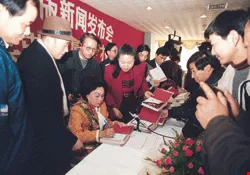
A legend in the Chinese community, Anna Chan Chennault is still writing tirelessly despite being over 70. She has now published over 50 volumes, and continues to set new personal records for sales. (photo by Jimmy Lin)
Giving back to her motherland
Since 1981, she has established the "Chen Hsiang-mei Education Prize" (Chen Hsiang-mei being the Mandarin pronunciation of her Chinese name) in more than a dozen cities in mainland China in order to encourage outstanding teachers. Each year she travels to various cities to present the award.
Chennault states: "Over the last two years the PRC has been undertaking a program of opening up its northwestern region. This has made me determined to go to the northwest, which is backward and in need of help." She brought 250 outstanding teachers from that region on an excursion to Beijing, paying all the costs herself, and also gave them each a prize of RMB2500.
"These people might spend their entire lives in the harsh northwest, and never get the chance to go to Beijing. Allowing them to see more of the world means allowing their tens of thousands of students in the northwest to also see more of the world," she says. Besides creating these awards, she has also founded "Hsiang-mei schools" in Taiyuan in Shanxi Province, Benxi in Liaoning, and Foshan in Guangdong. She built these middle schools from scratch, covering all the costs out of her own pocket.
Anna Chennault explains that she herself comes from a world in chaos. In her teens, because of the war against Japan, she too experienced the life of the itinerant student, and now in her later years she considers education to be especially important.
Besides all this, Irving Kaufman, who is an aerospace engineer, has over the past few years led groups of American specialists to design seven modern airports for cities in mainland China, including Shenyang and Shenzhen, all totally free of charge.
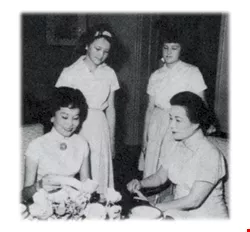
The marriage between Anna and Gen. Claire Chennault (facing page, top), though short-lived, was a happy one. Their two daughters (above and with their mother and Mme. Chiang Kai-shek, bottom of facing page) are today both accomplished professionals.
On the outs?
In contrast to earlier times, when Chennault was very active in Taiwan, in the past few years she has been working to give something back to her motherland, mainland China. When she comes to Taiwan she usually is just passing through and doesn't stay for long. Some people have therefore been tempted to speculate that because of the victory in the last election of the Democratic Progressive Party, she has had no choice but to take her show on the road to mainland China.
When Chennault hears of such suspicions, she just laughs out loud: "Everyone should remember that back in the 1970s and 1980s, I also established journalism and script-writing prizes in my name in Taiwan. It's just that now Taiwan is wealthy, and I feel that the poor areas of mainland China need this money even more," she says. In fact, she came to Taipei at the end of last year and again early this year, meeting with President Chen Shui-bian, former president Lee Teng-hui, Kuomintang party chairman Lien Chan, and People's First Party leader James Soong.
So how do rumors of her being "on the outs" get started? Chennault suggests an answer: "I don't have a dime or any property on either side of the Taiwan Strait, and the funding that I donate is all money I made in America, so I prefer to keep a low profile when I'm going back and forth."
Nevertheless, the people of Taiwan have never forgotten her. Last year a cable television station again broadcast the story of her life. The series put particular emphasis on her love story with General Chennault.
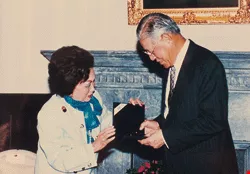
Once a "secret ambasssador" between the US, PRC, and ROC, Anna Chennault's movements were mysterious and closely observed. The photos show Chennault with, respectively, former ROC president Lee Teng-hui (below), former US president John F. Kennedy (right), and former Chinese leader Deng Xiaoping (left).
The general's wife
To be sure, the amazing story of Anna Chan Chennault's life really began with her marriage to Claire Chennault.
Her father was a diplomat, and when Anna Chan was small she was the most opinionated and stubborn of all the kids. In an autobiographical book published in 1991, she recalls that her father told her that she was the most ill-behaved child in the family, that she had too many independent ideas, and that he didn't like her. One winter when she had a bad case of the flu, her father said to her mother: "This child is really troublesome. She makes trouble two days out of three. We should just give her away to someone else."
Although her father might not have meant it, it still hurt her to hear such things. Today, she still feels that the real reason her father didn't love her is because she was not born a boy.
Thinking back on the past, her memories are rich in details such as these. It seems that this was the source of her never-say-die, independent, determined character, which was perhaps never more clearly illustrated than in the matter of studying abroad.
At that time, China was in chaos because of the war against Japan. Anna's father wanted to send all six of his daughters abroad to study. But she was determined to go her own way, so she rejected her father's decision. As a consequence, she experienced a nomadic student life at middle school in Hong Kong and at Lingnan University in Guangdong.
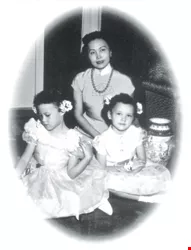
The marriage between Anna and Gen. Claire Chennault (facing page, top), though short-lived, was a happy one. Their two daughters (above and with their mother and Mme. Chiang Kai-shek, bottom of facing page) are today both accomplished professionals.
A reporter's life
In 1945, Anna Chan turned 20 and graduated from university. She joined the Central News Agency as a reporter, becoming the first woman ever to do so.
At first, she was assigned to do stories on the wives of American officers in China. But she was very unhappy with the disdainful attitude that the officers' wives had toward women reporters. She then asked to be transferred to reporting directly on the US military, and this is how she met Claire Chennault.
Early in the war against Japan, because the US had not yet entered the war, General Chennault had to resign his military commission and go to China as a civilian to help the Republican government organize an air force. The Flying Tigers squadron that he trained made him immensely popular among Chinese servicemen and civilians alike.
Anna Chennault recalls that when she first interviewed her future husband, she still had her hair done up into two braids like a little schoolgirl. Her father, who already knew the general, had asked him to look out for his daughter. Chennault agreed to take on this responsibility, but the more time that Anna spent with him, the more she admired him, and the two quickly fell in love.
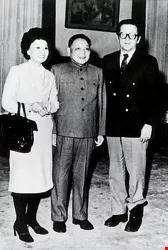
Once a "secret ambasssador" between the US, PRC, and ROC, Anna Chennault's movements were mysterious and closely observed. The photos show Chennault with, respectively, former ROC president Lee Teng-hui (below), former US president John F. Kennedy (right), and former Chinese leader Deng Xiaoping (left).
Little Hsiang-mei gets married
At that time, Chinese society did not look kindly upon this kind of love affair between an older foreign man and a younger Chinese woman. In addition, in the 1950s, American diplomatic and military personnel were not allowed to marry foreign women except under special circumstances, further adding to the difficulties of the relationship. But Anna Chan never wavered, and changed her family's initial opposition by taking a light-hearted approach.
She recalls that her grandparents really enjoyed playing bridge, a game at which Chennault was also skilled, so she arranged a game involving the general and her family.
That day Chennault arrived with a huge bouquet of roses. Anna squealed with delight and asked, "Are these beautiful roses all for me?" Chennault replied: "Sorry, but these are for your grandmother," after which the two just look at each other and laughed.
The whole thing was a setup to let the grandparents win, and they came away with a good impression of their granddaughter's beau. Similarly, the couple adopted a light-hearted, positive attitude to overcome her parents' opposition. In the end her father merely asked that Chennault remain in China, which was no problem for him, as he promised he would stay in China and help China build its air force. He even came to Taiwan when the Nationalist government retreated here.
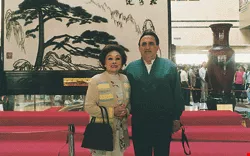
Anna Chan Chennault, a portrait.
Struggling on alone
Their relationship was sweet but short. After eleven years of marriage, Claire Chennault diet of lung cancer back in his home in Louisiana, leaving Anna Chan-now better known as Mrs. Anna Chennault-a widow with two daughters.
Bereavement was followed by a series of challenges. Chennault recalls that though she lost her mother when she was 15, and afterwards had a nomadic existence pursuing her studies, she always had her sisters to keep her company. Moreover, in her youth she didn't understand life and no matter how difficult things got she always thought that tomorrow would be better, giving her strength to go on. But after her husband died, "I finally tasted the truly bitter fruit of life." She says that she still doesn't know today how she found the strength to continue as a young Chinese woman alone in Western society, where people seemed cold and remote.
The most immediate problem for Anna Chennault was financial. Prior to the general's death, because Claire Chennault had followed the Nationalist regime to Taiwan, there were legal problems over the airline he had founded, with lawsuits tied up in Hong Kong for two years. In the end, he had no choice but to sell his airline to the US Central Intelligence Agency. His wife never knew anything about this matter. It was only after he died that the CIA pushed her to leave the company. The new boss even wanted her to cut off her ties with Taiwan altogether, because "Chennault was seen as being too close to Chiang Kai-shek."
Anna Chennault says that she really felt like a mistreated orphan, and was saddened to discover that people could treat the widow of the company founder in this way. Fortunately she got a letter from an attorney asking her to go to Washington to handle some matters related to the late general. She also felt that Washington would be a better place to educate her children, and so moved there, thereby creating a whole new life for herself.
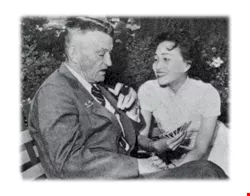
The marriage between Anna and Gen. Claire Chennault (facing page, top), though short-lived, was a happy one. Their two daughters (above and with their mother and Mme. Chiang Kai-shek, bottom of facing page) are today both accomplished professionals.
Getting to the top
When she first got to Washington, she found a job translating foreign language textbooks into English for Georgetown University. She says that this job greatly improved her English ability, so that she was able to hold her own in society thereafter.
Chennault gradually built up a reputation in academia, and later was hired as a program host by the Voice of America. She also wrote articles for the media in Taiwan, including the Central News Agency, various newspapers, and her favorite publication-Biographical Literature. Later, through introductions from friends, Chennault became active in Washington social circles. She was very active in Republican Party affairs, with posts including co-chairman of the Republican National Committee's Finance Committee (1966-1983) and twice chairman of the National Republican Heritage Groups Council.
Because she helped a number of Republican presidential candidates in elections, she gained the trust of the White House. Presidents Kennedy, Johnson, Nixon, Ford, Carter, and Reagan all asked her to take on various informal tasks for them. In 1963, president Kennedy named her the chairman of the Chinese Refugees Relief Committee, making her the first person of Chinese ancestry to be named to the White House staff.
Besides actively participating in politics, she also got involved in business, and served as an executive in "Flying Tiger Airlines."
As Chennault became increasingly prominent in mainstream political activities and gradually built up her status in DC social circles, she came to be known in the US capital as "the hostess of Washington."
Because a president has many visitors, the budget for hosting foreign guests is always stretched to the limit. Chennault was there to help by serving as hostess for many a dinner party. Inevitably, politics being what it is, she became surrounded by rumors.
The occasion that Anna Chennault remembers most vividly came after Richard Nixon entered office, when he was urgently seeking to find a solution to the Vietnam War. Nguyen Van Thieu, the president of South Vietnam, dispatched Vice President Nguyen Cao Ky and his wife on a visit to Washington, with Vice President Spiro Agnew in charge of the visit. Mrs. Agnew, knowing that Chennault knew VP Nguyen and his wife very well, asked her to host them at her home. Chennault was worried that the State Department would object, so she privately talked the matter over with Vietnamese ambassador. Eventually, because Chennault lived in the Watergate complex, frequented by the politically powerful, it was easy for cabinet officials and their wives to just "pop upstairs," so she agreed.
The guest list was drawn up by the office of the vice president and the State Department, while Chennault put up the money and did the work. Many people vied for invitations, and those who could not get in the door were very unhappy about it. The next day there were reports in the newspaper saying that the reason Chennault was not made a cabinet official or ambassador was because she preferred to play hostess in Washington, and show people that Chinese could also make a go of things in a place like the US.
Chennault says, on the other hand: "In fact at the time I didn't think so much about it. 'Hostess for the White House' was an expression that other people used, not a title I sought for myself."
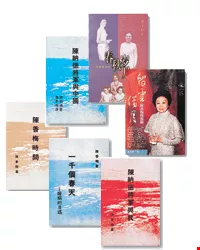
A legend in the Chinese community, Anna Chan Chennault is still writing tirelessly despite being over 70. She has now published over 50 volumes, and continues to set new personal records for sales. (photo by Jimmy Lin)
Unwanted suitors
Besides having to cope with the intricate world of politics, as a single woman she also had to figure out how to fend off potential unwanted attention from guests.
In upper-crust American society in those days, guests at dinner parties mostly came in couples. Anyone who attended alone would have a dancing partner selected for them by the hostess. Often these arrangements could lead to unsolicited pursuits. In order to keep herself free from such problems, she agreed with the famous lawyer Thomas Corcoran, an old friend of General Chennault's as well as a widower, to serve as host when she was hostess. Though this gave rise to rumors, their relationship was one of great mutual trust and friendship, and the arrangement avoided unnecessary problems.
"Chinese like to create cliques, and often miss the forest for the trees. But there are many difficulties in getting into the mainstream, so I always say that everything depends on talent and hard work. If other people work an eight-hour day, then you have to work more than ten," says Anna Chennault. Today she still helps people of Chinese ancestry to get into mainstream political circles. She is willing to help anyone who shows real promise. For example, it was through Chennault that Elaine Chao, who is now secretary of labor in the Bush administration, first became a White House staffer.
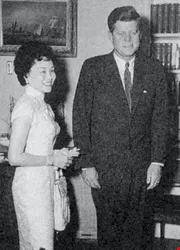
Once a "secret ambasssador" between the US, PRC, and ROC, Anna Chennault's movements were mysterious and closely observed. The photos show Chennault with, respectively, former ROC president Lee Teng-hui (below), former US president John F. Kennedy (right), and former Chinese leader Deng Xiaoping (left).
Enjoying the autumn years
Chennault has maintained good relations with Republican presidents in the US, and also has deep ties with the government of the Republic of China. In addition, her uncle Liao Chengzhi was a high-ranking official in mainland China. In the early 1980s, as mainland China began to open up to the outside world, it was only natural that Chennault should serve as an envoy between the three points of the triangle. In 1980, shortly after Ronald Reagan's presidential election victory, she was sent to Beijing as a special ambassador to meet with Deng Xiaoping. When Chiang Ching-kuo was ROC president, she worked hard to get the government to allow old mainlander soldiers living in Taiwan, who had been separated from their homes for more than 40 years, to return to mainland China to visit their relatives; she also helped in getting tacit agreement from the mainland side. In 1989, she headed a trade group from the US Council for International Cooperation-which also included Taiwan businessmen-on a visit to China, marking the beginning of Taiwan business activities in mainland China. In 1996, she was instrumental in helping Eva Air get the rights to fly directly to Macao.
"I don't like to make a big deal about the things I do, because that makes it easier to get things done. For example, a lot of people going back and forth across the Taiwan Strait are very busy leaking information to reporters, with the result being a lot of confusing signals, so that high-ranking Communist Chinese officials have become more reticent about receiving visitors in recent years," she says.
Time passes and things change. In recent years, the two sides of the Taiwan Strait have been at a new crossroads for peace and prosperity. Would Chennault be willing to again serve as a secret ambassador between the two sides? Laughing she answers: "Nobody has asked me." She points out that there has been a generational change in the regimes on both sides. The new leaders have less of a historical burden to bear, and both sides are better informed and educated. She believes that under this generation cross-strait relations will move in a peaceful direction. As for any role as a secret ambassador, she laughs that this also should be passed on to the next generation, and that she would rather focus on education and writing these days.
Chennault published her first collection of poetry and essays when she was only 20. She has so far published more than 50 works in English and/or Chinese. She relates that she really enjoyed writing poetry when she was younger, moving more toward prose fiction as she got older. Today, having lived so fully and had so much international experience, she prefers writing more philosophical essays about life.
Some people ascribe all of her amazing life to her marriage with Claire Chennault. But it is likely that contemporary feminists would not think much of the disdain this shows for the determination and wisdom exhibited by this courageous woman. Chennault herself, on the other hand, doesn't seem to care either way these days. She prefers the sentiment expressed in a verse by Xing Qiji (1140-1207), the gist of which is: "When young, I didn't know the real taste of sadness; it was a concept that only entered my consciousness as an instrument to create new poetry. Today I know the taste of sadness, and want to let go of hardship and bitterness, and only to speak of cool weather and beautiful autumn days."
Anna Chan Chennault has experienced a great romance, has played an important role in US-China-Taiwan relations, and now wishes to enjoy her autumn years. Those of us who have observed her life cannot help but ask, though there may indeed be a new generation on the rise, who can take her place?


@List.jpg?w=522&h=410&mode=crop&format=webp&quality=80)


