Back in Print: Family Photos Make a Surprising Comeback
Chang Chiung-fang / photos Jimmy Lin / tr. by Josh Aguiar
December 2009


How long has it been since your family got together for a complete family photo? Or to put it more plainly: do you even have a photo of all your family members, young and old, all gathered together?
Back when cameras were rare and expensive commodities, many families would either hire professional photographers to come to the house to take family photographs on special occasions, or the family would go to a studio. Ironically, in the digital age, though people think nothing of stepping into a photo booth with a group of friends for some playful pictures or snapping an offhanded shot of themselves with their mobile phone, family photos are becoming increasingly rare.
Have families just evaporated in the postmodern epoch? A surprising number of wedding photographers and media workers have been using their off-hours to shoot traditional complete family photos, the beginning of an unexpected renaissance that defies the broader cultural grain.
On one windy fall holiday morning, Deamor Wedding studio owner Sicoke and her assistant assemble cameras, lights, and reflectors, grab a cab from their studio at Chengde Road and head over to Dazhi Street to take pictures of the Lin family.
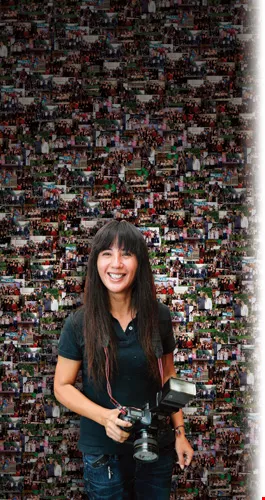
By committing to take 1000 family photos for others free of charge, Sicoke is bringing joy to others to atone for personal regret.
Fulfilling dreams
But getting today's busy folk in the same place for a family picture can be a pretty tall order-even when the photographers do it gratis at the family's house. The aforementioned Lin family, for example, twice tried to convene a photo session, but the third daughter's husband was unable to make it to his in-laws' on a Saturday morning because of work. In the end, 13 people appeared in the picture with one noticeable absence that kept the occasion from attaining perfection.
The Lins' youngest daughter, Lin Yiwei, says that they tried to arrange a session the previous month, but her older sister and her sister-in-law were out of the country-that would have been even less people. In fact, it's only in the last six months that all 14 family members have been living in Taiwan. Over the past three years, Mr. Lin, the family patriarch, was working in Thailand, and Lin Yiwei herself was studying in Japan. During that time it was hard enough just to have the opportunity to say more than a few sentences to one another, let alone congregate for a formal photo.
"It was a dream come true for both Sicoke and me," says Lin Yiwei. The idea of taking a full family photo came up years ago, but Lin's older daughter, having just given birth, wanted some time to regain her figure. Now, 13 years later, that child is in middle school, but the photo remained to be taken! The Lin sisters joke that the reason for the delay was an unsuccessful diet, and that to this day, the older sister still has the biggest waistline of the bunch.
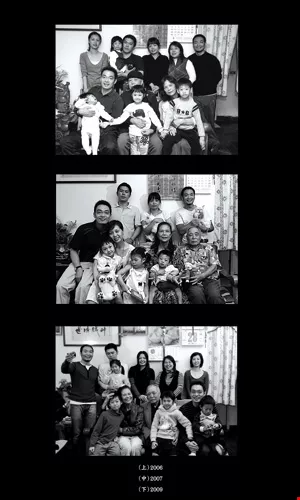
In the exhibition "Portrait of My Father," photographer Lee Kai-ming's camera preserves one irretrievable moment after another, in the process commenting on the subtle tensions and unspoken discourse between family members.
No regrets
In her time away from her wedding photography work, Sicoke zigzags across Taiwan, even traveling to the outlying Penghu islands. In nine short months, she has already photographed more than 400 families, all free of charge. What ideal impels her to sacrifice time and money-she even pays her own travel expenses-to help others document familial harmony?
In the 10 years that she's been in the wedding photography business, Sicoke has shot untold numbers of newlyweds. Yet, when her father passed away four years ago, though she searched high and low, she couldn't find one single full family photo to remember her father by. Not only that, but pictures with just her and her father were scant, indeed. She channeled her regret into a kind of penitent quest: she made a promise to take photos for 1000 families, free of charge. When she posted her intentions on the blog of her wedding photo studio at the end of 2008, she immediately received an overwhelming response. And so, as she seeks to fulfill her quest and make peace with herself, she is bringing meaning and poignancy to others.
In August 2009, she went to Nantou County's Meishan Township to shoot a family of more than 30 people. The matriarch of the family was in her 90s, and at her insistence that "grandpa must be present," a portrait of her late husband was brought out to complete the family. As Sicoke took her photos, her thoughts turned to the elderly Amis tribespeople in her hometown of Guangfu Township in Hualien County, and her eyes reddened with tears.
In her regular gig as a wedding photographer, Sicoke has seen couples break up on the eve of their photo shoot, with the joint photo session devolving into the woman's solo shoot. Similarly, in her avocational family photography, she's inadvertently taken a "divorce" picture.
A young married couple once got in touch with her to schedule a family photo session, but in the four months from the making of the appointment to the scheduled date, the couple's marriage came unglued. On the day before their divorce, the couple somehow managed to affect an air of contentment while Sicoke's camera recorded a poignant last memento of their marriage. She recalls a palpable sadness surrounding the entire family on the day of the photo. When the shoot was over, the wife cried in Sicoke's arms; the next day, the husband called to express his gratitude, saying that, while the family had come apart, he felt better knowing that there was a photograph testifying to the time it had spent together. Sicoke knew all too well the unsettling emotions involved in the situation, having herself gone through a divorce only the week after her father passed away.
She remembers also how a young man in his twenties enlisted her support in a seemingly impossible mission: an attempt to get his long-divorced parents together with him for a picture. His parents had divorced when he was very young and had subsequently started new families, but he somehow hoped to have just one photograph of "just my parents and me." She promised to do what she could, but in the end the young man just disappeared-whether he himself abandoned the notion or it was shot down by his parents, she never knew.
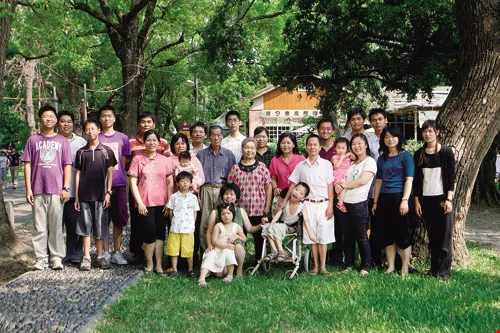
From sprawling clans to small families of just a few, reuniting is a great blessing.
Capturing the moment
For Sicoke, the challenges involved in family photography far exceed those of wedding photography.
"In wedding photography there's only the couple and the tone of the set is clear-intimacy, warmth, tenderness," she says. Family photos are a different ball of wax, with sometimes as few as two or as many as 30 or more people. The more people in the picture, the harder it is to control the situation. Aside from the contact person in the family, the other family members might be totally put off by the whole thing, or even feel paranoid about non-family interlopers prying into their affairs. When this is the case, cooperation is very poor, indeed. Every so often she finds a family to be so intractable that the shoot just falls apart. There have also been instances when she has been stood up completely, much to the chagrin of both her and her assistant.
The composition of these family photos requires both skill and a knowledge of tradition. The conventional layout used to be elders in the center flanked by family members arranged according to age. Sicoke has photographed families of all sizes, from one parent and one child to families of more than 30 that span four generations. She hews to the traditional placement of family members with the oldest generation as the focal point and each family-within-a-family clustered around. But contemporary photos don't necessarily try to express the Confucian "benevolent father surrounded by his filial sons" image with its smiles and dignified poses. These days, more effort goes towards expressing each family's unique character, with the result that each picture is different. Some of the family pictures project casualness, others close-knit warmth, while others still emphasize the distinct personalities of the individual members.
For results that feel good, she must contemplate the relationships within each family in a short period of time before shooting begins. The biggest challenge is that, in big families, it can be difficult to pay attention to everyone. Small children, often hyper or prone to throwing tantrums, narrow the window of opportunity for the perfect shot. Kids in their late teens, neither children nor adults, can be obstinate and willful, and feel above what they deem superficial displays of familial harmony. Elderly people generally dislike having their photographs taken, and if they are ailing, their energy can be low; nevertheless, when properly persuaded, they are the group that regards the occasion with the most respect and enthusiasm.
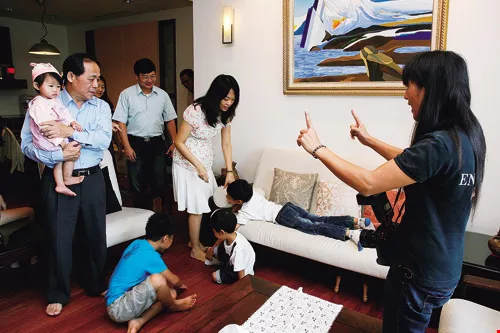
It is a huge challenge working with families as an outsider and trying to satisfy the needs of all their members, from young children to seniors. Here we see Sicoke in action with the Lin family in Dazhi.
Onsite photography
It used to be common to take advantage of wedding banquets to take family photographs, once before and once afterwards, at the family home in front of the ancestral shrine with the whole clan encircling the couple. This symbolized clan solidarity and lineage. Today's wedding photography is done at a studio with just the bride and groom; wedding banquets are held in five-star hotels which, while splendidly opulent, are detached from the spiritual core of the family, the home. As a result, the most organic setting and opportunity for family photos has vanished.
However, as long the will is there, with the right setting and a little bit of motivation, family photos needn't be too great an ordeal. The Zhang family in Taipei is an outstanding example.
Every three to five years or so the Zhang family gets together at Binjiang Park to have a family photo taken in the main hall of Lin Antai Old Homestead, a well-preserved traditional courtyard structure that evokes an air of prosperity. This little family tradition lets them record the growth of the family, and the children in particular.
In addition to the 20-person family photos taken every Chinese New Year's, there are also plenty of Zhang family photos from trips to various foreign countries. Now in his 70s, Mr. Zhang, the patriarch, presides over a family of numerous children and grandchildren. In midlife, Zhang was diagnosed with diabetes and high blood pressure, and, always aware of his mortality, he frequently prevailed upon his family to take family vacations, reasoning that each time could very well be his last. Today, the plentiful holiday photos speak to the invaluable time spent together as a family.
Because people's apartments have limited space, and also to expedite her clients' requests, she often schedules prolonged sessions at famous landmarks, like Rongxing Garden, Da'an Park, or Chiang Kai-shek Memorial Hall in Taipei, Hsinchu High Speed Rail Station, Tunghai University in Taichung, and the Linbian Sugar Refinery in Kaohsiung. When the weather is accommodating, she's able to handle as many as 20 or 30 different family sessions per day at a given location.
Sicoke says that these family photos are a blessing that people ought to seek out. One of her most profound experiences in family photography came in July 2009, when she photographed Mr. Lin's family at the hospice wing at Mackay Memorial Hospital. When Lin's daughter, Lin Chunru, a school nurse, saw Sicoke's online advert for free photos, her father, though terminally ill with lung cancer, had yet to be transferred to hospice care. Seven days later, the morning after the photos were taken, Mr. Lin passed away peacefully. "I think he was holding on until this moment!" says Lin Chunru.
She notes that most people are loath to take pictures of the seriously ill, but her father loved family photography and always took pictures every few years. Though in this last session he couldn't be behind the camera as was his wont, he participated wholeheartedly, recording some of his last moments for his family to cherish.
On the day of the session, nine impeccably dressed family members gathered at Mr. Lin's room in the hospice. With them came a friend who works as a makeup girl for a bridal photography studio, who helped Mr. Lin put on a suit and some makeup. Everyone's heart was heavy with the strain of letting go, but they gathered around for this last photograph, smiling through their tears all the while. Yet at the same time, they were grateful to have this opportunity to bid farewell, unlike so many who refuse to see their parents off because of estrangement or unresolved grievances, or are unable to do so because of work or study overseas. This precious final photograph now provides the background image on Lin Chunru's mobile phone and computer, affording her daily remembrances, making her feel her father's presence.
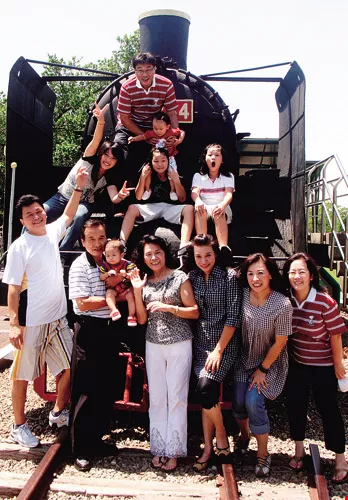
From sprawling clans to small families of just a few, reuniting is a great blessing.
Reconnecting with family
While Sicoke pursues her family photo mission, a photographer at the China Times named Lee Kai-ming has been using his camera to explore family relationships in his own way. A recent graduate of the Graduate School of Applied Media Arts at National Taiwan University of Arts, his graduate thesis and exhibition, "A Portrait of My Father-Photo Installation Exhibition," used images of his own family as a vehicle for provoking a visceral emotional response.
"This work is more than just a family photo album-it's my father's story, it's the story of my family, it's a retrospective on my father's life, and the process by which my family rediscovered and achieved understanding of one another."
"I think we tend to take pictures of flowers, beautiful scenery, building, and pretty girls, but seldom did we turn the camera around on ourselves," Lee says. He observes that it takes extraordinary circumstances for most people to realize the value of family. In his own case, it wasn't until his father underwent colon cancer surgery in the spring of 2007 that he began to sort through old photo albums and to start taking new family pictures.
In the beginning, the going was tough. The emotional walls that had built up silently between family members over the years made family photography awkward. But the experience allowed Lee to fully confront himself and his family, and in the end relations were greatly improved, especially with his stern, former career soldier father.
"My father is like many elderly people: they work hard their whole lives, and as they reach their twilight years, they begin to question the meaning of it all. Above all, they worry about being forgotten by those close to them," he says. His camera helped his father rediscover a sense of self-worth. These days, Lee is the only one who is at ease with his 86-year-old father, and has even accompanied him on trips to visit family in mainland China. The elderly Mr. Lee was very touched by his visit to his son's graduate photo exhibition, commenting emotionally, "I never knew you were so attentive to detail!"
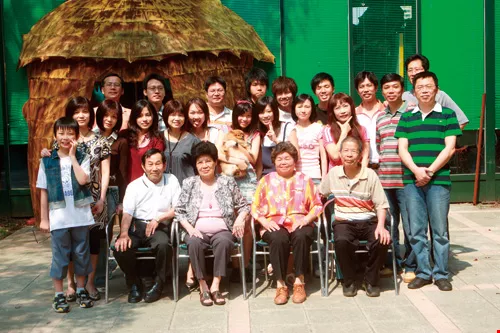
From sprawling clans to small families of just a few, reuniting is a great blessing.
Tomorrow's memories
What significance do family photos have for families? What kind of feelings can they preserve?
According to the analysis of Kuo Li-hsin, chairman of the National Chengchi University Department of Radio and Television, family photos confer solemnity, symbolism, and permanence upon seminal events in family life such as weddings, births, graduations, and trips. As a result, they intensify family solidarity and identity; the traditional full family photos are even more significant, as they allow at a glance to see the entire network of intra-family relationships.
"Only with images can you solidify that uniquely unrepeatable moment," says Lee Kai-ming. So, what does a photographer look for when preparing to capture that moment?
"Completeness," says Sicoke succinctly. She works tirelessly to bring happiness to others through her photography, with the result that she reaps rewards as great as do those to whom she dedicates her labor. She says that in her role as the behind-camera observer, she has learned a lot, to wit, "How to open up, relax, and enjoy the moment." For her, a meaningful life entails doing meaningful things. The seeds of kindness she has sown have brought her a tremendous bounty; as her name and reputation has grown, so has her wedding photography business.
It's true that not all of the family members that she photographs are fully appreciative of the opportunity, but she doesn't mind. "I'm just a guest in people's homes, I just try to be as accommodating as possible." This acknowledgement makes it easy for her to relax and settle into each situation without any preconceptions or needs.
Of course, people do grow old, and their memories begin to decline. But a photo of the entire family can bring a precious moment back to life, happiness and blessings captured permanently in film.
So what are you and your family waiting for? Get that picture taken!
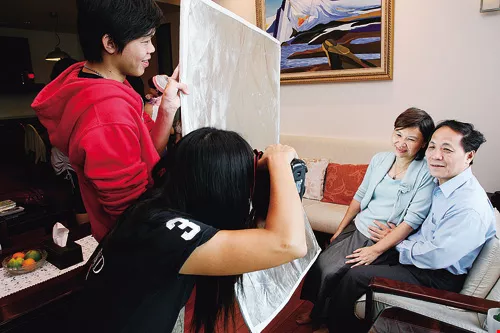
It is a huge challenge working with families as an outsider and trying to satisfy the needs of all their members, from young children to seniors. Here we see Sicoke in action with the Lin family in Dazhi.
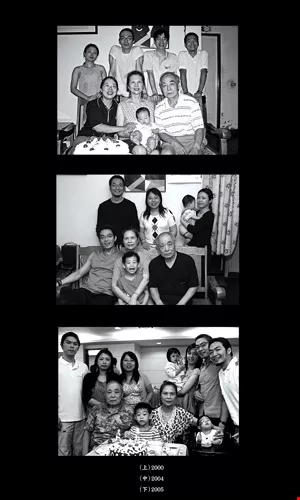
In the exhibition "Portrait of My Father," photographer Lee Kai-ming's camera preserves one irretrievable moment after another, in the process commenting on the subtle tensions and unspoken discourse between family members.
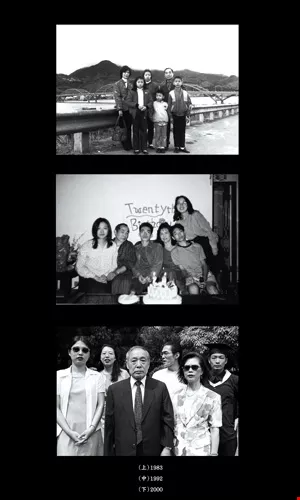
In the exhibition "Portrait of My Father," photographer Lee Kai-ming's camera preserves one irretrievable moment after another, in the process commenting on the subtle tensions and unspoken discourse between family members.
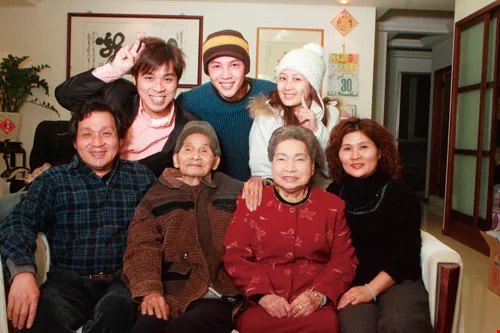
From sprawling clans to small families of just a few, reuniting is a great blessing.


@List.jpg?w=522&h=410&mode=crop&format=webp&quality=80)


