A Matter of Degrees Taking the Academic Plunge into China
Teng Sue-feng / photos Jimmy Lin / tr. by Phil Newell
September 2002


Just as the autumn winds are beginning to blow, many Taiwanese students are packing their bags to head off across the Pacific to start the new academic year. That's only to be expected. But, others are just hopping over the Taiwan Strait. Conservative estimates put the number of Taiwanese who have studied in the PRC at over 10,000, and the number has been steadily increasing. Today, when there is little reliable information about education across the Taiwan Strait, what advantages are there to studying in mainland China? Is it worth the investment?
It is the weekend, and there are few traces of the office worker crowd here in this high-rise on Taipei's Minsheng East Road, Section 3. But a lot of people seem to be heading for the 17th floor, where they crowd into the conference room of the Straits Exchange Foundation. More than 150 bodies are pressed into the small space, all of them here for the second annual get-together for Taiwanese students studying in mainland China. Among them are wives with their husbands, dads with their daughters, and moms with their high-school age sons, all here to gather a little information.
Mrs. Sun's son is an outstanding math and science student in his second year at Chienkuo High School. She wants to know: If her son wants to study in the PRC after graduation, how can he get around the problem of having to do his compulsory military service in Taiwan? Someone tells her that if a young man has one parent who is a Taiwan businessperson doing business in the mainland, then he can apply for a delay in the conscription date. If that doesn't work, when he gets his notification of military service at age 20, he will have to take a leave of absence from school to do his military service.
"I don't deny that my son has good opportunities in Taiwan, but my son enlightened me, he told me that the real future lies in China," says Mrs. Sun. If it were not for the problem of military service, her son would go directly after high school to the PRC to attend university; right now he has his sights set firmly on Jiaotong University in Shanghai. To pave the way for their son's education, two years ago the Suns bought property in Shanghai. "It's right across the street from Jiaotong University," she says.
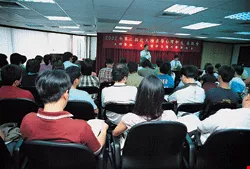
Old students and new meet in one hall. Vets warn rookies to be prepared for the worst: It may be a long time before Taiwan recognizes degrees from the PRC.
Accreditation issues
As interchanges between the two sides of the Taiwan Strait have become ever more complex and numerous, it has become something of a trend for Taiwanese students to pursue their higher education in mainland China.
The earliest cases of Taiwanese studying in the PRC can be traced back to just after martial law was lifted in Taiwan in 1987. Some Taiwanese businessmen who went to the PRC at that time and whose businesses hit the skids then stayed to continue their studies. But the real beginning of mainland fever in education was sparked by the promulgation of the "Statute Governing Relations Between People in the Taiwan Area and People in the Mainland Area" in September of 1992; it is a fever that shows no signs of breaking.
Under the Statute, Taiwan residents are formally allowed to go to the mainland for educational purposes. Moreover, to deal with the problem of accreditation of mainland degrees, Article 22 of the Statute declares: "Rules governing review and accreditation of academic credentials are to be drafted by the Ministry of Education and promulgated after approval from the Executive Yuan." In October of 1997, the ministry, at the time headed by Wu Jin, produced its "Rules for Review and Accreditation of Academic Credentials from the Mainland Area," and drew up a list of 73 recognized mainland universities. The Rules would have allowed students to apply to the Ministry of Education to get their mainland degrees accepted for use in Taiwan. But after Wu left office in February of 1998, his policy was put on hold, and remains in limbo.
The Rules state that applications must be made in accordance with certain regulations in order to be approved. The minister of education who succeeded Wu decided that because the enforcement rules of the Statute had not been announced, applications for approval of mainland credentials would not be accepted. This essentially permanently shelved the recognition of mainland academic degrees.
"The problem is not currently one of whether or not to recognize, but when. Students are in a race against time," says Yang Ching-yao, an associate professor in the Graduate Institute of China Studies at Tamkang University who studies the PRC educational system. There are still many variables in the credential recognition equation, such as when the starting date should be for recognition, and whether those who "jumped the gun" should have their degrees recognized.
Yang, taking one example of the complexity of the problem, says that government policy does not allow Taiwan students to study in the mainland for credits in education. But two years ago Peking University, China's most famous and reputable university, established a College of Education. Should this be included within the list of recognized institutions? Also, the "Rules" say that no recognition will be given for degrees from departments that involve communist ideology. There are questions, in that case, as to whether the departments of history or philosophy at Beida (as Peking University is more familiarly known) should be excluded under this rubric.
To make matters more complicated, just as the problem of accreditation seems insoluble, the PRC's system of higher education is undergoing a major transformation.
Chou Chu-ying, a professor in the Department of Education at National Chengchi University, points out that between 1992 and 1998, 258 general institutes of higher learning were amalgamated into 105 such bodies. The most famous example was the merging in 1998 of Hangzhou University, Zhejiang University, Zhejiang Agricultural Institute, and Zhejiang Medical University into a single Zhejiang University, with 11 fields of study including the humanities, engineering, the sciences, medicine, law, and agriculture. Of the 73 recognized schools in the 1997 list produced by Taiwan's Ministry of Education, nearly 40% (about 28) have merged with other schools.
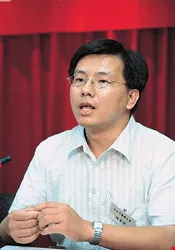
Hitting the mainland
There still seems a long way to go before mainland degrees are accredited in Taiwan, but this hasn't stopped the "invasion" of students into the mainland. According to the China Times, conservative estimates put the number of students who have studied in the PRC at over 10,000. Among this number are several well-known legislators who have pursued advanced study (while still serving in the legislature) at Beida or Tsinghua University, while former legislator Pan Wei-kang is now a PhD candidate at Changchun University in Manchuria. (They don't have to go to class every day, but they must meet several times each semester with the professor mentoring their research.) This being the case, why are so many people getting PRC degrees that aren't recognized in Taiwan?
In fact, while Taiwan currently does not recognize these degrees, the rest of the world does. Even more tempting is that, as mainland China's economic power grows, there is a vast demand for skilled human resources. Many Taiwan students go there in order to try to get a leg up on their competitors. As Tuba Tan, who began pursuing a PhD in law at Beida in 1996, says, many people have their eyes on the future employment market. "Just like those who went to the West to study, they hope to stay in the country and make their future."
"When I first came here I was going against the current," he relates, "and knew that I couldn't go back to Taiwan for three to five years. When I came in 1996 I was only thinking about studying, but the situation has changed quickly, and a lot of students who come here now are also inquiring into housing prices in Beijing." After earning his PhD, Tan and a few friends opened a law office in Beijing which specializes in handling legal queries for people coming and going across the Taiwan Strait.
"Now that mainland China is in the WTO, it needs at least one million people for the trade field, with demand also high in finance, insurance, and securities," says Tan. Moreover, he adds, doing business in mainland China requires good personal connections, and studying there is a good way to network.
Others have their own reasons for studying in the PRC. Says 37-year-old Hung Chin, "Coming here at my age, I'm not just doing it for the degree." Hung, who had been in graduate school in a private university in Taiwan and who closely follows cross-strait relations, says that the worst-case scenario is that there will be a drawn-out war between the two sides. But even if there is fighting, in the end there will have to be negotiations, and there are too few people on the current scene in Taiwan with personal experience in mainland China. He hopes to build up personal relationships with elites in mainland China and do whatever he can for the future of cross-strait relations.
But there remain problems with how useful a mainland degree can be back in Taiwan. Hsu Lu-lun, who entered the Central Drama Institute in mainland China in 1999 and who got her doctorate in theater this year, says that it is extremely difficult to get a teaching position in Taiwan based on credentials earned in China. Because she does not have a recognized doctorate, she had to accept a position as a lecturer at a technical college in Taichung based only on the MA that she earned in Taiwan. "Fortunately the school realizes that the lack of accreditation for my mainland degree is a political problem, and is very positive about my personal abilities to critique and analyze scripts," she says.
"Those who go to mainland China to study should be psychologically prepared for a long drawn-out struggle, because accreditation has become a political problem, and can no longer be seen as a purely educational question," says Tamkang University's Yang Ching-yao. Of course this may not matter to many students. After all, if you don't want to be in the civil service or in education, but just want to work in a private enterprise, then it's no big deal whether the government recognizes your degree or not.
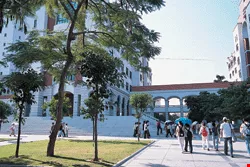
Xiamen University was founded in 1921 with money provided by Chen Chia-keng, an Overseas Chinese from Southeast Asia. It is the only "key" comprehensive university in all of China located in a special economic zone, and includes a Taiwan Studies Institute.
Belt of obscurity
Because of legal restrictions, there is little clear information about higher education in mainland China.
The lack of clarity starts with the degree system. Yang Ching-yao points out that among the more than 1000 institutes of higher learning in the PRC, there's no shortage of bluff and bilgewater in recruitment information. For example, Beida offers MA degrees and also an EMBA degree. But the latter is not equivalent to a master's degree, because it has not been approved by the Education Commission of the State Council. He explains, "If you want to understand the diversity and complexity of the mainland education system, you need 'sixth sense' and judgment, because it has developed in its own idiosyncratic way."
"The greatest worry," says Hung Chin, who is about to begin studying philosophy at Beida, "is the qualifications of the faculty." The mainland has only put its degree system into place in the last couple of years, and it is very possible that the majority of teachers in universities there do not have doctorates. During the ten years of the Cultural Revolution, it was problematic for the generation now in their 40s to even get a university education. As a result some have turned to faking their credentials; even Jiang Zemin recently said that action must be taken against fake degrees, so you can see how serious the problem is.
Hung Chin says that although the College of Social Sciences at Beida boasts some great intellectuals like philosopher Sun Xiaoli, Sun is now over 70, long past retirement age, and he is only staying on to keep up appearances and the reputation of the school. Even the president of Beida has said that the school is still ten years behind the top schools in the world.
Besides the difficulty of judging the value of a PRC education, another problem caused by lack of information is that there are opportunities for self-appointed middlemen to bilk hopeful students out of their money.
Taiwan legislator Chang Ching-fang has exposed the dark side of institutions which promise to arrange access to education in the mainland. Media reports say that some of these businesses claim to be able to guarantee admission to a mainland school, and charge from NT$600,000 to NT$1 million to pay for the "back-door" connections that are to be used for the promised enrollment. But because these middlemen do not act through normal channels, no one can say for sure that they can truly guarantee enrollment. However, despite the problems, no legal action has yet been taken to ensure that people get what they pay for.
Mr. Lin, who made a fact-finding trip to mainland China at the end of last year with 20 or so friends and colleagues in the field of traditional Chinese medicine, says that he took his friend's word that entry into a mainland institute of Chinese medicine could be guaranteed. But the intermediary company, despite taking tens of thousands of NT dollars from him, never came up with the necessary documents. It was only later on, relying on family connections, that Lin gained admission to a different institute of traditional medicine.
"I don't deny that you can 'get in by the back door' to some universities in the mainland, but this doorway is going to get narrower and narrower," says Tuba Tan. He has heard the head of an office of Hong Kong, Macao, and Taiwan Affairs at a certain university say that you have to act while the exams are still being graded. A lot of schools don't publicly post examination results, so there is the possibility of privately arranging to fix examination results. In addition, besides recruiting students through the formal entrance system, many schools have a system of "conditional admission." Students admitted under this system have no academic status in their first year, but if their grades are good, they can formally enroll in the second year. There are also possibilities of gaining admission through donations of money.
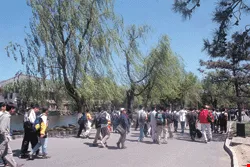
Underneath the willow trees, a cool breeze blowing, Peking University (aka Beida) is an academic palace, as well as a popular tourist attraction. (photo by Vincent Chang)
Still obscure
Besides "going through the back door," some students get in by using a passport from a third country. Exams in mainland China pose questions of varying difficulty depending upon the status of the exam taker. Tests are most difficult for local students, with a huge number of hopefuls competing for few openings. Tests are easier for students from Taiwan, Macao and Hong Kong, and easier still for persons holding a third-country passport.
Fan Yuan-sheng is a graduate of Fuhsing High School in Taiwan. His mother is an Overseas Chinese from Indonesia, and, with his father often traveling to Indonesia on business, he went there to attend university. His grades were good, and the teacher thought it a pity for him to remain in Indonesia to complete his studies, and suggested he go to the US, return to Taiwan, or go to mainland China. Fan, who figured that he would never test into the top schools in Taiwan, and that studying in the US was too expensive, spent a month prepping for the entrance exam to Beida. The exam had four sections: Chinese, English, history, and math. Today he is a sophomore in the Department of Industrial and Commercial Management in Beida's Guanghua College of Management.
As far as he knows, there are about 20 students from Taiwan in his college, most of whom entered on third-country passports. Some of them even specifically bought third-country passports for this purpose. "For Taiwan students, holding a third-country passport is a short-cut, and a lot of people from Hong Kong have two passports. Anybody who has been to high school in Taiwan can definitely test into a university in mainland China on the third-country exam," he declares.
Going to study in mainland China appears to be an unstoppable trend at the moment. So how can one get accurate information? What academic advantages are there to higher education in mainland China?
Hung Chin, who strongly rejects the mindset that looks for a back door or a "fixer," says: "In fact finding a teacher is the most reasonable and normal approach to informing yourself about admissions, and you can definitely save yourself a lot of trouble." He asked a teacher how to prepare for the exam, and the teacher hinted to him to pay particular attention to several critical books in the field of the philosophy of science.
Tuba Tan, meanwhile, suggests that students personally pay a visit to schools in which they are interested to understand the environment and get a feel for the school. For example, the climate in northern China is exceptionally dry, making nosebleeds common. Little details like this can affect the way you feel about studying.
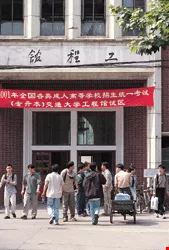
Of the more than 1000 schools of higher learning in China, over 70% are devoted to engineering and the sciences. Shanghai's Jiaotong University-alma mater of PRC president Jiang Zemin-is one of the most famous of these.
Chinese medicine is hottest
Chengchi University professor Chou Chu-ying says that from 1987 to 2001 there were over 3000 students from Taiwan who entered mainland universities through the examinations for residents of Hong Kong, Macao, and Taiwan, or who were formally certified as Taiwanese students by the PRC Ministry of Education. Taiwanese students tended to congregate near China's coastal regions, around Beijing, Tianjin, Jiangsu, Fujian, and Guangdong. The most popular area of study was traditional Chinese medicine, followed by law and politics, trade, and management. Fields like humanities, religion, and traditional arts were at the bottom of the list. The school that attracted the most Taiwanese to sign up for the exam was Beida, but the school with the largest number of Taiwanese students was China Zhengzhi (Political) University. There were also many Taiwanese students at institutes of traditional Chinese medicine in Beijing, Shanghai, and Guangzhou.
"Of the more than 1000 mainland institutes of higher learning, 70% are for science and engineering, because the mainland has always given preference to these fields and shortchanged the humanities. The PRC is also strong in military science and aerospace technology," says Yang Ching-yao. But as far as he knows, few students from Taiwan go to the PRC to study science or engineering. Departments of archeology and anthropology are also as yet undiscovered treasures. "Virtually anywhere in mainland China, all you have to do is dig and you get yourself the equivalent holdings to Taiwan's whole Museum of Prehistory; there's an inexhaustible scholarly treasure house there."
Chen Cheng-sheng, who went to Beida in 1999, studies political science, which promises the lowest economic returns. Chen, who decided to continue on for his PhD this year, does not exclude the possibility of teaching in the PRC in the future, but says that right now salaries there are too low, so the prospects are not very attractive. For him, the important thing about getting his degree in the PRC is that "I can have the experience of learning side by side with the cutting edge elite in mainland China, which is rare and precious. But having a mainland degree won't necessarily be any help in finding a job."
Know thyself
Wu Hsiao-ming, a doctoral candidate in international relations at Fudan University in Shanghai, assumed when he entered in 1997 that it wouldn't be long before direct travel would be possible between the two sides. Five years have passed and the prospect of direct travel is still remote. Many students likewise thought that the government would recognize mainland degrees by the time they finished their programs, and that everything would be smooth sailing thereafter, but this idea has proved far removed from reality.
In addition, notes Wu, when Taiwan and mainland students interact, it is necessary to keep a firm and confident attitude about Taiwan's future, or they will think that peaceful reunification is even more reasonable. "Maybe you don't agree with the 'one country on each side' formula, but you have to let them understand the background to this kind of idea, and don't forget where you come from."
In an era when the future of cross-strait relations remains clouded, only you can decide whether studying in mainland China is right for you. But no matter what, the return on this kind of educational investment may have to wait for the future.
Lin Hung-yang
(interview by Teng Sue-feng/ tr. by Robert Taylor)
Lin Hung-yang went from faraway Argen-tina to study in mainland China ten years ago, and this year gained his doctorate in clinical medicine at Nanjing University of Traditional Chinese Medicine (NJUTCM). Now aged 33, he talks about his motives for studying TCM in mainland China, what it is like to study there, and the opportunities that the TCM market offers.
When I was in my second year of junior high, our whole family emigrated to Argentina. Over there traditional Chinese medicine is well established, but most of the patients are of Chinese descent. At university in Argentina I read business administration, but in my first year there, the local TCM practitioners' association invited a teacher from NJUTCM to teach a short course of lectures, and this kindled my interest in TCM.
In 1991 I joined the undergraduate program at NJUTCM, and five years later I started on a master's course. Back then, in 1996, I was NJUTCM's first master's candidate from abroad, and they had to hold a special meeting just to figure out how much tuition they should charge. Three years later I started on the doctoral program, and I just got my PhD this year.
The strongest fields at NJUTCM are acupuncture and moxibustion, and pediatrics. The teachers are highly experienced in clinical practice, and because mainland China has suffered many natural disasters and periods of unrest, doctors of whatever specialism have to treat pretty much all kinds of diseases. Our school has many famous doctors. One example is Qiu Maoliang, aged 90, who was China's greatest living acupuncturist, but sadly he passed away just recently. Others include ENT specialist Gan Zuwang, as well as Shen Jize, who teaches a course on the third-century medical textbook Synopsys of Prescriptions of the Golden Chamber. His approach of combining ancient TCM texts with practical clinical examples makes the ancient books interesting and accessible.
At present there are about 80 students from Taiwan at NJUTCM. As far as career opportunities for Taiwanese TCM students go, there are probably three main paths open to them. The first is to return to Taiwan and take the TCM certification exam, but the current exam will soon be scrapped, because policymakers want TCM practitioners to be trained in formal educational institutions from now on. The second is to enroll in a postgraduate program in a TCM department after getting your bachelor's degree; and the third is to emigrate overseas and gain residency in another country. Comparing the TCM systems in various foreign countries, Canada's is one of the best, and British Columbia even has a bureau of traditional Chinese medicine. But apart from having to pass the TCM certification exam, you also have to get a license to practice. It's the same in the US, and in California alone there are 6000 licensed acupuncturists, so competition is very intense. On the other hand, Singapore recognizes qualifications from five long-established mainland Chinese TCM universities, including Beijing and NJUTCM, so you can directly go into practice.
It looks like a promising career, but in fact there are many obstacles. I hear that in Taiwan the TCM practitioners' association hopes that the Ministry of Education will require people who study TCM on the mainland to take the mainland's certification exam, then go back to Taiwan and take the mainland qualification accreditation exam, before finally taking the government professional exam for TCM practitioners. That's why many people take things one step at a time. Some open up a herbal medicine dispensary at home, so that they will have something to fall back on if they don't pass all the exams. If they don't think it is below them, in Taiwan they may be able to earn more from practicing traditional folk remedies such as massage and cupping than from TCM. Some people go into other lines of work, but once you leave this field you are unlikely to be able to get back into it again.
Originally I planned on going back to Argentina after graduating, but six months ago the economy there collapsed, so now I may look for work in mainland China. It's only this year that the mainland opened its medical certification examinations to foreign nationals and to students from Taiwan, Hong Kong and Macao. Perhaps I will club together with three or four friends to put up US$100,000 and open a small clinic in a big city. I'm in at the front so I have time to grab a good patch, but in the future things may get more crowded.


@List.jpg?w=522&h=410&mode=crop&format=webp&quality=80)


