Unbridaled Merriment--The Outcome of 5,000 Years of Sexual Repression?
Teng Sue-feng / tr. by Robert Taylor
June 1993


June is the marrying season, with no end of couples choosing to tie the knot this month. But before the newlyweds can embark on their life together, they have to go through the unique complexities of the Chinese marriage ceremony.
The high point of the wedding party is when the couple's relatives, friends and classmates invade their bedroom and raise havoc. Why do the Chinese love to do this? For thousands of years, people have been thinking up new tricks to play on newlyweds on their wedding night. How have couples endured it? Do modern Chinese still keep up this tradition?
The main attraction in Ang Lee's film The Wedding Banquet is a traditional Chinese wedding ceremony. What's so special about a wedding? Hasn't everyone been to a wedding party? The episode which adds "spice" to this one starts when the formal ceremony is over, and the party, with its endless rounds of toasting, begins.
First of all, an old classmate produces a small chicken hung on a thread, with its head, tail and wings stretched out, which he swings back and forth in front of the bride and groom's faces as they try in vain to take a bite out of it. Suddenly he jerks the bird upwards, and the couple inadvertently kiss, to the great amusement of all.
The party mixes both Chinese and Western traditions: after the bride throws her bouquet to the female guests, the men crowd around shouting "the garter!" With a look of annoyance, the bridegroom says "Damn it, don't these people know when to stop?" But not having the courage to go against their wishes, he nonetheless turns to the bride, apologizes and troubles her to sit down.
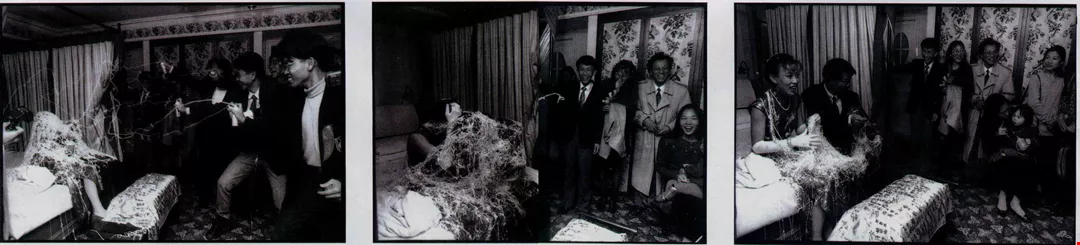
Larks like this can be great fun, but it takes some finesse to make sure no one's feelings are hurt along the way. (photo by Vincent Chang)
The best is yet to come:
The groom squats down, slides his hands up under the bride's white wedding dress and slips off her garter; then with his back to the male guests, he stretches it and fires it over his shoulder. By this time the bride's face is scarlet with embarrassment. According to Western wedding customs, the girl who catches the bouquet and the man who catches the garter will be next in line to be married, and so all the unmarried ones present vie to snatch these prizes, hoping the happy couple's good fortune will rub off on them.
When the party is over, the newlyweds stand at the door to see the guests out. Some of the guests fall to one side in a drunken stupor; and the bride and groom themselves are three sheets to the wind as they make their way upstairs to the hotel's honeymoon suite. This should have marked the end of the revelries. But suddenly 15 or 20 of their young friends come bursting into the suite. "I thought you were drunk!" the startled groom blurts out to their leader, an old classmate.
"Drunk? If I were dead it wouldn't stop me coming to raise hell in your bridal chamber! This is a unique treasure of Chinese culture, and it should be upheld and glorified overseas too!" says the intruder, whereupon some of the crowd start setting up tables and noisily shuffling mahjong tiles, settling in to "lay siege" to the newlyweds.
The finale comes when they make the bride and groom get into bed and take their clothes off one by one, throwing them out from under the quilt. The "guests" will not be persuaded to leave until the couple have both stripped off completely. This is when the invasion is really over. This depiction of an overseas Chinese wedding in The Wedding Banquet is based on scenes personally witnessed by the director Ang Lee, who cannot help but exclaim "Chinese people can be really cruel!"
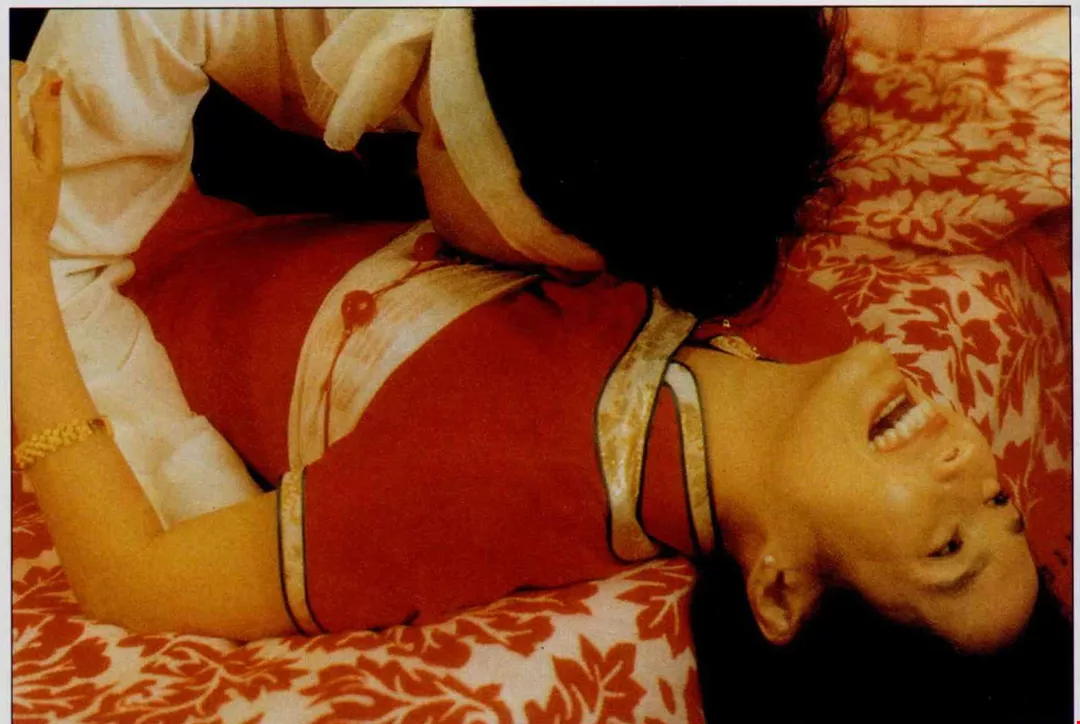
The wedding night pranks in The Wedding Banquet are the high point of the whole film. The blindfolded bridegroom must bite cherries one by one from a thread tied around the bride's bosom, in a scene which is definitely "not suitable for children "! (photo courtesy of Central Motion Picture Corporation)
The boot on the other foot:
There are certain preconditions for a suitably riotous "invasion." An effective hellraising ringleader is essential, and the accomplices must provide plenty of vocal encouragement, clapping and giving shouts of appreciation.
Hsiao Jung, a news photographer, is generally acknowledged by his colleagues as a "prankster first-class." He loves to party, and is never short of crazy ideas; he is always coming up with unexpected new tricks to throw newlyweds off balance. If he is on hand, things are sure to be lively, and the better he knows the "victims," the more outrageous his pranks will be.
Once at an old classmate's wedding, when everyone was tipsy, on the spur of the moment Hsiao Jung called over a little boy he saw there, and had him pee into a beer glass. Then he stirred soy sauce, chili sauce and mustard into the half-full glass, and forced the unwitting bridegroom to drink the mixture.
At another wedding, when the couple were seeing the guests out, everyone pulled out lipstick and made ready to kiss the bride's face to leave a "souvenir." Some of the "gentlemen" kissed her on the face, some kissed her on the lips and some on the back, but Hsiao Jung put out his hand, lifted up the bride's dress and starting kissing his way towards her thigh. "I could see that the groom wasn't any too pleased," he says.
Because of his past "excesses," when Hsiao Jung's turn came to get married he found the boot was on the other foot. The cruelest retaliation was when they made him drink wine from the bride's high-heeled shoe. On the principle that what's good for one is good for all, Hsiao Jung joined willingly in the fun." At the time it didn't worry me, but when I thought about it afterwards I really did feel a bit sick," he says. But a leopard can't change its spots, and since getting married he has become yet more unbridled, playing even more merciless tricks on newlyweds.
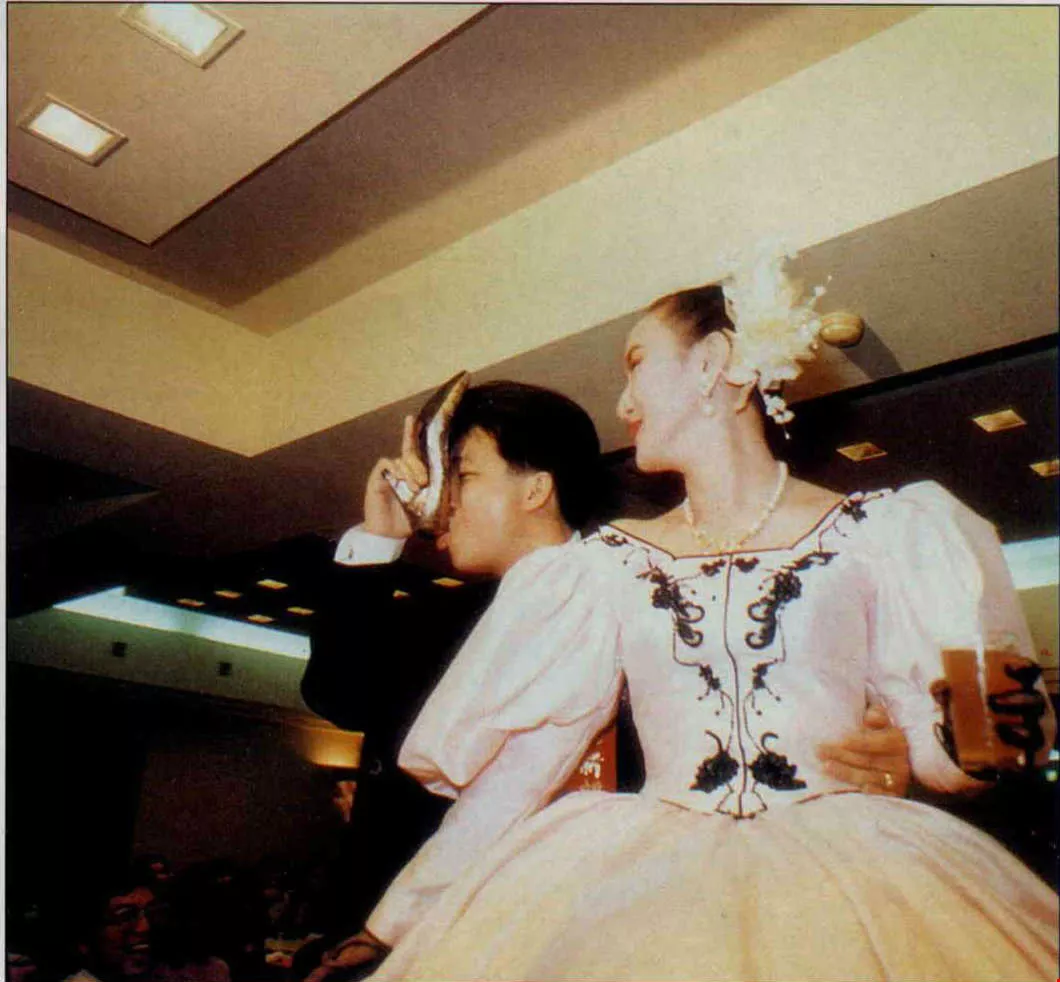
Would you drink from a lady's slipper? The Chinese can be merciless in getting their own back. (photo courtesy of Hsiao Jung)
It's once in a lifetime, so why not make the most of it?
Of course, not all newlyweds take this kind of treatment lying down.
Teng Wan-ching, a charity worker, recalls the wedding of some Chinese classmates while she was studying in the USA two years ago. A large group of "hellraisers" first threw some melon seeds onto the bride's body, and had the groom retrieve them by feeling for them with his mouth; then they dropped a grape down the groom's shirt, giving the bizarre explanation that if the couple wanted a son, they would have to make the grape fall out of his left trouser leg; if they wanted a daughter, it would have to come out of the right.
Their final trick was to have the couple hide behind a sleeping bag, and each throw out twenty items removed from their own body." The groom was actually stripping off with gusto, but the bride refused, and said very coldly 'You'd really get a kick out of that, wouldn't you?' which rather dampened everyone's spirits."
The Chinese love a lively atmosphere, and this aspect of their national character is expressed nowhere more strongly than where food is concerned. They will not feel that they have enjoyed themselves properly unless the tables are loaded down with fine dishes, the guests play drinking games and toast each other round after round, and the room is crowded and raucous. And marriage, as a once-in-a-lifetime occasion, is seen as a time for celebration on a par with passing the imperial examinations, so there can be still less excuse for going against tradition.
Teng Wan-ching remembers how she once went to a classmate's wedding party at which "no-one raised hell. " She did no more than call out to the bride and groom to sing a few songs and to drink a toast with linked arms, but later the bride's mother came over specially to thank her, saying "a wedding's no good if it's not lively."
Who started it all?
There is no end to the number of tricks the Chinese play on newlyweds at the wedding party, but is this a "unique treasure of Chinese culture" as claimed by the character in The Wedding Banquet? Perhaps not. The all-night singing and dancing seen at the weddings of Taiwan's aboriginal peoples have the same symbolic meaning of prayer for good fortune as is at the origin of the tricks played on the wedding night, and nearby Japan and Korea both have similar customs. But in China the origins of this tradition can be traced back to the earliest times.
The custom of invading the bridal chamber was also known as "dinning the bride" or "drinking tea with the bride," and was a special ceremony after the end of the wedding banquet, in which tricks were played on the bride. The purpose was to test the bride's patience, but also simply to take the opportunity to get a good look at her. Other terms which appear in ancient Chinese records are "making fun of the bride," "teasing the bride," and so on. Why should this custom exist? Different explanations abound.
According to folk legends, in ancient times the lascivious fox spirits loved nothing better than to play tricks on newly married couples, and so on the wedding night family and friends would gather together in the bridal chamber in order to strengthen the forces of humanity and light, and to drive out the forces of evil and darkness. Hence the popular saying that "If people don't raise a rumpus, then demons will."
Another version has it that when Su Hsiao-mei, younger sister of the great Sung Dynasty poet Su Tung-po, was married to Chin Shao-you, all their friends came to congratulate them, and made great fun of the bride in the bridal chamber; out of this there grew a lasting custom.
No bar on childish behavior:
ut in fact, the earliest reports in Chinese historical records of making disturbance in the bridal chamber date back to the Han Dynasty, a thousand years before the Sung. The Han Shu (History of the Han) records that "On the wedding night, for amusement they listen in secret outside the window to the words and actions of the new wife." Where's the amusement in listening to newlyweds from outside their window? This practice of "bedroom eavesdropping," with its voyeuristic overtones, has caused some to interpret these customs as being symbolic of Chinese people's sexual repression. And many of the tricks played do indeed include an element of "sexual harassment."
In one well-known joke, on the morning after the wedding night a husband calls room service from the hotel honeymoon suite, and asks for two breakfasts to be sent up. Suddenly a voice calls out from under the bed: "No, send up five!"
At military weddings, a trick is played called "plucking the moon from the sea": an egg is dropped into the bridegroom's underpants, and the bride is told to put her hand in and fetch it out, while the onlookers keep shouting "Don't pull out the wrong one!" Or a crowd of people play mahjong outside the bridal suite, and at the end of four rounds they bang on the door and shout "Come out and start work, we've got to do overtime!"
Yang Chen-min, who married a soldier, remembers that before their wedding her husband warned her that she should be mentally prepared. After the wedding party was over and the guests had been shown out, a group of her husband's comrades installed themselves in the bridal suite and played cards, while she had to wait on them with food and drink. By midnight they still showed no signs of leaving, and it was only the bride's mother-in-law who after looking in on them several times, finally broke the "siege" by shooing the guests out.
Five thousand years of sexual repression?
Professor He Chun-jui of Central University takes the view that the "sexual problem" in the custom of invading the bridal chamber is most apparent in the way that "the newlyweds are publicly exposed to covertly sexual banter and derision; it is a way of challenging sexual taboos." For Professor He, one of the most intriguing aspects of the custom is that for it to be fun, it is essential for the newlyweds to be unwilling victims! "If the couple openly and straightforwardly show their affection in front of everybody, then the ones to be unspeakably embarrassed will be the invading guests," she explains.
Ang Lee, director of The Wedding Banquet, evidently agrees with this view. Acting a bit part in his own film, he jokingly tells a Western guest who has watched in bewilderment as the wedding guests embarrass the newlyweds: "What you have just seen is the result of five thousand years of Chinese sexual repression."
Ang Lee explains that this observation is half tongue-in-cheek and half serious, but "a wedding really is the only time when one can legitimately give vent to such feelings."
Such legitimacy is given by the popular wedding custom of "three days without respect for old or young," whereby for three days after a wedding, members of older or younger generations can all make fun of the newlyweds. During this joyous time all taboos are lifted, providing a perfect opportunity to play tricks on the newlyweds, in addition to scrutinizing the bride and praying for the couple's happiness.
A unique treasure of Chinese culture, to be honored eternally?
The custom of raising havoc in the bridal chamber reaches back into the mists of Chinese history; maybe it really is a "unique treasure of Chinese culture." But as it has changed and evolved through countless generations, perhaps it has lost its original meaning, and even become a controversial practice which smacks of abusing the bride.
In his book Pao P'u Tzu, the Eastern Chin Dynasty writer Ke Hong refers to bloody tragedies arising from the contemporary custom of making fun of newlyweds. In one episode, someone asks a bride mortifying questions in front of a large crowd; other tragic stories tell of drunken guests invading the bridal chamber and beating the bride with sticks, or even hanging her upside down until she dies. This is why the great Tang Dynasty calligrapher Yen Chen-ching once petitioned the emperor to abolish this "pernicious practice."
In his Tan Ch'ien Hsu Lu, Yang Shen of the Ming Dynasty also rebukes his contemporaries for going too far when making fun of brides. He accuses them of taking any opportunity to pull up brides' dresses or take off their shoes to look at their bound feet. Yang Chen censures this behavior as treating brides no better than street prostitutes. But evidently the severe disapprobation of past commentators did not succeed in putting a stop to this ancient practice.
It is said that in early agricultural society in Taiwan, the custom of invading the bridal chamber was extremely widespread. Some of the guests would even gamble in the bridal chamber and then present all their winnings to the couple as a wedding gift.
To analyze the phenomenon from a sociological viewpoint, in olden times many couples were brought together by matchmakers, neither of them even knowing what the other looked like before the wedding ceremony. Thus the custom of the family invading the bridal chamber had the function of breaking down the feelings of unfamiliarity between the couple. According to anthropologist Ruan Chang-jui, it was also "a social process by which the joining of two people as one flesh was given public recognition."
But nowadays most couples have had contact or even intimate relations before marriage, so that the original significance of invading the bridal chamber would no longer appear to exist. And yet human relationships in our industrialized society are far more distant than in the old society, where they were mainly based on ties of blood and place. Employment now scatters former classmates and close friends far and wide, and it takes a wedding invitation to bring them all together. Taking advantage of this rare opportunity for a little fun and enjoyment among friends provides a rationalization for continuing with the custom of raising havoc in the bridal chamber.
Striking the right balance:
The tricks played on newlyweds are as many and varied in style and content as the people playing them. Perhaps they really do give the couple something to look back on; but those who escape such treatment seem to have no great sense of regret. For on their wedding day, from fetching the bride in the early morning to the banquet in the evening, the newlyweds are so exhausted that all they wish for is to go home to their beds and drop.
When the banqueting hall is festooned with "happiness" characters and ringing with the clamor of a crowd decked out in suits, leather shoes and fashionable dresses, you can be sure that once again someone will be having a great laugh at the expense of the bride and groom. But whether their banter will really succeed in pleasing both hosts and guests equally, without hurting anyone's feelings, depends entirely on their own finesse.
[Picture Caption]
p.28
The Chinese custom of playing tricks on newlyweds in the bridal chamber is a tradition which goes back thousands of years (drawing by Tsai Chih-pen)
p.29
Larks like this can be great fun, but it takes some finesse to make sure no one's feelings are hurt along the way. (photo by Vincent Chang)
p.30
The wedding night pranks in The Wedding Banquet are the high point of the whole film. The blindfolded bridegroom must bite cherries one by one from a thread tied around the bride's bosom, in a scene which is definitely "not suitable for children "! (photo courtesy of Central Motion Picture Corporation)
p.31
Would you drink from a lady's slipper? The Chinese can be merciless in getting their own back. (photo courtesy of Hsiao Jung)


@List.jpg?w=522&h=410&mode=crop&format=webp&quality=80)


@List.jpg?w=522&h=410&mode=crop&format=webp&quality=80)
