The Shrinking Giant--The Story of Li Chi-keng
Chang Chung-fang / photos Shih Wei-kang / tr. by Phil Newell
September 1994


Some people say that life is like a game of cards, and that you have to play with the hand that fate deals you. Li Chi-keng, who suffers from muscular dystrophy, says that although he's been dealt a very poor hand, "no matter what, you've got to play it out as best you can." Li argues that "little defeats are victories, and the only really big failure is giving up."
In the middle of July, Li Chi-keng represented Taiwan at the Eighth Meeting of the World Alliance of Muscular Dystrophy (WAMD). At the conference he showed a videotape of his life entitled, "A Confident Life--A Contented Becker-type Muscular Dystrophy Sufferer from a Developing Country."
"I am very content with my present life," stated Li with deep sincerity. "I have a focus to my life, and an income better than I had ever expected. I have very rich and full days."
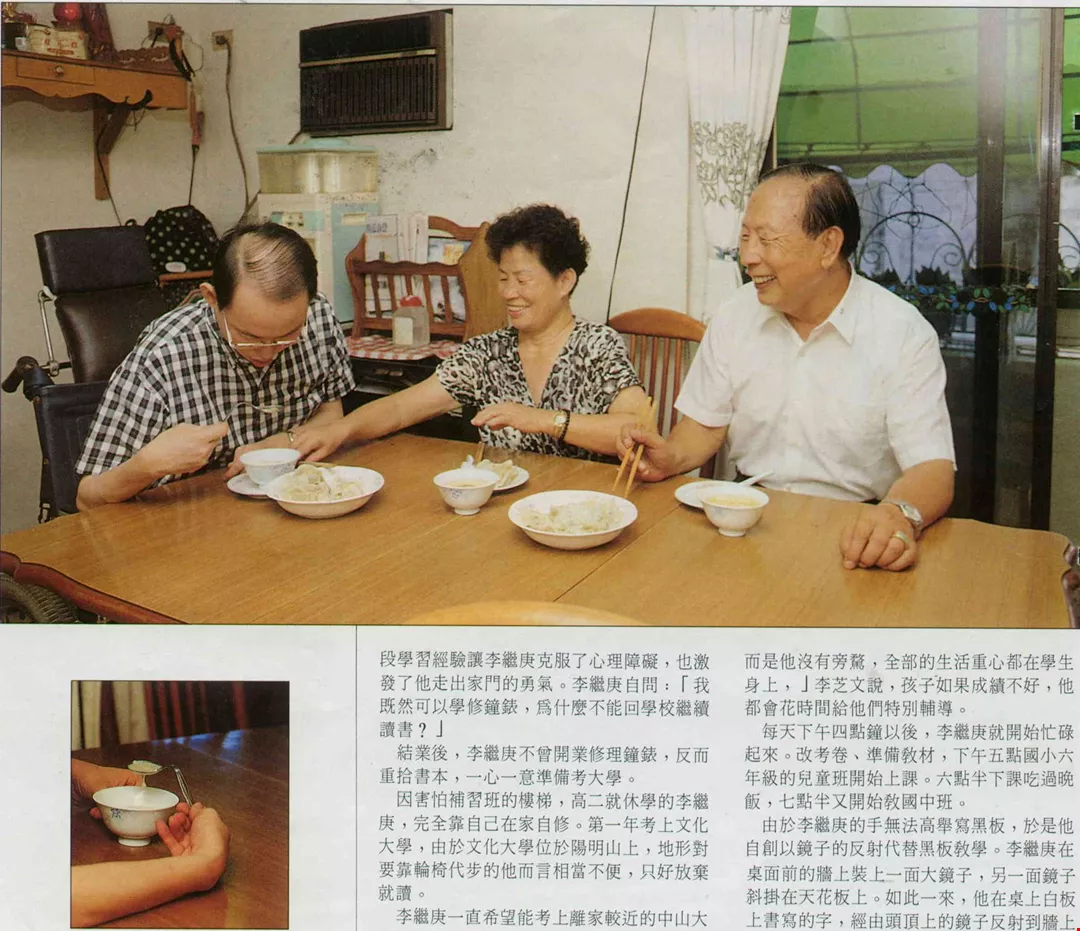
Independent-minded Li Chi-keng will not accept help for anything he can do himself. Take eating, for example: With a little adjustment to the spoon, he can eat on his own.
Pride and joy
"I am very proud of him," says Chi-keng's 73-year-old father Li Chih-wen. "Everything he has today was completely unexpected. At first I assumed I would have to take care of Chi-keng for his whole life. I never thought that he would be supporting me." Adds Chih-wen with a laugh--and a sense of pride that can't be disguised--"Recently he forced me to put up with twenty days of travel in Europe."
Li's second elder brother Li Tien-keng, who is closest to Chi-keng, says that he has never heard his brother complain or wallow in self-pity. "He always acts self-reliantly, which makes us want to help him even more." Tien-keng says that his approach to life of "taking things as they come, without trying to force anything" comes from his brother's influence.
Li's arms and legs are thin and weak, and his skin is pale from not having been exposed to the sun for a long time. Sitting in his wheelchair he says tranquilly, "When I first came down with the disease I hadn't yet lost the use of my limbs. I have only become weaker gradually, and in the process, gradually came to accept the fact of my illness." Because the muscular dystrophy has also affected his facial muscles, Li's tone of voice and expressions are not as natural and lively as those of a healthy person.
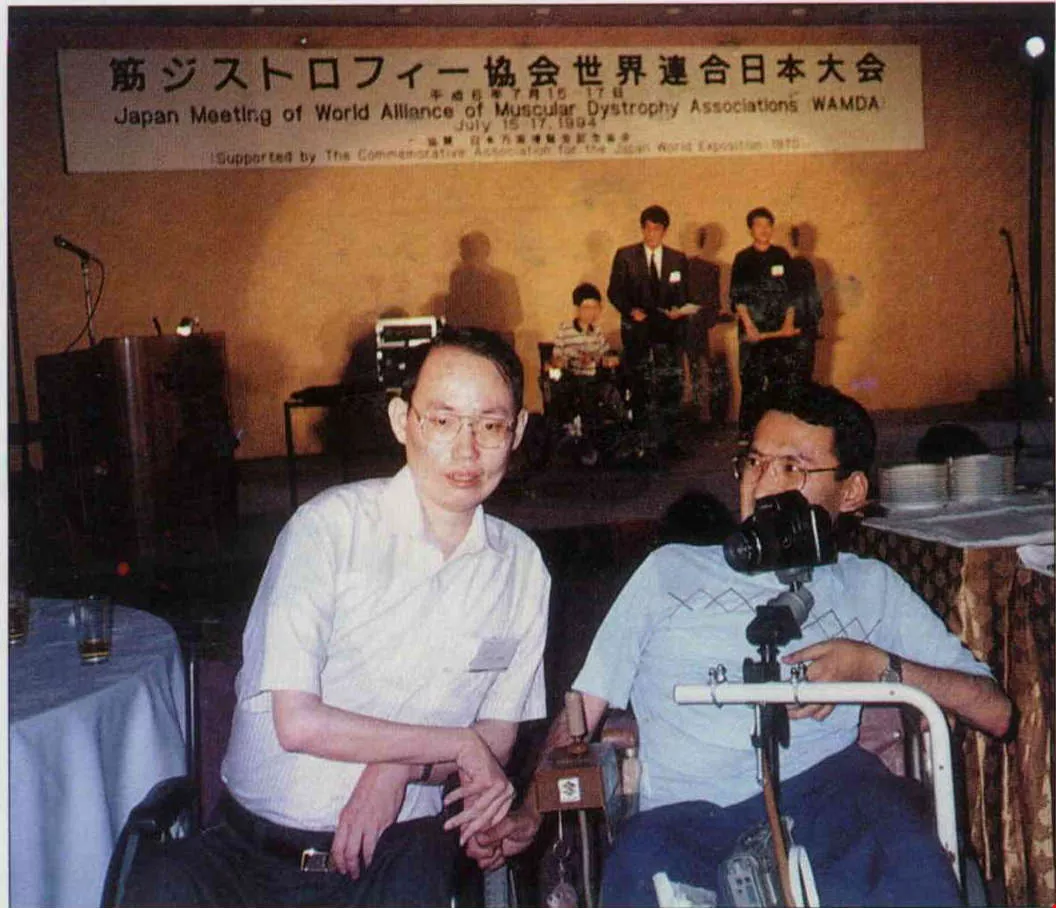
At the meeting of the World Alliance of Muscular Dystrophy, held in Tokyo, Li exchanged ideas with fellow MD sufferers from around the world,making him even moredeter mined to set up an MD association back in Taiwan. ( courtesy of Li Chi-keng)
A bolt from the blue
As a youngster Li Chi-keng was as active and lively as any normal child. During the junior high school entrance exams, his teachers discovered that Li had a problem with his legs when he was unable to do the leapfrog. After visits to several major hospitals and tests on samples of muscle tissue, the diagnosis was confirmed to be "progressive muscular dystrophy." At the present time, neither cause nor cure is known for this syndrome.
The Li family patriarch describes his feeling at that time as being like "the sky falling in." Although they were told that the disease has no cure, he and his wife did not give up hope. They brought their child to famous doctors all over the island, and even tried some absurd prescriptions such as eating toads and bathing in pig-skin water. Nevertheless, despite all the doctors and quack cures, Chi-keng, still in his adolescence, continued to grow up in all ways but the physical: He became more reed-like by the day, and deteriorated year in and year out. His movements became slower and more exhausting.
Although Chi-keng is the youngest boy in his family (having two older brothers and one younger sister), he was by no means accustomed to being spoiled. "Ah Ti" (or "little brother"), as he is called in the family, was always well-behaved and insightful in understanding the feelings of others.
In order to ease the burden on his father, a policeman, when taking the examination to enter high school Chi-keng only listed one school, "Kaohsiung High School," a relatively inexpensive public school, on his preference list. To help him get back and forth to and from school, his father bought him a three-wheeled motorcycle. Unfortunately, he was involved in an accident in his second year in high school.
The accident affected his respiratory system, and the doctor cautioned that there was "not very much hope." Though Li unexpectedly survived, he could no longer walk at all. "Actually, I would have lost the use of my legs sooner or later because of my illness, so all the traffic accident did was move things forward a bit!" says Chi-keng, downplaying the incident.
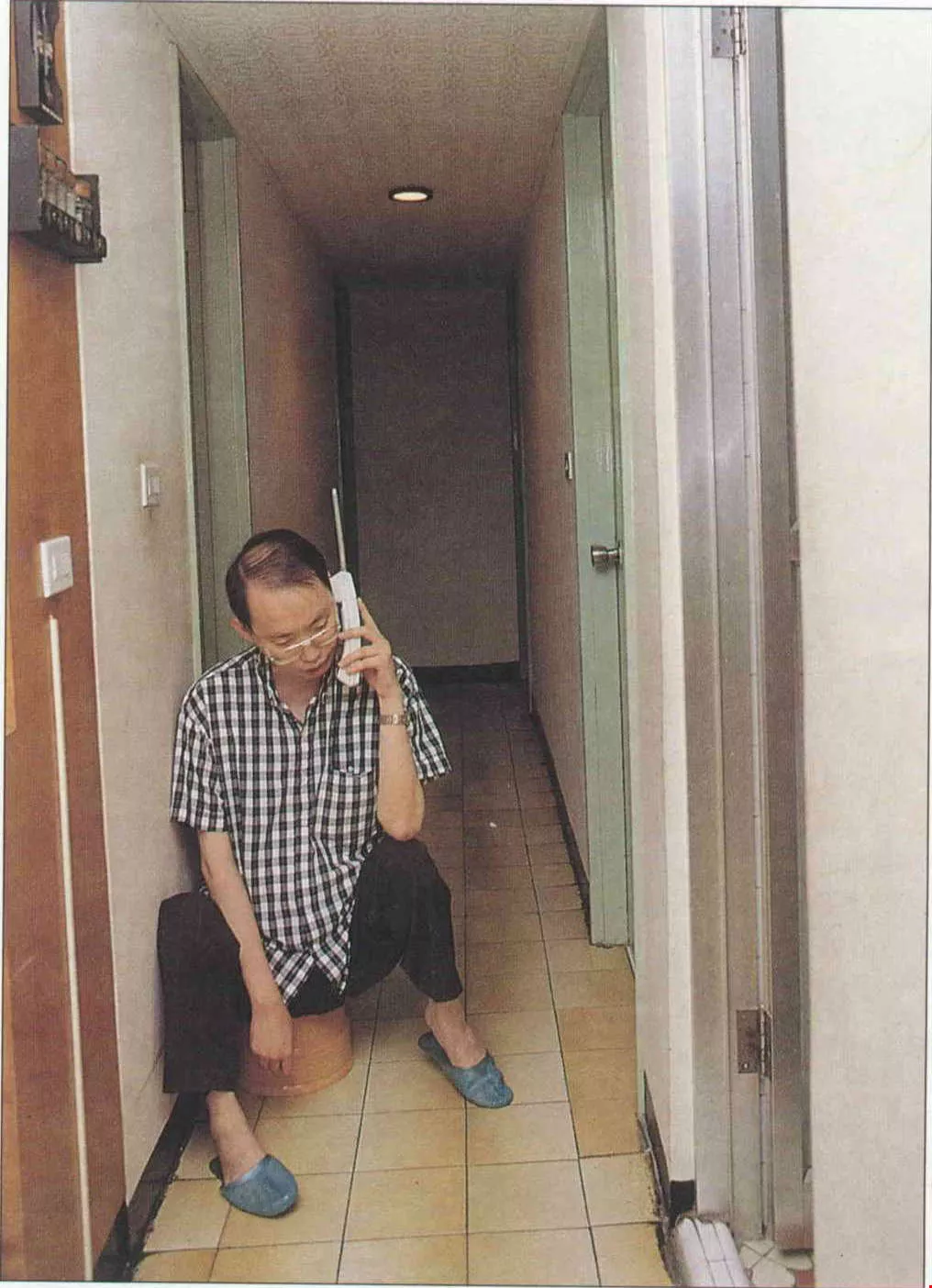
There are wooden stools all over so that Chi-keng can move more easily through his house.
Back to school
After losing his mobility, Chi-keng stayed at home for the next seven or eight years. "I didn't feel sorry for myself, but I was worried about my future," he relates.
Like many handicapped people looking for a way to make a living, Li decided to study watch repair.
Since the classroom was on the second floor, for each day of the two-month term Chi-keng had to make his way up the stairs one at a time. This experience allowed him to overcome his psychological inhibitions and gain the courage to get out of the house. Li asked himself: "If I can study watch repair, why can't I go back to school again?"
After completing the course, Li never did begin repairing timepieces; instead he took up his books and began preparing for the college entrance examinations.
Because he feared climbing the stairs at supplementary schools, Li, who withdrew in his junior year of high school, had to study completely on his own at home. The first year he took the exam he tested into the Chinese Culture University. Unfortunately, the university is located on Yangming Mountain, and Li would have had great difficulty getting around in that topography, so he had to forego attending.
Li always hoped that he could test into National Sun Yat-Sen University, located near his home. In his second year taking the exam he missed out by just a few points. Finally, in his third attempt, he tested into the Chinese Department at Sun Yat-Sen University. After one year in the Department of Chinese, where he was the top student, Li was allowed to transfer to the place he had always wanted to be--the English Department.
Naturally his Chinese Department professors did not want to lose this outstanding student. Li recalls that "I frankly told my professors that in order to insure that I would be able to make a living after graduation I had to transfer to the English Department, and my teachers immediately agreed after hearing what I had to say."
Classroom without blackboards
After graduating from university in 1987, Li Chi-keng began teaching English out of his home. He began with one-on-one classes with individual students, and, relying on word of mouth, gained more and more students over time. These days he has classes all evening from Monday through Saturday, and has reached saturation point on the number of students he can accept.
"The reason there are so many students isn't that Ah Ti teaches in some special way, it's that he has no outside distractions and so devotes himself totally to his students," says Li Chih-wen. If the students' grades are not good, he will spend extra time to give them special guidance.
Chi-keng starts to get busy every day after 4 pm. First he corrects papers and prepares the day's classes. At five the children's class for sixth graders begins. Class ends at 6:30, after which Li takes an hour for dinner; the junior high school group begins at 7:30.
Because Chi-keng is unable to lift his arms to write on a blackboard. he uses the reflection in a mirror instead--a device of his own invention. Li has set up a large mirror on the wall in front of the table, and has hung another mirror from the molding on the ceiling. He writes on a white board on the table, and what he has written gets reflected off the mirror over his head onto the mirror on the wall, the effect being just like a blackboard.
Most teachers face their students when they instruct. but Li has his back to them. The students and teacher see each other in the mirror.
Chen Hung-min and Huang Ying-chi, two third-year junior high school students, began taking English classes at the home of Teacher Li when they were sixth grade students in primary school. Chen, who has the highest grades in English in his class, says, "Teacher Li explains things even more clearly than the teacher in school." Ying-chi also gets good grades in English. "Mr. Li teaches very well, and sometimes even tells jokes to make us laugh," she relates.
About progressive muscular dystrophy
Few people understand much about muscular dystrophy (or MD for short), and most are likely to mistake it for polio.
According to estimates by Li's doctor Chen Shun-sheng, head of neurology at the Kaohsiung Medical College, there are probably more than 1000 MD sufferers in Taiwan. Because there are relatively few victims, the disease is very unfamiliar to most people.
"Progressive muscular dystrophy" is either inherited or is caused by genetic mutation. Abnormalities in the X chromosome cause muscle cells to lack certain proteins, leading to the deterioration of the muscles and eventually to death.
Because there are many different types of missing proteins, there are many varieties of MD. Of them the most serious is Duchenne type. Those with this strain usually come down with the disease before the age of five, lose the ability to walk within ten years, and die from heart disease and respiratory infection before the age of 20.
Li Chi-keng has the relatively less severe "Becker" type. The disease develops relatively late. anytime between the ages of five and 25. Because it does not affect the heart muscles, there are cases of people living into their sixties.
Chen Shun-sheng states that it has only been in the past two to three years, with progress in genetic research, that it has been possible to determine with certainty which type of MD a person has. In other words, for the past 20 years Chi-keng's family has not known how much longer he might live.
Waiting for high tech
At the Li family home you can see a number of clever ideas and designs to make Chi-keng's life a little easier. For example, there are little wooden stools scattered about that Li can use to "walk around." There is a plastic bottle with a straw to make it easier for him to drink water. Then there is the spoon which has been twisted into just the right shape for Chi-keng to use. These are all creative innovations developed through experience over time.
But not all problems can be resolved through ingenuity.
Li finds it more difficult to move with each passing year, and his movements are slow. To get out of bed, get dressed, and get washed up--which might take a healthy person just a few minutes--takes Li an hour. He needs help from family members to wash his hair, dry himself off, and do other daily tasks.
"My family has had to work hard all their lives to take care of me, so anything I can do for myself I will do for myself." Being thoughtful, he long ago noticed that his aging parents are not as able to move his wheelchair as well as they once could. He states, "We need high-technology help. The better the equipment, the less the burden on the caregivers."
Li argues that the most urgent need is for a "handicapped rehabilitation equipment information center." At one time the Industrial Technology Research Institute (ITRI) had a plan to do research and development of rehabilitation equipment, but couldn't carry it out after the budget for it was slashed. Most private enterprises reason that there is little profit in developing products for such a small number of people, so they have little interest in pursuing the matter.
Li Chi-keng points out that there are huge differences in the conditions of each handicapped individual, and equipment must be designed for individual needs. But even so, if it truly helps the individual, it can reduce the burden on the family and on society.
Leaving the country
Li and Dr. Chen began preparing in March of this year for participation in the WAMD meeting. The theme of this year's conference was "High Technology and Personal Independence." Li began to mull over the question of what kinds of things would make his own life easier. In the end they decided to make a "computer-controlled window" and a "remote-controlled lamp," which were relatively easy to complete. They also applied to link up his home computer to American libraries.
Li applied to the Department of Social Affairs for financial assistance, and then found a firm that makes automatic controls. He set up a computer-controlled window in his own room. Then he went to ITRI for a remote controlled lamp which he installed in his home. "Now when I want to open the window or turn on the lights, I don't have to bother anyone else for help," he says with delight.
Going to Kyoto to attend the conference in July was Li's first ever trip out of the country. "To tell you the truth, I was very afraid before going abroad." he admits.
"I didn't expect everything would go so smoothly." Except for having to rely on a minibus and a cargo lifter to get him into the plane at the Kaohsiung airport (because there was no bridge to the plane at the airport), he was able to get around in his wheelchair without problems while overseas.
Compared to the situation in Taiwan, where wheelchairs must compete with motorcycles for space on the roads, Kyoto's obstacle-free environment left Li deeply impressed. "I could move about freely, on the streets, in the subway... everywhere," says Li with excitement. Each subway station has one attendant specially designated to assist disabled persons. "It seemed like he was standing there just for me."
Chi-keng met not only people from Japan, the host country, but exchanged experiences and picked up the latest information from fellow MD patients from around the world. It was a great learning experience for him.
He discovered that in Holland, for example, they have an agency specializing in researching new equipment to help the handicapped, and the conference delegate had a mechanical arm attached to his wheelchair. In Denmark they have courses in "Sexual Life" for MD victims, and the Danish delegate said contentedly, "I don't feel like a person with a disease, I just feel like a person."
The mystery of life
Having had his perspective widened, Li decided to strike out to do something meaningful for other sufferers. With the help and encouragement of Dr.Chen Shun-sheng, Li took the position of founder and began actively planning the establishment of the "Muscular Dystrophy Patients Association."
"While this disease still has no effective form of treatment, fellow victims can lend mutual support," explains Li. He adds that another purpose in establishing the association is that "people with similar illnesses should band together to express their common needs, and not just sit around waiting for help."
Dr. Chen, who devotes much effort to MD research and to helping the afflicted, says that although there are not a great many MD victims, they are given a great deal of attention in the United States and Europe.
"Looking at these people, others can understand that the mystery of life can be found in helping others directly or indirectly," says Dr. Chen. In some countries, victims are treated with the kind of care normally accorded to "national treasures."
In the past few years, Taiwan has progressed a great deal in terms of welfare for the disabled. But it must be said that there is still a way to go compared to the advanced nations.
Li Chi-keng is quite fortunate in some ways. His brothers, sister, and their spouses all help to look after him. Even so, father Li Chih-wen has still made some "arrangements" for his youngest son's future. "I wrote my will early on. I will leave everything I have to Chi-keng," he says.
A matter of duty
As for Chi-keng's own marriage, neither his family nor he himself are anxious about it. Li Tien-keng says that he once introduced a woman to Chi-keng; although she was willing to stay in touch with him, her family was strongly opposed. Chi-keng, worried about "causing trouble for other people," gave up on the idea.
For Chi-keng's parents, looking after their son for their whole lives has been natural, and they have neither complaints nor regrets. For his siblings and their families, they see it as an "unshirkable obligation" to take over and continue caring for him. Nevertheless, for a society built on ideas of fairness and equity, it should be even more obligatory to help the families of the afflicted.
[Picture Caption]
P.111
Where there's a will, there's a way. Li Chi-keng, unable to lift his arm to write on the blackboard, uses two mirrors to achieve the same effect.
P.112
Independent-minded Li Chi-keng will not accept help for anything he can do himself. Take eating, for example: With a little adjustment to the spoon, he can eat on his own.
P.114
At the meeting of the World Alliance of Muscular Dystrophy, held in Tokyo, Li exchanged ideas with fellow MD sufferers from around the world,making him even more determined to set up an MD association back in Taiwan. ( courtesy of Li Chi-keng)
P.115
There are wooden stools all over so that Chi-keng can move more easily through his house.


@List.jpg?w=522&h=410&mode=crop&format=webp&quality=80)


