Growing Pains: Chung-jen and Chung-yi at Nineteen
Laura Li / photos Hsueh Chi-kuang / tr. by Phil Newell
August 1995


National Taiwan University Hospital celebrated the 100th anniversary of its founding at the end of June. Amidst all the high-and-mighty public figures in attendance, quite unexpectedly two young men holding crutches, with urine bags tied to their waists, each with only one leg, yet effusive and optimistic, became the center of attention. Chung-jen and Chung-yi have grown up!
Sixteen years ago, surgery to separate Siamese twins Chung-jen and Chung-yi captivated the nation. The 12-hour operation produced the world's first successful separation of male Siamese-twin infants joined at the hip and born with only three legs. Some of the many people crowded around TV sets set off firecrackers in celebration, or thanked providence. The day after the surgery, President Chiang Ching-kuo met the entire medical team. Meanwhile, the news was sent into mainland China so that mainland compatriots could also share in the joy.
Like the Hongyeh Little League baseball world champions and the gentle sounds of Teresa Teng, Chung-jen and Chung-yi became part of the collective memory. With a little reminder, it all comes flooding back. The question is: How are Chung-jen and Chung-yi, now 19-year-old young men, doing?
When you enter the new complex at the National Taiwan University Hospital (NTUH), the first thing you see is the information desk, afloat in the center of the enormous lobby like a desert island in the South Pacific, and its inhabitants: yellow-vested volunteers. But on Saturdays things are a bit different. The generous women of the Chang Teh Association who usually are here are not around. Instead, a young man in a wheelchair stakes out the center of the information desk. Many people who head over there with questions look at him a bit skeptically, but he always breaks the ice: "Is there something I can help you with?" He speaks with such self-assurance that his visitors heave a secret sigh of relief.
Surrounded by a wall of inquisitors, this young man of only 30 kilograms looks especially frail. But as you watch he handles an endless stream of questions, answers the phone, and occasionally dexterously toys with the computer. Obviously he is in no way inferior to even senior volunteers in terms of his knowledge of every nook and cranny of both the old and new buildings of the hospital. And every once in a while a more attentive passer-by will recognize him, and blurt out in surprise, "Are you Chung-jen or Chung-yi?"
It is Chung-jen, the "elder" brother, and he has been serving as a volunteer for over a year now. But it's not hard to find Chung-yi if you want to: When volunteer shifts change, Chung-yi usually shows, perhaps walking with crutches, perhaps in a wheelchair. And if he doesn't appear, that means he must be somewhere else in the hospital doing something for his friends. Although they were born attached together, these identical twins share no special sixth sense; if one wants to find the other, he'll have to try the pager a few times like everyone else.
When the brothers are together, they get even more amicably curious glances. Some people even stop what they are doing for a careful look, as if these passers-by were comparing the young men today with the image engraved on their brains of the two attached infants. Both have long and narrow eyes, with beautiful rounded lips beneath high, straight noses. The only difference is that Chung-jen looks more drawn in the cheeks, whereas Chung-yi looks more robust. Because each has only half a pelvis, both appear short in the upper body. Also, each has at the end of his empty pant leg (one left, one right) a clear plastic urine bag: These seem to be reminders to others not to forget that the two have traveled a very hard road.
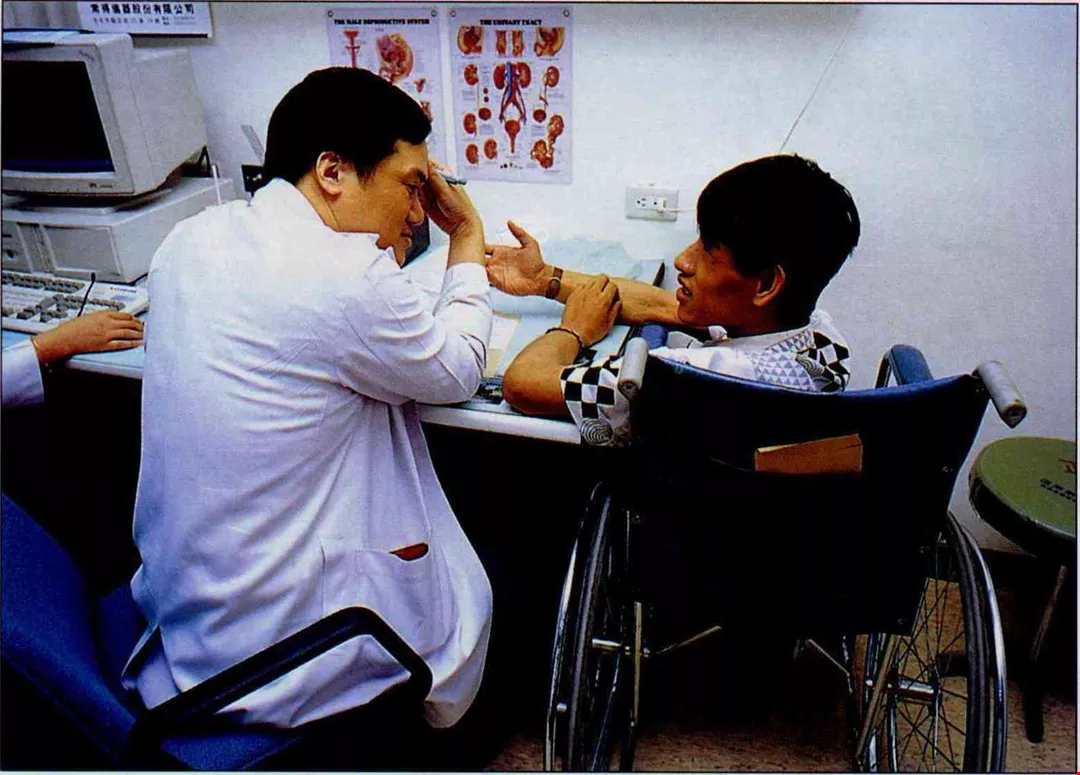
"Doctor, you've got to do something. If you were me, after five years of pain wouldn't you go crazy?" Suffering from kidney stones, Chung-jen appeals to the physician, who can only make a frustrated face by way of an answer.
Children of NTUH
Chung-jen and Chung-yi both are students in the Department of Information Science in the evening division at Hsihu Industrial and Commercial High School; the former is in his third year, the latter in his second. They are, without exaggeration, the "children of NTU hospital." From the time they get up in the morning until they go off to school at 6:30 pm, they spend more than half the day at the hospital. Although this is where they feel most at home, these two 19-year-olds are not necessarily hanging out at the hospital every day by choice.
"Most of our classmates work during the day, so they can't really hang around and goof off," explains Chung-jen. And even if the twins have companions, Chung-jen and Chung-yi have their limits: one is limited mobility, the other is limited money.
"lf our classmates say they want to go out and have fun, my first reaction is to ask, 'Where do you want to go? What do you want to do?'" says the more fragile Chung-jen.
However much he may envy the others, Chung-jen has no choice but to miss out on biking, hiking, or any other activities that require two legs. Even for group dinners or the movies, the first consideration is whether or not there will be unascendable staircases. Then comes the question of cost. And if the location is distant, who will pick him up? The two brothers have been relying on the NT$7 million fund of donations made at the time of their surgery. The subsidy they get from the Office of Social Work at NTUH is very small, and taxis are only subsidized for trips between home, the hospital, and school. When he has no money in his pocket, if no one picks him up, Chung-jen can't go anywhere.
But sitting quietly is not easy either. Despite surgery to straighten his spine, Chung-jen's back is bent in the shape of an S, and he only has half a pelvis. When seated, his body leans over toward his absent left side at an angle of 30 degrees. From time to time he has to prop himself up with his left hand and adjust his position in order to avoid the pain that comes from pressing down on the kidney stones that have long plagued him. It is extremely difficult for him to sit for an extended period in hard chairs without arm supports, such as those in class or in McDonald's.
In comparison, Chung-yi is far more mobile than his brother. He only needs to borrow a motorcycle from a friend, and put on supporting wheels, and he can cruise around the city, head into the mountains, or take off to the coast. With the help of a crutch, he can walk on his one strong leg as fast, if not faster, than ordinary people. The only difference is that he has to rest if the walk is a long one.
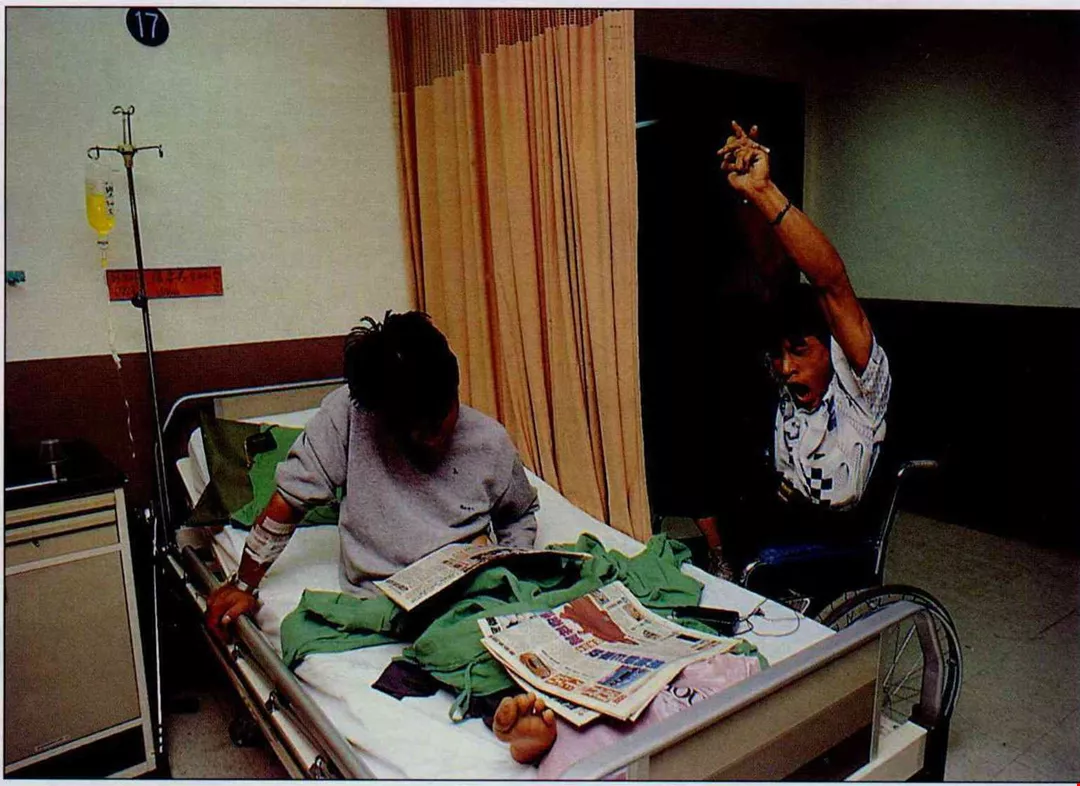
Chung-yi is in the emergency room again. Chung-jen, at his side, occasionally runs to get something, food or whatever, for his brother. The twins have to support each other in whatever small ways that they can.
Defining friendship
As Chung-jen describes it, although the two are twins, they each have their own individual troubles. Because of pressures caused by the structure of his body, Chung-jen suffers from very painful kidney stones. It has proven impossible to break them up with ultrasound shock waves, to extract them with endoscopic surgery, or to fully ease the pain with analgesics. Periodically Chung-jen has to stay in emergency care at the hospital for urinary tract infections and consequent high fevers.
Chung-yi's weak spot is that he has relatively serious intestinal adhesion, so that he cannot expel waste on his own. With this condition, in theory he should have his intestines cleaned (a process also called "intestinal lavage") every three to four days. But this process is both expensive and painful, and Chung-yi sometimes procrastinates. Once he took a trip around the island, and on another occasion went to the beach to watch the sun rise and then went up Yangming Mountain the next day. The fun-loving Chung-yi has in fact been to the emergency room no less than his brother. If he goes overboard for even a single meal, the price is that his stomach is painfully full and as taut as a drum. Then he must go to the emergency room, where he is hooked up to an IV and his intestines are cleaned out every eight hours for as long as it takes to eliminate all the food and no longer produce gas. In these moments, Chung-yi's face turns sallow, and his normal vitality pales.
While other men are able to roam about and make the world their oyster, Chung-jen and Chung-yi have little choice but to report to the hospital every day. What do they do there? Besides regular weekly checkups and the occasional emergency visit and hospital stay, they come, of course, to "visit friends."
What friends would those be? Chung-yi always goes downstairs to the restaurant, where he visits Mama Yen, his "adoptive mother," and the young students who work there. Here he often runs into a little tornado of friendship. Meanwhile, Chung-jen goes back and forth in the halls of the old and new buildings. Most of the time he is just roaming around killing time, though sometimes when he thinks of it he will head to some special corner of the complex to visit one of his more familiar friends. If his friend is busy he will wait quietly at the door until his friend looks up and notices him, and he will give an exaggerated smile, wave, and say hello. If his friend isn't available, there's no harm done. "He (or she) is busy. It wouldn't be right to disturb his (or her) work." So he just quietly pushes his wheelchair away. It's not necessary for him to say anything, yet he is painfully lonely. But everyone has their lives to attend to, and no one can permanently fulfill this young man's need for friendship.
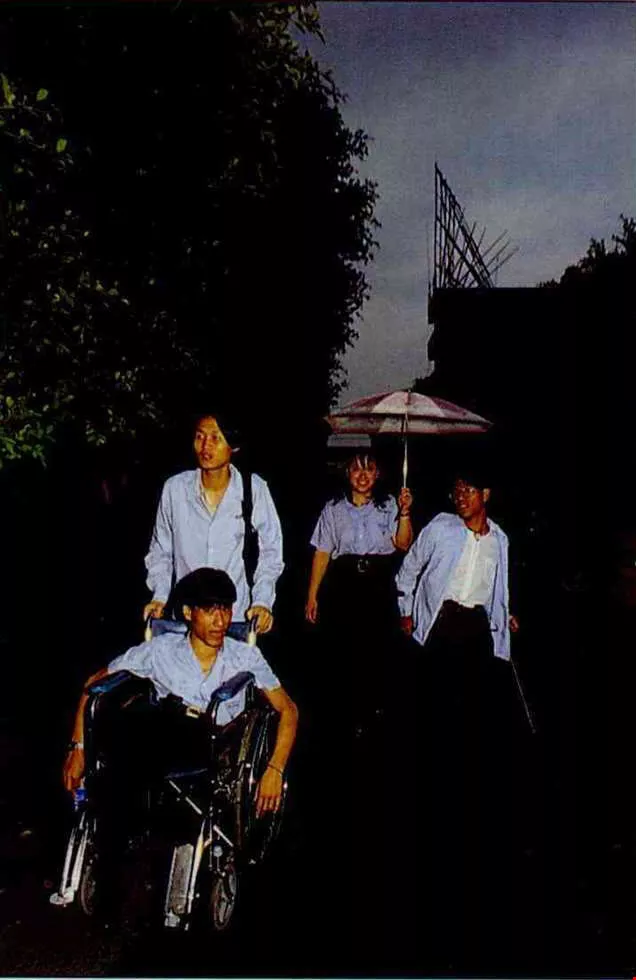
Although they are all together only three or four hours a day, the teachers and students at Hsihu High School offer the brothers some warmth and concern. Lu Fang-yu, who is pushing Chung-jen in the picture, accompanies the twins out of school five minutes early every day, and makes sure they get off safely into a taxi before the hundreds of other students pour out and take to their bikes.
Don't talk about me in front of my face!
Of course, as "children of the hospital," Chung-jen and Chung-yi often meet familiar faces in the halls. It's just that sometimes, after they exchange a few pleasantries, the person will ask a frustrating question: "So are you Chung-jen or Chung-yi?" This despite the fact that Chung-yi wears glasses, while Chung-jen does not, and that Chung-jen has a right leg, Chung-yi a left. Yet there are careless people who have seen the two boys grow up from infancy yet still cannot remember such obvious characteristics.
They have long gotten used to familiar people being unable to tell them apart. What really causes them to turn a cold shoulder is the curiosity of strangers. It might be called curiosity, but it is hard to take the crudity and lack of basic courtesy that some people show.
Once Chung-jen was traversing the Ching-fu underpass between the old and new sections of the hospital. On the less than 100 meter-long wall were stuck three or four pictures of the Siamese twins who had been separated at birth. They were meant to show the special importance of these brothers in the history of NTUH. Just as Chung-jen was perusing the pictures, a mother walked by with a pair of little boys in tow. She immediately recognized Chung-jen from the photo. Besides being surprised and excited, she also bent over and said to the boys, "Do you see? He's one of the three-legged twins from the wall. After the doctor cut them apart, each of them was left with only one leg...." Her deliberately suppressed whisper rang very clear in the tunnel. Chung-yi simply pushed his wheelchair and left with a blank expression on his face, while by-standers felt embarrassed and saddened.
"It's always the same old thing. Are you Chung-jen or Chung-yi? How do you two get along? What school are you in? What about your parents?" When asked how it feels to be a public figure, Chung-jen uses his special, exaggerated humor to express disdain for strangers. Faced with such well-intentioned queries, Chung-jen usually gives pro forma replies. But Chung-yi, who has a more forceful personality, can't help but ignore the questions without really caring whether the other person is offended.
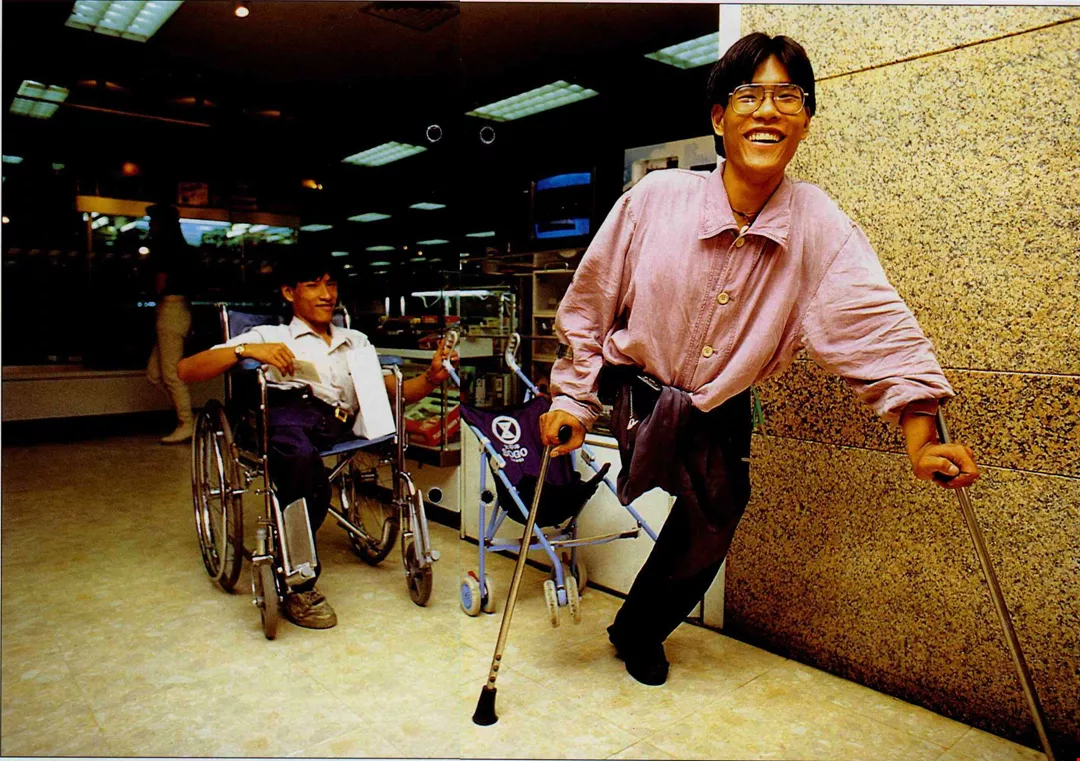
A rare trip to a department store to go shopping and take pictures. Too bad everything is so expensive, so they have to go home empty-handed.
Different personalities, comparable dreams
Compared to Chung-jen, who is more mature and tactful, Chung-yi is far more "cool." When he is in a good mood, he is thoughtful in many ways, and is gentle and warm. But there is another side: whether he explodes in anger or hunkers down, he creates a stultifying atmosphere with little regard for how others might feel. Once Chung-yi went to the emergency room for abdomen pain. The doctors and the nurses dawdled and didn't dare treat him at once. In pain and angry, Chung-yi picked up a chair and threatened to smash the NTUH emergency room computer!
Chung-yi knows himself: "That's just the way I am. My mood can change as quickly as turning the pages in a book." When someone asks him to chill out a bit, he often retorts, "Next thing you'll be telling me to take up qigong breathing exercises." As for what frustrates him most, the worst thing is misunderstandings among friends, either because he messes up something he did for a friend with the best of intentions, or because he feels a friend is not treating him with sincerity. From an adult point of view, these are typical "teenage growing pains."
In Chung-jen's eyes, his brother is stronger, can push his wheelchair along faster, can play more deptly with the computer, and has better relations with girls. lt's just that he worries about Chung-yi's hard edge and rashness. In other words, despite being twins, the brothers leave each other plenty of room, and are rarely together. Therefore when his brother looks especially unhappy, Chung-jen just sits quietly at his side and keeps an eye on him, but won't ask any questions. In fact, Chung-yi feels close to his brother, but he will not say anything to his brother to explain his own moodiness: "What's the point of getting my brother all worried about me?"
Nevertheless, NTUH is a complex environment. There are four to five thousand health care personnel, and countless patients, family members, visitors, and pharmaceutical and medical instrument sales people. Here the two brothers have acquired a knack for judging people's expressions. But it is not enough to have the hospital as their main field of activity.
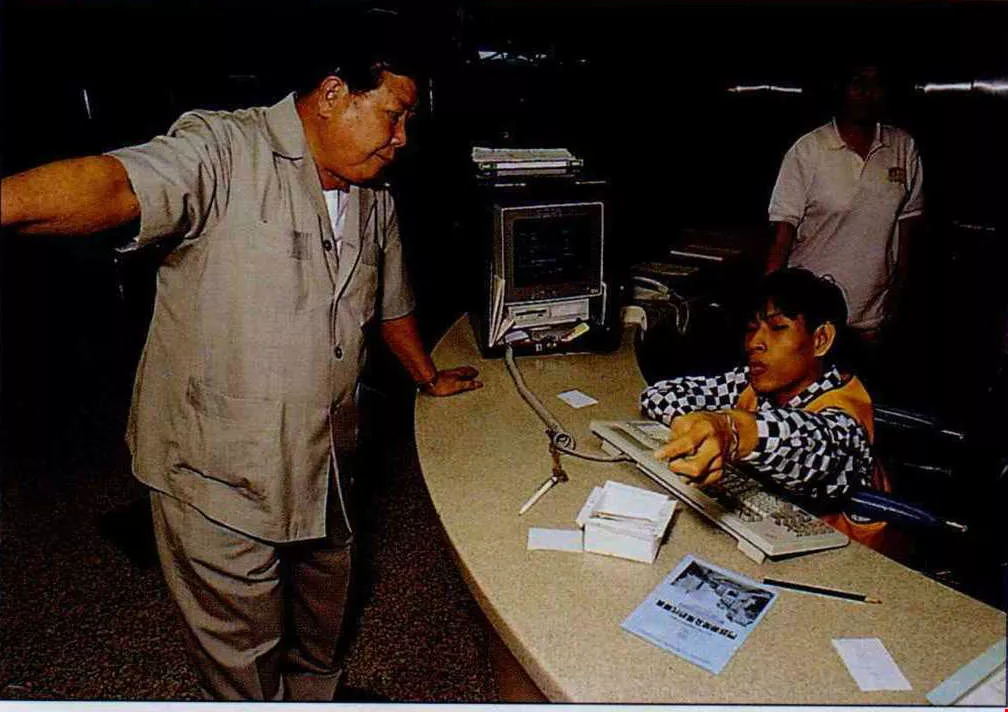
Chung-jen does volunteer work at the NTU hospital information desk. Seeing him searching though the computer for information while speaking with a passer-by, he appears highly professional and confident.
Bury the past!
"Seeing the two of them roaming the hospital every day makes me worried... no that's not it. It makes me very sad," says Dr. Hung Wen-tsung, a pediatric surgeon who was involved in the historic operation to separate the twins.
In fact, it's not that Chung-jen and Chung-yi don't know that there are many problems and personal grudges at the hospital and that relationships made there will be shallow, and that it would be better for them to stay at home and hit the books. But for these two, who have lived on their own since age 17, home is a series of "have nots." There is no mother's love to nurture them, no hot and tasty meals, no well-organized and warm interior decor, no person to tell them what books they should read, and--this for two students of information sciences--not even a personal computer (they don't have the money). For them home is just a place that they want to leave as soon as they open their eyes and don't see again until late at night; it is just a hotel where they crash out. It's no surprise they don't want to stay there.
For the twins, the sentiments associated with "family" are obscure. The topic of "parents" is so sensitive as to be virtually off-limits. Though already a young man, when Chung-jen mentions his mother, he unconsciously pulls his eyebrows together and closes his eyes tightly. Only after a while does he relax and open his eyes, but no sound comes from his lips. As for Chung-yi, his friend Ah Kang says that "it seems like he wants to completely bury the past." And Chung-yi doesn't deny it. What kind of experience have they been through in growing up that has made them so unwilling--or unable--to look back?
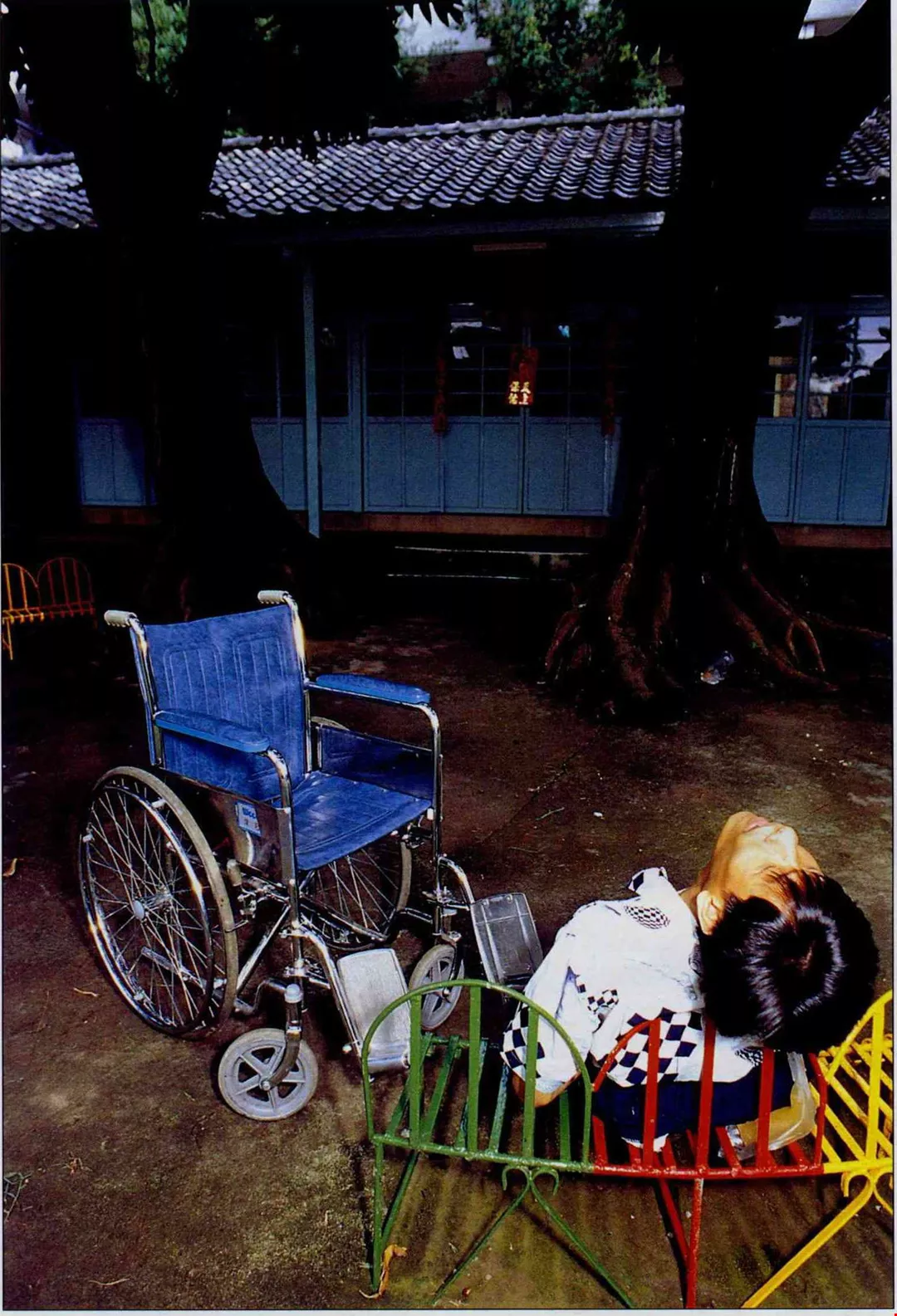
As a result of this story, Chung-jen went back to the Lourdes Home, to which he had not returned in many years. The shady trees seem the same, but what is Chung-jen thinking?
Who can give me a home?
Nineteen years ago, on their second day in the world, these very unusual infants, joined at the body, found themselves being sent from the Kaohsiung Children's Emergency Center (which did not have the facilities for them) to the teaching hospital at the Chung Shan Medical and Dental College in Taichung. Their parents, whose financial position was not good, were unable to travel back and forth, and were unwilling to absorb the enormous costs of their medical care and upbringing, so they declared they were giving up. The twins were released from their parent's embrace and turned over to all of society. Though the surgery to separate them, which came two years later, was a success, they still had serious deformities and they often had to be hospitalized for pain and sickness. They could never stray far from NTUH, much less return to Kaohsiung to live.
It was in these circumstances that NTUH found a place for them to live--Lourdes Home in Tienmu, run by Catholic nuns. There they were cared for by Huang Man-tsu, whom they called "Grandma." Their care-giver looked after them diligently, and Lourdes provided them with a first-floor room so that they would not have to climb to the second floor and be jammed together on a large collective sleeping platform with the other children. But in this environment, mixed in with ordinary children, they faced many frustrations growing up.
Church regulations required that boys leave the home when they reached adolescence, so the twins left Lourdes, where they had lived for eight years, after graduating from primary school. They rented an apartment on their own. They went through a number of live-in care-givers. In their three years of middle school, because of difficulties extending their lease and for the convenience of their care-givers, they changed schools three times and homes four or five times. Of these changes, one was when Chung-yi had major spinal surgery, so it was no longer convenient to climb to the fifth floor of the apartment building. So all they could do was grit their teeth and spend a little more money to rent a third-floor apartment in a high-rise with an elevator.
With frequent changes of homes, care-givers, and schools; the fact that the boys were often absent from school to go to the hospital; and the natural rebelliousness of adolescence, it is not surprising that they had poor grades and behavioral problems.
"For a while somebody would call to complain almost every day. If it wasn't the care-giver, then it was the school teachers, or even some stranger," recalls Hsu Ya-chi, a social worker at NTUH who has seen them grown up and has helped them with problems large and small. Ms. Hsu, who is unmarried and has no children of her own, still has, despite all her efforts on their behalf, times when she is unable to quite get a grip on these two and "I feel like I can't go on working with them."
"Which child isn't rebellious in middle school?" That's how Chung-yi responds to the events of that period. Compared to the other kids in the special class for problem students--who often fought, caused trouble, or took drugs--the stuff they did (skipping class to roam around, occasional trips to the video game arcade or KTV to relax, racing with the busses on city streets) looks tame enough. What's more, that's all in the past.
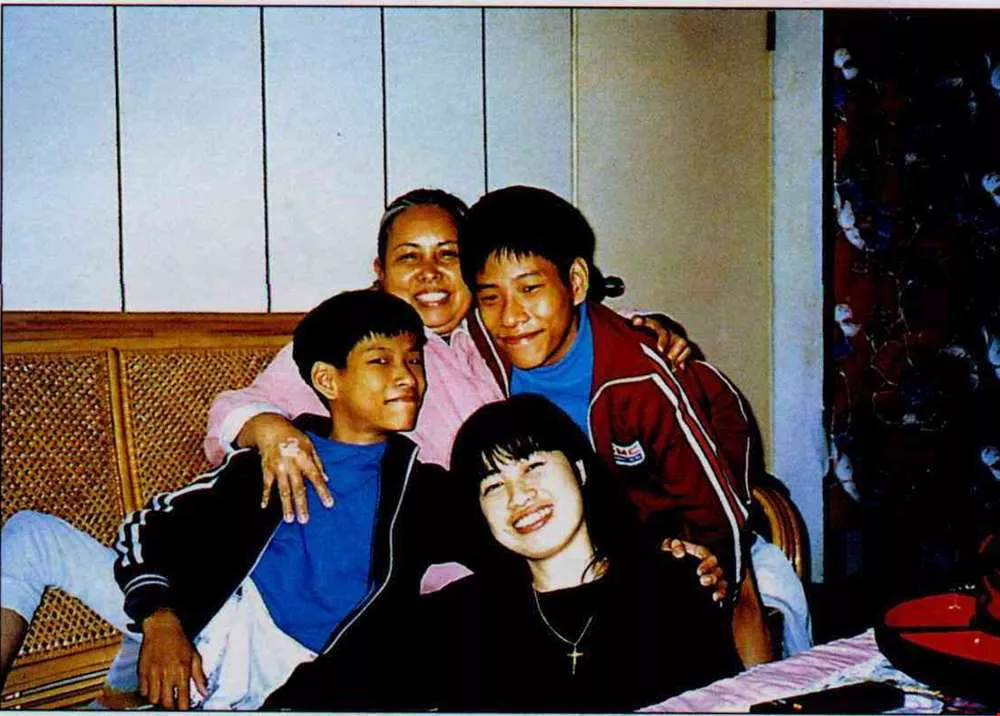
Mama Kao, who looked after the twins for seven years in all, and her daughter. They gave the boys a home-like atmosphere for a time. (photo courtesy of Chung-jen and Chung-yi)
Smoke gets in their eyes
Through it all they have had no one who has remained by their side; people from their past have drifted away like smoke in the breeze.
In the early days, back at Lourdes, there were frequent changes and transfers of the nuns there, so that today neither of the twins can remember any particular nun's name or face. Having been through three schools in three years of middle school, today it is extremely difficult for them to recall any special teacher who made a particularly strong impression. They lost contact with "Grandma" (Huang Man-tsu), who treated them like family. They also had a break with their most frequent care-giver, Mama Kao, who looked after them on and off for seven years, over unhappiness surrounding the breaking of a partnership to rent together. It seems like they have been close to many people in their lives, but upon closer investigation those ties appear fragile. After many short acquaintances, broken off before long, the two brothers have only each other to rely on.
What about their parents? Their mother would prefer not to let anyone know she has any relationship to these two suffering young men. Therefore, if anyone recognizes her, she will take her three daughters (all younger than the twins) and move elsewhere. They have deliberately dropped out of contact. Counting up the days, the last time Chung-jen and Chung-yi went back to see their parents was five years ago. Two years ago, after Mama Kao left, when they looked around themselves the boys couldn't see anyone that they could fully count on anytime they needed to. When ill, they can only flag down a taxi and go to the hospital alone. In the ward, they see family members visiting other patients and bringing them soup and snacks, while the twins have to "persuade" the doctor to hook up an IV so they can get enough basic nutrition. They have really been through the wringer!
Chung-yi's high school homeroom teacher Hsieh Chen-fen makes this heartfelt appeal to their parents. "Please come and see them. If it is too far, then a phone call would be fine. Children need family warmth and parental love." After all, Chung-jen and Chung-yi still face many hurdles in the future. If they lack family support, who will help them when they face danger or are wandering?
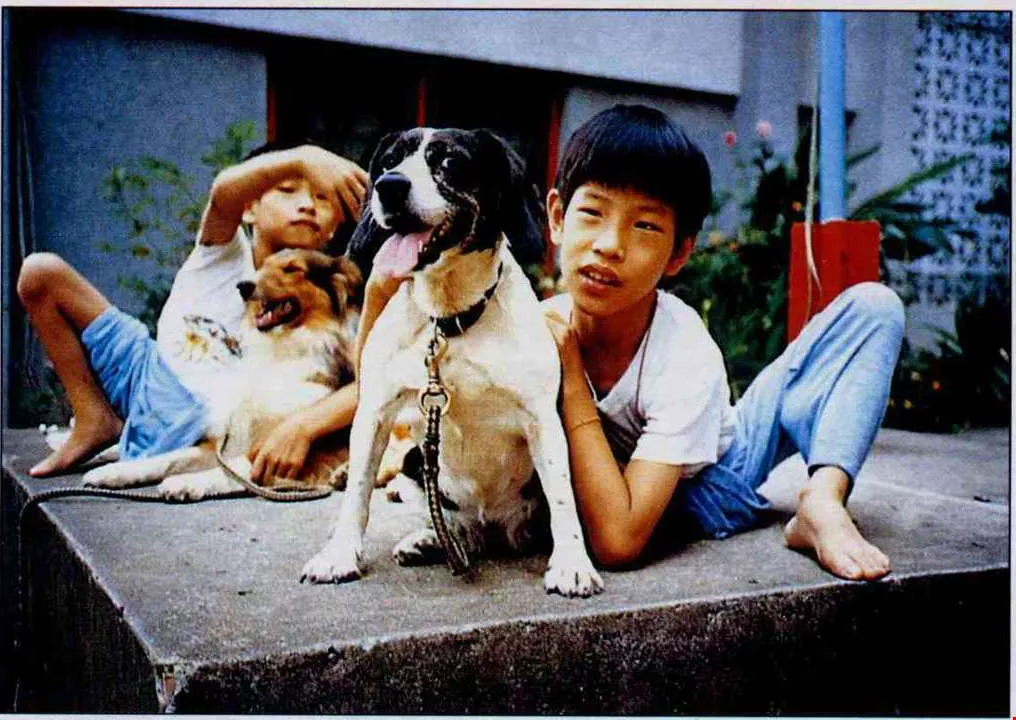
This is how innocent Chung-jen and Chung-yi looked in primary school. It was really hard to tell them apart then, but the older they get the more different they appear. (photo courtesy of Chung-jen and Chung-yi)
Money, money, money!
When talk turns to the future, the brothers cannot disguise the fact that they are at a loss. Right now they are under pressure from their school work, and they often just barely scrape by in their examinations. So the current priority is to graduate. After graduation, given their handicaps and susceptibility to illness, will they really be able to support themselves with what they have learned?
The twins relied on the fund of donations to live. Although even today the odd small donation comes in, there are still medical expenses (especially for the spinal and urinary tract surgical procedures), tuition, care-giver's fees, and other expenses. In the interests of long-term planning, the two understand that they can only draw down this fund very slowly. Of the NT$30,000 per month they get for living expenses, nearly NT$20,000 goes for rent and utilities, so they have to count every penny to get by. Once there was a period when things were really harsh, and the brothers sold chewing gum on the street at the Shihlin night market. For Chung-jen, who knows that his dream of visiting Japan or Hong Kong is far beyond his reach, the future is all about money, money, and money. His fanaticism for "getting rich" is at once entertaining and disheartening.
"Many times I have dreamed that I am like Chow Yun-fat in the movie God of Gamblers. When I come to NTUH to see my friends, I am leading a caravan of long black Mercedes or BMWs stretching all the way from the Chungshan Bridge, and I have a row of bodyguards. Everyone is wearing a trenchcoat and dark glasses. Ah, that would be great! Then we'll see who would dare to mistreat me!" Also a big fan of Jackie Chan (whom, as Chung-jen knows, is very active in charitable causes), Chung-jen has also imagined himself in a movie scene where he is "in a sea of flames, caught in my wheelchair, and Jackie Chan is pushing me out and running for all he is worth!" Who' s to say he wouldn't become an overnight star?
Chung-jen's dreams make one smile. But, even as everyone is praising him for his understanding of the need to repay society with volunteer work, Chung-jen freely admits that his enthusiasm for volunteering is waning. The reason is none other than, "l don't get paid for this. I want a job with a salary."
Employment is one of the biggest hurdles to clear in the future, and another is romance. Chung-yi, who listens without fail to Chang Hsueh-you's "Real Love" every night before going to sleep, seems to get along on a deeper level with women than does Chung-jen, and he has a much stronger desire to find love. Were it not for the cruel practical joke of the Creator, the good-looking Chung-yi would have no problem with this hurdle. But Chung-yi also understands that romance and future prospects are indivisible. "I have to find a job, and then l'm confident I can find a girlfriend" says Chung-yi, who has not dared to go further with well-intentioned girls in the past because "I couldn't offer them any security."
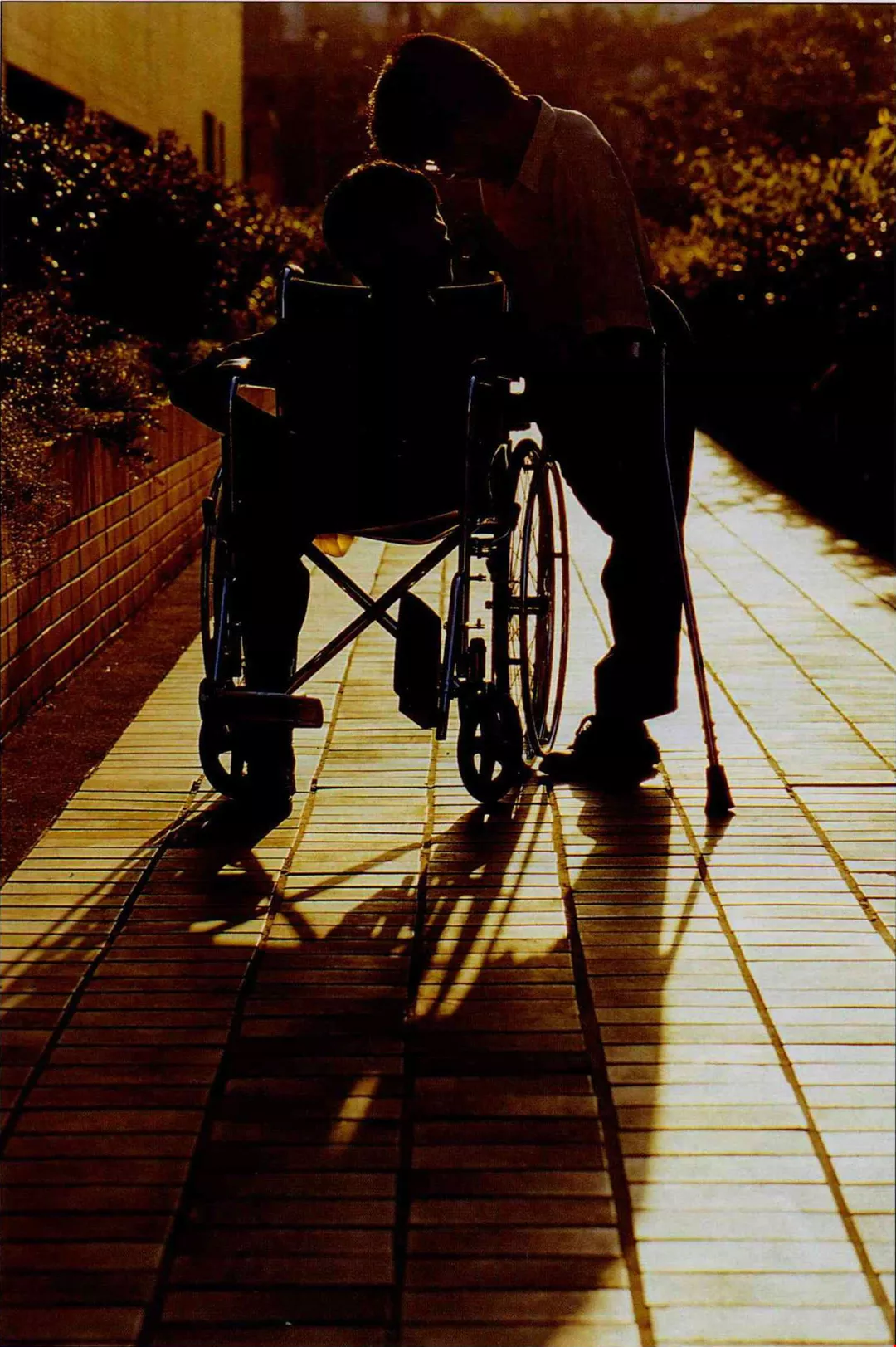
Those close to the twins have scattered to the winds. Now only the two young men are left to look after each other.
Live on!
Twenty-year-olds still have the right to dream. But there is a dark theme underlying the way Chung-jen and Chung-yi think.
"In past conversations, the two brothers would often say in exasperation, 'Why think so much about things, because who knows how long we have to live anyway?' As their teacher, all I can do is teach them to accept reality and adapt to circumstances," says Chang Meng-chia, the head of the Department of Information Science evening division at Hsihu. In particular, whenever pain and illness flood over them, both have at times wondered, "Why did they have to let us live?!" But over time all the pain and frustration have bred thick skins, and anyway they feel that there are still beautiful moments in life worth treasuring.
"Didn't the doctor say that we must accept God's will and not complain?" says Chung-jen, who seems to have come to terms with life.
But for the twins, life and death is not just a philosophical problem; it is a danger they may face at any time. Right now they are ill enough to affect their quality of life, and putting off treatment is not the best option. But should they go under the knife again? lt's hard to estimate the risks. When in a funk, all the brothers can do is to bolster each other's morale: "If one of us cannot go on and departs first, the other must bravely live on!"
Right now perhaps Chung-jen and Chung-yi are no worse off than any other seriously handicapped young people, nor are they more tragic than orphan children. lt's just that, as National Taiwan University president Chen Wei-chao, one of the members of the medical team back then, says: The survival of the twins is the result of the care and concern provided by society. Everyone will have to try harder in order for this achievement to live on and to become even more meaningful. This is a challenge not only to the Creator, but also to humanity.
[Picture Caption]
p.24
Chung-jen and Chung-yi are now young men. The photo of themselves they hold in their hands, taken when they were two years old, was stunning and moving for people in Taiwan, and is now part of the collective memory.
p.26
"Doctor, you've got to do something. If you were me, after five years of pain wouldn't you go crazy?" Suffering from kidney stones, Chung-jen appeals to the physician, who can only make a frustrated face by way of an answer.
p.27
Chung-yi is in the emergency room again. Chung-jen, at his side, occasionally runs to get something, food or whatever, for his brother. The twins have to support each other in whatever small ways that they can.
p.28
Although they are all together only three or four hours a day, the teachers and students at Hsihu High School offer the brothers some warmth and concern. Lu Fang-yu, who is pushing Chung-jen in the picture, accompanies the twins out of school five minutes early every day, and makes sure they get off safely into a taxi before the hundreds of other students pour out and take to their bikes.
p.28
A rare trip to a department store to go shopping and take pictures. Too bad everything is so expensive, so they have to go home empty-handed.
p.29
Chung-jen does volunteer work at the NTU hospital information desk. Seeing him searching though the computer for information while speaking with a passer-by, he appears highly professional and confident.
p.30
As a result of this story, Chung-jen went back to the Lourdes Home, to which he had not returned in many years. The shady trees seem the same, but what is Chung-jen thinking?
p.31
Mama Kao, who looked after the twins for seven years in all, and her daughter. They gave the boys a home-like atmosphere for a time. (photo courtesy of Chung-jen and Chung-yi)
p.31
This is how innocent Chung-jen and Chung-yi looked in primary school. It was really hard to tell them apart then, but the older they get the more different they appear. (photo courtesy of Chung-jen and Chung-yi)
p.32
Those close to the twins have scattered to the winds. Now only the two young men are left to look after each other.


