Crutched Crusader--New Legislator Eric Shyu
Chang Chung-fang / photos Huang Li-li / tr. by Phil Newell
February 1993


During the recent elections for the Legislative Yuan, there appeared one unknown candidate clutching crutches. Some people said that he was "cannon fodder." But when the ballots were counted, he had the highest number of votes in Taichung County.
Eric Shyu, who calls himself the "hobbled Ph.D.," is the first handicapped person ever to enter the Legislative Yuan. That he was able to win with the highest number of votes is even more intriguing.
Ten days after the election, and Eric Shyu is still running himself ragged thanking people for their votes. Besides making the rounds of the constituency in a sound truck, he even visited factories and the homes of neighborhood leaders and key supporters to express his gratitude in person.
All along the route, everywhere he went, some people were moved, others startled, and others delighted. Everyone rushed to make tea to make him feel welcome. After ten days, though Shyu confesses to now being "frightened at the sight of tea," he is very happy to accept the good will of the county residents. When people sincerely congratulated "Legislator Shyu" for winning with the highest number of votes, he would always reply, "I'm called Legislator Shyu in the Legislative Yuan, but in Taichung County my name is Eric."
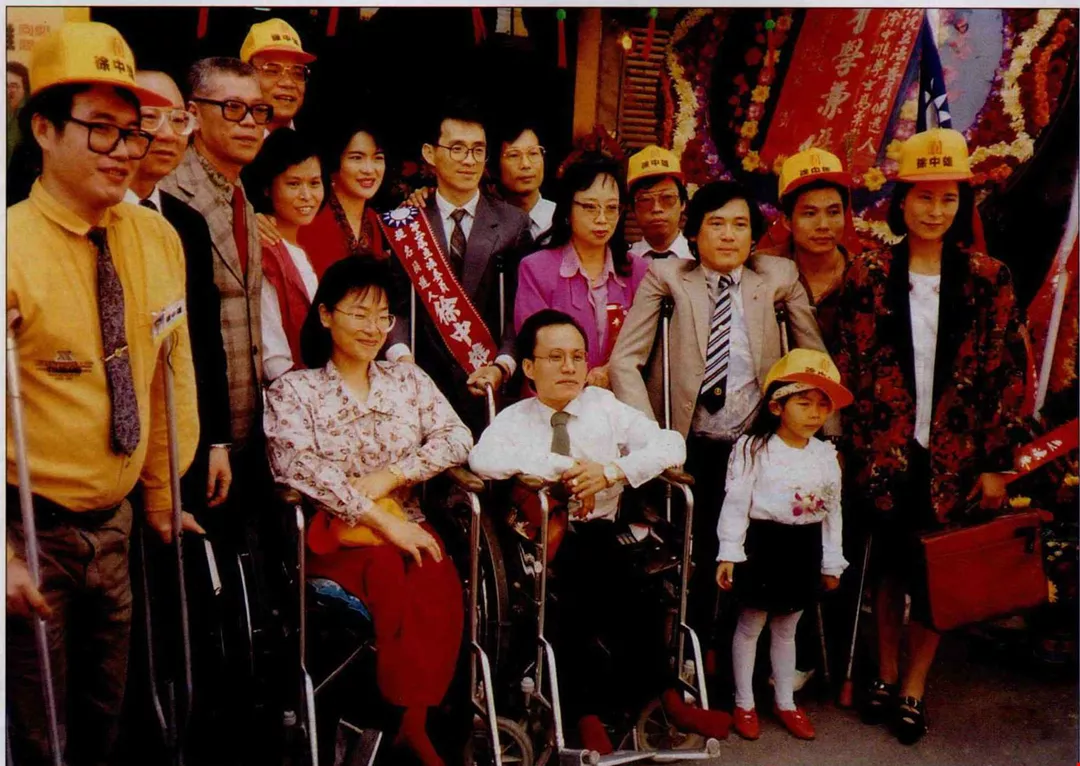
The day the campaign headquarters was set up, advocacy groups for the handicapped came to cheer Shyu on. Many people also volunteered to work, give Shyu and his wife a big morale boost. (photo courtesy Eric Shyu)
Step by step:
Chiang Chun-ming, director of the Taichung County Sheng Hui Association, who stepped forward to work as a volunteer, states that since Shyu had no corporate backing, and no support from local factions, everything he got was achieved, crutches in hand, "step by step."
As his campaign brochure proclaimed, "Walking forward, crutches in hand, full of passion, full of dedication," Shyu walked his way through each one of Taichung County's 21 urban and rural townships, not even missing remote, mountainous Lishan. He held his crutches for so long that his armpits began to bleed, his hands blistered, ruptured, bled, and formed callouses, and he lost six kilograms as well.
The fact of the matter is that at first Shyu had to persist in running for parliament against the opposition of his entire family. At a family meeting, his father asked, "With no money and no influence, how can you run for office?" His mother wondered why he would "give up a safe and stable job to exhaust yourself getting involved in those shady elections." Even his wife pronounced that "having a straightforward personality and not being opportunistic are not advantages when it comes to politics."
Nevertheless, this man who holds a doctorate in the philosophy of social policy for the handicapped--a rarity in Taiwan--did not waver. "It is precisely because I am handicapped that I understand just how important a sound social welfare system is." "Disadvantaged groups need a specialist spokesperson." With a determination based on the idea "if I don't do it, who will?" and with a commitment not to engage in vote-buying, he finally won the support of his family.
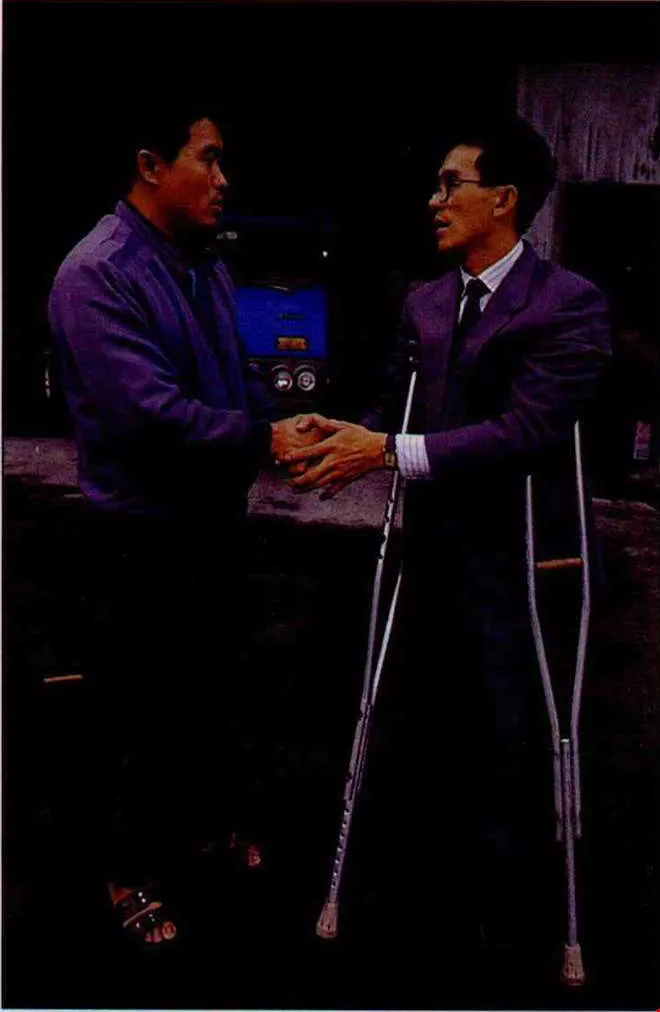
Just having a truck circulating to broadcast "Thank You" to supporters was not enough; Shyu personally visited homes to express thanks to show the sincerity of his gratitude.
Catching frogs, stealing papayas:
Going back even beyond the election, one can see Shyu's characteristic "unwillingness to admit defeat" from his efforts as a child to try everything, to his solo trip to study abroad to his challenging process of courtship and marriage.
Shyu, now 37, is from Fengyuan in Taichung. At two he lost his natural father, and also came down with poliomyelitis. When he was six, his mother remarried; fortunately his father accepted Eric as if he were his own son, so that "if it hadn't been brought up in the campaign material, nobody on Fengyuan Street would have ever known that he was his stepfather." Of course Mother Shyu was delighted at having picked the right guy, but, regrettably, this still couldn't improve little Eric's polio.
In order to help her son learn to walk as early as possible, Mother Shyu suddenly quit her job in the county government. She brought him everywhere for treatment, read up on her own about rehabilitation, and gave him two hours of massage every morning and every afternoon. She put two bamboo poles across a grapevine trellis, getting Eric to walk step by step with the help of steel leg braces. By eight, the child that had crawled along the floor like a "mermaid" was finally walking with the aid of crutches.
Given his family's assistance and their educational method of "treating him as much like a fully healthy person as possible," although the hobbled Shyu knew that he was different from the other kids, he had no sense of inferiority. Mother Shyu laughs that he has been restless ever since he was small. When he saw others playing he would grab his crutches and play along, and it was not unusual to have to change and wash his clothes five or six times in a day. Young Eric also didn't get into any less mischief because of his polio. He did everything: fishing for frogs, stealing papayas, falling into the pig trough, sneaking off to the river to swim, grabbing his crutches to scuffle with somebody . . .
The open and optimistic Shyu says that riding a bike, swimming, or playing ping pong were never too difficult to learn. Unable to join an organized baseball team, he got together the kids in the neighborhood to form a team of their own; he played catcher. "Anywhere someone with two legs could go, I could go too," says Shyu, who walks even faster than an ordinary person. He could even use his crutches to play on the rocks around Tachia River.
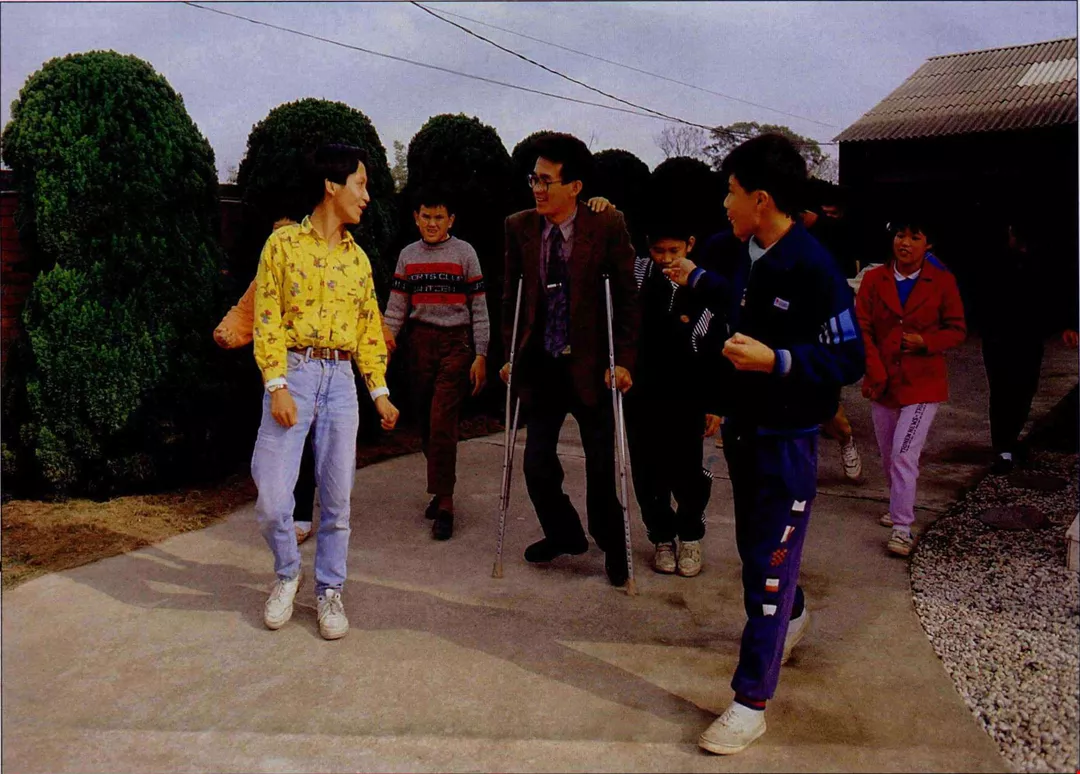
Shyu often goes to agencies for the disabled to walk around. The photo shows a recent visit to mentally handicapped firends at a center in Taya Rural Township in Taichung.
Is it me who's handicapped, or society?
Further, schoolwork never was much of a burden to Shyu. Although he could not have been considered studious, and his grades were only so-so, his passage from primary school to the Mingtao Middle School to Fengyuan High School to Soochow University was smooth sailing all the way. One thing that made him luckier than many others was that his stepfather was a banker, so the family had no financial worries, and thus he met no other major trials in the process of growing up. But the year he graduated from university was his first shock, and a turning point in his life.
"Like all college students, after graduation I wanted to find a job, get married, have a family," relates Shyu. But three or four months down the road, when his classmates had found employment, Shyu was stuck at home feeling increasingly anxious.
Finally, he could only find a job through relatives in a paper factory, working for half a year, completely divorced from what he had studied in school, washing pulp and picking out defective paper.
"Was it really that I didn't have the ability to work and fit into society, or that this society did not have the ability to accept the handicapped?" Having "run into a wall" for the first time in society, Shyu continually reflected, but couldn't figure out what it was that was supposed to be wrong with the disabled. Unable to find an explanation, he finally opted to give up finding a job for the time being, and go to the US for further study, to see whether or not he might be able to find a more open road.
"Eric's grandmother chastised me for being cruel, but I was worried about his future, and anyway couldn't stop him," sighs Mother Shyu. The day Eric left the country, his grandmother kept herself upstairs crying, and when his escort got back from sending him off at the airport, his grandma was still in tears . . . .
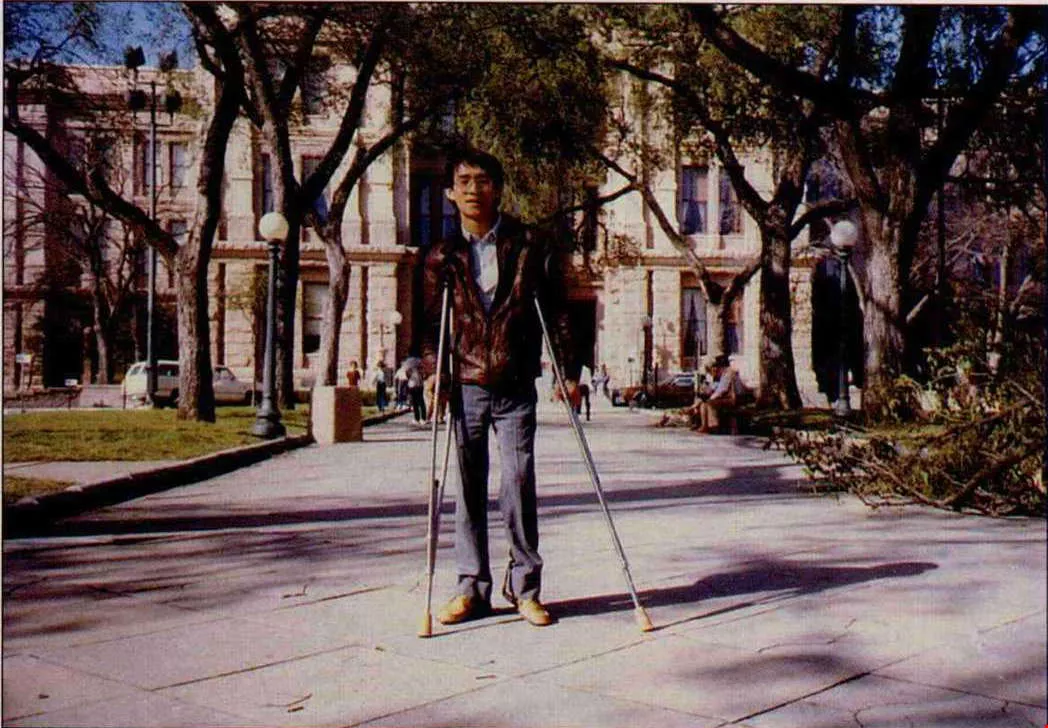
Shyu was very active as a student in the US, even being elected head of the Chineses students' association at the University of Northern Colorado. (photo courtesy of Eric Shyu)
Looking for hope in a distant land:
Because his family had requested it, Shyu first spent half a year studying for an MBA, which "would be better for finding a job in the future." But because it didn't suit his interests, he switched to Special Education, specializing in the severely and multiple handicapped. After studying for a year, he ran into trouble after beginning his practical. The subjects of his practical were two American victims of cerebral palsy. "One was 13, one was 14, and both were taller than me. Every day I had to feed them, change their diapers, clean their behinds, and put them to bed. I didn't have enough physical strength to handle it." Shyu felt this was a serious blow, as his original enthusiasm was fast ebbing away.
With the help of his adviser, Shyu reluctantly completed his MA, but decided to switch to handicapped welfare for his Ph.D. It was only then that he discovered that the idea that most people have that "handicapped welfare" is just "special education" is in fact erroneous. Indeed, handicapped policy has always included education, medical care, employment, and special care for the disabled; special education is just a small part.

Shyu, who places great emphasis on his family life, has been out the door early and home late ever since the election, and hasn't had the chance to enjoy his family in a long time.
Friends, OK, but not for a husband!
While studying for his doctorate at the University of Northern Colorado, Shyu was highly active outside his studies. He participated in many activities, and was even elected president of the Chinese Students' Association. He enthusiastically served as chauffeur, interpreter, host, kitchen helper. . . running all over, a hand in everything. His commitment and enthusiasm attracted the attention of two alumni. One was Huang Kun-huei, currently director of the Mainland Affairs Council, the other was the lovely Sherry Chiu. The former helped Shyu arrange for a suitable post even before his graduation, while the latter, after overcoming many obstacles, became his wife.
In Sherry Chiu's eyes, although Shyu has certain physical problems, psychologically he is much healthier than most people. "He is optimistic, always ready to help others, thoughtful, and determined. He is a person you can trust, you can rely on," says Chiu. Her parents also liked him at first. But when they found out about the emotional tie between the two, they were intensely opposed.
Strange looks from friends and the bitter-end resistance of her parents by no means caused Chiu's heart to waver. But still it was hard for them to win approval for their love. With no other choice, Chiu, who had always been pampered at home, went behind her parents and friends and married Eric. It was only after they had been married a year, and had a son, that they began to slowly win the understanding of the bride's family.
For Shyu, whose married life has been blissful and who now has three sons, looking back over the process of getting married he can't help but sigh, "Other people get to walk this road so easily, but it's been very arduous for me."

He's by no means lonely, but neither is he entranced by popularity and applause. When someone comes along to take his place, Shyu will readily step back.
The hobbled Ph.D. returns home:
In order to put what he learned to good use, Shyu, after studying overseas for seven years and two months, didn't even hang around for the graduation ceremony, but packed his bags the day after his dissertation defense and headed off to Taiwan. A US social welfare agency offered to hire him at US$72,000 a year, but his heart was set on Taiwan. The reason: There are lots of specialists in handicapped social policy in the US, but Taiwan really lacks talent in this area.
Returning home after completing his studies, Shyu clearly understood that foreign ideas are not necessarily suitable for Taiwan. In order to avoid being stuck in the ivory tower, he chose to enter base level service. As a staff person in the Department of Social Affairs of the provincial government, Shyu was responsible for studying and evaluating the specific implementation of welfare laws for the disabled. In his year there, he drove his car 64,000 kilometers, visiting the more than 50 licensed handicapped organizations on the island to understand the situation on the ground.
"Standards are very mixed at domestic agencies for the handicapped," he points out. Among them are some that only know how to advertise, that are run for profit. The supervision of their finances is less than independent, so that the money often doesn't go to those who really need it. Taking one such organization in Taoyuan as an example, its 300-400 patients receive extremely poor treatment, but it receives the most in subsidies. Some well-intended groups have nothing but enthusiasm, and lack specialized knowledge. Although Shyu really wants to help, there is no legal basis for him to do so. As he tells it, because his responsibilities and powers are limited, he can only "observe with my eyes and remember with my heart" all kinds of oversights and unreasonable conditions, but can't really do anything about them.
After switching professions to become an associate researcher at the Taiwan Province Middle School Teachers' Research Association, he had an opportunity to accept a commission from the Ministry of the Interior to participate in the research and drafting of laws and regulations. However, it turns out that welfare for the disabled comes under the jurisdiction of many different agencies: education under the school authorities, medical care under the health agencies, employment under labor bureaucracies, and special care under social welfare agencies.
"Each department only thinks of resolving the problems they face today," says Shyu. This "uncooperative division of labor" severely affects implementation of welfare for the disabled. "Even if today there were a complete set of laws on the books, without some overarching administrative agency, it would be just as impossible to do anything as it is now," he laments.
It was only at this point that Shyu realized that he could only put his ideals into effect by participating in the legislative process, without allowing anyone to short-circuit things. Thus he came up with the idea of running for legislator.
You can't win if you don't buy votes?
But an election is a contest of intelligence, physical durability, and finances.
"I always thought an election would mean big glasses of champagne and banquets," recalls campaign assistant Chiang Chun-ming. "I never expected that over three months I wouldn't touch a drop, and would be eating take-out boxed lunches every day." And Sherry Chiu was often so busy that "I would forget to eat for a whole day."
Even more trying than the physical exhaustion were the malicious, hurtful comments and cold hearted ridicule. One person shouted, "What do you think you're going to do in the Legislative Yuan? How are you going to be able to fight it out with crutches? It'll be hard to even protect your own life!" Others said, "You'll never get elected if you don't pay for your votes." Some even went so far as "Shyu is faking those bad legs!"
Fortunately, there were more people who were encouraging than abusive. Many organizations for the disabled rushed to help this candidate with the clean image and the clear principles. Some people came forward to volunteer; the three-wheeled motorcycle brigade of handicapped groups covered more than 100 kilometers in a single day; and one father of a handicapped child knelt on the ground, appealing to passers-by that Shyu just had to win. One person even brought the title to their home, their ID, and their name chop, and wanted to turn them over to Shyu so he could use the house to cover campaign expenses--and that was the only place that that person has.
With this kind of support pushing Shyu forward, "I didn't know where my voting base was supposed to be, but just kept moving, and slowly people's enthusiasm began to grow," he says.
Although Shyu did not lack for helpers at all sides, none of them had election experience. The campaign headquarters was chaotic, without even a director. After the victory, Chiang Chun-ming presented Shyu with a humorous couplet: "Chaos to the highest point, order in the heart." The matching calligraphy across the top read, "Highest number of votes."
Each vote another expectation:
They didn't know where the votes were supposed to come from before the election, and knew even less about where they came from afterwards. Taking Tantzu for example, it was estimated that Shyu could hope for about 3,000 votes there, but when the slips were counted there were 7,000-plus. In Taichung County, where local political factions are clear-cut and strong, it was really incredible that Shyu, belonging to neither the "Red Faction" nor the "Black Faction," could break through the factions and resist the onslaught of financially well-off candidates.
Shyu is convinced that some of these were "sympathy votes." But "crutches aren't for propping up others' sympathy," he points out. Calling himself the "hobbled Ph.D." shows that he had already accepted his situation, but also shows that he hopes to use his specialized knowledge to give even more disabled people hope, so they can escape from a sense of inferiority and assimilate into society.
Shyu's victory made those who placed their hopes in him even more excited than Shyu himself. Besides being happy that he did not let people down, Shyu's most significant feeling was, "the responsibility on my shoulders is even greater." "It's easy to repay a debt of money, hard to repay a debt of gratitude. With each vote the people gave me, they gave me one part sentiment and one part expectation," explains Shyu. In the future, he wants to repay them with legislative achievements, and he doesn't dare rest for a day.
Promoting social welfare is Shyu's central task. He says that the first thing he wants to do after entering the Legislative Yuan is to see to it that the government sets up a specialized agency for social policy. The second is to promote a comprehensive increase in spending on social welfare, and to oversee the government so that it puts the money where it is needed most. After that he wants to review and study the laws on the people's livelihood. . . .
Over the next several years, there's going to be a "warrior on crutches" in the Legislative Yuan. How will he get his ideals into practice? What kind of report card will he bring home to his constituents? It's all just beginning.
[Picture Caption]
p.44
For Shyu, the end of the election marks just the beginning.
p.45
The day the campaign headquarters was set up, advocacy groups for the handicapped came to cheer Shyu on. Many people also volunteered to work, give Shyu and his wife a big morale boost. (photo courtesy Eric Shyu)
p.46
Just having a truck circulating to broadcast "Thank You" to supporters was not enough; Shyu personally visited homes to express thanks to show the sincerity of his gratitude.
p.47
Shyu often goes to agencies for the disabled to walk around. The photo shows a recent visit to mentally handicapped firends at a center in Taya Rural Township in Taichung.
p.48
Shyu was very active as a student in the US, even being elected head of the Chineses students' association at the University of Northern Colorado. (photo courtesy of Eric Shyu)
p.49
Shyu, who places great emphasis on his family life, has been out the door early and home late ever since the election, and hasn't had the chance to enjoy his family in a long time.
p.50
He's by no means lonely, but neither is he entranced by popularity and applause. When someone comes along to take his place, Shyu will readily step back.


@List.jpg?w=522&h=410&mode=crop&format=webp&quality=80)


@List.jpg?w=522&h=410&mode=crop&format=webp&quality=80)
