Relocating the City in the Sky--Juiyen Finally Gets a New Home
Vito Lee / photos Yu Wen-fang / tr. by Scott Williams
April 2006


Though the memory of the Chichi Earthquake of 21 September 1999 is fading, many people are still hard at work rebuilding their homes. The path to reconstruction has been especially long for the residents of a few Aboriginal villages--the earthquake so devastated the land on which they sat that the villages have had to be relocated in their entirety. Six years after the quake, these projects remain incomplete.
Juiyen Village, located in a remote mountainous section of Nantou County's Jen-ai Township, is a case in point. Villagers have been bitterly disappointed by the extent to which this project in the "City in the Sky"--the legendary birthplace of the Atayal people--has been constrained by geographic and human factors.
Through the collective effort of a number of groups, Juiyen's new infrastructure was completed in 2004, and work on the village's relocated housing finally got underway at the end of 2005.
After all these years, the people of Juiyen can see the light at the end of the tunnel. But further difficulties await. Though the ground has now been broken on their new homes, the efforts to reestablish their society and culture are only just beginning.
The winter sun may not be strong enough to drive the chill from the mountain air, but that doesn't stop Tiemu and his neighbors from having their breakfast outside. This morning, the mountain village of Juiyen looks peaceful and content, like a veritable utopia.
On Tiemu's lawn, some people are getting a fire going and passing around stools. They clean three fat river fish, rub them with salt, and grill them, washing the fish down with mouthfuls of Whisbih, a tonic drink. When they spot a new face, they warmly invite the stranger to join them.
After polishing off the meal, most smile contentedly or begin humming a song. But the 52-year-old Mrs. Ku is deep in thought. "There's a groundbreaking ceremony today," she says, "and I don't know whether to go. If I go, I won't be able to go to work in the cabbage fields. That's NT$1,000 I won't earn."
"Of course you're going," says the youthful Tiemu. "You have to sign your contract yourself." Though Tiemu is one of the few villagers who isn't taking part in the relocation, he is very familiar with this morning's groundbreaking and with the contract-signing ceremony. "If you don't go sign the contract," he reminds his neighbors, "you won't get a home to live in."
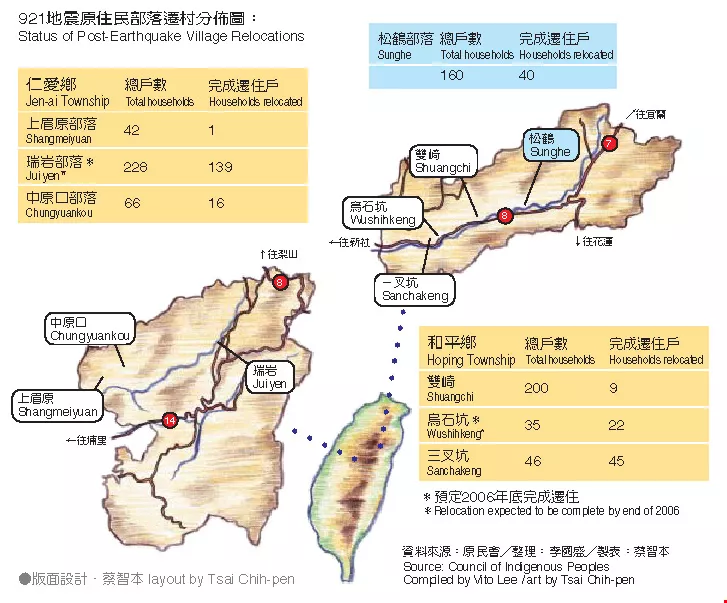
Status of Post-Earthquake Village Relocations / Source: Council of Indigenous Peoples / Compiled by Vito Lee / art by Tsai Chih-pen
Glimpsed through the clouds
Taking the Puli exit from Provincial Highway 14, we pass through Wushe and catch sight of the renowned Ching Jing Farm just ahead. Just before the entrance to the farm's busy guesthouse area, we make a quick left onto Lihsing Commercial Road, the only road to Juiyen. Though the driver of the minivan immediately slows down, the frequent scraping of the van's chassis against the rough road sends jolt after jolt through our hearts.
Even in the relative dryness of winter, this is a dangerous road. Landslips and rock slides are problems, as are the ruts worn through the asphalt into the black bedrock beneath by the many fruit and vegetable trucks that have driven it over the years. "It's even worse in summer, when there's a lot of rain," says Huang Mei-ying, a lecturer in the history department at National Chi Nan University who often visits Juiyen. "This road is never in good shape!"
But the hazards of the road don't keep the village's sons and daughters from returning home for the groundbreaking ceremony. As their cars snake single file across the last winding stretch, their faces are glued to the windows, looking down at their city in the sky, their mist-shrouded mountaintop home, from the vantage of the road.
Bounded by rivers on its southeastern and northwestern sides, Juiyen arises like an orphan isle. When seen from a distance, the metal rooftops and green trees that top this rise make it look like a city in the clouds. But the village's peculiar and precarious topology caused great suffering for its 228 households during the Chichi Earthquake--the village's only elementary school and eight homes were utterly destroyed, 15 homes were partially destroyed, and eight people were killed.
After the earthquake, the Council of Indigenous Peoples (CIP) asked a team from National Cheng Kung University's Disaster Prevention Research Center (DPRC) to inspect the village. The DPRC report stated: "From a long-term perspective, the village's marginal slopelands have been steadily collapsing, whether because they have been undermined by the rivers or for other reasons. As a result, the lands on which it is permissible to build have been getting ever smaller. Over time, every structure in the village will be affected. It is therefore necessary to relocate the village." The team also recommended that the CIP assist the village in moving.
There are several other villages in the mountains of central Taiwan that are similarly facing relocation. In Nantou County, these include Jen-ai Township's Shangmeiyuan Village and Chungyuankou Village, and Hsinyi Township's Tannan Village. In Taichung County, they include three villages in Hoping Township--Shuangchi, Wushihkeng, and Sanchakeng.
But Juiyen, with more households than any of these other villages, is the largest of the post-earthquake relocation projects and faces topographic constraints which have made the construction work difficult and very expensive. This morning, after six long years, ground is being broken on 139 homes, and residents are at last beginning to see the light at the end of what has been a very long tunnel.
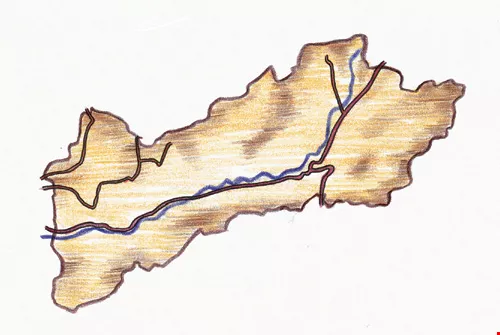
Status of Post-Earthquake Village Relocations / Source: Council of Indigenous Peoples / Compiled by Vito Lee / art by Tsai Chih-pen
A scarred village
After seeing his neighbors off, Tiemu picks up a two-meter-long hunting gun and heads into the mountains to hunt. In contrast to the low, wooden, metal-roofed houses typical of the village, Tiemu's home is a brand-new concrete structure. "Tiemu's family used to have it tough," says Chen Li-chun, Tiemu's wife and a fellow Atayal. "He spent many years driving a backhoe to earn enough money to build this house. His father died in this house, and recognizes it as his home." (Traditionally, Atayal were buried in their family home when they died. Though this is no longer the case, ancestral spirits are still believed to stay with and protect their descendents.)
"Juiyen is shaped like a tennis racket," says Chen. "We live in what would be the racket's grip, where it's higher."
Their new home is still in good shape and they are very attached to it. Tiemu, who is known as Wang Ching-kuo in Mandarin, rejected the offer to exchange it for another piece of land and decided to remain where he was.
"For both sentimental and practical reasons, the decision to move isn't an easy one," says Reverend Lin Te-chuan, standing in front of the village's recently rebuilt Presbyterian church. "When villagers were confronted with the government's decision to relocate them after the quake, local opinion was very divided."
To build a consensus, Juiyen formed a relocation committee that communicated with villagers and functioned as a conduit for dialogue with the government. "There were people who said, 'Anyway, Chichi-type earthquakes don't happen often!'" recalls Lin, who was himself a member of the committee.
After the quake, the county government sent people to the village to reinforce damaged buildings. Much of the village now looks as it did before the quake, and children are once again able to dart through its narrow alleys and lanes without supervision.
But the village has not been maintained. Much of it is aging, and flies and bugs are everywhere in the summer. Even prior to the quake, the village's quality of life had been deteriorating.
"Everyone knows in their hearts that the quality of life in Juiyen isn't good," says Lin. "Moving to a lighter, more open environment would be a good thing. What those who oppose the move are really worried about is money!"
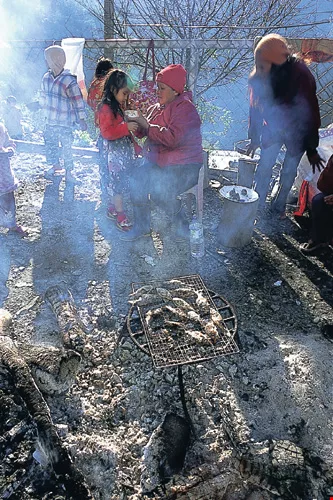
Barring natural disasters, life in Juiyen is cosy. Nestled in the mountains' embrace, residents enjoy grilled fish for breakfast under the blue sky.
The torture begins
Once the villagers were sure that the government was going to pay for the move, the number of people making the decision to relocate to the new village and signing letters of intent to that effect grew rapidly. Tiemu's family and some others aside, around two-thirds of the village's 200-plus households agreed to the move. At this time, design teams brought in by the township administration began working on a series of blueprints aimed at making a better future for the people of Juiyen.
The new home of the villagers' dreams began to take shape. It would be safer, more open, comprehensively planned with an underground sewer system, a police station, an events center, a new elementary school, and even a waste treatment plant, something Juiyen had previously lacked. The new Juiyen would be more than eight times as large as the old one, and each household would have at least 150 square meters of space. In the minds of residents, the "City in the Sky" was becoming a fairytale "castle in the clouds."
It was only after signing the letters of intent that residents began to learn of problems.
"At the outset," says village chief Tseng Chen-chung, "everyone was hoping to build a large home. But when we added up the numbers, we discovered that after you accounted for the NT$750,000 to NT$1 million in assistance from the government and the 921 Earthquake Reconstruction Foundation, each household still needed to come up with about NT$1 million on their own, an amount which would all have to be borrowed."
But these are people who, by and large, make their living from casual labor and farming. They couldn't even offer their land as collateral because most of it is slopeland that the banks consider worthless as security. They were cold-shouldered again and again.
But the need to themselves raise money to rebuild their homes wasn't the only problem. The government was also encountering problems with its requests for bids on the infrastructure projects. The bidding failed four times due to the difficulties involved in transporting materials and actually carrying out the work. Even after a bid was opened, the contractors were a mixed bag. Unable to coordinate their progress with one another, the work progressed very slowly.
Later, there was the corruption case involving Chuo Wen-hua, the head of Jen-ai Township. "Kuo-teng Construction, which had originally been overseeing the new village project, was also involved," Tseng explains. "The county government cancelled the contract and reopened the bidding, which was another major reason the work took so long."
"Looking back on it," says Tseng, "it really was a nightmare. On top of the cost and contract problems, we were hit with a barrage of natural disasters."
Portions of the Lihsing Commercial Road were washed out by flooding from Typhoons Mindulle and Aere in consecutive years. When international steel prices shot up in 2004, contractors began to fear default penalties and avoided taking on what they viewed as money-losing projects in Juiyen.
"It was at this point that residents realized that their visions for their new town had been so much pie in the sky," says Hsieh Chih-cheng, executive director of the 921 Earthquake Reconstruction Foundation. Hsieh says that as the relocation work on the neighboring Shuangchi and Sanchakeng Villages was completed and the huge Chichi Earthquake disaster area began to look like its old self again, residents of Juiyen were stuck waiting.
In September of 2004, Hsieh requested that his foundation become actively involved in Juiyen's relocation.
"In Taiwan," says Hsieh, "when you mention projects, what people think about is the distribution of profits. We didn't have a lot of experience with this kind of thing, so at the outset, we really weren't clear about what kinds of problems we'd face. But when we saw the problems Juiyen was encountering, I began talking to the chairperson of our foundation about changing our position from one of providing financial assistance to one of being actively involved."
"The 921 Earthquake Reconstruction Foundation's involvement was crucial in bringing the Juiyen relocation project back from the dead and turning it into a success," recalls CIP minister Walis Pelin.
The foundation again gathered and assimilated the opinions of the villagers, covered the funding deficit, served as a guarantor for loans to the villagers, and, finally, assisted the village's relocation committee in issuing a request for tender.
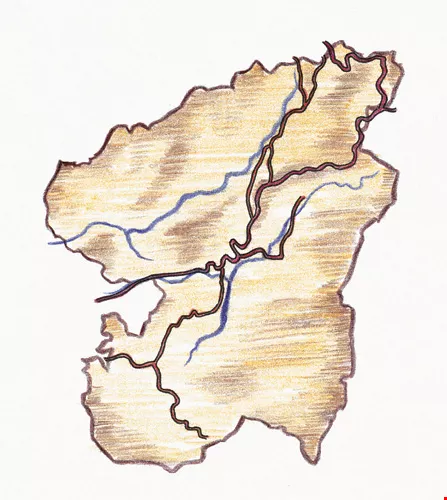
Status of Post-Earthquake Village Relocations / Source: Council of Indigenous Peoples / Compiled by Vito Lee / art by Tsai Chih-pen
Adjusting the pace
"The village relocation policy currently being implemented by the government operates on two key principles," says Huang Jung-te, who has been head of the Construction Section of Nantou County Government's Bureau of Aboriginal Affairs since 2002. "The first is, 'give money but don't be responsible for the construction of homes.' The second is, 'handle the acquisition of land and homes through market mechanisms.' But this approach to assistance has proved difficult with indigenous peoples."
Building a home takes money. In urbanized areas, people must usually use land or another building as collateral when applying for a loan. But banks won't accept the mountainous lands on which indigenous peoples typically live as security on a loan, and locals have nothing else to offer. "In addition, the current rules on housing assistance funds require that new homes must have been completed and passed an inspection before assistance funds can be disbursed," explains Huang. "If you have no money of your own, you can't build a home, and therefore can't apply for assistance funds."
Once the foundation became involved, the funding deficit was resolved and contracts were signed. Housing reconstruction officially began at the end of 2005. The project has not been cheap. Given the NT$180 million outlay for the housing project, the NT$200 million cost of the infrastructure work, and the additional future costs for road work, more than NT$2.5 million is being spent on each of the 139 families that is moving. "There's no denying this is an expensive investment," says Hsieh.
"Fairness dictates that we can't give them additional assistance because Han families that suffered as much from the disaster aren't getting any," says Hsieh. "However, if you recall that NT$30 million won't build even half a bridge in the mountains, but can provide 139 Aboriginal families with homes, the amount starts looking more reasonable."
Building on this idea, the villagers, the township administration, the county government and the CIP gained new momentum and were ultimately able to hold last December's groundbreaking ceremony.
After the excitement of the ceremony passed, life in the old village returned to normal. In contrast, the site of the new village began to bubble with activity as building supplies came pouring in.
Construction is expected to be completed by April. The walls of the new homes, which will be Western-style single-family and semi-detached houses, will be made with locally sourced materials, primarily wood and bamboo. The use of angled roofs and diamond-shaped designs basic to Atayal arts will give them a strongly indigenous feel.
The new village is three kilometers from the old, so the casual work in the nearby orchards and fields which is the villagers' economic lifeblood should be largely unaffected. As for the village's viability, in addition to the infrastructure that has already been completed, the construction of a large dual-use residential-commercial building for residents who previously owned shops should ensure commerce also continues.
Right now, the only signs of life in the still officially unfinished new village are the sounds of recitations and laughter from the children at the school.
Fahsiang Elementary School, Juiyen's most advanced educational institution, was moved to the new village in November 2004. Portraits of hunters with bows and arrows hang from walls decorated with traditional Atayal rhomboid patterns.
The three-kilometer stretch of road separating the old village from the new is steep and crosses a stream. For adults with their own vehicles, it poses no problems, but parents were worried about children walking it to get to school. When the school was relocated, the staff worked with the parents' association to arrange for a nine-seater van to shuttle the children to school every day.
"Life will be easier for everyone once the whole village moves over by the end of the year," says Chen Li-chun, who teaches at the school.
Though Chen is one of the few residents who isn't moving, her work places her squarely at the forefront of the effort to preserve the village's social and cultural cohesiveness after the move. Singing softly, she leads the children through the weaving song left to them by their ancestors. "We just learned this song from the village elders," she explains.
Lin Te-chuan, who has long been a leader in the village's search for its roots, hopes that the villagers will be able to recover their gaga--their traditional social mores and their relationship to the natural world--in the new village.
"For a place like Juiyen, which is almost entirely Atayal, the gaga code is probably a good starting point," says Chen Mau-thai, a research fellow in the Academia Sinica's Institute of Ethnology. "Gaga represents the village's collective wisdom. It is especially important when facing a major change, such as a relocation. Ultimately, relocating isn't just about people and goods. It also involves moving the culture, the village social structure, and the social bonds."
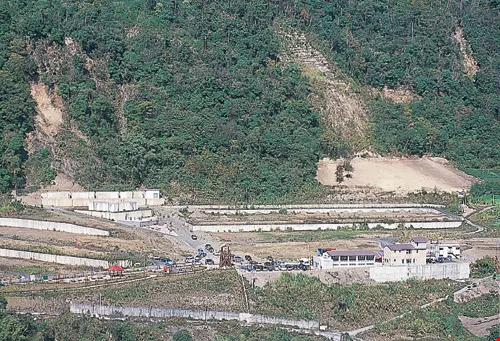
Initial work on the new Juiyen, which is to be located on a ten-hectare site on the terraced bank of the Peikang River, was completed some time ago. The building in the lower right of the photo is the long-since-completed village administration building.
Hopes emerge
Standing by her home in the old village, 75-year-old Chang-Yang Ah-mei gazes towards the new village at the foot of the mountains. She has many childhood memories of the river terraces on which her new home will be located.
"My parents and grandparents originally lived at the foot of the mountains [at the site of the new village]," explains Chang-Yang. "Later, the Japanese moved them over here because it made it easier to administer them."
"Like many Aboriginal villages," observes Lin Te-chuan, "Juiyen was relocated twice, once in the Qing dynasty and once during the Japanese occupation. They've been through this before."
Decades ago, Japanese colonists forced them to relocate their village. Now, natural forces are compelling them to move back.
"Having twice experienced the agony of relocation," says Huang Mei-ying, "indigenous people have serious misgivings about moves made at the behest of national authorities."
But this isn't Chang-Yang's only misgiving as she gazes towards the site of her new home.
"The village's gaga says that moves must be to higher ground," explains Chen Mau-thai. "Otherwise, inauspicious things will happen. Will the current move to lower ground have a psychological impact on the elderly? We have to be alert to this."
On the other hand, who knows if this elderly woman is thinking about her ancestors' gaga as she watches the trucks traveling in and out of the work site?
The only thing we can be sure of is the smile that plays around the corners of her mouth. For her and most of Juiyen's people, their long wait has finally become the prospect of a brighter future.
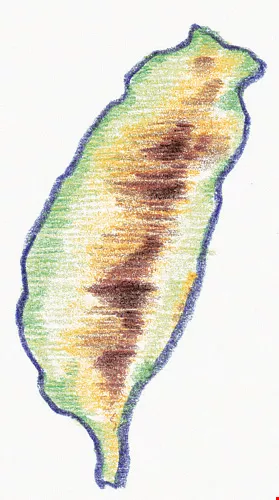
Status of Post-Earthquake Village Relocations / Source: Council of Indigenous Peoples / Compiled by Vito Lee / art by Tsai Chih-pen

Many in Juiyen earn their living through casual farm labor. Given that the village's new location is close to the fields, their livelihoods should be unaffected.
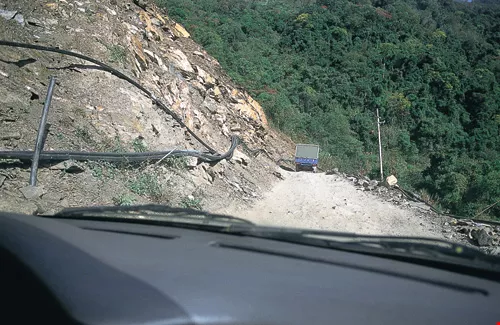
Even during the dry season, the fragile topography of the only road to Juiyen makes for a frightening ride, as the view from the driver's seat makes plain.
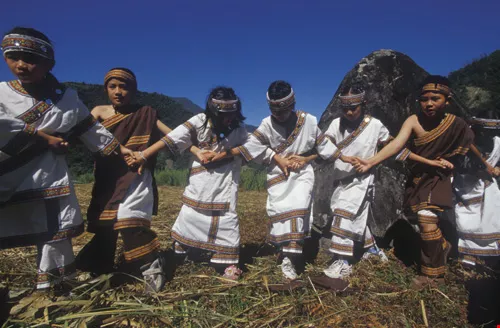
Legend has it that the Atayal people originated from an animate stone located on a plateau near Juiyen. The legend adds an air of mystery to this mountain village, which holds an annual dance festival honoring its ancestral spirits.
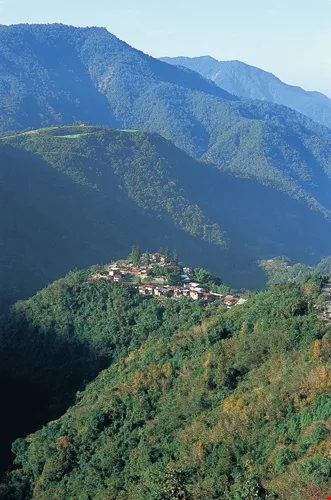
Barring natural disasters, life in Juiyen is cosy. Nestled in the mountains' embrace, residents enjoy grilled fish for breakfast under the blue sky.
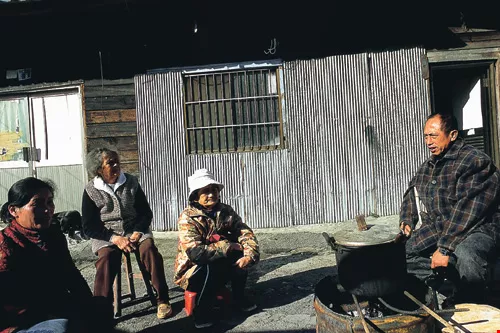
Rebuilding personal relationships is one of the important tasks associated with the relocation of the village. After drawing lots for the location of their new homes, villagers were allowed to swap their locations with one another to enable old neighbors to continue living next to one another. In the photo, villagers chat in front of their old homes.


@List.jpg?w=522&h=410&mode=crop&format=webp&quality=80)


