New Ideas for Senior "Homes"
Chang Chiung-fang / photos Chuang Kung-ju / tr. by Anthony W. Sariti
December 2004


In late October more than 300 senior citizens, with an average age of 80, enthusiastically participated in celebrations marking the eighth anniversary of the Ruen Fu Newlife Vision senior community, the famous upscale retirement facility in Tanshui Township that they all call home.
In December the first phase of the Chang Gung Health and Culture Village located in Kueishan Rural Township, Taoyuan County, will be completed, and already more than 380 units of a planned 706 have been rented out.
In recent years there has been a great upsurge in rental retirement homes targeted at healthy seniors who can "live independently." Added to this has been a government policy of encouraging private-sector investment, all of which has led to an explosion in the retirement industry.
As private-sector investment in the elderly care market comes into full bloom, there is a rush to build retirement homes all over Taiwan. As for seniors, does living one's golden years in a retirement home mean a life of ease and comfort-or is it done out of necessity? The issue of retirement living in an aging society is tied to the future of each and every one of us, and is well worth taking a good look at.
Some say the young seniors in their sixties today represent the "last generation of filial children," yet the "first generation of 'abandoned' parents."
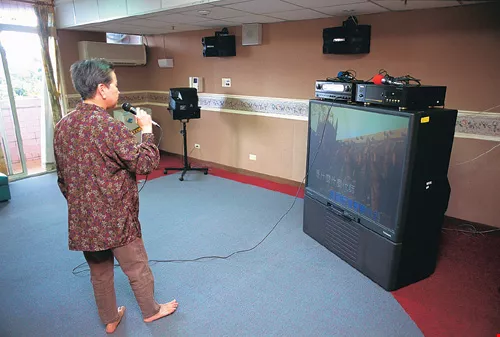
An elderly lady passionately sings out the lyrics from "The Past Can Only Be Remembered" in the karaoke room. With her soft and plaintive voice, she's the equal of any professional singer.
Abandoned? Take care of yourself!
According to a Ministry of the Interior (MOI) survey made in 2000, almost 70% of Taiwan's elderly think the ideal retirement life is to live with or close by their children. Only some 5.2% favored living in a social welfare facility.
Although living in old age with one's children remains the ideal, today, when the small, two-generation family has gradually become the mainstream, the two-income family is becoming increasingly common, and the number of children who study abroad, work abroad or emigrate is growing, many people in their twilight years must contemplate another approach to life in retirement to avoid living alone with no one to care for them.
Currently Taiwan has an elderly population of some 2.07 million aged 65 and over. Of that figure 30%, some 600,000, live alone or with their spouse. Add to this those 50- to 65-year-old "potential future consumers," and the market demand for senior housing is truly quite large. However, hindered by the traditional idea of filial piety, economic circumstances and quality of care concerns, it is not at all certain that these elderly will choose to live in a retirement home.
A survey by the MOI's Department of Social Affairs showed that in 2004 there was an elderly housing demand of 7,361 persons, but the number of units offered by both public and private sources fell far short of that mark, with places for only 1,545 people available. The government is hoping the gap will be made up by encouraging increased private-sector participation.
In May of this year the MOI published a plan to encourage the private sector to participate in the construction of senior housing, and included senior housing in the category of major public infrastructure projects. With an investment (exclusive of land) of NT$150 million, a private investor is qualified to apply for a number of tax incentives, like a reduction or elimination of corporate income tax.
After the plan was approved it elicited a great deal of public interest. In addition to Chang Gung Health and Culture Village, already under construction, immediately changing its design to dovetail with the regulations, West Lake Resortopia in Miaoli and the Sunlife Group cooperated to build a health center with 780 residential units occupying 50 hectares, and the Chi Mei Group is planning a "Youlan Mountain Lodge" in Tainan. All of these projects can look forward to benefiting from the preferences the law allows. In addition, the Shin Kong, Cathay and Fubon groups have all announced plans to invest in the senior housing industry.
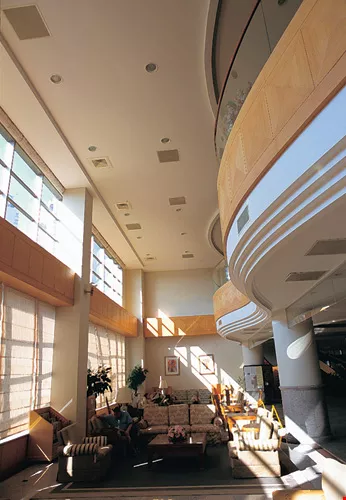
Ruen Fu Newlife Vision Initial residency conditions Over 50 (spouse any age), able to care for self Guarantee deposit NT$5 million (50 m3 unit); NT$8.5 million (80 m3 unit); NT$10 million (100 m3 unit) Management fees (monthly) NT$9720 (single); NT$16,200 (double) Meals NT$5400/month Mains services Approx. NT$2000/month Contact tel. no.(02) 2629-9000
Enjoying a five-star hotel
Nevertheless, even without government encouragement, the trend toward building homes for the elderly is inexorable. With the transformation in social and family structures, senior care has been moving from "family care" to a "caring (surrogate) family" and seems the only choice there is.
The Ruentex Group is the first company in Taiwan to enter the retirement housing market for healthy seniors.
In 1991 Ruentex worked with Japanese construction company Nakagin to propose a housing complex for middle-aged persons and seniors by the scenic mountains of Tanshui. However, due to a variety of reasons such as a high sales price and the fact that the senior housing market had not yet taken off, sales did not meet expectations and only five units were sold. At that point Ruentex bought the units back and turned the entire complex into rental units.
At Ruen Fu all meals and housework are done by service personnel. There is also a central system for monitoring the safety and physical health of the residents. This is all very costly, but as incomes rose, seniors gradually opened up to the idea of independent living, and after two years of operation, rentals soared across the board. Except for ten guest units that have been reserved, the other 300 units are 99% rented out.
Once they broke through the general stereotype of a retirement home as a place that was "like a sick room," "full of the smell of urine" and a "home for the poor," Ruen Fu Newlife Vision went all out to make the rented senior home into an upscale hotel and successfully turned the concept of living in a senior home from one where seniors felt "abandoned by children and having no other choice" to one of a "reward" they gave themselves for a lifetime of hard work.
"The vast majority of retirement money of the residents comes from their pension or savings," says Huang Ping-fu, deputy general manager at Ruen Fu Newlife Vision. As for the residents themselves, they come from all walks of life. There are retirees from the National Assembly, the Legislative Yuan, and retired high-ranking military officers. There are doctors, professors, lawyers, artists, writers, and popular movie stars. There also is the widow of Wu Ching-hsiung, JD, who describes the residence as an "institute of elderly wisdom."
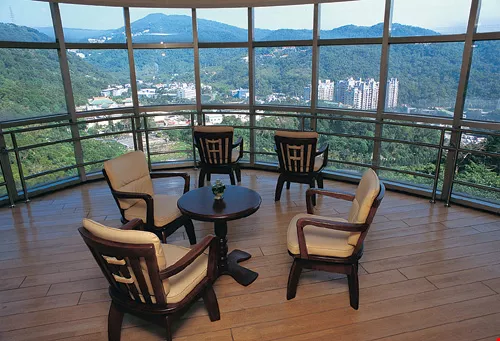
Zhi-Shan Residential and Nursing Home (retirement section) Initial residency conditions Over 65. Resident in Taipei City at least one year. No psychiatric illness or infectious diseases. Guarantee deposit NT$60,000 (single); NT$90,000 (double) Management fees (monthly) NT$23,600 (single); NT$33,200 (double) Mains services Separate charge Contact tel.no.(02) 2883-2666 ext. 100
Crisis of old age
"The service personnel here treat us like elder members of their own family. They work hard at pleasing us," says Mrs. Wu, a two-year resident. The head nurse in the health unit is on call 24 hours a day. When a resident is sent to the hospital, even the director of the facility accompanies him or her. This sense of respect and care felt by the residents is excellent. Every day at noon Mrs. Wu dresses neatly as if she were a guest and goes down to lunch. In the afternoon she plays a bit of mahjong with her fellow students at the institute. For dinner in the evening she boils up some noodles in her room and thus brings an end to a peaceful and enjoyable day.
In June 2004 well-known writer Chi Chun and her husband Li Tang-chi returned from New Jersey in the US to retire in Taiwan. Chi Chun and her husband spent 20 years in the US. It wasn't until recently, well up in years, and with some health problems, that they began to experience the "crisis of old age." Li Tang-chi says when he was in the hospital with a gastric hemorrhage, it was hard for Chi Chun to get around because of her artificial joints, and it was even difficult for her to get out of the house to get something to eat. Economic considerations led to a decision to return to Taiwan to be among well-loved friends and surroundings.
In addition to Newlife Vision, Ruen Fu is promoting a three-generation residence "for all ages" at Great Taipei New Town in Hsintien. Huang Ping-fu says that at the moment there are only a few dozen seniors and their families living there. After the kids go to school, the seniors feel somewhat lonely, not like in Tanshui where there are many seniors and activities and things are more lively.
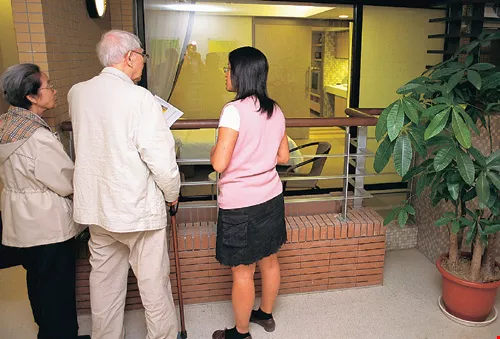
A continuous stream of people visit the Chang Gung Health and Culture Village's show apartment. The senior housing market should not be underestimated.
Shangri-la
Compared with the scale of the Ruen Fu Tanshui facility and the services available there, the Yang-Ming Senior Citizen Apartments located on Yangte Boulevard in Yangmingshan is a retirement home more for the ordinary citizen.
Begun in 1998, these apartments are government owned and privately operated. There are currently 85 residents, two-thirds of whom are not native Taiwanese. The residents are primarily retired military, civil servants and teachers, with a small number of unmarried veterans.
The costs at Yang-Ming are low, and those who qualify as low-income residents even receive a 20% discount. Even more special is the fact that it is located in scenic Yangmingshan, where the air is fresh and pure. The apartments are bright and clean and well equipped. The nurses, social workers and nutritionists all have a friendly and kindly attitude, always referring to residents as "grandfather" or "grandmother."
"Yang-Ming is an 'intentional family' organization centered on the senior citizen. Whether it's spiritual or material needs, we all hope to create a feeling of family," says director Tsao Szu-mei. In this atrium style building each resident has a balcony and each room opens onto a courtyard. Each floor has its own parlor and lounge area, and there is a great deal of interaction among residents.
Almost all the residents at Yang-Ming are there because their families were unable to care for them. Pan Wen-chi, the deputy director of social services, points out that although some seniors arrive somewhat unwillingly, being with friends of the same age is better than living a lonely existence at home. Most residents grow fond of living at Yang-Ming once they spend some time there.
Eighty-six-year-old Chen Jui-ho has lived at Yang-Ming since its opening. Unlike some others who had no choice, he is here of his own accord.
"After my wife passed away, I couldn't cook for myself and often felt lonely," says Chen, a retiree from the Directorate-General of Telecommunications. Six years ago when he decided to move into Yang-Ming his son and two daughters both objected. They felt that Dad, who was in robust health and a vigorous walker, really didn't need to "to go prison." They also worried about being saddled with the reputation of being "unfilial." Unable to persuade their father, who had already made up his mind, they were forced to bite the bullet and agree.
Having solved his biggest worry-food-Chen Rui-ho is free and easy. Each day he passes his time climbing and attending calligraphy, sign language and brush painting classes. Every week he travels down the mountain to dine with his children and grandchildren. "When you get old, it's great to have your own freedom," says Chen.
A different case is 82-year-old Yang Jui-ying. She "abandoned her partner" and moved into Yang-Ming by herself to get some peace and quiet. Mrs. Yang says that all her five kids were grown and had their own families, but her husband still liked a lot of activity. All day long they would be visited at home by colleagues and friends to play mahjong. She had to prepare snacks for them day and night. The older she got, the more this was too much for her. Added to this was her high blood pressure and bad heart, so she just "upped and left" to go retire at Yang-Ming. As things turned out, six months ago her husband had a stroke and was confined to a wheelchair, and he then moved into Yangmingshan's Zhi-Shan Residential and Nursing Home. Each spouse lives separately but on holidays Mrs. Yang goes with her children to visit her husband at Zhi-Shan, and the whole family is together once again.
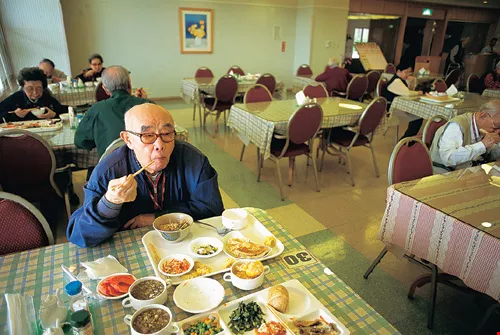
With service personnel preparing three meals a day and a monitoring system for security, seniors move into a first-class retirement home with no anxieties, and family members are put at ease.
Retirement and nursing in one place
Aside from a scenic environment and clean air, a connection with a medical facility has also become another reason for choosing a retirement home.
The Kang Ning Apartment Complex, located next to the Kang Ning Hospital in Neihu, advertises the convenience of getting medical help. Living next door to a hospital certainly gives seniors a great sense of security. Kang Ning is also one of very few retirement homes located in the downtown section of a city. One can enjoy easy access to transportation and living conveniences while at the same time finding a quiet refuge amid the urban hubbub.
"Seniors cannot cut themselves off from a hospital," points out Martin Shih, sales manager at Kang Ning. Four years ago when we were promoting the complex, the market was not yet mature and only seniors with a more modern outlook were moving in. Also, the cost was high. Of the originally planned 165 units, currently only 50-some are occupied.
Healthy seniors "live in retirement" while disabled seniors "receive care." Combining the two types of seniors into one retirement facility represents another model for retirement homes.
The Zhi-Shan Senior Home near Yangmingshan, operated by Cardinal Tien Memorial Hospital of Yungho under an agreement with the Taipei City Government, opened at the end of 2003 and started accepting residents at the beginning of 2004. The 109 retirement units are now fully occupied, with a waiting list of 80 people.
Li Chun-an, a 74-year-old, was the very first person registered at Zhi-Shan. He says living here with his wife is like being in Shangri-la. Each of his three children living overseas has made the trip here to take a look, shot some video footage and returned home. The children were very happy to have their parents living here and didn't want them to move under any circumstances.
Li Chun-an is also full of praise for Zhi-Shan's nursing facilities. "They really take good care of seniors who fall ill, and the place is very clean," says Li. Every once in a while he and his wife go over to the nursing facility to do volunteer work and help the patients with cutting their hair. When they see how well some incapacitated or paralyzed seniors their own age are being looked after, they no longer have any anxieties about their future. "You can just put it out of your mind, there's nothing to worry about," says Li nonchalantly.
The manager of the retirement section, Li Yen-hung, says the average age of a Zhi-Shan resident is over 80 years. The oldest is 97. Although some seniors do not want to face the possibility that they might become bedridden and move into the neighboring nursing section, there is a real convenience in combining the two types of facility. Because the health of each partner of a married couple is different, chances are high that each will at some point live in a separate section, but being in the same overall facility means they can look after each other and won't feel lonely.
The cost of Zhi-Shan is modest but the environment and equipment are in no way inferior to that of a five-star retirement home. Everything is provided-a spa, sauna, swimming pool, conference room, ping-pong room and a billiard room. Li Wen-chieh, a specialist at Zhi-Shan, says this equipment is meant both for the use of residents and as an "inducement" to attract family members to rest and relax and visit seniors.
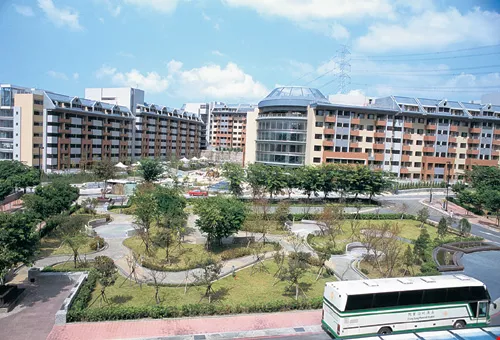
Chang Gung Health and Culture Village Initial residency conditions Over 60, spouse over 50. Must pass Chang Gung Hospital health check. Guarantee deposit One year's management fees Management fees (monthly) 45 m3 unit: NT$18,000 (single); NT$23,000 (double) 70 m3 unit: NT$26,000 (single); NT$31,000 (double) Meals Menu rates Mains services Metered Contact tel. no.(03) 319-7200
Retirement villages
An attractive, top-notch retirement home can only care for a small number of seniors at the top of the pyramid. Retirement homes for the average person are limited in the number of people they can accommodate, and ones with a good reputation often have long waiting lists and cannot meet the demand. To permit all seniors who have the need to find an affordable place to live, Chang Gung Memorial Hospital will promote large-scale "retirement villages" at Kueishan in Taoyuan, in Ilan, and in Chiayi.
Wang Yung-ching, chairman of Chang Gung Hospital and Formosa Plastics Corporation, donated 34 hectares of land in Kueishan, and combined Chang Gung's emergency and chronic disease health system with care resources drawn from Chinese and Western medicine to create Taiwan's first "lifetime continuing care community." The community is located next to Chang Gung's Taoyuan hospital and itself has a nursing facility with 400 beds.
In addition, Chang Gung Health and Culture Village will also promote a preferential savings plan. It will offer a preferential interest rate on savings to safeguard seniors' savings, while the accrued interest can be used against the monthly costs of care.
When all the culture villages are completed in 2006, there are to be some 4,000 residents, making this the largest group of residential complexes for seniors in Taiwan. To avoid having the villages become monotonous senior communities with a tomb-like atmosphere, various groups and people of all ages will be induced to come to the community by the large-scale community activity centers, thus giving the seniors the opportunity to maintain contact and interact with people from the outside.
Different from other hotel-style retirement homes, Chang Gung wants to build "senior homes." Each resident will be provided with a complete parlor, kitchen, bedroom, bathroom, and balcony. And senior services will not be the top priority, as Chang Gung will promote the idea of "resident participation," requiring residents to keep their units clean and to participate in community organized activities.
"Being in a retirement home generally means being waited on, but we are proposing to create a new 'retirement culture.' We don't advocate passive retirement but rather the concept of a community family," says Yang Li-chu, deputy head of Chang Gung hospital's administration section. The family here is different from the family the residents had when they were young. "In the past, they worked hard to make a living and take care of their children. Now they can be free and easy and select a comfortable environment where old friends and siblings can have the chance to live with them and get together again."
To achieve the vision of the retirement village that Wang Yung-ching outlines-where one leads an active, independent and dignified life, a life of continued learning-each village will have a "senior academy."
Many people are full of curiosity and questions about such a large novel senior continuing care community. After only six months, tens of thousands of people have come to take a look or have registered to get information; more than 380 have already signed up and are getting ready to move in.
Kang Ning Apartment Complex Initial residency conditions Over 45, able to care for self. Guarantee deposit NT$4.9-6.4 million (65 m3 unit); NT$7.9-9.2 million (100 m3 unit) Management fees (monthly) NT$9000 (single); NT$15,000 (double) Meals NT$60/meal Mains services Metered Contact tel.no.(02) 2634-8999
Feelings money can't buy
Taiwan's senior citizens' market gets more active every day. There are many different products and seniors can choose according to their needs. "No matter how good the equipment or service," however, "family sentiments are irreplaceable," says Martin Shih, director of the Kang Ning Apartment Complex. Although the complex organizes activities like a traditional New Year's Eve dinner, if the children don't come to visit or don't take the parents home to celebrate together, it's difficult for them not to feel hurt. When one partner of a couple that originally moved in together loses the spouse, the survivor also will feel sad and lonely.
Tsao Szu-mei, director of the Yang-Ming Senior Citizen Apartments, says that the age when children looked after their parents is past. Each person must plan for his or her own life in old age. Although "be it ever so humble, there's no place like home," and living at home in old age is still every senior's desire, given the gradual physical and mental deterioration everyone experiences, there needs to be a caregiver. When family members cannot play this role, then just let the social workers in the retirement home take their place! But Ms. Tsao cannot help wanting to tell the children: "Seniors aren't looking for much, just love. Even if you young people cannot 'see parents to bed in the evening and greet them in the morning,' at least you should make a few more phone calls, ask them how they are and show them you're thinking of them."
On the other hand, social welfare researchers and organizations express some concern about the commercialization of the care industry. "Senior care cannot rely on the business model," warns Professor Lin Wan-i of National Taiwan University's Department of Social Work. He points out that business views profit as its top priority. If a business in the senior care system sees no prospect of a profit it might just withdraw or lower the quality of care. With the capital needs for the elderly care market growing daily, it may end up that middle- and lower-income seniors and those living in remote areas won't be able to receive care, while high-income seniors will receive the most services.
The trend toward profit-making in the care industry is worrisome. If all we have is the material side of things and no spiritual side, then it will be impossible to offer seniors a dignified life in later years.
Who will take care of the seniors? How will they be taken care of? Where will they spend their golden years? This is a question each person, sooner or later, must face. Aside from individuals doing their own advance planning, society at large and the government need to give serious thought to the issue.
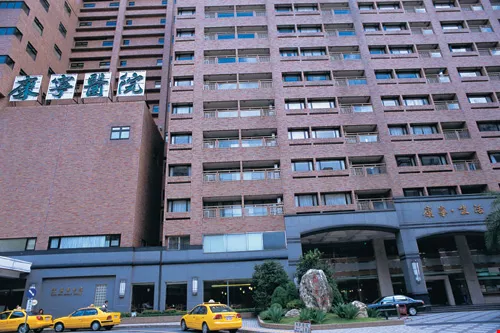
Living next to a hospital is extremely convenient for the elderly, who often have to go for a visit. The Kang Ning Apartment Complex is one of a few senior rental complexes located in a city center.
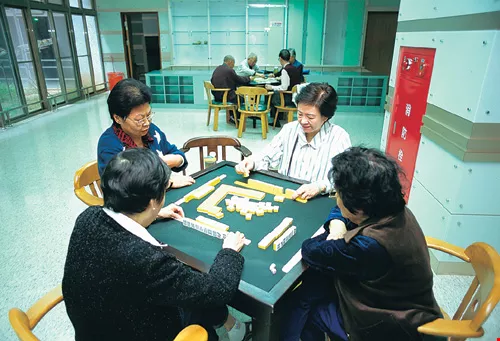
Mahjong is an excellent way for seniors to make friends, pass their time and exercise their mind. No retirement home can be without its mahjong tiles and tables.
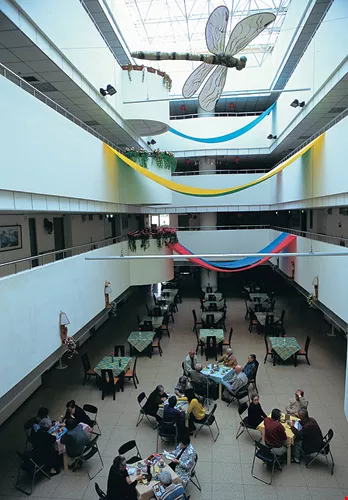
Yang-Ming Senior Apartments Initial residency conditions Over 65, able to care for self. Resident in Taipei City at least one year. No notifiable infectious diseases, psychiatric illness, or dementia. Guarantee deposit NT$60,000 (single); NT$100,000 (double) Management fees (monthly) NT$16,800 (single); NT$25,400 (double) Meals NT$3600/month Mains services Metered Contact tel.no.(02) 2861-9296
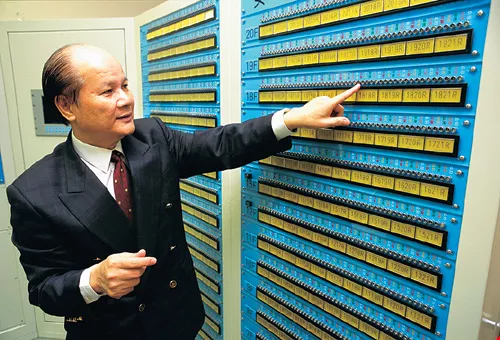
With service personnel preparing three meals a day and a monitoring system for security, seniors move into a first-class retirement home with no anxieties, and family members are put at ease. At the right of the picture is Huang Ping-fu, the deputy general manager of Ruen Fu Newlife Vision.
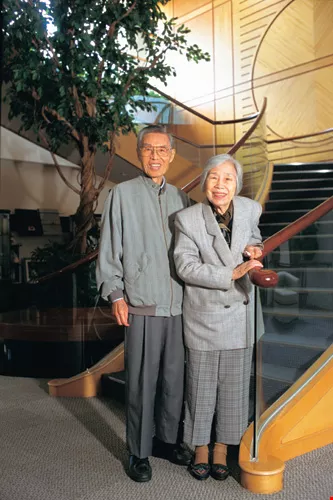
Well-known writer Chi Chun, author of Midnight Dreams with My Book as a Pillow, lived with her husband in the US for more than 20 years. After returning to well-loved friends and surroundings in Taiwan and moving into the Ruen Fu Newlife Vision retirement home, they finally found a solution to the "crisis of old age" and can live in retirement without worries.
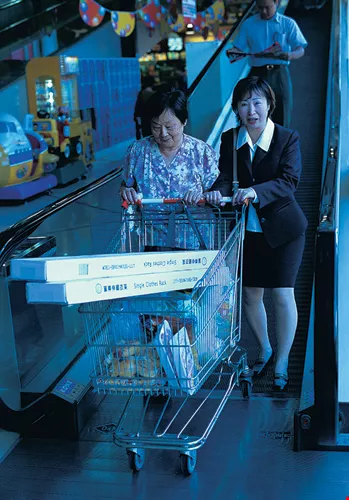
Accompanying residents on a weekly trip to a nearby shopping center is one of the friendly services offered by retirement homes.
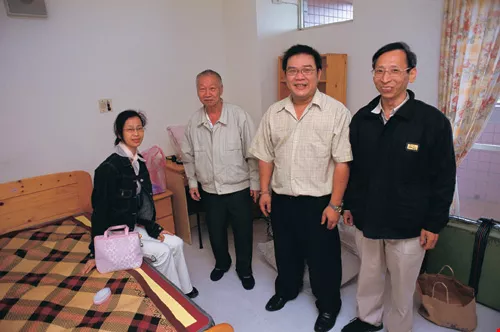
A happy move! This elderly gentleman (second from left) moved from the Kuang-Tzu Po Ai Institution, where several beds were jammed into each room, to the Yang-Ming Senior Citizen Apartments where each person has an individual room. A social worker (far left) and friends lent a hand.
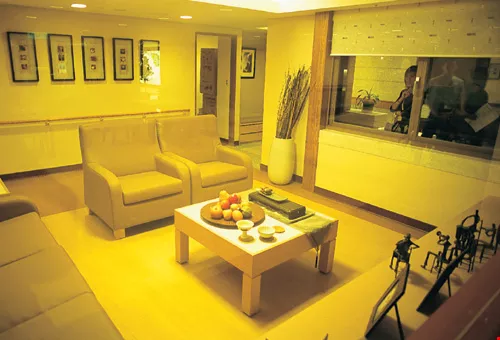
The culture villages, which place top priority on the concept of a "home," provide for each resident a parlor, bedroom, kitchen, dining room, and balcony.


