

Every profession has its woes."Many people complain about taxi drivers refusing to make short trips, asking for fare increases and giving poor service. But taxi drivers also have their bitterness and grievances. Why are they bitter? And what injustices are they aggrieved about? Let's hear the cabbies' side of it.
Many young people, unable to find work immediately after completing their military service, see driving a taxi as a job which offers independence and an apparently reasonable income, so they enter this "reception center for the unemployed and waystation for those changing jobs." It's only after they hastily embark on this career that they find that many aspects are not as they had imagined.
Once on Green Peace radio station's "Cabbies' Hour" program, a listener who had just started as a taxi driver called in and asked the host whether it was better value to rent his taxi license plates, or to buy them. Immediately the host strongly advised this new professional driver to change to another line of work. The caller did not appreciate this advice, and said he was just driving a taxi as a parttime job, and not planning to do it all his life. Within ten minutes following his call, another four or five taxi drivers phoned in, each of them advising the first caller to think again, and all for similar reasons: they thought that the only people who should enter this profession were middle-aged or older people without any skills. Several even cited themselves as examples to awaken newcomers to the pitfalls.
Is driving a taxi really such dreadful work? The saying goes that "whatever line of work you're in is the one you'll complain about," and people in almost any job inevitably have their own catalogue of gripes. But it cannot be denied that factors such as the growing number of taxi drivers, increasing numbers of private cars, worsening traffic conditions and an inadequate supervisory system, have caused taxi drivers generally to complain that "Its getting harder and harder to earn a living."
(left) When gridlock sets in or spirits flag, cabbies simply stop by the roadside for a snooze.
Hard to earn a living
The supply of taxis in Taipei City far exceeds that in other major cities around the world. According to a 1987 study by the city's Bureau of Transportation, the number of inhabitants per taxi in New York City was 1000, in Tokyo it was 400, and in Hong Kong 300. But in Taipei City it was only 75.
Since then the number of taxis in Taiwan has continued to rise. Many cabs ply the streets empty, consuming time and fuel but not earning money. Thus there are many drivers who drive one day and take two days off.
Deteriorating traffic conditions only make the situation worse for taxi drivers. Frustratedly facing today's "traffic dark ages," some cabbies try their hardest to find back allies to dodge through, some vent their anger by sounding their horns incessantly, some simply give up and stop by the roadside or go home to rest for a while. But naturally there are still more drivers who seem to have got used to the situation and simply follow the long lines of crawling traffic with glazed expressions, putting up with it until they reach their destinations.
But although competition and traffic chaos make drivers feel it is hard to make a living, what really makes them feel most powerless is the unreasonable system which requires drivers to be affiliated to cab companies.
The cab companies' stranglehold
Throughout Taiwan there are over 4000 cab companies, and 80% of taxi drivers drive company-registered cabs. On joining a firm, drivers have to pay a deposit of NT$30,000 for their license plates (if they leave they are refunded NT$10,000), and each month they also pay a rental of NT$2000. If they prefer to buy the use of the plates outright, they have to pay NT$80,000 to NT$100,000 (if they sell them back they only get NT$10,000 to NT$20,000). In addition, they have to pay the company a monthly affiliation fee of NT$1800, an annual group insurance premium of NT$1300, annual labor insurance of NT$7000 to NT$8000, and so on. Each time they replace their vehicle they have to pay the cab company a service charge of NT$30,000 to NT$50,000.
This monetary "exploitation" is one thing, but what makes cabbies even more uneasy is that although the car is bought with the driver's own money, ownership is registered in the cab company's name. If the cab company wants to pull a fast one on the driver, it is very easy: it can simply use the car as security for a loan, and there is absolutely nothing the driver can do about it. Thus reports of cab companies deliberately going bankrupt or of companies' new owners selling their affiliated drivers cars when they have disputes with previous owners, leaving the drivers suddenly robbed of their livelihoods and with nowhere to turn for compensation, are only too frequent.
The cab companies reap large profits for little exertion, but the service they provide to the cabbies who drive under their colors is very limited. In many drivers' view, all the cab companies do is to phone them every month to press them for their license plate tax, fuel tax and affiliation charges. Even if one of a company's taxis is involved in an accident or dispute, at most the company will help by mediating, but any liability remains the responsibility of the driver himself.
Plates with a price
In fact this affiliation system which drivers so resent is the product of a particular age.
It is said that in the early days before Taiwan had a car industry, car imports were limited and vehicles were very expensive, so it was not possible for car hire businesses to survive. It was not until 1959 that some returning overseas Chinese began to set up car hire firms, which employed drivers and operated taxi services. But because the employed drivers did not report their takings in full, many of these car hire companies ceased operating or went broke.
After negotiations it was finally decided that the drivers would buy their cars from the companies by instalments and pay certain fees to pay for the companies' administrative costs and the rental of their premises, to ensure that the companies could operate sustainably. For their part, the companies would be responsible for tax payments, insurance, inspections and other such services. This was the origin of today's company affiliation system.
In 1960, in order to assist tricycle rickshaw drivers in changing jobs, the government instituted an "outmoded vehicles elimination charge," and required applicants for taxi license plates to pay a charge which was used to help trishaw drivers find new work. This is the origin of today's payments for taxi plates.
As the number of taxis rose, in 1978 the government imposed a blanket freeze on issuing new taxi plates. Thus they became in short supply and began to command higher and higher prices. Actually the administrative charge made by the government for issuing a pair of plates is only something over NT$1000, but the cab companies demand a service charge of NT$100,000 from drivers.
Ruffians or heroes?
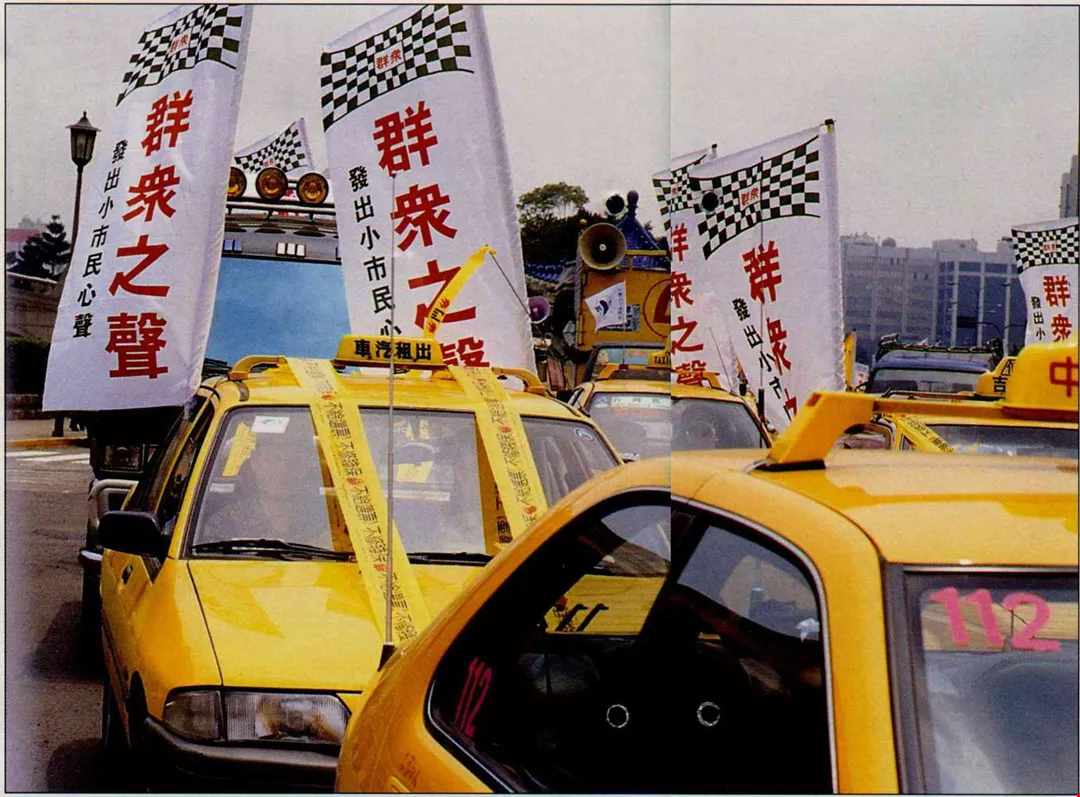
In October last year, the "All People's" taxi drivers' association was formally established, with the aim of getting the affiliation system abolished. Several of All People's founders started hosting programs on underground radio stations, such as "Ah-Chu Speaks Out," in which they talked about the affiliation system and other matters directly affecting taxi drivers.
Because many taxi drivers have been exploited for years and are full of bottled-up anger, the underground stations' willingness to speak out and criticize was very much to the cabbies' liking, and many called in to join in the discussions and express their feelings. In just a year, All People's grew from a small group of 25 people to an organization with 3000 members.
Initially they were simply dissatisfied with the cab company affiliation system and wished to break free from it. But after explaining the situation to everyone from the Ministry of Transportation and Communications to the Control Yuan and the courts, and getting no response, they began to become dissatisfied with the government itself. A small number began to actively take part in other political activities to oppose the government. In particular, in the period before low-power radio stations were authorized, many All People's drivers enthusiastically responded to calls by hosts on underground radio programs to go and "besiege" various government agencies such as local courts, and this generally led to serious traffic congestion.
During last year's elections, stories were often heard of cabbies with strong views coming into conflict with passengers with different political opinions, or even injuring them. In many cases these incidents involved All People's drivers. Thus the public at large gained a generally negative opinion of All People's. With the bloody clashes of August this year, All People's was branded a "violent organization," and the events even prompted several cab companies to band together to oppose it.
For instance, a Mr.Hsu, an individually licensed driver who has been driving for over a decade, commented: "That All People's boss behaved no better than a gangster. He broke both the other guy's arms, then he told the guy to use his radio to call for help. He said who he was, and that he'd beaten the guy and what were they going to do about it?"
But whether they are heroes or ruffians, All People's various protest actions have forced the relevant government departments to review the taxi supervisory system as it has operated over the past 30 years, and to come up with specific solutions to its problems.
Cabby cooperatives
In September this year, the Ministry of Transportation and Communications published draft "Rules for the Establishment and Management of Taxi Cooperatives."
The draft rules require vehicles to be provided by the cooperative members themselves, and ownership to be in the drivers' names. An eligible driver need only join a cooperative to be entitled to hold taxi license plates; if he leaves the cooperative, the plates immediately expire. In this way such unfair practices as companies using the plates as a means to exploit drivers, and unclear ownership conditions, can be avoided.
Apart from this, cooperatives are to be managed jointly by members, and the cooperatives' affairs, their rules and the election of their officers are all to be decided by the membership. This conforms completely to the spirit of democracy, and organizations formed by cab drivers in this way will be able to work towards setting up welfare systems, bonus systems and even retirement pension schemes, and establishing a healthy industry with reasonable conditions.
At present this draft is still being discussed by the Ministry of Transportation and Communications. When it will be approved and when it will come into effect cannot yet be predicted. But it is good to see that at last a scheme has been devised to address the long-standing problems of the taxi business. It's just that for the cabbies, every day of in vestigation, discussion and delay is another day of hard work and of wondering if their hopes will ever come true.
[Picture Caption]
p.116
(right) Following their "enlightenment" by underground radio stations, taxi drivers have emerged as a new group of "political animals."
p.116
(left) When gridlock sets in or spirits flag, cabbies simply stop by the roadside for a snooze.


@List.jpg?w=522&h=410&mode=crop&format=webp&quality=80)


