Overwork:A New Disease for the 21st Century
Teng Sue-feng / photos Chuang Kung-ju / tr. by Geoff Hegarty
March 2005


The Chinese classical novel The Ro-mance of the Three Kingdoms tells the story of a great battle when an impasse was reached between the parties of Zhuge Liang (also known as Kong Ming), the prime minister of the kingdom of Shu during that period, and Sima Yi, the general of the kingdom of Wei. Sima Yi had delayed sending his troops into the battle, and was instead chatting with a messenger who had delivered a letter of challenge from his opponent Zhuge. For all intents and purposes, Sima Yi seemed to be enjoying a friendly chat with the messenger, but in reality he was ferreting out information. Not, as one might expect, intelligence about the deployment of troops or military strength, but information about the daily life of Zhuge Liang.
The messenger answered candidly: "I saw my master get up early though he had gone to sleep late, and on rising, personally supervised the 20 blows given in punishment to those who have made mistakes. He eats only a little food each day and has not been able to sleep well. He has no taste for food-he sometimes even forgets to eat." After the messenger was gone, the cunning Sima Yi told his subordinates, "Kong Ming eats little and has a terrible workload. He won't last long!" Not long after this episode, Zhuge Liang died from an illness as the result of his persistent overwork.
Nearly 2000 years later, at the beginning of the 21st century, many people are becoming more and more like Kong Ming-feeling both mentally and physically exhausted as a result of working too hard. If the stress, tension and tiredness from overwork are the causes of disease, then what is the answer for modern people who are suffering for the same reason that Zhuge Liang suffered-because of stress from the workplace?
Fifty-seven-year old Mr. Lin runs a chain of restaurants. Every day he arrives at his office at 10 a.m., and after looking after his business affairs, goes from restaurant to restaurant greeting customers until three in the morning. He usually gets to sleep around four, and then sleeps an average of only five and a half hours. On average, Mr. Lin works 284 hours a month. He has an inherited heart problem exacerbated by long-term work stress and an irregular diet, so now he also suffers from high blood pressure and high cholesterol. To make things worse, he has never sought medical help for his problems. One morning when he suddenly became dizzy, he was rushed to hospital and diagnosed with coronary heart disease. Mr. Lin's high blood pressure, obesity, heavy smoking and drinking put him in the group at the greatest danger from overwork.
Another example, Mr. Wang, is a 53-year-old Taiwanese businessman based in mainland China. Because he is very busy and has to regularly travel long distances, he usually takes weekend flights so as not to disrupt his daily work. On one particularly busy day, he went to bed at 11 p.m. and got up at three in the morning to get a nine o'clock morning flight to Taipei via Shanghai. At Shanghai airport while carrying his luggage, he felt a suffocating pressure on his chest and broke out in a cold sweat. Arriving in Taipei in a bad way, he went to hospital. The medical team considered that, since he had experienced no obvious symptoms before the trip, it was simply the stress of getting up so early that had caused his problems.
There is a saying around the workplace that when you are 30 years old, people see your qualifications; when you are 40, they see your working experience; but when you are 50, people see your medical history. The cases described above were collected by Professor Cheng Tsun-jen of the Insititute of Occupational Medicine and Industrial Hygiene of the College of Public Health at National Taiwan University. Cheng has been commissioned by the Council of Labor Affairs (CLA) to investigate the relationship between people's working hours and work-related disease.
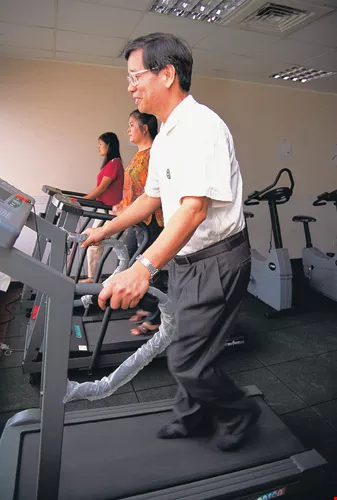
In recent times a healthy trend has taken root in Taiwanese corporate life. A number of companies have set up gyms in their offices in the hope that their employees will exercise during their breaks from work. A healthy employee will work harder and progress in their career.
Working to live, or living to work?
Two years ago, Professor Cheng, working in collaboration with teaching hospitals in Northern Taiwan, collected 164 cases of people who have cardiovascular disease. Through a detailed analysis of their occupations, lifestyles and medical history, the researchers discovered that 17 out of the 164 cases had been directly affected by stress at work. However, while many in this group suffered from long working hours, ever-increasing responsibility at work, frequent business travel, irregular work schedules and shift-work, other factors such as smoking, drinking, obesity, and family medical histories may all have contributed to their medical problems. Thus they realized that it is the interaction between all of these factors that is critical, rather than any one single cause.
Although overwork is a relatively new medical phenomenon in Taiwan, it has been around in Japan for at least 20 years.
In the 1980s, a number of middle-aged males suddenly collapsed and died in Japanese workplaces. As an example, a 43-year-old advertising executive who had been working more than three hours overtime a day for the previous three months died suddenly from a coronary thrombosis. In a second case, the manager of a manufacturing business who had faced the revaluation of the Japanese Yen and undergone enormous pressure from an 80% decrease in profits, suddenly died from heart disease on a golf course at age 55. The realization that people were living to work and dying of work spurred Japanese society into action.
From 1997 to 2000 in Japan, it was estimated that 2115 deaths were due to overwork, and 329 of these were identified as being directly related to the person's occupation. Following these findings, in 2001, the Japanese Ministry of Health, Welfare and Labor softened the rules governing compensation, and the number of applications rose immediately. In 2001 alone, there were 690 applications for compensation for circulatory system diseases, and 143 of these were identified as being related to overwork.
It is well acknowledged that Japan leads the world in terms of its technological advances and economic achievements, yet so many people are "killed" by their devotion to work. This rather twists the true meaning of development-work should bring human beings self-fulfillment, not death.
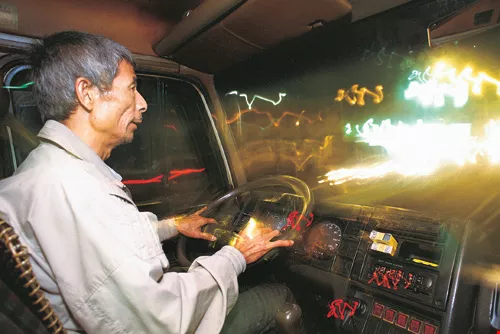
Truck drivers speeding along the freeway are the group at the greatest danger from overwork. In order to deliver on time, they often drive through the night and many even come to regard their truck as home. When they are tired, they just have a nap in the back.
Death in the workplace
The phenomenon experienced in Japan has spread to Taiwan. In 2000, a truck driver named Huang worked continuously for 26 hours, became overtired and died suddenly from heart and lung failure. His family applied for compensation from both the CLA and his employer, but there were arguments as to whether his death could be directly attributed to his work, an argument that resulted in a complex court battle.
The dispute went from the Taipei District Court to the Taiwan High Court, and eventually it was confirmed that his death was indeed the result of overwork. The judge noted that Huang had worked from seven in the morning until the time he became sick, at 9 a.m. the following day. Though he had had a short break during the night, he was still on call, so the court decreed that the period of work had to be regarded as continuous. In the end, his employer had to pay more than NT$2 million compensation.
Two years ago, labor groups repeatedly appealed to the CLA to define overwork as an occupational disease. They considered that although the regulations do mention a standard for "an acute circulatory system disease owing to occupation", the rules for gaining compensation are too strict. A worker must have worked either continuously for 24 hours before death, 16 hours every day in the week before, or have done more than 100 hours overtime in the month leading up to the onset of illness. The situation becomes further complicated as employers will often argue about exactly how many hours a person has worked. A lot of companies do not keep strict attendance records for their employees, and of course many people work overtime at home at night or at the weekend. As a result, the figures often do not accurately reflect actual working hours.
In September 2003, the CLA established an "overwork task force" to look into research findings from Japan and Germany, to open discussions about reducing the standard for defining overwork, and to look realistically at the overwork problem in Taiwanese workplaces.
Professor Cheng Tsun-jen argues that the phenomenon of overworking can't be accurately defined by science because it is a human problem, not like a chemical spill that can be measured, quickly assessed and causes found. While the research certainly shows that people die because of long working hours and the resulting stress, if those same people are also subject to other influencing factors, it becomes difficult to lay the blame on a definite single cause.
Cheng says that many of his colleagues are too strict in their interpretation of the facts-they want concrete scientific evidence before they draw any conclusions, but by then it is often too late to help those suffering. Therefore, he has suggested that the CLA should look to Japan for guidance in order to widen the present standards used to assess overwork.
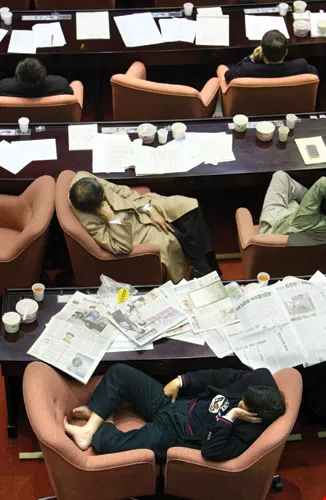
Past midnight, legislators struggling to examine and pass legislation in the Legislative Yuan have become a unique spectacle in the Taiwanese political arena. The photo shows a group of exhausted legislators sprawled in their seats after struggling for hours to finish their work. (photo by Chen Po-heng).
Employees are suffering
At the beginning of this year, the CLA decided to revise the thrust of the regulations to consider not just normal working hours, but also the different types of work that people do to take into account such as irregular hours, shift and evening work, the different time zones and environments in which people work, and accumulated long-term stress and tiredness.
"Things are now more flexible. In the past, only company work records would be considered," explains Shih Tung-sheng, chairperson of the CLA's Institute of Occupational Safety and Health, "but now consideration will also be given to people like salespeople who normally wouldn't keep records of working hours, but often work for extended periods, as long as they have reasonable evidence." The standard of overtime work hours has also been reduced in line with Japanese standards. The new policy looks at a worker's hours in the six months before any sudden illness, considering whether overtime has exceeded 45 hours per month or two hours per day. It is hoped that this new policy will more accurately take account of a worker's actual working conditions when sudden sickness strikes.
However, while these reforms mean that overwork is finally being recognized as an occupational disease, it does not mean that workers have won any great victory. After all, if one loses one's life or health, no compensation is really adequate. Monetary compensation doesn't solve the problem.
Professor Lin Hsien-tsung of the Sociology Department at National Chengchi University has analyzed the phenomenon of overwork in Japan and believes that it is closely related to recent changes in Japanese management styles. Japan's spectacular success after the Second World War has been attributed to its "family" style of business management. For example, employers looked after their employees for a lifetime. Workplaces were harmonious and had enthusiastic government support. Employers and employees enjoyed the relationship of partners who could both share the benefits of their labor. This family-based system won great praise for Japan from all over the globe in the 1970s.
However, good times unfortunately don't last forever, and in the1980s Japan experienced economic collapse. With the long recession, the system of lifelong employment came under severe criticism, and Japanese enterprises looked to overseas for new ideas to reform the system. The old values of teamwork, cooperation and "family" began to disappear. People began to compete with one another. Corporations encouraged their employees to learn new skills and develop their creativity. Efficiency and quality became the new catchwords.
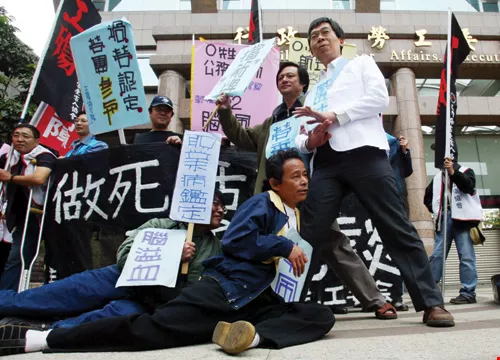
In April last year, labor groups called on the Council of Labor Affairs to protest about the too strictly defined standard for overwork. After discussions, the standard was revised early this year. (photo by Lin Chun-liang)
The workplace is not the jungle
"Survival of the fittest" has been the overriding principle of capitalist societies for over a hundred years. However, as long as a society blames individuals for the overwork issue, there will never be any solution.
There is a logical contradiction in this approach. It seems to avoid seeing the problems in social and economic systems, and resorts to trying to change the individual's behavior to find solutions. Society seems unwilling to try to identify which systems tend to make people "willing" to work to excess. Under such a structure, if you don't work hard, you will lose your job. Neither basic security of employment nor economic security are guaranteed. How can we hope that our workers will be able or willing to look after their health under such a problematic structure?
If corporations encourage their employees to work hard and induce them to take pay or bonuses rather than their well-earned holidays, or if they don't replace new employees when someone resigns, the workload increases-even doubles-almost imperceptibly.
The Japanese experience shows that reducing the problem of overwork is a long process of recognition and understanding, moving away from blaming the individuals towards seeing the responsibilities of the social and corporate structure.
Lin Hsien-tsung points out that Japan originally made the same error. When stories of death from overwork began to circulate, in general there was sympathy, and one often heard people comment on how sad it was that someone could die so young: "He shouldn't have worked so hard!"
Later on, however, people started questioning the system, rather than the individual. It came to be believed that a society as rich as Japan's should rethink its seemingly inhuman attitude towards work. At the same time, Japan's extreme working hours attracted the concern of Western countries, which further encouraged the Japanese to reflect more deeply on the problem.
As a result, in 1988 Japanese lawyers and doctors set up an "Overwork Hotline #110" to provide counsel for those in trouble from overwork. This campaign brought not only social recognition that the problem was increasing in seriousness, but also that the issue was one that concerned the whole of Japanese society: government, industry and labor.
At present in Taiwan, we are still treating people who tend towards overwork with advice like "don't be too aggressive," "look after your health," "you don't have to kill yourself to become successful, you know," "remember to get plenty of relaxation-have plenty of holidays," "don't worry too much," and "make sure you do some exercise and get enough sleep."
Surprisingly, when Cheng Tsun-jen talks to workers about their illnesses, most don't believe that their problems are related to work. Cheng explains that perhaps they really don't understand the possible effects that overwork can have on their health, or perhaps they are generous enough to think that if you earn a salary from your employer, then you have to take some risks and pay the cost.
High-risk groups
According to Cheng, there is in fact some progress in workers' awareness of how their lifestyles can affect their health, and many clearly understand that smoking, drinking alcohol and working long hours can be risk factors. However, while they understand the situation, whether they actually give up these habits is another matter. Everyone knows that the best way to relieve your tiredness is to relax more or take a holiday. Nonetheless, even when people become tired and stressed out, most will concentrate on finishing unfinished work rather than taking a break. Their feeling of loyalty or responsibility to the company, or the working environment itself, compels them to keep on working. Clearly, for those groups in danger from overwork, the theory is much easier than the practice.
Coach drivers know, for example, that chewing betel nut can cause cancer, but many of them will take the risk in order to keep up their energy levels, even though everyone's lips become oddly red.
Before Chinese New Year, the Council of Labor Affairs inspected 14 long-haul coach companies and discovered that a number of them were violating basic labor regulations. There were five companies in which the drivers' working hours exceeded 12 hours per day, and seven where drivers had worked more than 46 hours a month overtime.
CLA minister Chen Chu announced that in order to eliminate such flouting of the law, the CLA would continue with its inspections of drivers' working conditions, and would ask coach companies to submit details of their holiday-period work rosters for checking. If any company was found in breach of the rules, it would receive a fine from the local government.
Shih Tung-sheng, head of the CLA's Institute of Occupational Safety and Health, believes that employers should be educated about how to take care of employees' health. It may be easier to convince employers by drawing on economic incentives, explaining that overworking their staff will backfire in the long term, and lead to eventual losses in quantity and quality.
Learning to be good to oneself
At present, there is a healthy trend taking root in many companies in Taiwan. A number have started to take care of their employees' health of body, mind and soul to help them relieve stress by building a healthy environment.
However, Wang Hao-wei, a psychiatrist, is wary of this idea. He argues that the concept of emotion or stress control is a phenomenon inspired simply by greed, whereby a boss wants to obtain more output by promoting work efficiency. The motive itself is not a healthy one. If work itself is still a source of frustration, then the problem remains unsolved.
Wang regularly sees patients aged around 45 in his clinic, and many of them are very worried. They know that if they lose their job, they will have great difficulty in finding another, and if they are unhealthy as well, it will be very difficult and too late to learn new skills. They worry that the next time they become seriously ill, it may well be the end of their working lives. Since they are so insecure, they dare not argue with their boss, whether they believe their argument to be justified or not. Their situation forces obedience on them, and they feel terribly frustrated.
Wang Hao-wei agrees that hard work is a good thing, but he also insists that we need to look after ourselves. Maintaining this delicate balance-stopping and calmly considering the balance of forces in our lives-is the way to achieve enduring energy and wisdom.
Around 200 years ago, the German philosopher Karl Marx claimed that capital never cares about workers' health or lives unless society forces it to do so.
Two hundred years have passed since the Industrial Revolution, and our economic sophistication should have demolished the idea that employees are "tools." In the era of the knowledge economy, an employee's intelligence is the most valuable of any company's resources. Only if employees are appreciated and looked after as intelligent human beings can their potential be maximized for the benefit of their company and the health of their communities.


