The Chinese View of Life and Death
Wei Hung-chin / photos pu Hua-chih / tr. by Christopher Hughes
April 1993


"Boundless" by Chen Chao-pao: Where do we come from? Where do we go? These are the perennial questions of humanity.
What is the meaning of life? Is there really a world after death? These are the common questions in the hearts of all human beings.
For thousands of years, Confucius's saying, "Not knowing life, how can we know death?" seems to have been the definitive statement of the Chinese view of the matter. But do the Chinese really have such a fatalistic view of life and death? Why is it that the Buddhist "other side" and the "kingdom" of God have become so widely followed?
Over two thousand years ago, Confucius's eternal teaching of "Not knowing life, how can we know death?" became the belief of the orthodox Confucian literati. There could be absolutely no talk of death.
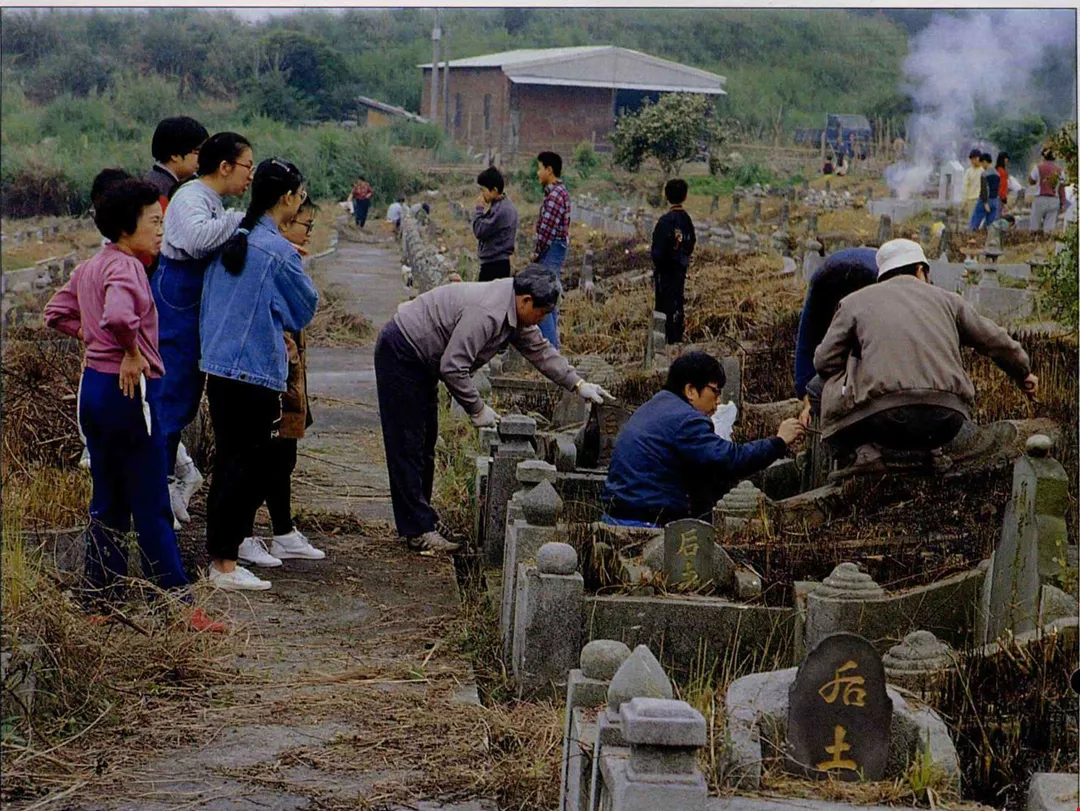
Tomb sweeping for the Chinese is not just significant as a way of cherishing one's predecessors but is also a way of guiding one's descendants towards filial piety.
Eternal life from the here-and-now:
Someone has actually counted that the Chinese character meaning "death" only appears 38 times in the Analects of Confucius. On no occasion is it discussed in any depth. The disciple Chi Lu was actually reprimanded when he asked the master about the subject.
Confucius preached a doctrine of the here-and-now. If he could have decided how he would die, he hoped to "hear the right way in the morning, and die in the evening without regret." The emphasis was still on how to live in this life. It seems that the Western philosopher, Spinoza, was in agreement with Confucius on this point when he remarked, "The wise only consider existence and do not bother themselves about death." Very much the standard Confucian view.
"The sages Confucius, Yao and Shun were all people, not spirits. As people, how could they solve the so-called problems of what comes before and after life?" is the opinion of Wang Pang-hsiung, a professor of philosophy who has often examined the problem of life and death in traditional Chinese philosophy. The Chinese think of life as being something rational within the existing world. If you do things well when you are alive and have no regrets when you have finished them, then you do not fear death.
With this emphasis on the real world, the Chinese style of life could be vigorous and positive. It was earthly society that the Confucians hoped to change into the "other kingdom" or "other side." They thus paid attention to the perfection of politics, education and society, because only with a perfect society in this world could people be at peace about life and death. It was better not to let the real world turn to chaos, a realm with no distinction between life and death.
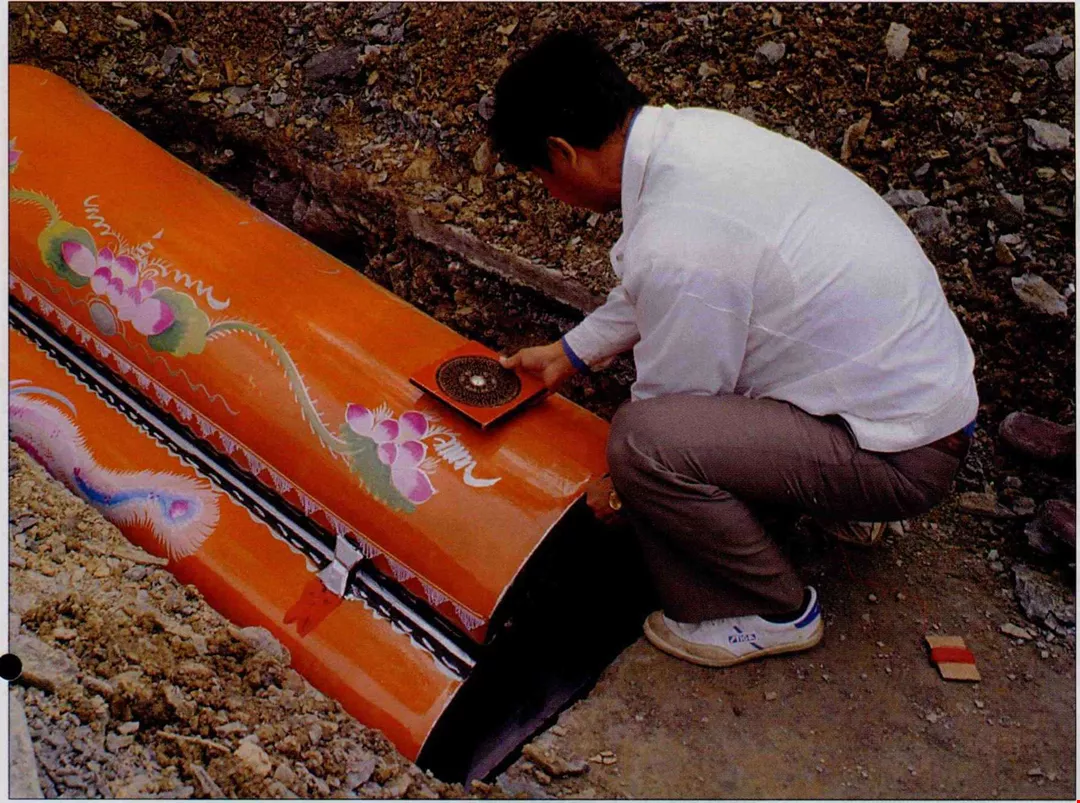
Chinese emphasize the importance of geomancy, believing that the position of the coffin affects the future fortunes of the occupant's sons and grandsons.
Life and life, not life and death:
"The Confucian view of life is one of 'life and life' not 'life and death,' explains Wang Pang-hsiung. What structures the foundation of life for the Chinese is the family and ethics, where does life come from? It comes from your ancestors; Where does death go? It goes to your descendants. The continuation of the family down the generations is not only the extension of invisible life, but is also the passing on of experience, culture and thought, which will thus never die.
The Confucians preached "life and life" and the Taoists "no life." If a person cannot even grasp life, then what can be done about death? The Taoists had a very natural view of life. Lao Tzu said, "out to life, in to death," seeing life and death as no more than the coming out and going back of a human form of existence. Chuang Tzu talks of "coming and going." So there is coming and there is going, an equal view of life and death, ethereal and elegant.
The modern literati artist Chi Pai-shih is representative of someone who upheld the Taoist view of life and death. At the age of 70, Chi Pai-shih had already prepared himself for death. Not only had he made ready such things as his burial clothes and coffin, but when he had nothing else to do he would saunter about looking for a location for his grave. At 85 he had a dream in which he saw his funeral procession, and he did not forget to write the amusing epithet couplet: "World famous for painting, a loyal subject and filial son; Such a superhumanly wise countenance, he is not afraid of the horse-faced and bull-headed demons."
In the end, Chi Pai-shih lived to the age of 97. He seemed to be mocking that the less you fear death, the longer you will live.
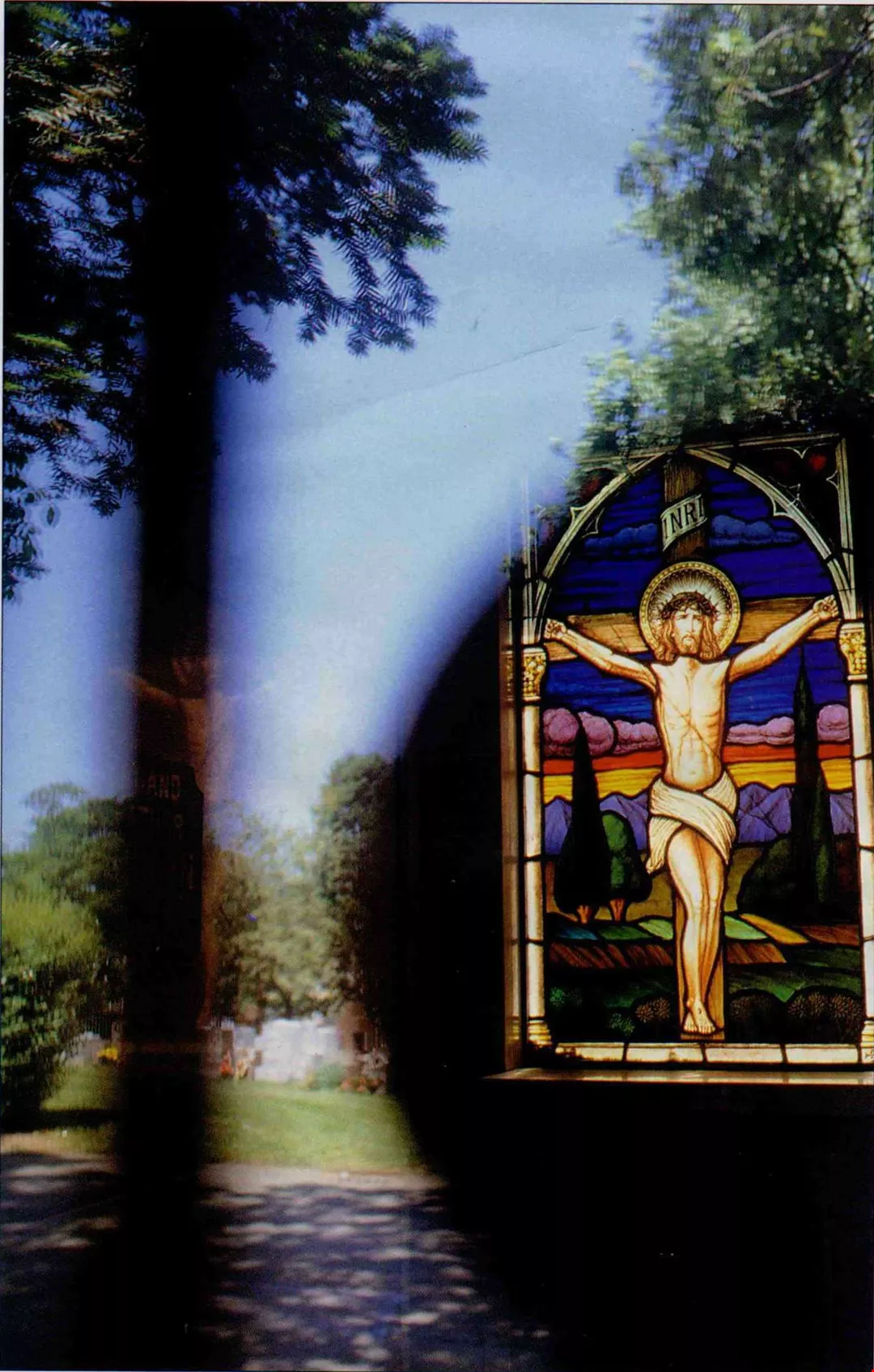
For some devotees Christianity has resolved the black hole of Chinese thought--the death complex.
Unbearable fate:
Another story about death that is passed on by the Chinese is that of how Chuang Tzu was beating a tub and singing when his wife died. His old friend, Hui Shih, could not bear this and berated him. The sage would have none of it and took the opportunity to educate his friend, saying: "How do you know that death is not returning to the home of nature, and that human life is like a child who has lost his way and can't find his home?" Hui Shih was left quite lost for words.
The Confucians used ethical education, while the Taoists preached a doctrine of non-action. No matter what method they faced human life with, both hoped that people could live good lives and saw no need to deal with the matter of death. The only problem is that moments of weakness are hard to avoid. When his most beloved disciple, Yen Hui, died, even the rational Confucius cried out in sorrow and despair to the heavens: "Alas! Heaven is destroying me! Heaven is destroying me!"
Concerning man's fate--when death pays a visit, most people can still not stop grief welling up inside!
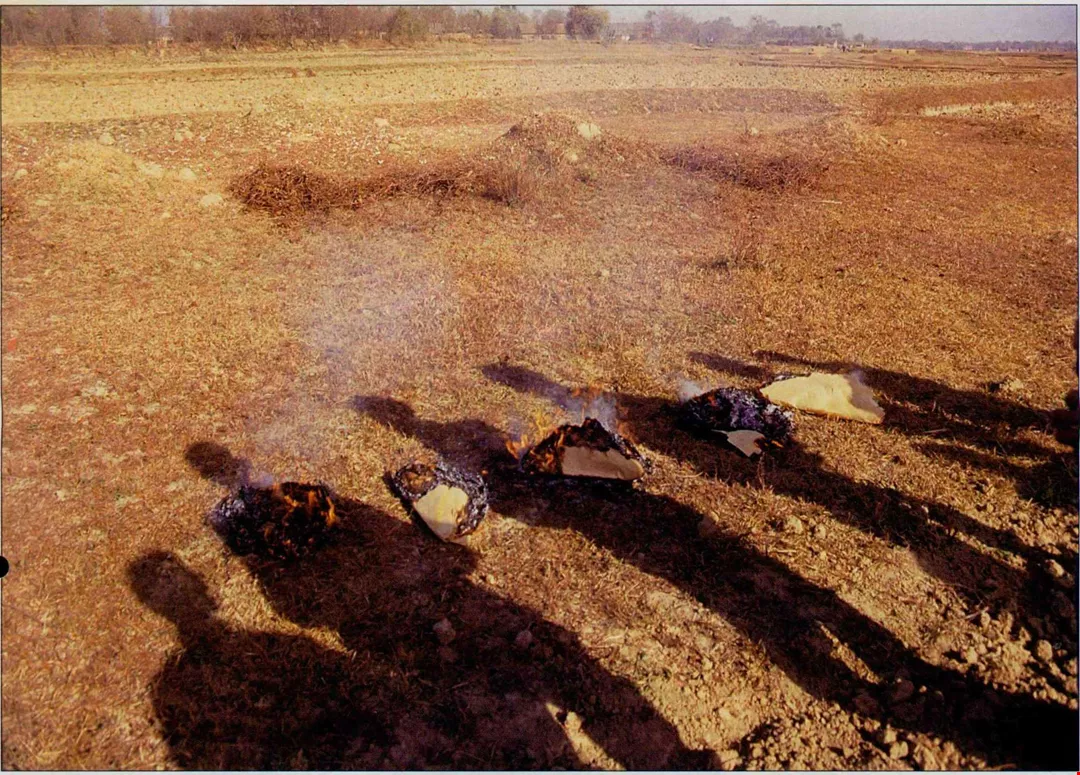
Rituals for the Tomb Sweeping Festival being performed in Anhui Rural Township. How the great Cycle of Life and Death is joined is not something people can resolve.
Death is so final. How can you not grieve?
Although the Chinese have their traditional concept of doing good for the world, it is still probably man's biological instinct to value life and fear death. Although on the surface the Chinese are not willing to talk about the problem of death, they are still not completely at ease with it.
In the introduction to his Essay on the Orchard Pavilion Gathering, Wang Hsi-chih, the great painter of the Eastern Chin dynasty, lamented how, How long you live is up to chance, but in the end all comes to nothing." He was pointing to the absurdity of life and death, and his sentiment, "Death is so final, how can one not grieve!" is still the feeling of sorrow most people have about passing away.
Then there was the brilliant Tsao Chih, of the Tsao-Wei kingdom, who, although he grew up in a rich home, could not help expressing his sorrow on seeing the vicissitudes of the world. "The world has no ultimate limits, yet our life is like the morning dew. . . . it disappears as the early morning dew evaporates." Bearing witness to great historical turbulence, when lives were but mere blades of grass, the Chinese when faced with the misfortune of death could only "grieve over the shortness of life, envy the never-ending Yangtze," and shrug it off.
Confucianism is the daylight thinking of the Chinese:
"The Confucian way of looking at death is really just the daylight thinking of the Chinese," says editor-in-chief of Health World magazine, Wang I-chia, examining it from a psy-choanalytical angle. He points out that the fear of death is a necessary part of human psychology. The Confucians used the positive side of the existing world to suppress people's consciousness of death. But throughout history we can still see people trying to resist death and striving to win longevity from nature.
Taoist doctrine was originally developed from the thinking of the Taoist masters. These masters actually preached passive inaction and following nature, but Taoist doctrine turned this basic naturalism into a different kind of reasoning which affirmed that various "natural" methods, such as alchemy and controlled breathing, could actually resist the limitations of nature and extend life without limitation. There is a passage in the early Taoist classic, Tortoise Shell Writing, which reads, "My fate is in me and not in heaven; cinnabar becomes gold for millions of years," expressing the existence of some kind of soul force. The only problem is that, from ancient times down to the present, people's extending of their lives through alchemy and flying off to the land of the immortals has remained the stuff of historical novels.
The black hole of Chinese thinking:
"Traditional Chinese thought is a black hole when it comes to death," says Wang I-chia. He thinks that this is why so many religions, be they Confucian, Taoist, Buddhist, Christian or Muslim, have all found mass followings on Chinese soil.
Wang Pang-hsiung also recognizes this, pointing out that, "Apart from China, it is hard to find a country that can tolerate and embrace every kind of religion." Out of the world's five major religions, China produced two, namely Confucianism and Taoism. That China could also integrate into itself Buddhism, Christianity and Islam is something of a miracle. The main reason for this is that Confucianism and Taoism do not deal with the problem of death, allowing religions advocating a future or everlasting life to come and spread themselves. As for Chinese folk beliefs, they also reflect somewhat the contradictory death complex of the Chinese.
"The extreme case of this can be seen in ghost stories," says Wang I-Chia, adding that the handing down of ghost stories is something that can be found amongst all peoples. It is always a reflection of the same belief in a soul, something that has been present at all times and in all places--the idea that after death there is existence in some other form.
However, the fear of ghosts and the desire to chase them out of our living world also reveals the attitude people hold of rejecting death. "This kind of contradictory complex of both accepting and rejecting death is widespread in people's psychology," he says.
The twentieth-century taboo--death:
The death complex has thus been something of a constant problem for people. In ancient times they did not dare to face up to death, yet the experience of natural and man-made disasters, and sickness and disease, created a practical custom and philosophical dialectic which helped them to deal with issue of life and death. Although present-day people still love life and spurn death in the same way, it does seem that they have gradually become able to indirectly address and manage it.
Wang I-chia thinks that sex was the taboo of the nineteenth century, but that death is the twentieth-century taboo. This can be proven by the attitude of people when confronted by death.
It is said that the folk design of "The Five Fortunes Visiting" used to feature five bats symbolizing wealth, fortune, longevity, happiness and a good death. However, the one symbolizing a good death has gradually become taboo, and most people now prefer to put only four bats in the picture. Moreover, not only has the custom of preparing one's own coffin and burial clothing gradually waned, but adults these days rarely mention relatives who have passed away to their children. "Anyway, it's useless to talk about it," says Wang I-chia.
Modern witchcraft--saved by medicine?
Along with the development of modern medicine and the successes won in man's battle with nature, the place for dealing with death has also been transferred out of the home and into the hospital. Nowadays it is very difficult for the family to have a hand in the process of death.
In the hospital, neither the drugs given to a patient by the doctor, nor the operations performed, nor even what time to announce the patient's death and attempt final emergency measures, are decisions that can be made by the relatives.
Modern medicine prolongs the process of death, and relatives have no way to take part in it. In addition to this, the division of labor brought about by urbanization has especially distanced the world of the living from that of the dying and led to a very clear division. People do not only hand over all the rights to handle the funeral to an undertaker, but even the resting place of the deceased is kept at a safe distance. Wang I-chia points out that people always used to be buried in a cemetery outside their village, separated from the living by just a wall, while the ancestral tablet in the home would be a constant reminder of their predecessors. When people die today, though, they are packed off to some faraway place. People claim that this is to find a pretty and peaceful place in the country for their ancestors, but it is really a way of not having to face up to death.
It is still. "If we do not know life, how can we know death?"
The Chinese advocate the idea of fate, that life is bestowed on us by heaven and is not something that human effort can decide. It is because of this that the Chinese do not struggle over the line between life and death. "With life, death follows: With death, life begins." Life and death are certainly not separate from each other but form a joined cycle. In what form they are connected, though, is not a matter that human beings can resolve. Ultimately, people are really and actually living in the here-and-now. How then can we pursue the truth about another world?
Chuang Tzu said: "My life is limited, knowledge is not limited: Using what is limited to pursue what is unlimited--it is useless!" We are already unable to fathom that which we want to get to the bottom of within this short life, and "not knowing life, how can we know death?" It is still best to live a good life in the real world!
[Picture Caption]
p.8
"Boundless" by Chen Chao-pao: Where do we come from? Where do we go? These are the perennial questions of humanity.
p.10
Tomb sweeping for the Chinese is not just significant as a way of cherishing one's predecessors but is also a way of guiding one's descendants towards filial piety.
p.11
Chinese emphasize the importance of geomancy, believing that the position of the coffin affects the future fortunes of the occupant's sons and grandsons.
p.12
For some devotees Christianity has resolved the black hole of Chinese thought--the death complex.
p.13
Rituals for the Tomb Sweeping Festival being performed in Anhui Rural Township. How the great Cycle of Life and Death is joined is not something people can resolve.


@List.jpg?w=522&h=410&mode=crop&format=webp&quality=80)
