All in the Family--Caregivers' Lonely Burden
Chang Chiung-fang / photos Yang Hung-hsi / tr. by Anthony W. Sariti
January 2006


In 1996 labor groups took to the streets in protest against "Six Things We Cannot Afford"--cannot afford to live, cannot afford to have children, cannot afford housing, cannot afford education, cannot afford to get old, cannot afford to get sick.
Today, ten years later, there has been some improvement. But as the dark clouds of an aging society gather above us, who will care for the old and sick? This question causes great concern for an increasing number of families.
Nevertheless, caring for their parents is a "labor of love" that children find difficult to shirk. Come what may, every person sooner or later must face and bear such a responsibility. Some people are swallowed up by it, while others have made it through this difficult period. Listen to their stories and consider--what can be done so both generations live in peace, and caregivers no longer bear their heavy burden or sing their sad song alone?
From January 1, 1997, when her mother suffered a stroke, until January 2, 2004, when her mother died from peritonitis caused by kidney dialysis treatment, 30-something Pei-fen (not her real name), a recognized scriptwriter, gave up her job and cared for her mother for seven full years.
Pei-fen's three older sisters were already married with their own families to take care of. When her younger brother, a prosecutor, was assigned out of the area, and with their father already 76 years old, the choice of caregiver fell to the most appropriate person--the unattached Pei-fen.

Age and illness are a necessary part of life. How can "old age be secured"? How can there be a "win-win for both generations"? Such questions deserve some thought.
Picking up and laying down
Pei-fen, a woman who pays scant attention to her outward femininity, was a gentle, professional caregiver. Her routine began at 5 a.m. every day. She changed her mother's dialysis solution, took her blood pressure, gave her medicine, bathed her... right down to 11 p.m. when she changed the dialysis solution for the fourth time--everything was carefully laid out on a schedule, and Pei-fen followed it each day.
In bathing her mother and attending to her other personal needs. Pei-fen did not rely on the help of others, because her mother told Pei-fen she did the work best and made her feel comfortable.
Caregiving is mentally and physically tiring. The enormous pressures on Pei-fen completely exhausted her. When she was working on her mother she had to use one arm to prop herself up so she could move. After she had taken care of her mother for over a year, she enlisted the help of a foreign healthcare worker and resumed her daytime job. However, because of communication difficulties and the wide gap in values, the Indonesian attendant unexpectedly became another source of stress for Pei-fen.
"As a result, things didn't get any easier at all." After Pei-fen finished her daytime job she would come home and take over from the Indonesian girl. Burning the candle at both ends like this led to a flare-up of Pei-fen's epilepsy. She had to quit work after only one year and return home once more to take care of her mother.
"Every time my epilepsy would come on, Mama would become very distressed, feeling it was her fault," says Pei-fen sorrowfully. In fact she doesn't blame her mother. "Mama desperately longed for love. When she was sick she always hoped I could be by her side. She complained that the foreign caregiver didn't do a good job. She wanted me to do the work. When I think of it now, perhaps this was being a bit spoiled on her part."
After her mother passed away, Pei-fen felt very calm, but once she had a dream in which she had a good cry. "Laying a burden down and picking up a burden are two sides of the same coin," says Pei-fen. Accompanying her mother through her final seven years and fully meeting her responsibility as a child causes Pei-fen "no regrets." Her father, now in his 85th year, is beginning to show signs of dementia. "Accompanying my father through the last phase of his life is a responsibility that now falls to me," she says.
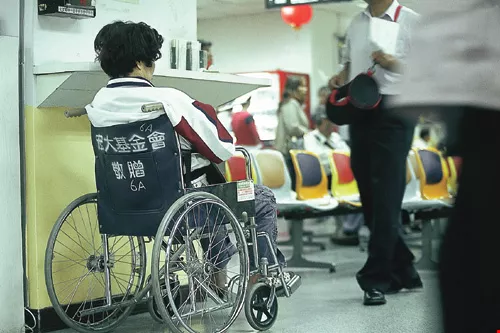
Caregiving is a lofty and noble "exchange of life." It should be praised and honored, but even more should have a support network to help out.
A glimpse into one's own future
Some elderly people cannot be cared for at home because they require the use of modern medical equipment. The father of Ah-liang (not his real name) is just such a person.
Two years ago as a result of a stroke, Ah-liang's father suffered a brainstem thrombosis that was not discovered in time, and he fell into a vegetative state. After two months in an intensive care room he was moved to the Respiratory Therapy Center at Sungshan Armed Forces Hospital, where A-liang also hired foreign care workers to look after him. "Luckily, my dad had a monthly retirement income," says Ah-liang who, just having lost his job, was spared any financial burden. This was a great stroke of fortune in an otherwise unfortunate situation.
There were 20-some patients with tracheotomy tubes living in the Respiratory Therapy Center. They were quiet and tranquil, sleeping soundly. Although he had hired a healthcare worker and his father appeared unconscious and showed no response, Ah-liang came to visit his father at least twice a week. He bathed him, washed his face, gave him a footbath and applied lotions to his skin. Everyone says people in a vegetative state cannot feel anything, but seeing Ah-liang carefully infuse citronella in the water, gently bathe his father's feet and pat them dry, it seems he is afraid of causing his father pain. When his father gets red in the face because he cannot cough, Ah-liang keeps patting him softly on the back. The father in his 70s who is lying in his sickbed seems to have returned to the days of his childhood.
Ah-liang, who has a mentally disabled son, must care for both his son and his father. Friends and relatives commiserate: "How hard it must be!" Ah-liang always answers, "Those lying in a sickbed have it the worst!" In looking after his father, one thing over all has struck him: "When some day your own turn comes, you have to bear all the pain yourself. Nobody else can bear it for you!"
Ah-liang says he is very well aware his father will never make a recovery, "But taking care of him has brought me great consolation, and I have seen my own future," he adds.
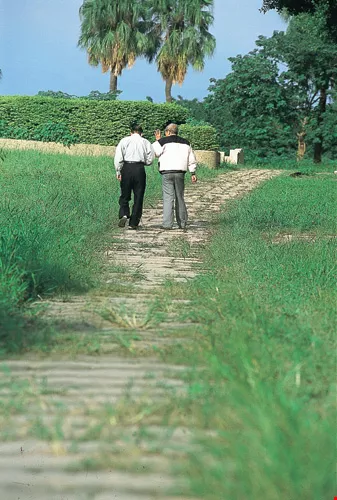
Life's journey will some day come to an end. To have someone to care for one and be one's partner along the way is the fond hope of every elderly person.
Old age a punishment?
When an elderly person in the household falls ill and needs care, a son, a daughter or daughter-in-law, if not choosing to quit a job and do the home care work themselves, will burn the candle at both ends. On the one hand one has to work, on the other hand one must share the healthcare burden. No matter the circumstances, in each and every corner of society many people are taking on the "labor of love."
Half a century ago the average lifespan in Taiwan was just 50 years. Today the average male will live to be 73, and the average woman will live even longer, to the age of 79. The elderly population is increasing, as is average life expectancy. Healthcare needs in the future will grow indefinitely.
According to a 2002 survey by the Directorate-General of Budget, Accounting, and Statistics, the number of people needing care is over 338,000. More than half this figure (53.88%) is composed of the elderly. The proportion of disabled persons cared for at home is 92.4%.
The life of the elderly is now being extended, but it is not necessarily a blessing.
The Chinese writer Ba Jin, who passed away in October, 2005, was 101 years old, but it appeared he didn't want to live so long. In his later years he suffered from conditions like Parkinson's disease, chronic bronchitis, high blood pressure and low blood pressure. He once he burst out, "Long life is a punishment!"
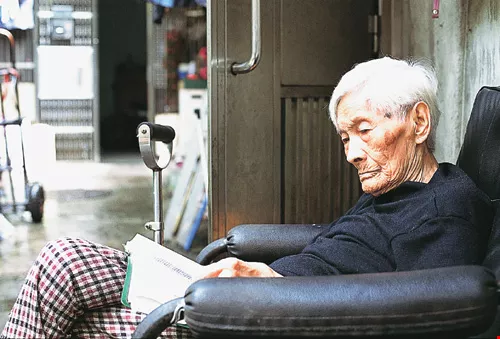
Changes in the social environment have inevitably caused people to raise the cry that they "cannot afford to get old," and "cannot afford to get sick"!
Female = caregiver = poverty
Long-lived old people, punished by myriad diseases, also, very often, represent a punishment for the caregivers.
Chen Yu-fen, secretary-general of the Taiwan Association of Family Caregivers (TAFC) points out that because Taiwan practices traditional family values the responsibility for caregiving has always been a "family affair" or a "private affair." The government has only provided free care institutions for the elderly poor and indigent. The family has been the sole source of care for the rest of the elderly population.
If taking care of the elderly is a family responsibility, who does the caregiving?
According to Wu Shwu-chong, the director of National Taiwan University's Institute of Health Policy and Management, in her study "A National Profile of Family Caregivers of the Disabled Elderly People In Taiwan," more than 70% of caregivers are female, and 30% of that figure are themselves over the age of 65. Nearly half the male elderly population are cared for by their wives, and nearly half the female elderly population are cared for by their daughters-in-law.
In other words, whether or not the family employs a foreign healthcare worker, women--including wives, daughters and daughters-in-law--are the chief caregivers in Taiwan.
Professor Wang Li-jung of NTU's Sociology Department points out that women's taking on the role of caregiver is the result of traditional pressure deeply rooted in the sociocultural system. It is also a difficult problem in the life of modern women.
When the caregiving is being done there is certainly an expenditure of time and energy and even the need to abandon a job, but once the elderly person has passed on, although the work of the caregiver is over, her "sad song" is not.
Wu Shwu-chong says after the patient has passed away, the caregiver is often left with nothing at all. Not only has she lost the feeling of needing each other that she shared with the disabled relative, she has also lost economic self-sufficiency.
A caregiver sadly bemoaned to the TAFC, "Friends tell me I have no income, that I'm just a parasite at home!" In fact, not only is the caregiver not a parasite, his or her economic value is surprisingly high. Calculated at an hourly wage of NT$180 for a home healthcare service provider over a one-year period of 365 days with a workday of 18 hours, this comes out to a value of more than NT$1 million. Nationwide there are some 300,000 caregivers who receive neither salary nor vacation, whose yearly value equals 3% of GDP. "The work of caregivers is definitely not without value," says Chen Yu-fen.
Nevertheless, many caregivers are unable to draw a pension because they have been out of formal employment for long periods. As a result, when they themselves get old they are both sick and poor. Those who have cared for others in the end have no one to look after them. It is a pitiful situation.
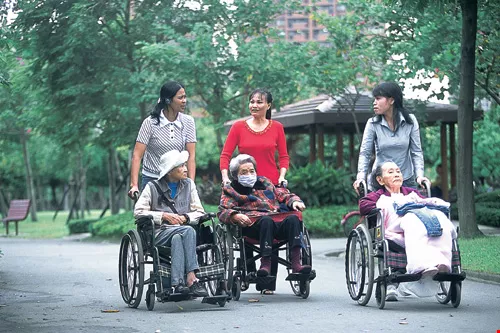
130,000 foreign healthcare support workers have performed a great deal of care work and solved difficult situations for many families, yet their presence has prevented the timely creation of a community care system.
Win-win for both generations?
"Caregiving is an unrelenting 24/7, 365-day-a-year job. You can imagine the pressure," says Chen Yu-fen. Caregiving is a job where "life is exchanged." The younger generation is willing to exchange youthful years for an extension of the elder person's life, but caregiving often gives the caregiver a feeling that nothing has been accomplished, and this is very painful to them.
Wu Shwu-chong points out there is a completely different state of mind associated with caring for the elderly and caring for children. The health of the elderly constantly deteriorates. Not only does this sadden the caregiver, the caregiver feels the future holds no hope.
It is especially those caring for patients with dementia or mental illness who are on call 24 hours and suffer in silence. Dr. Fu Chung-ling of the General Neurology Division at Taipei Veterans General Hospital has conducted a survey among caregivers for dementia suffers. One third of the respondents showed a tendency toward depression.
Yu-chuan (not her real name), who lives in Chiayi, is an example. Yu-chuan was married only one month when her mother-in-law had a heart attack brought on by her diabetes. With no time even for the joys of a new bride, Yu-chuan had to bury herself in work caring for her mother-in-law.
"My husband was an only son, and maybe my mother-in-law felt I had stolen him from her," is how Yu-chuan explains why her mother-in-law fell ill.
The traditionally minded mother-in-law had frequently criticized her friends' children for not being filial when they "dumped off" the work of caring for them on a Filipina maid. When she herself became ill, naturally she was not willing to have a maid care for her, and it followed as a matter of course that the job fell to her only daughter-in-law.
With three meals plus snacks, Yu-chuan prepared food six times a day with reduced oil and salt in strict accordance with the doctor's orders, and she also ate with her mother-in-law to provide some encouragement for her. But the mother-in-law showed no thanks for her efforts, and if she didn't feel well, she blamed it on the poor food Yu-chuan had prepared.
This kind of carping Yu-chuan could handle, but what was difficult to take was that the mother-in-law, who had a history of mental illness, was likely at any time to exhibit "odd behavior." For example, she would urinate in the washbasin next to the bed and then toss the contents off the balcony, or she would take Yu-chuan's business card and go around calling on people and cause trouble.
"Every morning I got up and went downstairs trembling with fear, not knowing what my mother-in-law would be up to," says Yu-chuan. For four years she was constantly "preparing for battle," with no chance at all to go to work, and the thought was always with her that she might "just die along with my mother-in-law." Even today, three years after her mother-in-law has passed away, she sometimes finds herself awakened by dreams at night.
Another example is the Hung family. When the four daughters and mother put the father, who suffered from dementia, into a nursing facility, they were questioned by their neighbors: "With so many women in the family, you mean you can't take care of one old person?" But, says Mrs. Hung, after becoming ill her husband was a completely different person. He would always be getting lost, would relieve himself anywhere and sometimes even wrap up his bowel movements and hide them in the closet. Nobody in the family could take it. Add to this that she was an elderly person herself and suffered from diabetes, and that each of the four women either had a job or a family to look after--it was really impossible to take care of him.
"In the nursing home there are trained nursing staff to take care of him, what's wrong with that?" says the eldest daughter. Every week she now goes to see him at the nursing center. The old feeling of disgust that wouldn't go away and the evil thought of "How long is he going to drag this thing out before he dies?" gradually dissipated and she has a better relationship with him now than when they lived together.
The pressure felt by many caregivers actually stems from a lack of understanding on the part of others. An example is the "elderly parent" phenomenon that has characterized Japan in recent years, where 60- and 70-year-olds are caring for 80- and 90-year-old parents. One almost 60-year-old couple was caring for the elderly father, who had diabetes and high blood pressure. They carefully did everything the doctor ordered and watched over the old man's diet very strictly, making him so unhappy that he went on a hunger strike. After he passed away relatives didn't understand and thought they had "starved the old man to death." The couple felt very hurt and thought their good intentions and filial conduct had been misinterpreted and they had been wronged but had nowhere to turn for sympathy.
No regrets?
"No regrets about life or death." Many people, Wu Shwu-chong points out, are ready to live by this motto. Everyone should respect and encourage this high-minded sentiment. But there's no hiding the fact that for many people it is not a matter of choice--they must abandon their job, return home and take over the burden of caregiving.
When a family is incapable of providing care, the government must extend a helping hand so that caregiving is no longer the overwhelmingly depressing work each family must carry out behind closed doors. The risk of this heavy burden should be shared by the entire society. Thus the creation of an adequate number of long-term care facilities of reliable quality is the direction in which many advanced countries are moving.
Currently Taiwan's long-term care system includes the Department of Health and the Department of Social Affairs of the Ministry of the Interior. Unfortunately the two are not integrated and there is no common policy direction.
At present assistance provided by county and city departments of social welfare is limited to either "in-home service" or a "special care subsidy." The targets of this help are the disabled elderly; the caregivers are only sideline beneficiaries. But for quite some time only a few people have availed themselves of these social benefits because of the many restrictions and conditions.
In the past the "in-home service" carried economic restrictions (only for middle- or lower-income elderly). This service was extended to all elderly persons in 2003 when an "In-home Service Plan for Non-Middle- or Low-Income Disabled Elderly" was begun on a provisional basis. After one year less than 15,000 elderly were enjoying this service, a very low percentage of the more than 180,000 disabled elderly.
Because the "caregiver subsidy" that was supposed to make up for losses sustained by family members who had to give up employment opportunities to provide home care was only NT$5,000, it was really impossible to pay for any kind of service. Also, there was a strict requirement that a caregiver be under 65 years old and have no income at all. As a result, this was called the "betel nut subsidy," and very few people took advantage of it.
Chen Yu-fen cites Taipei as an example. Only 80 to 90 people have requested the "special care subsidy," and the number for all of Taiwan is around 100. Wu Shwu-chong points out that the Taipei County Government made subsidy payments for a few years on a broad basis but did not spark sufficient interest, and no domestic in-home service industry was developed.
"Sunny holidays" for caregivers?
As for the treatment side, the National Health Insurance Bureau pays for two "in-home care" visits a month. Professional nurses come to the home and provide nursing guidance and care. Demand for this service is higher. In 2002 alone 122,008 payments were made.
In addition, the Department of Health provides a daycare "hospice service." Popularly known as a "sunny holiday" for caregivers, this service is available seven days a year with a subsidy of NT$1,000 per day for the disabled elderly. The caregiver can send the patient to a nursing home or care facility where 24-hour care is available and then take a few days vacation for herself. Nevertheless, according to 2003 statistics, only 2,068 people made use of this service, a smaller percentage than for in-home care.
Why don't caregivers make good use of these rare "sunny holidays?"
One caregiver says her fondest desire is to be able to take a three-day vacation. But, since it's so hard to get a vacation, why doesn't she make use of the hospice service? The reasons are that the vast majority of care facilities are not of reliable quality, transportation to take the patient to and from the facility is a lot of trouble, and there are worries that the care given will not mesh with the patient's personality or even that during the very short period of time for which the patient is handed over there might be an accident , causing a lifetime of regret on the part of the caregiver. These factors lead people to reject the government's good intentions.
In all these measures that seem to assist the caregiver there is, however, a catch.
"The root of the problem is that at the community level in-house service or hospice facilities have not really become a reality," points out Wu Shwu-chong. As long as neighborhoods lack a support system and caregivers are isolated and unsupported, there is no way to improve this situation where the caregiver has no one to share the burden with.
In recent years the Peng Wan-ru Foundation has actively promoted the idea of community-level healthcare. Professor Liu Mei-chun from National Chengchi University's Institute for Labor Research points out two reasons for this. First, idle manpower in the community can be turned toward the care industry and employment opportunities for women can be created; second, sharing the heavy burden of home care with a local community-based service can break the natural linkage between caregiving and women and further advance caregiving, heretofore unpaid, as a "paid activity."
To get fair treatment for caregivers--usually women--the elderly in some countries have a custom of "leaving the house to the caregiver." Also, to fit the notion of the elderly "growing old in their own home," a popular trend has developed in the US, Canada, Europe, Japan and Singapore where "care and living costs are mortgaged." The elderly person mortgages the house to the bank, which in turn makes regular monthly or yearly payments to the individual until she or he dies, at which time the house reverts to the bank.
The caregivers
Moving toward a community-based care industry seems feasible, but why is it so slow in coming?
Wu Shwu-chong says frankly that the reason community care can't get off the ground has a lot to do with the introduction of foreign healthcare workers. "This is a chicken or egg question," she explains. 130,000 foreign healthcare workers not only make it impossible for local workers to find employment, they also have caused us to neglect an opportunity to create a community care system. The government's policy should really take into consideration the overall, long-term picture and not just what is happening at the moment.
In addition to economic and physical help, having an emotional outlet is also extremely important for caregivers.
There are ten branches in Taiwan of the TAFC. Each month they organize an afternoon tea and provide four hours of hospice service so caregivers can get free to have tea, chat with one another and "vent." When 40 or 50 caregivers get together and start talking about things that make them feel bad, red eyes and tears--and a lot of mutual bucking-up--are inevitable. But when will the day come that caregivers will really be able to be proud of their work and no longer sing their somber song alone?


@List.jpg?w=522&h=410&mode=crop&format=webp&quality=80)


