An Artist at the Wheel--Chou Meng-te
Chang Chiung-fang / photos Lin Meng-san / tr. by Robert Taylor
December 1995


In mid-August this year, a series of violent street clashes between taxi drivers once again brought Taiwan to the attention of the international media. Television news broadcasts in countries such as the USA and Japan reported the battles between Taiwan's cabbies as a "major international incident," alongside the terrorist bombing at the Arc de Triomphe in Paris.
For over a year, there have been frequent reports of Taiwan's taxi drivers being involved in street protests and disputes. They have featured in campaigns ranging from opposition to the system of affiliation to cab companies and the introduction of compulsory third-Party motor insurance, to protests against the planned fourth nuclear power plant. This has led some people to describe the various disturbances associated with taxi drivers as a "yellow peril."
During the gubernatorial and other elections late last year, taxi cabs flying supporters' pennants could be seen on' the streets everywhere, and there were frequent reports of passengers being ordered out of taxis by drivers because of differences of political opinion. Sociologist Micheal Hsiao describes urban taxi drivers as a newly discovered herd of "political animals."
"Yellow peril" or "political animals," in fact taxi drivers such as these are only a minority among Taiwan's 170,000 cabbies. Most taxi drivers spend their days driving busily hither and thither to earn their living. Chou Meng-te is one of them. But what sets him apart from most taxi drivers is that as well as holding the steering wheel, he often wields an artist's brush.
With his moustache, his slightly tousled shoulder-length hair, which is held off his forehead by hairpins, and his short, 160-centimeter stature, the somewhat dishevelled-looking Chou Meng-te exudes the air of an "artist." But in fact, by profession Chou Meng-te is-a taxi driver.
A 1600cc yellow Ford Laser taxi with the name Chou Meng-te sprayed on the doors in red is the tool on which Chou relies every day to earn his living.
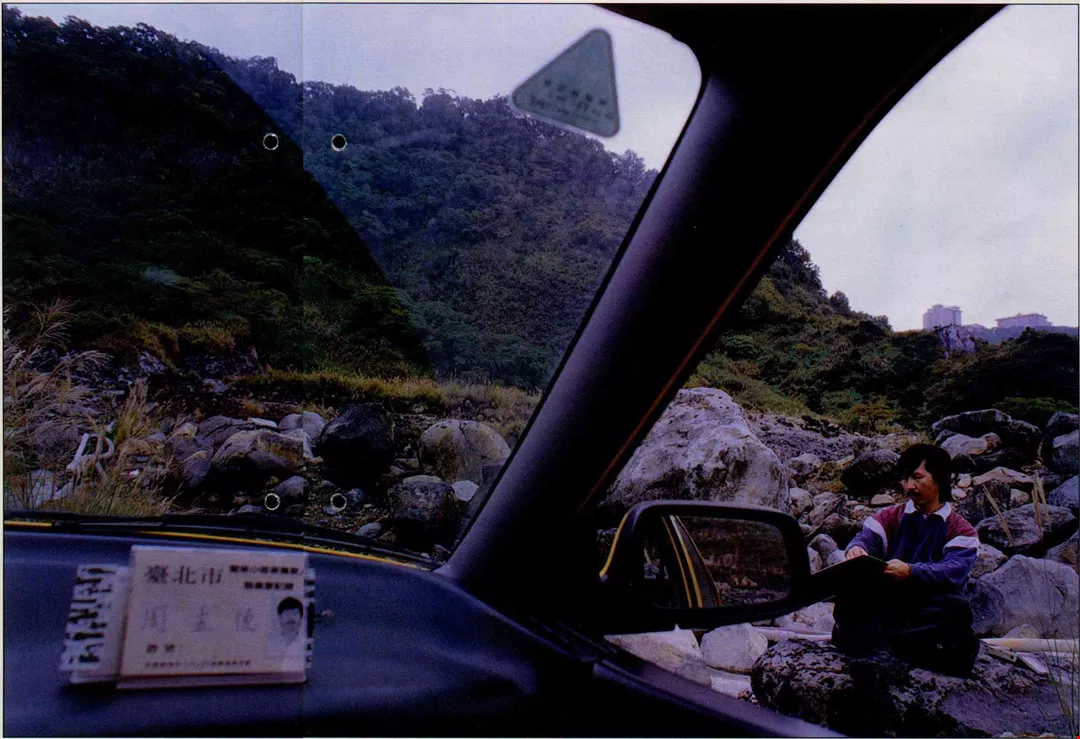
Taxi driving is his profession; painting is his passion. Chou Meng-te is constantly seeking a balance between his ideal and the realities of life.
Inside the black bag
The inside of Chou Meng-te's cab is clean and simple. Apart from his driver's registration certificate on the dashboard shelf, there is no other decoration. The only thing at all suspicious is a large black shoulder bag next to the driver's seat.
Every day when Chou leaves home to drive his cab, he takes this bag with him to have on hand when he needs it. So just what is in this bag which never leaves Chou Meng-te's side?
With the owner's permission, we open the heavy bag and look inside. There is no sign of a lunch pack or drinks flask to still Chou's hunger or quench his thirst. Instead, the bag is filled with neatly arranged artist's materials: wax crayons, ball-point pens, sketchpads, copper engraving plates and so on.
In fact, this is not the only art equipment Chou Meng-te carres with him in his cab, for in the boot of the car he also has an easel, oil painting equipment, colors and more everything a painter could need.
For a taxi driver, all these paraphernalia are superfluous and take up space. But for Chou Meng-te they provide spiritual sustenance while he is driving. Among Taiwan's taxi drivers, Chou Meng-te is possibly the only one who combines a cab-driving career with artistic creativity.
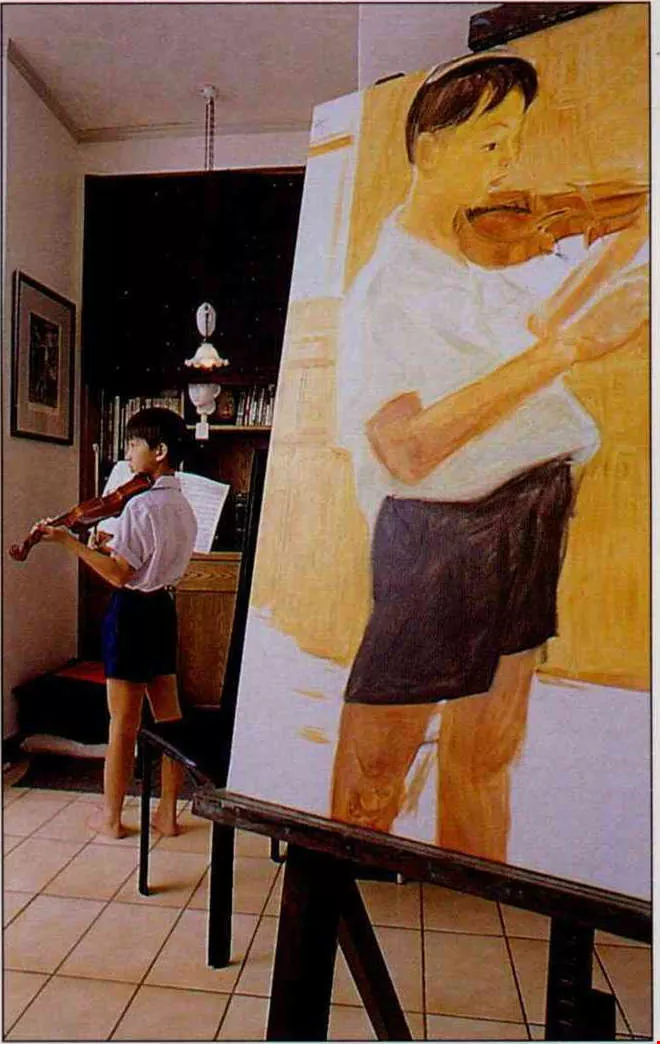
(above) An oil painting on which Chou Meng-te is still working. The model is his younger son, who not only plays the violin well, but is also quite a gifted artist.
Income and independence
Many people think of taxi driving as an excellent "reception center for the unemployed and waystation for those changing jobs."One just has to pass the test to get a commercial driver's license and sign up with a cab company, and one can immediately get on the road and start earning money.
Chou Meng-te, a commercial college graduate, once taught advertising design to physically handicapped students at the Jen-ai experimental school in Changhua. In his spare time he painted for his own pleasure. But later his father suffered a stroke, and the family faced a difficult financial situation. The burden of supporting the household fell entirely on Chou Meng-te's shoulders, and he had no choice but to leave his undemanding teaching job with its regular salary and find another way to earn a living.
What kind of job would enable him to earn more money but still pursue his interest in art? Taxi driving, with its flexible hours, was a job which Chou Meng-te thought at the time would be worth a try. "There's money to be earned 24 hours a day, and I could decide myself how much I wanted to earn, and when I wanted to rest or paint." Chou Meng-te asks: "What other line of work can give you that much independence?"
So he ignored his family's opposition and moved from Changhua to Taipei to enter the taxi business, despite his family's fears that it would bring him into contact with all kinds of undesirable characters. Since then 15 years have gone by, and he has gone from bachelorhood to marriage and fatherhood, from rented rooms to his own flat-all of it paid for by his taxi driving.
The large degree of independence of taxi driving also enables Chou Meng-te to look after domestic needs while working. Because his wife Cheng Hui-luan is paralysed in both legs and cannot get around easily, jobs like shopping for food or ferrying the children to and from school have always been handled by Chou Meng-te. When his wife needs to go out anywhere, Chou is naturally her driver too.
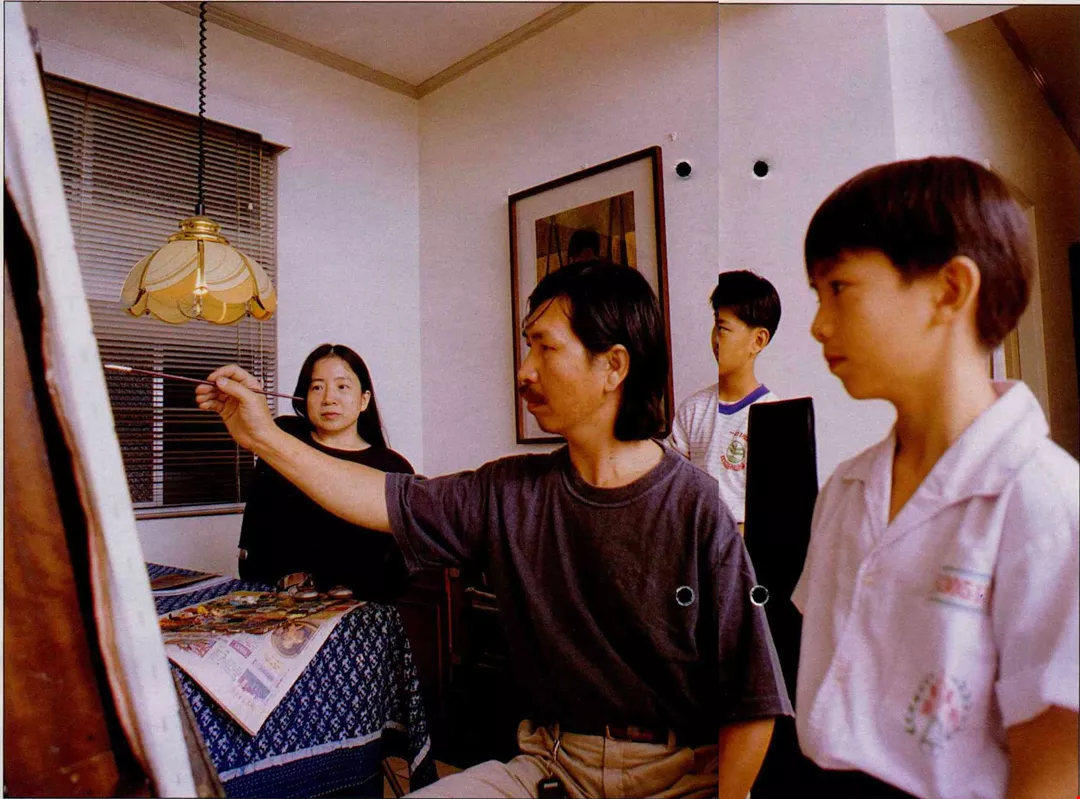
(right) For the last 15 years, Chou Meng-te has relied on driving his taxi to get married, raise a family, buy a flat and lead a happy, satisfied life.
Saving for a sunny day
In the first two years when Chou was driving, Taipei city had only around 20,000 taxis, and private cars were less common than today, so business was quite good. It was not hard for Chou Meng-te to earn enough every month to send money home for his parents to live on, and to pay for his own living expenses and his cab company fees-around NT$30,000 in all. But after he married and set up his own home, his burden became heavier.
In order to meet his family responsibilities and pursue his interest in painting, Chou Meng-te made some careful calculations. "After my own and the car's 'food money,' I made it my rule that every day I must earn NT$2000 to take home and give to my wife before I could put away the car and do what I wanted to myself." He says that apart from household expenditure, these NT$2000 also covered the cost of maintaining the car and the money to be put aside to replace it in the future.
To save money, Chou Meng-te is constantly on the lookout for eating places with cheap, good food and convenient parking. "I look for a spot in every area, so when mealtimes arrive I have somewhere to go nearby wherever I happen to be." Chou says a chicken-and-rice shop on Chilin Road is one place he visits often.
The ever-provident Chou Meng-te is always looking to "save for a sunny day." On rainy days when business is better, or when his luck happens to be in, he works longer to earn more, to make up for times when trade is slack.
Nevertheless, for a taxi driver, earning NT$2000 a day is no easy matter. On average Chou used to drive at least 12 hours a day before he could knock off.
"When he came home after working hard all day he often stayed up half the night painting," says Cheng Hui-luan, adding that Chou often used to drive until two or three in the morning, but then still found the energy to go to a crowded pub or a hot springs on Yangmingshan to paint. "In Taipei City it's really not easy to find a spot with beautiful scenery to paint." Although it makes her heart ache to see how much effort her husband expends to both earn a living and pursue his interest, she has never interfered or tried to stop him, because she knows very well that: "If he can paint, he's happier!"
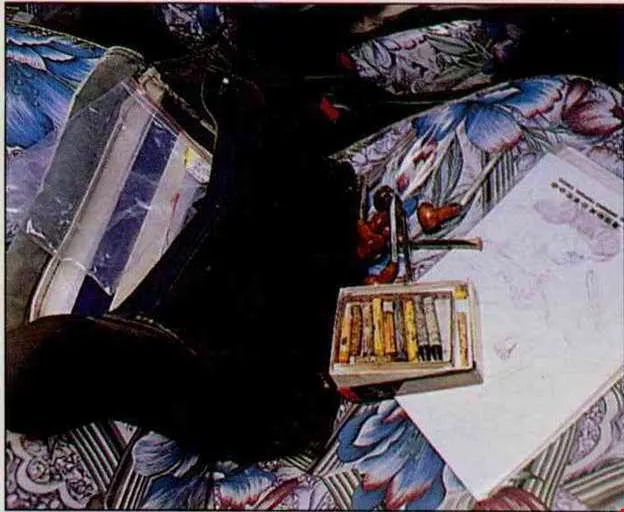
In Chou Meng-te's car, a full selection of artist's materials is on hand.
Self-cultivation at the wheel
For anyone, spending 12 hours a day at the wheel of a car, or doing any other kind of work for a dozen hours without a break, would be an arduous task. Driving in Taipei City is an even greater challenge.
But in many years of driving, Chou Meng-te has gained the instincts of a professional. "When a fare gets in and tells me where they want to go, by the time I've moved off and reached fourth gear, I've already planned out my route," he says. After that, much of his mind is free to think about other things, such as chatting with his passengers about everything under the sun, thinking about his paintings, listening to the radio and so on.
Threading his way through Taipei's streets and alleys from morning till night, Chou knows every part of the city, and the routes through it, like the back of his hand. "You can get through along Chunghsiao East Road in the morning before the shops open at 11 o'clock, but from three in the afternoon till seven in the evening, nothing moves...." "Don't go towards Keelung on Fridays, because that's when goods go through customs, and the road's chock-a-block with container lorries...." "Whatever you do, don't go to Sanchung on the 25th of April. There's a big temple festival there that day, and once you're in you'll never get out...," he says, displaying his comprehensive knowledge.
However, in busy, chaotic Taipei, there's often no way to avoid getting caught in a snarl-up. When this happens, says Chou Meng-te with a laugh, "I make the driver's seat a place to cultivate myself." Taipei's traffic situation is something he can do nothing to change, so he can only find ways to adapt.
When the traffic grinds to a halt, Chou Meng-te takes his sketchpad out of his bag, and uses the opportunity to quickly sketch the passengers dozing in his cab, or people waiting for a bus at the roadside, as "notes" to serve as material for later paintings.
But most of the time Chou Meng-te simply attentively observes and remembers impressions and features. Then after his fare has got out of the cab, he stops somewhere at the roadside and sketches what he has just seen from memory. "I can often capture some pretty good things!" He says with a laugh: "Other people hate traffic jams, but I like them!"
For a while he even took plasticine along with him in the cab and in traffic jams he would mould it into little human and animal figures, which he placed along the top of the dashboard under the windscreen as decoration. But when the weather turned hot the plasticine would soften and collapse in the sunshine, so he stopped.
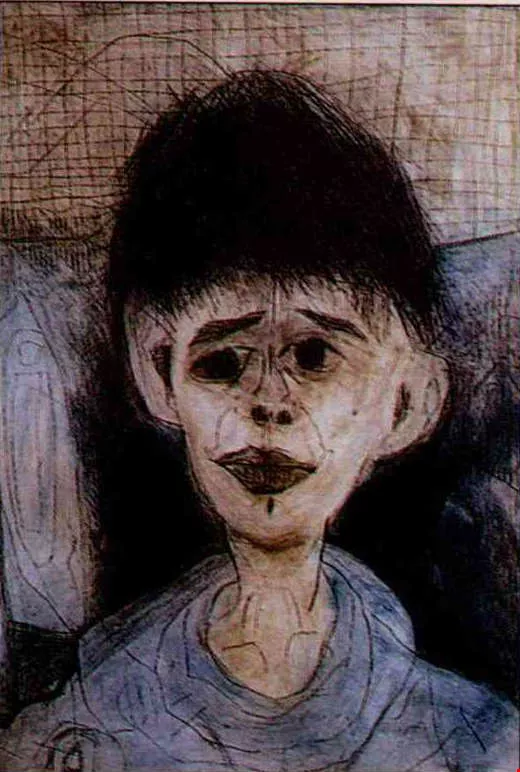
A self-portrait by Chou Wu-han, Chou Meng-te's younger son. Can you tell it is the work of a nine-year-old child?
A lone warrior of the streets
Since the advent of radio taxi firms in 1988. drivers with two-way radios in their cabs often use them to argue or chat with friends and colleagues as they drive.
Unlike these radio cab drivers who can build friendship with colleagues over the airwaves, individual operator Chou Meng-te works alone. He has no colleagues or even friends among his fellow taxi drivers.
"When I meet other drivers by the roadside we say hello and ask how trade is, but we don't talk about anything more than that. There's no real friendship to speak of," Chou Meng-te observes.
Driving around all day alone, with no colleagues to chat with to get news, and little time to read the newspapers or watch TV, listening to the radio has naturally become Chou Meng-te's main source of information. "I used to listen to Public Radio System or BCC, but now I like to listen to underground stations like 'Green Peace' [Green Peace Taiwan Culture Broadcasting Station--not connected with Greenpeace] and 'TNT,'" says Chou Meng-te. In any event, he says, traffic jams are everywhere, so there's no point listening to the traffic report. He would rather hear academics' and experts' analyses of current affairs and understand social trends and the stories behind the topics of the hour. For instance, the controversy over redevelopment of military dependents' villages has been hotly debated recently, and analysis on the radio has enabled Chou Meng-te to understand opponents' points of view.
Another subject which has been much discussed on underground radio stations recently- -the system of taxi drivers' affiliation to cab companies is even closer to Chou Meng-te's heart, for he himself has been one of its victims in the past.
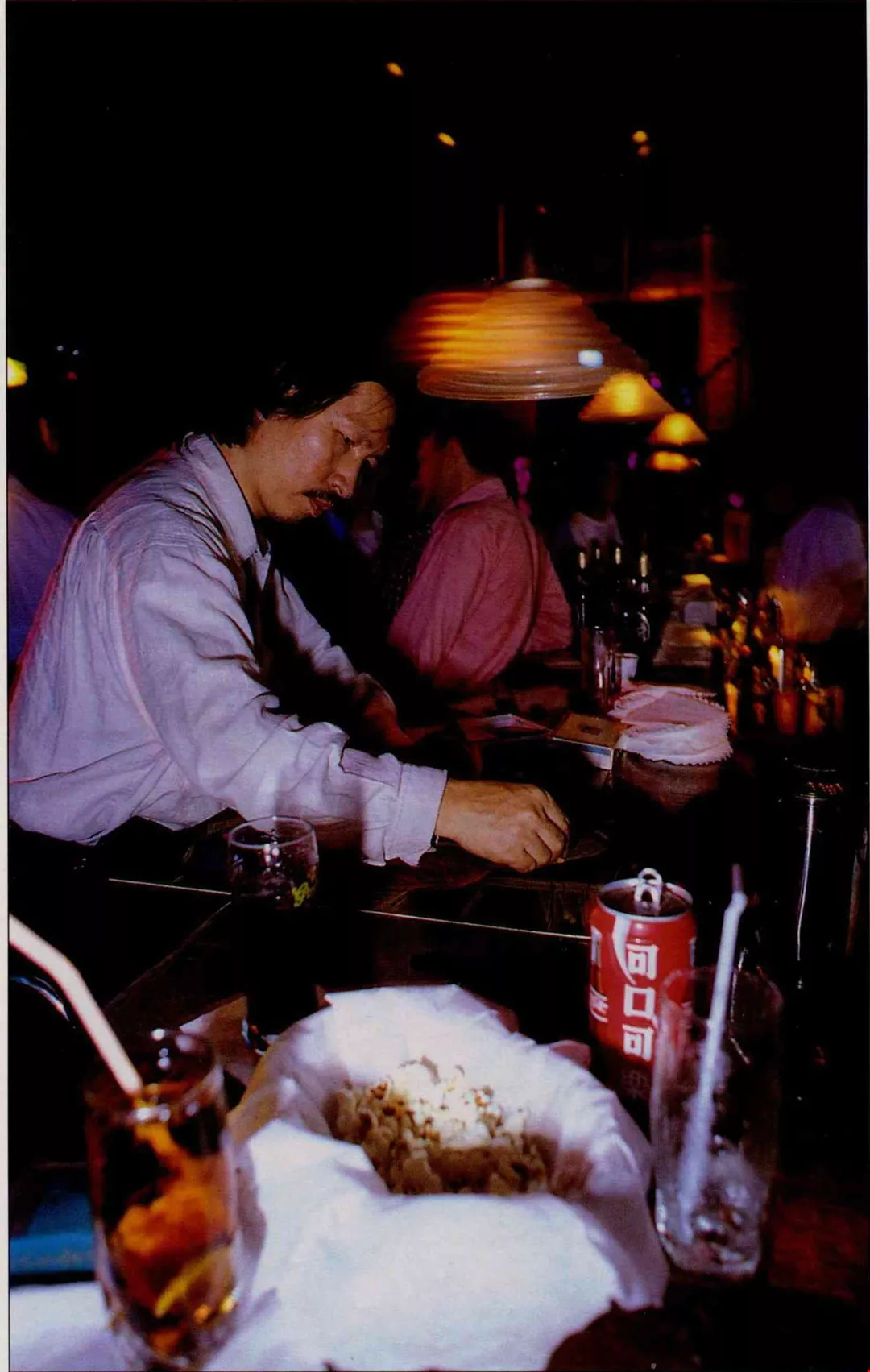
After work, Chou Meng-te often goes to a pub to observe the variety of night life. Despite the hubbub and low light, Chou still draws with intense concentration.
Leaving the cab company
Chou Meng-te has been driving a taxi for 15 years, and gained his individual license plates five or six years ago. In Taipei City, only 9000 or so drivers are in the same happy position.
Thinking back to how difficult it was to escape from the cab company and successfully apply for an individual license, Chou's normally mild tones become more emotional as he describes the many harsh restrictions which the Ministry of Transportation and Communications initially placed on their issue. For instance, drivers had to have been registered for at least 10 years (in May 1994 this was reduced to five years); they must not have any points against them for traffic violations in the last three years (in 1995 this was changed to not more than one point); the vehicle must be their own, and so on.
Apart from these restrictions, there is another bothersome hurdle for drivers to clear. Because under the cab company affiliation system all the vehicles are registered in the company's name, when a driver wishes to apply for individual license plates he has to get the cab company to issue a "certificate of transfer" before his vehicle, which was originally paid for with his own money, can be registered in his name. Chou Meng-te says he was a "good" driver who always paid his company dues on time and never owed any back taxes, but even so it took him two long years to get a certificate of transfer out of the cab company. As for some less "well-behaved" drivers, the companies simply do not let them go.
This is why Chou Meng-te expresses sympathy and support for the street protests by members of the "All People's" taxi drivers' association, calling for the company affiliation system to be abolished, even though he is not directly affected.
"Those All People's drivers joined together of their own accord to fight for what are nothing more than the rights taxi drivers ought to have. They sacrifice their own working time to fight for the rights of all taxi drivers, but because of a few violent incidents they've all been labelled 'ruffians.' It's really not fair!" Chou says with feeling.
"The vast majority of taxi drivers are good. It's just a small number who behave badly that bring down everybody's image!" Cheng Hui-luan also says that living as she does in the Rose China City estate in Hsintien, which is not very conveniently located, when her husband is too far away or too busy and she wants to go out or the children need ferrying to or from school, she calls a cab. As a taxi driver's wife herself, Cheng Hui-luan uses taxis with complete confidence.
However, as a cabby, Chou Meng-te is deeply aware of the atmosphere of mutual distrust between drivers and the general public. "Once a child asked me the way somewhere. When I explained it he looked a bit confused, so I told him I'd drive him there for free. When he heard that, he was so scared that he picked up his legs and ran," says Chou Meng-te with a wry smile.
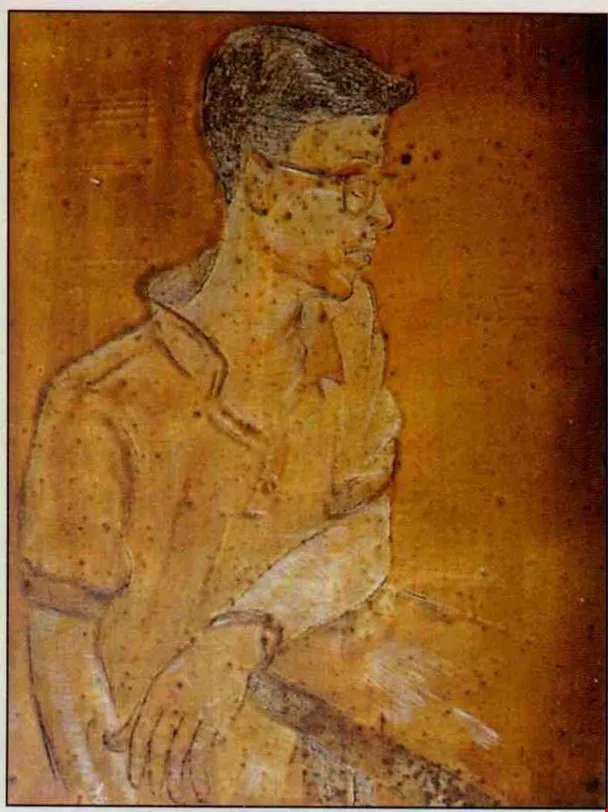
One of Chou Meng-te's latest works: an engraving based on a character in a pub.
Legs of jelly
The running battles between taxi drivers on the streets of the Kungkuan area of Taipei in April this year did tremendous harm to taxi drivers' already poor image. Chou Meng-te feels that there was "more to this conflict than meets the eye- -perhaps there were gang members involved. Taxi drivers would never have that much energy for fighting."
Something of the reasoning behind this conjecture is revealed in a joke which is currently going the rounds among taxi drivers: a cabby gets into an argument, and blazing with anger, jumps out of his cab to give the other fellow a thrashing. But when he gets out he finds his legs have turned to jelly, and he can hardly even stand, let alone fight.
Chou Meng-te feels this joke isn't at all exaggerated. To take using the clutch as an example, he points out that every time he stops at a red light, starts off again and shifts up the gears, he has to depress the clutch pedal five times. As to how many times he uses the clutch when driving twelve hours or more in Taipei's stop-go traffic, Chou Meng-te shakes his head and says:"It's impossible to calculate!" "Every day when I get home I have to spend NT$30 to get one of my kids to massage my legs," he says wryly.
Spending long periods in the restricted space behind the wheel has brought on many ailments. For instance, irregular meal times have given him digestion problems; he has hemorrhoids from long hours in the driver's seat; driving with the windows closed and the air conditioning on to keep out the polluted air gives him aching joints; watching the road and traffic signals all day tires his eyes and makes his vision blurry; using the clutch constantly in stop-go traffic leaves his left leg painful and weak, and so on. But such complaints are the order of the day for taxi drivers.
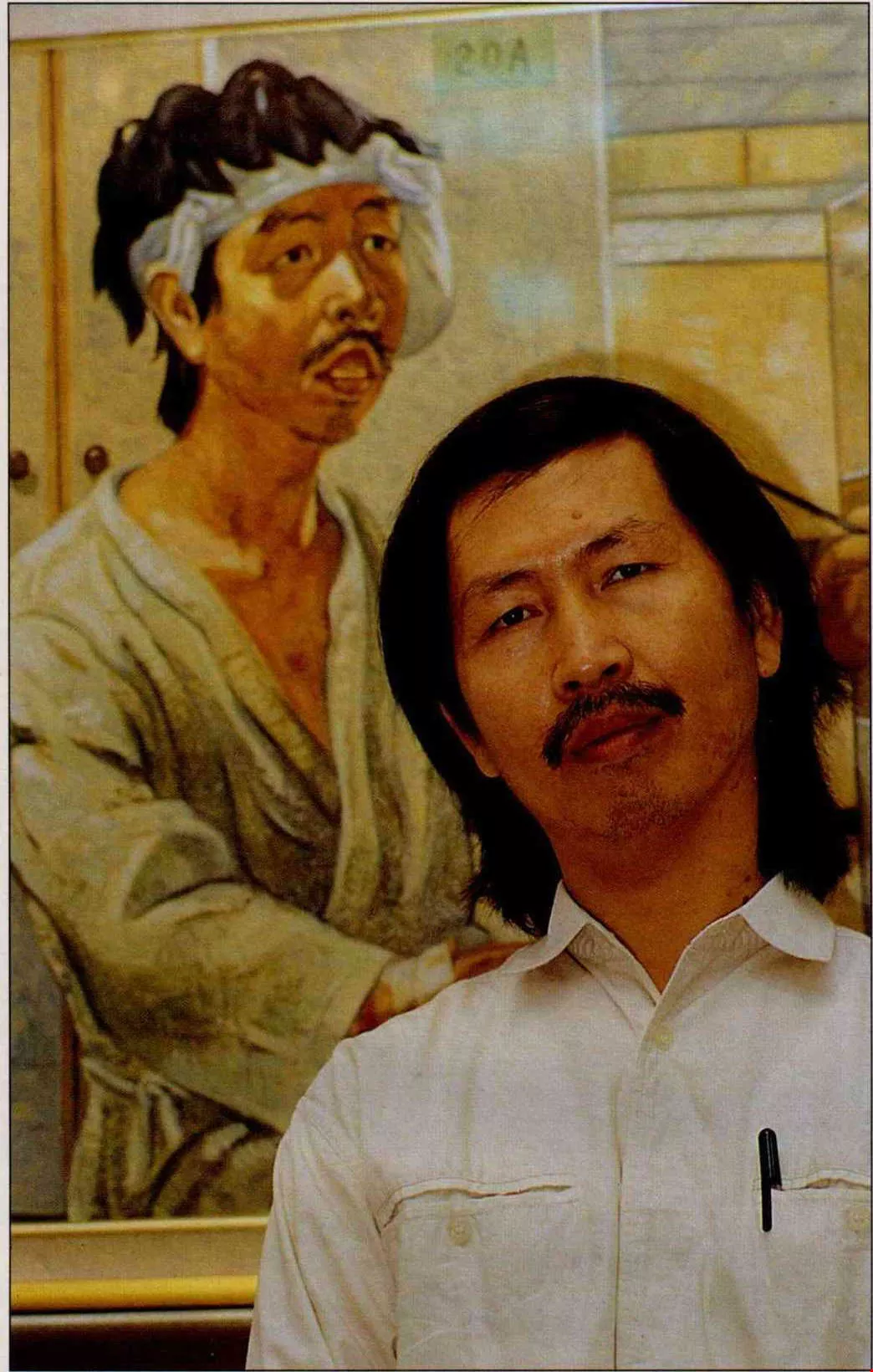
The artist and his self portrait, photographed at an exhibition in Kaohsiung in October of this year.
Springboard or quicksand?
"For a young person to spend the best ten years of their life driving a car around for ten or more hours a day really is a great waste." Chou Meng-te asks why our society can't provide a reasonable environment which would allow a taxi driver to be able to earn a living by driving eight hours a day, leaving cabbies time to be with their families, to do the things they want to do, and to relax.
He believes that the reason taxi drivers cannot earn a reasonable income has to do with many factors, including the high price of vehicles in the ROC, chaotic traffic conditions, unreasonable government policies, and the high cost of housing and consumer goods.
"Myself, I have no complaints about driving a taxi, because I take a positive attitude and get the things out of it that I want. It's been an important springboard in my life."
Chou Meng-te says with deep feeling: "But you can't stay too long on this springboard, or it will turn into quicksand in which you sink deeper and deeper the more you kick, and you'll never get out of it." This is because the older one grows, the fewer opportunities one has to change jobs. When you've been in this business too long, not only your car is old, you become riddled with aches and pains your-self too. "It really makes you feel bankrupt!" he says.
The painting taxi driver
Chou Meng-te has never given up painting, and it is not only an important spiritual element in his life, but has gradually begun to replace driving as a source of income. Starting from his first personal exhibition in 1986, Chou Meng-te has held 12 exhibitions. His works range from his ball-pen drawings-which few other artists do- -to oil paintings, prints and wax crayon drawings. In the last few years, as his opportunities to exhibit have increased, Chou Meng-te has gradually reduced the time he spends behind the wheel of his taxi. After taking his children to school at 7 a.m., he drives his cab until lunchtime. At midday he finishes work, fetches the children from school and returns home.
Today he has paid off the mortgage on his flat, and with the extra income from selling his paintings, driving half a day is enough to pay the family's bills. Thus Chou Meng-te can devote more of his efforts to artistic creativity. This taxi-driving painter really did store up enough energy in his "springboard" to propel him into the field of artistic creativity. But can Taiwan's 170,000 other taxi drivers follow his example and leap into the world of their own dreams?
[Picture Caption]
p.106
All kinds of taxi passengers are grist to Chou Meng-te's artistic mill. This work is entitled Lovers.
p.107
Taxi driving is his profession; painting is his passion. Chou Meng-te is constantly seeking a balance between his ideal and the realities of life.
p.108
(above) An oil painting on which Chou Meng-te is still working. The model is his younger son, who not only plays the violin well, but is also quite a gifted artist.
p.108
(right) For the last 15 years, Chou Meng-te has relied on driving his taxi to get married, raise a family, buy a flat and lead a happy, satisfied life.
p.109
In Chou Meng-te's car, a full selection of artist's materials is on hand.
P110
After many years of hard effort, Chou Meng-te is gradually pulling himself free of the "quicksand" and successfully shifting the focus of his activities to the creative art he loves.
p.111
A self-portrait by Chou Wu-han, Chou Meng-te's younger son. Can you tell it is the work of a nine-year-old child?
p.112
After work, Chou Meng-te often goes to a pub to observe the variety of night life. Despite the hubbub and low light, Chou still draws with intense concentration.
p.113
One of Chou Meng-te's latest works: an engraving based on a character in a pub.
p.114
The artist and his self portrait, photographed at an exhibition in Kaohsiung in October of this year.


@List.jpg?w=522&h=410&mode=crop&format=webp&quality=80)


