A Renaissance for Old Houses in the "Southern Capital"
Chen Mi / photos Chen Po-yi / tr. by Phil Newell
October 2008


It has been 280 years since Tainan formally became a city with the construction of its city walls, and it ranks first in Taiwan in terms of concentration and age of cultural assets, including such Grade 1 national historic sites as Fort Provintia and the Erhkushen Artillery Emplacement (known literally in Chinese as the "Eternal Golden Fortress"). Yet there is also a feeling about this place that "treasures are hidden among the ordinary people," because the city's real character comes from the old houses, shops, clinics, temples, markets, and narrow back alleys that are still inhabited or used in daily life.
In recent years, urban planners and cultural agencies in Tainan have been promoting a "renaissance of old neighborhoods," and have begun subsidizing private owners to maintain their old structures. But in the non-governmental sector as well, a group of old souls who are especially sensitive about the lighting, lines, atmosphere, and sounds of old houses have been, spontaneously and with no overall planning, working to preserve Tainan's memories, and have opened up a new dialogue of harmonization between modern and old spaces.
In the historic city of Tainan-known also as "the Southern Capital" because it was Taiwan's earliest political and commercial center-live a group of old souls who enjoy strolling through bustling streets and quiet back alleyways in search of old houses that offer the sights and atmosphere of yesteryear. When they spot one of their prey, their faces light up like a child who has found a beloved lost toy, or they gaze enraptured like one who has met his or her dream lover. What's especially interesting is that this nostalgia for the past is not confined to the middle-aged or elderly.
Thirty-year-old rock 'n' roller Lin Wen-pin, part of the "alternative" generation, loves to while away his spare time riding his bike along the streets of Tainan picking up "old junk." Last year he and his girlfriend, interior designer Huang Hsiao-chien, conceived a plan to open a bar that would have music as its soul and old objects and materials for its decor-with the emphasis on old. Eventually they encountered a house which would make a perfect location, combining Japanese and Western design features, that had been built in the 1950s. The owner was going to tear it down to make a parking lot, but after he heard the plan of these young lovers, he generously decided to rent it to them so that their dream could become a reality.
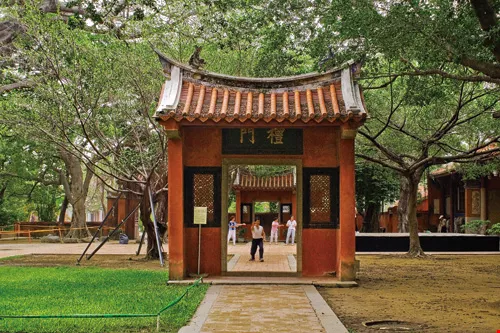
With so many historic sites dotting Tainan, the encounter between old houses and "old souls" has thrown up lots of sparks. The photo shows people doing martial arts training at dawn in front of the Confucius Temple.
Responding to the call
With its many doors and French windows, and a garden, the building already had plenty of light and gave clear, open views, so there was no need for any major structural alteration. The most difficult stage in the renovation process was converting the kitchen into a bar. Lin and Huang adopted "the drawer" as their design theme, and spent half a year arranging old drawers, dressers, wardrobes, and food shelves that they had collected, giving them new life as wine racks, bookcases, and so on.
Today, "Kinks25" is a coffee shop by day and rock bar by night. The front door faces directly onto the railroad tracks, where trains roar past periodically. But when you walk into this square space surrounded by a brick wall, in an instant the sound of rock music replaces that of rattling rail cars, and this 50-plus-year-old structure with its traditional black tile roof takes on a character that is surely unique.
There is in fact a whole group of young "alternative" people who never considered themselves the type to open their own establishment, yet have nonetheless heeded the beckoning of the old houses and plunged right in.
Shih Chien-wu, a 24-year-old graduate of National Hualien University of Education, returned to his hometown of Tainan to find his purpose in life. Just by chance he saw an old house on Shennung Street and conceived the notion to turn it into a workshop.
At first the landlord didn't want to rent the house-it had no electricity, the roof leaked, and it just seemed to be too much of a hassle to fix it up. But Shih promised that he would take responsibility for all the work. He and a former schoolmate, Lin Yu-cheng, used every free moment to work on the tottering walls and leaning pillars, and sent truckloads of refuse off to the dump. Finally, after investing six months and over NT$80,000, last September they completed the 76 Gallery, a free space for students and cutting-edge artists to exhibit their work.
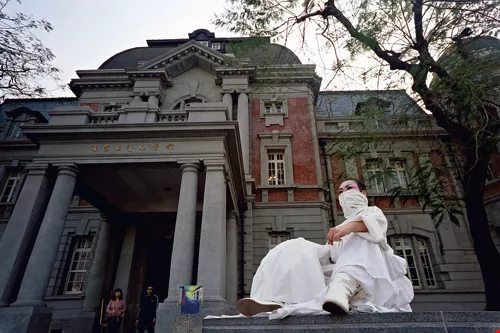
In 2004, the THAT Theatre Troupe, taking their inspiration from daily strolling around the "Southern Capital" of Tainan, produced the environmental play This City Is Stunningly Beautiful. The photo shows a performance in front of the Taiwan Museum of Literature.
At the cultural cutting edge
You can trace the origins of the reuse of old houses in Tainan back to the early 1990s. One of the most famous of the forerunners was Jamie Tu. In 1992, Tu, whose family made good in the jewelry business, opened her own art gallery and interior design company. With a natural eye for gems, she took a liking to an old three-story structure on Yungfu Road. She spared no expense to turn this former bank from the Japanese colonial era, occupying 1300 m2 of floor space, into the bastion of contemporary culture in Tainan-the New Phase Art Space.
Unfortunately, after seven years, it all ended because it became impossible to keep paying the enormous operating costs, and the building was torn down. You can get an idea of the huge sums spent by Tu from the descriptions that can still be found on the New Phase website: "Behind the main hall of the building, a theater has been added on, occupying 160 m2 and capable of holding an audience of more than 100. The whole space, with walls eight meters high, employs imported real wood flooring and soundproof walls. It is equipped with a dressing room, a control room, and imported specially designed stage-lighting and sound systems, as well as a 150-inch projection system."
At that time, in order to pay the rent of more than NT$100,000 per month as well as the salaries of her staff of more than 20, Tu ran herself ragged organizing events, holding exhibitions, and seeking sponsors, until the pressure pushed her to the brink of collapse. Finally friends convinced her to give it all up and she went to the US to study and recuperate.
Ahead of its time, the New Phase Art Space succumbed to financial pressures. Fortunately, other art spaces were established around that time that are still operating today and continue to serve as cultural and spiritual centers for students and local residents.
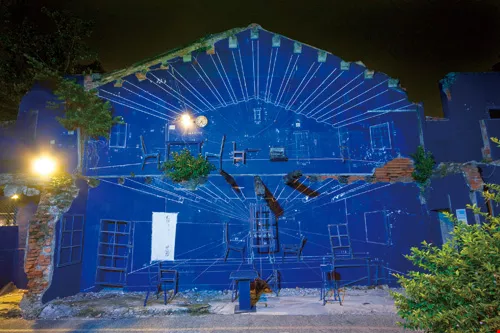
(left) The Blue Print, designed by the Opening United Studio led by architect Liu Kuo-chang, has been called a "wall of memories," and is one of the most famous sights on the "arts street" of Haian Road.
A people-friendly city
For the old souls, the spatial lines of the old houses and neighborhoods, the sentimental attachments of local people to their property, and the leisure hours they have spent in the course of their lives have left a deep imprint on their imaginations, and affected the way they think about lifestyles and spatial environments.
Yang Mei-ying, art director of the THAT Theatre Troupe, who has lived and done creative work in Tainan for a long time, has always enjoyed taking outsiders on strolls to the intersection of Minchuan and Yungfu roads. Turning westward, she says: "The sea used to come all the way up to here [before siltation moved the coastline several kilometers further out], and as you walk along you will feel that the whole street angles downwards. Next to the road over there is the cover of a water channel, the cover being in the shape of a half moon. Back in the early Qing Dynasty, this was the location of a canal serving commercial warehouses, where travelers came ashore, and was also a place where residents and ships could draw fresh water; it was known as the 'Big Wellhead' dock. Now it is a busy modern intersection with a lot of traffic, so it is really suited to explaining to people the passage of time and the tides of history."
Going back over a decade, Yang-who has always been interested in the possibilities of the interaction of people and space-though not looking deliberately for old houses, had opportunities for her company to perform in old structures, and these were very inspiring to her creatively. She says that in the past these places were considered "weird hangouts," opening and closing one after another and attracting only the small artsy crowd. But today the majority of Tainan residents affirm the value of historic architecture, and officially designated historic sites like "Wu's Garden" behind the Tainan Public Meeting Hall, the National Museum of Taiwanese Literature, the southern city gate, and the train station's front plaza have all become excellent venues for performances or just hanging around and thinking.
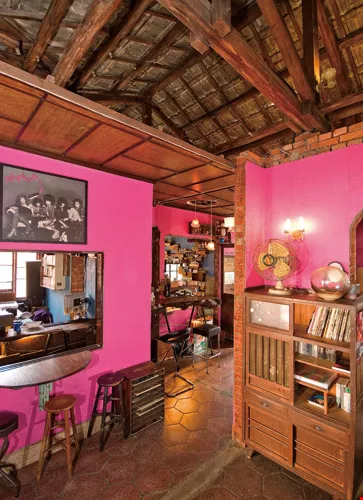
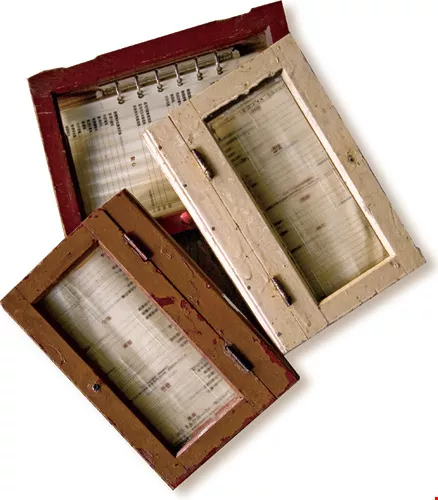
The large windows, sloping roof, and open garden of the live music venue Kinks25 are classic features of the architectural style that combines Japanese with Western elements. Pictured below are menus encased in old window frames.
Private citizens in front
In March of this year, the private Foundation of Historic City Conservation and Regeneration (founded in 1999 by professional architects and professors at National Cheng Kung University) launched an activity it called "Revitalization of Old Houses." The foundation chose 15 structures of at least 30 years of age, all well-preserved examples of the mixture of new and old features, and invited citizens to visit them and vote for their favorites, thereby encouraging local residents to treasure old buildings and put to them to good use.
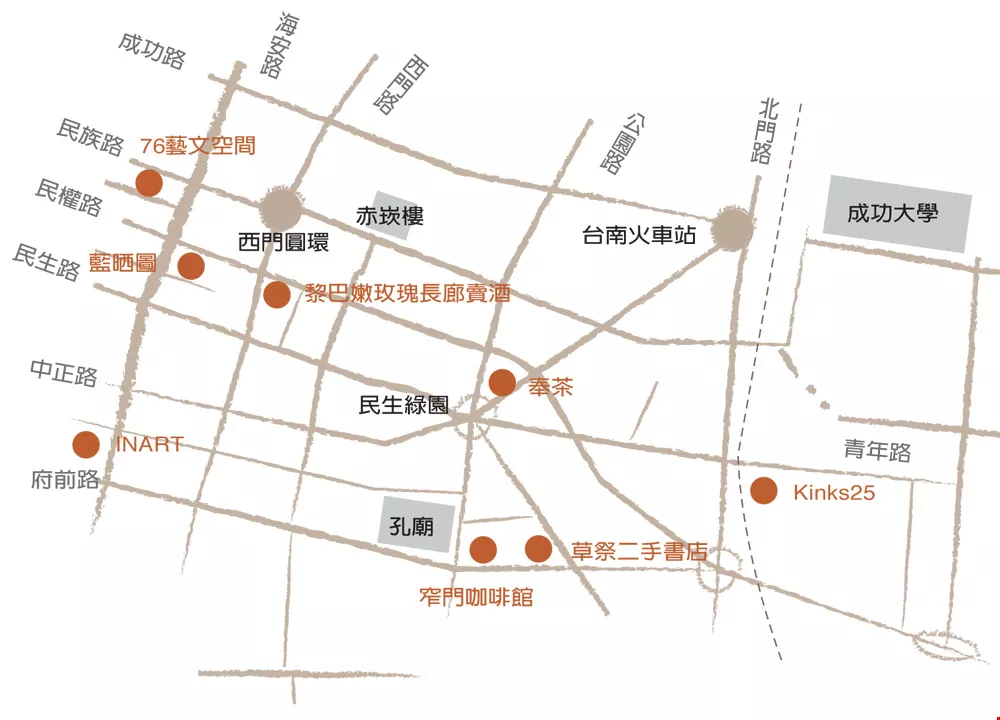
The 15 structures selected are mostly located around the city center, and have been transformed into all kinds of formats. They include a Japanese restaurant, a coffee house, a bar, and an arts and performance space.
Today, when there is constant-one might even say relentless-novelty in urban architecture and aesthetic discourse, why is there a group of citizens in Tainan who are determined to protect old houses, and are willing to put their creative skills to work to give new life to these creaking structures? After all, it cannot honestly be said that most Tainan people avidly treasure their old houses. Perhaps the objective conditions are part of the answer.
The tides of history have washed five different regimes over the city-from the Dutch to Zheng Chenggong to the Qing Dynasty to the Japanese to the Republic of China-leaving a legacy of traditional small lanes and byways. Even today many small streets and alleyways still have the same irregular twists and turns that they have preserved since the 19th century. When you add in the facts that Tainan has been under less development pressure than other cities in Taiwan (economic development having long been centered in other locales), and that land in Tainan is zoned into very small plots, often long and narrow, unsuitable for redevelopment by commercial builders, you can see why there are so many unused old houses waiting to be rented, renovated, and reused.
The panel of judges for the "Revitalization of Old Houses" event awarded the gold medal in the category of preservation to the Byblos bar. The reasons they gave were "the style is accurate, the workmanship skilled; it uses original structural materials, displaying multiple layers with minimal alteration."
The owner, who goes by the handle "A-bon," and whose family moved to Taipei from Tainan when he was small, has a natural flair for design. After growing up he worked for his family's clothing shop for a while, but after a decade he lost interest. Keeping his "superwoman" Mom in the dark, he returned to Tainan and, with some friends, put their money into a small shop they called Byblos, selling home-made cookies. Within a year, as if they were doing a whole street reconstruction in the manner often seen in Japan, they rented the two neighboring houses to open a "nouvelle cuisine" noodle restaurant and a clothing boutique.
Having completely changed the atmosphere of the street, it was a natural next step to organize family, friends, and neighbors to decorate the street lamps, beautify walls, and plant trees and flowers. The shops implemented a policy of "half price for senior citizens" to try to keep the many elderly locals involved, and a dance company moved in as their neighbors, with A-bon helping them design their dance studio.
A-bon eventually built up a string of six different Byblos shops, but two years ago walked away from that life for half a year. Now that he has opened the Byblos bar, which he says has "rekindled his passion for life," he has taken on himself the mission of "piecing together history and culture." He relates, "I interviewed the landlord, who is 80, and all the neighbors, and slowly reconstructed the history of this row of old structures." Only then did he discover that the buildings were the first department store ever opened by a Taiwanese in the Japanese occupation era, with A-bon's bar occupying what was once the stairwell.
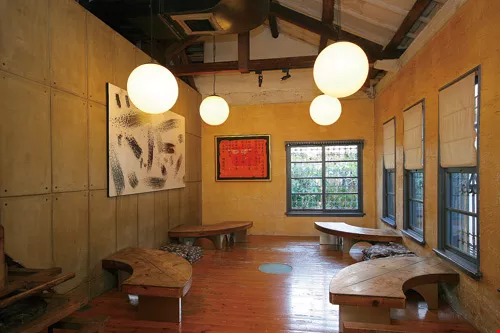
The old house where TeaServing is located was redesigned by Lin Yi-chen, a student in the Department of Architecture at National Cheng Kung University at the time she drew up the plan. After renovation, the ceiling beams were exposed, while the windows retained their original appearance. The spacious second floor is a meeting place, gallery, and performance space for arts groups.
Nostalgic, and visionary
Recently, thanks to the people attracted to work at nearby universities and the Southern Taiwan Science Park, these days running a bar with a nostalgic theme is not that financially difficult. Yet there are still other dreamers who go beyond the economic viability of the spaces they use. Take for example the man who was always determined to open a simple and spacious second-hand bookstore without regard for the "economic efficiency" of the use of his space. In fact, Tainan is the only place that could sustain an eccentric like this.
Thirty-five-year-old Tsai Han-chung, the owner of the Cao Ji Second-Hand Book Store, who does his designs based entirely on instinct, has over the last decade been living on an "elixir" of finding old houses, reconceptualizing and renovating the spaces, and then moving on to a different old house. Forty years ago the bookshop was a combined residence and printing business. With floor space of more than 200 m2, it consists of a narrow front structure and wide rear structure, though both (unlike most old businesses in Taiwan), are much wider than they are deep. Tsai opened a passage between the two and cut away the ceiling over the rear structure's basement to create a "well" where he has lovingly placed a huge collection of beautifully bound foreign-language books, with an involved story of being brought back from overseas by a previous owner, and which Tsai simply cannot bear to sell.
With the vogue for preserving old houses firmly established in the Southern Capital, it has also become a great place for architects to let their creativity run free. In 2005, the Opening United Studio (OUS), led by Liu Kuo-chang , a cutting-edge architect with a degree from the Graduate Institute of Architecture at National Cheng Kung University, began redesigning a series of old structures in Tainan. First, using their own labor, OUS turned an abandoned century-old warehouse on Chenghsing Street into the group's workshop.
Another striking OUS composition has been done using the wall of an old house on Haian Road, one part of which was chopped away by the passage of a street, leaving several of the internal beams protruding when the inner wall was exposed. The wall is painted to look like a blueprint, but is given a three-dimensional character by the protruding beams as well as by chopped-up old furniture that is attached to and also seems to be coming right through the wall.
Inevitably, in recent years there has also been destruction of several old state-run dormitories and cutting down of venerable old trees in large numbers, facts which cut the old souls right to the heart. But by defending their own spaces, they seem to get a kind of solace and strength from the old houses where they work, and are revitalized themselves.
As our whole island frantically seeks novelty and speed, luckily there are still those in Tainan who are putting century-old culture to use, and who are satisfied with a slow pace, with development that is comfortable for themselves, and with lifestyles that are calm and spiritual, walking their own paths in life.
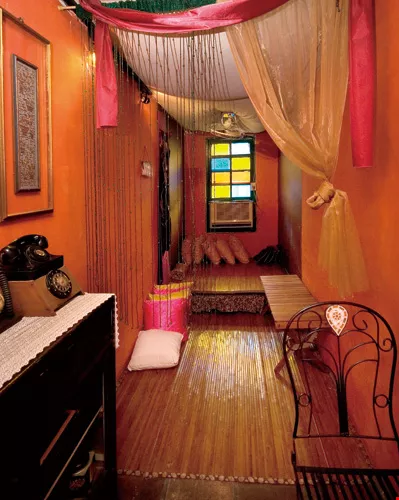
The space that today houses the Byblos bar was originally a staircase shared by two adjoining sides of a building, and for a time was also a residence and a name-chop carving shop. Only 145 centimeters wide, from the first to the third levels total floor space is no more than 25 square meters. The narrowness of the space creates a cozy feeling.
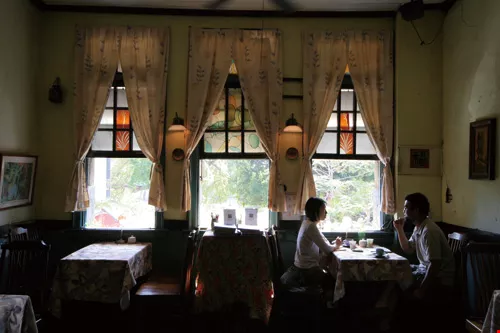
The Narrowdoor Cafe, with its high ceilings and elegant ambience, has a unique location. From its front windows you can take in the greenery of the lawn in front of the Confucius Temple.
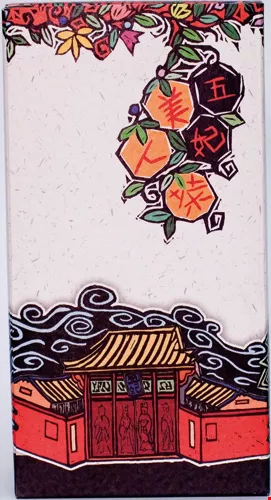
One of the commemorative teabags produced now and then by the TeaServing beverage house.
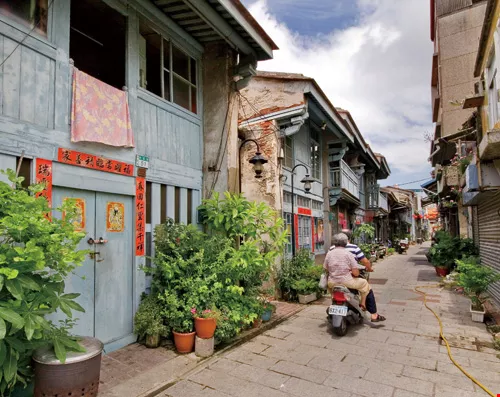
stepping into the street today is like stepping into a time tunnel.


@List.jpg?w=522&h=410&mode=crop&format=webp&quality=80)


