Farmer Chang,Hotelier Extraordinaire
Tsai Wen-ting / photos Lan Chun-hsiao / tr. by Michael Fitzgerald
November 2008


In the recent movie Cape No. 7, the character Hung Kuo- jung, chairman of the Hengchun Township Council, tries in earnest to entice the youth of the area to return home by helping them to find jobs. Consequently the character has become a symbol of love for one's homeland. Back in the real world, the so-called father of Taiwan's recreational farms, Chang Ching-lai, had undertaken the large task of developing the recreational farm industry as early as 20 years ago.
Chang Ching-lai's dream for his homeland not only doesn't exclude outsiders, but in fact focuses on people from overseas. His work has helped Taiwan's recreational farm industry to successfully break onto the world stage and allowed foreign tourists to fall in love with the pristine and enchanting island of Taiwan.
Exiting the Taipei-Ilan freeway at the Luotung interchange, we head off into mountain forests, meandering through the shade of verdant trees, while fruit trees intermingled with blooming flowers stretch out as far as the eye can see. Hidden within the village of Tachin in Ilan County's Tungshan Township, the area near Shangrila Leisure Farm is where the 56-year-old Chang Ching-lai spent his childhood.
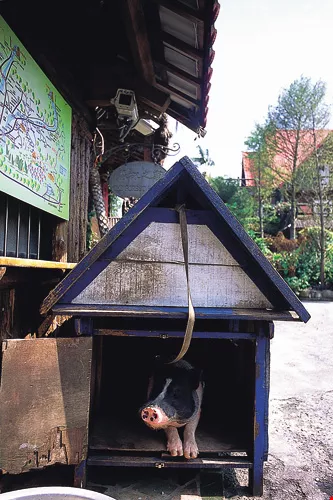
A small pig quietly curled up in its pen. At Shangrila, with natural scenery as its main appeal, miniature pigs are the only animals raised expressly for the enjoyment of guests.
A vine for a belt
The Tachin of his youth, a remote hamlet in the mountains of Ilan, had no fertile land to speak of. The land there was dry and stony, and about the only things that could be grown were low-value crops such as sweet potatoes and peanuts. A child of this mountaintop village, Chang Ching-lai ran around barefoot wearing baggy pants made of coarse fabric, and for lack of a belt made do using a vine he pulled from the ground. Except for two days around the New Year, Chang, like the other children in his village, had to help out on the farm year round.
"Life really was pretty tough," he says, thinking back on his childhood days, and speaking with the heavy twang of the Ilan dialect. One Sunday, a civil servant came riding through the village on a motorcycle, his child in tow, out for an excursion in the mountains. Dressed in ragged clothes, Chang Ching-lai watched them from behind a tree. It was then that he swore to himself that when he grew up he too would be a government worker, wearing fine clothes and living a leisurely life.
Unfortunately, when Chang was in the fifth grade his father fell ill, which meant his family no longer had the means to pay for his schooling. Consequently he was forced to stay at home and spend his time working full time as a child laborer.
"I would do whatever work was to be had. The most difficult was carrying cement for NT$11 a day," he says. He remembers that when he was 14 or 15 years old, he was very skinny, weighing no more than 30-odd kilograms. Nevertheless his job was to carry 50-kilo sacks of cement up the mountainside. Other workers helped to lift the sack on to his shoulders, but once it was loaded on it couldn't be put down because no one would help him lift it back up. When he felt as if he couldn't carry it any longer, there was nothing he could do but lean against the trunk of a tree and rest for a spell. In those days the rubber boots that the workers wore to help prevent them from slipping had no ventilation and the sweat rolling down their legs gathered inside. To prevent sweat from pooling inside the boots they would poke a small hole into the heel so that the sweat could drain out. Such stories provide some insight into the hardships of Chang Ching-lai's childhood.
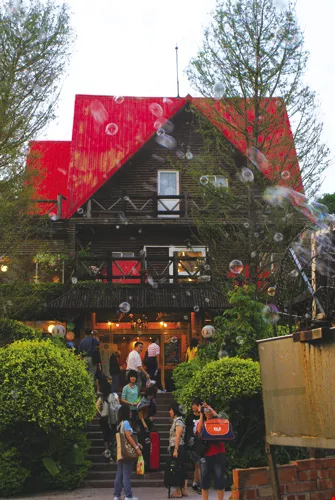
Guests from highly urban Hong Kong and Singapore long for the romantic feeling of small cabins in the forest. The popularity of Shangrila farm has spread by word of mouth among Southeast Asians.
Freezing feet while burning the midnight oil
Due to this energy-draining workday, which would begin at seven in the morning, Chang's legs would begin to cramp up around ten due to his having lost so much sweat. At such times he would have to quickly drink some salt water so that he could keep up. When he couldn't open his eyes because of the sweat pouring down from his forehead, the young Chang would continually tell himself that he had to find a way out of his impoverished existence.
For a child from a poor family without any connnections, the only way to escape such a life was by passing exams. With the image of the civil servant clad in a white shirt etched in his mind, at age 17 Chang resolved to study on his own for the tests. After his day's work was done he would diligently study the various books that would prepare him for the civil service exams.
In the spirit of the ancient practices of tying one's pigtail to the roof beam and pricking one's legs in order to prevent dozing off, he would study with his legs in a tub filled to his knees with cold mountain spring water. With a pile of books towering beside him, he studied by rote until he went to bed at three in the morning, and then woke again early in the morning to begin hauling cement.
Chang spent eight arduous years working his way up the ladder of civil service exams: first the general civil-service exam, then the junior-grade civil-service exam, followed by more and more tests until he passed his final exam at the age of 24 and was assigned to the Ministry of Personnel in the Examination Yuan in Taipei. "The day I can hold my head high has finally arrived," he thought to himself. Nevertheless he was already making plans to take advanced civil-service training and test into master's and PhD programs, so as to get into the highest levels of the civil service!
Finally wearing his white shirt and sitting at his civil servant's desk, Chang Ching-lai discovered that most of what he was doing each day was just redundant secretarial work. Worse than that, all he did was take orders. For a person like himself, extremely enthusiastic, blunt and unafraid to confront problems head on, it was a shocking realization. "Actually I wasn't suited to working for someone else, I was much more suited to being my own boss!"
With such a clear realization, and only a couple of weeks after starting work, he resolved to quit the "golden rice bowl" job that all his friends had envied so much and head back to his home village and work odd jobs so he could buy his own piece of land.
In recent years, with the thriving development of recreational farms and homestays, people have been flocking to the countryside in droves. But over 20 years ago Chang Ching-lai, having decided to follow his own path, foresaw the limitless potential in a new but otherwise lonely industry. At the time he was only 25 years old.
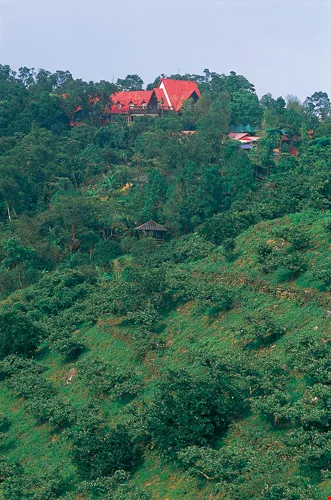
The farmlands have been long deserted / Come on back home! "The countryside isn't just land, more than that it's a kind of culture." Chang Ching-lai hopes that more "weary birds" can come back to protect the lush mountain forests and peaceful farmland of their hometowns.
A child grows together with the fruit
"God loves the simple man." The year he returned to Tachin Village, both the quantity and quality of plum production in central and southern Taiwan had fallen sharply due to heavy rains. With his acumen for business Chang took his entire savings of NT$50,000 and bought up plums off the farms in Tachin that in a normal year would have been worth NT$500,000. As a result, within two months he was able to make more than NT$600,000, which at the time would have enabled him to buy five government-built apartments.
However, the comfortable urban lifestyle wasn't for him, so he used part of his earnings to buy 240 acres of land in the mountains and began to build the foundation for his life's dream. "At the time I was watching the transformation of the Japanese agricultural industry and knew that the same thing was happening to the island economy of Taiwan. The future of the industry was becoming service oriented and the time had arrived for Taiwan's recreational farm industry."
In 1980 Chang Ching-lai, after buying his land, was selling soda while also finding people to slowly clean up his farm and plant fruit trees. Remembering that his wife had said her wish was to have her own villa where she could enjoy the natural life, Chang brought his new bride up to the mountains to give her a first-hand look at the huge expanse of forested mountains and show her his plans in detail. Harboring the same dream in their hearts, the couple worked together to make it a reality.
In the days when Taiwan did not yet have any tourist orchards, farmers felt they would be on the losing end of the deal to allow people to come into their orchards and pick fruit. Their reasoning was that tourists would pick all the large fruit, leaving them the small ones that no one would buy. They didn't understand that Chang was not so much interested in the fruit, but in the happy fruit-picking tourists that would be coming out to his farm.
When it came time to plant fruit saplings in his orchard Chang already had a plan in place. Deviating from the standard single-crop format, he had chosen more than ten different native fruit varieties to plant. "Native varieties are less susceptible to insects and diseases, meaning you don't need to apply pesticides; and with a variety of fruit there will be fruit for every season. Only when there is an abundant amount of fruit is it possible for the tourists to savor the pleasure of picking it." And so it came to pass that saplings of kumquat, carambola, orange, guava, tangerine and wax apple began to grow on the mountainside.
After their first child was born, Chang's wife carried the infant up the mountain and asked Chang, "How long before our fruit orchard will be open and making money?" Chang laughed and said, "You'll have to wait until our child starts elementary school." Chang spent ten years of effort from when he first bought the land until the farm opened. In 1988 Taiwan's first recreational fruit orchard created for tourists finally opened for business.
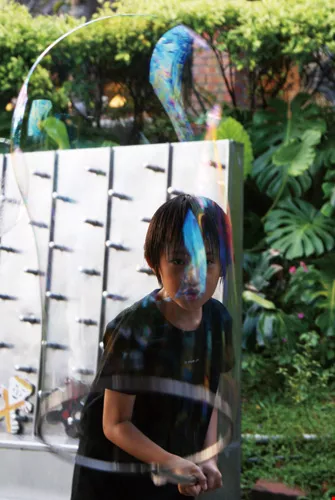
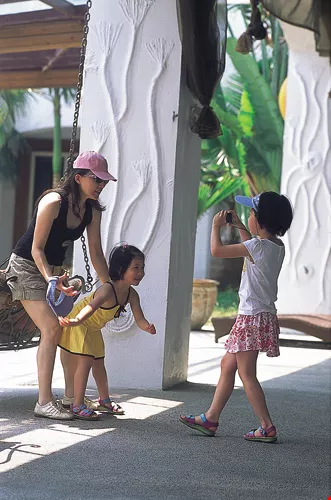
Making a giant soap bubble. Children who come to the farms find pleasure in simple childhood activities.
The start of recreational farming
For the Taiwanese, who were just beginning to experience a prosperous lifestyle and to be able to enjoy leisure activities, Chang Ching-lai's recreational orchard created quite the sensation and lured them in in droves. Each day thousands of people were entering the orchard. At NT$60 for adults and NT$40 for children, takings could be as high as NT$200,000 a day. Chang had taken a rudimentary agricultural business and developed it up to a service industry, and in the process had become a media darling.
Good times didn't last forever though, and the tide of visitors coming out to the mountains lasted less than three years before it started to recede. Chang analyzed the situation and saw that most people coming to the farm were locals from Ilan who came because the farm was a novelty, so they tended not to return. He was startled to discover that the primary places for tourism were Taipei and places outside of Ilan County. As for tourists who would come all the way from outside Ilan just for the sake of picking fruit, the area lacked additional recreational value.
"You always have to be thinking about what the customer wants," says Chang. After assessing the reasons for the continuing decline in earnings, he began to adjust his strategy and evolved the business to include ecology as its primary attraction, as well as providing a rich itinerary of activities and high-quality accommodations and food. He also made use of his orchard's natural environment to raise fireflies, and in the process of reinventing his business once again created a new wave of media attention for Shangrila Leisure Farm.
"I was very ambitious," says Chang, "I didn't want to be number two, or even number one. I wanted to be 'the only one.'"
But for all his desire to play a pioneering role, it was illegal at that time to build a hotel or open a restaurant in an orchard. In the early 90s, with a vision and pace that surpassed the government Chang began proposing ideas to the Council of Agriculture (COA), the Ministry of the Interior and the Tourism Bureau. Finally, in 1998, the government revised relevant legislation. "I am not afraid of hardship, but in trying to start a new business what caused me the biggest hardship was the law," he says.
At that time Taiwan had not yet developed any regulations to promote the recreational farm sector, and although government agencies were willing to guide farmers in transforming their businesses, they were hampered by the lack of a legal framework. Furthermore, recreational farms that included restaurants and accommodations were something farmers had never dealt with, so they had no precedent to go on. It was under such conditions that Chang Ching-lai moved forward on his own by assimilating large amounts of foreign information in the field. In such an environment the thought of building a hotel brought concern that it would be designated as illegal and torn down; even holding seminars was done in secrecy.

Strength in numbers
It was at this time that Chang Ching-lai, who had been struggling along on his own, realized that the development of the recreational farm sector and the ability to compel the government to pass necessary laws and regulations depended on having more people involved and on increasing the size of the pie. Once more people began moving into the business, the government would be more compelled to quickly pass proper legislation, and the establishment of a greater variety of farms in Ilan would create a swarm effect which would attract more tourists.
In 1999, when the COA began formally promoting recreational farms, Chang applied to join its guidance program. Once the COA realized that he was already full of very good business ideas they commissioned National Taiwan University's Graduate Institute of Environmental Engineering to draw up comprehensive plans, thus beginning the first chapter of Taiwan's tourism farms. That year Chang elatedly built six white-walled, red-roofed buildings with over 100 rooms at Shangrila Leisure Farm.
Once the necessary laws were revised Taiwan's recreational farms began to spring up like mushrooms. Within a few years it seemed the industry had reached its saturation point, with mountain areas being exploited to the point of no return, and businesses engaged in competitive price slashing. At this point Chang once again began to think about how to expand the market.
In his opinion, at a time when Asian economies were on the rise, increasing economic power was blurring international boundaries. Taiwan's population was limited and so the travel industry needed to internationalize and orient its marketing efforts toward the entire Asian region. Always at the forefront, Chang Ching-lai was once again taking the initiative to bring Taiwan's recreational farm industry onto the international stage.
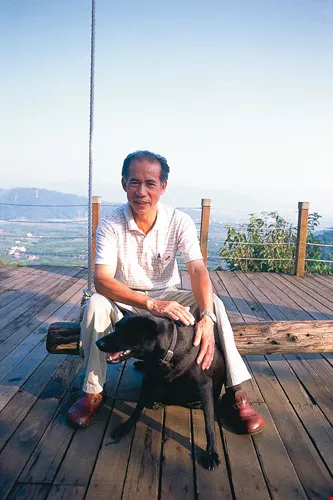
Sitting atop his swath of verdant mountainside property, Chang Ching-lai has brought Taiwan's recreational farm industry onto the world stage and has made Ilan one of the first destinations for tourists coming to Taiwan.
A deft hand makes silkworms
From 2002, in keeping with Chang's vision, Shangrila Leisure Farm manager Chien Pei-ping proceeded to market Shangrila in such territories as Hong Kong, Macao, Singapore, Malaysia, and Thailand, and even to America, France, Britain and Japan. "In the initial stages we targeted the overseas Chinese of Southeast Asia," says Chien. This was because there are over 10 million Chinese in Southeast Asia alone, and most of them are prosperous, with the means to travel abroad.
In order to market the farm, the petite Ms. Chien was continually attending tourism expos around the world, and in one year went to Singapore six times.
"First I had to tell foreigners about the Taoyuan International Airport and then about Taipei, before I could even get to telling them about Ilan," she explains. "Most of them had never heard of Ilan!" At the exhibitions, she would use bamboo chopsticks and tissue paper to create cute lifelike silkworms, immediately capturing the attention of visitors who would line up just to get one.
Having piqued tourists' interest in the recreational farm, Chien would work the other end by stimulating the interest of local travel agents. She was active on many fronts at the same time, receiving local news groups and giving endless exposure to the farm. This worldwide marketing model is still going on today. This year alone, Chien had already gone abroad eight times by August.
According to statistics from the Taiwan Leisure Farming Development Association, in the four years from 2004 to 2007 the number of international tourists visiting recreational farms in Taiwan surged from just 1,300 to a whopping 40,000, a growth of 32 times. With far away the most visitors at over 14,000, Shangrila Leisure Farm had 40% of the total market.
"Of course this was in part due to the opening of the Taipei-Ilan freeway. In the past, once tourists got off the plane they usually spent their first night in Taipei, followed the next day by a direct flight to Hualien. Nowadays many tour groups choose to spend their first night at Shangrila, which makes Ilan the place where they first connect with Taiwan," says Chang Ching-lai with pride. "Come with the family to Taiwan's Shangrila Leisure Farm," was the theme in many newspapers, including those in Southeast Asia. Airline companies would also promote "flight and farm" packages. "Many tourists become familiar with Shangrila before they get to know Ilan," says Chien Pei-ping.
Foreseeing a market for wedding banquets and the need for conference space for foreigners as well as locals, Chang Ching-lai spent an additional five years building a Mediterranean-style resort hotel on the banks of the Tungshan River.
This beautiful Shangrila
The expansive natural environment of the farm has a deep allure for travelers from highly urban Singapore and Hong Kong, while traditional cultural activities fulfill a nostalgic longing for simpler days for Chinese from around the world. Chang Ching-lai emphasizes, "The irreplaceable value of Taiwan's small towns is nature and culture."
Coming from Hong Kong, Huang Jianzhong and his family have been to Taiwan twice, and just as Chang Ching-lai says, traveling around Asia is nothing unusual to them. Huang, who rents a small piece of farmland in Hong Kong, has been longing to live the life of a farmer where he can sink his feet in the mud and pick fresh fruit. After finding the scenery of Shangrila Leisure Farm on the web, he and three generations of his family decided to go there for a vacation. When along the way 70-year-old Grandma Huang saw waves of rice fields she was ecstatic. In stark contrast to the skyscrapers of Hong Kong, Huang Jianzhong's wife quietly enjoyed the tranquil, fresh air of the farm. She says the air in the mountain forests really does have the sweet smell of plants and earth. Beside her is a group of visitors from Malaysia sitting around a table making glutinous-rice dumplings, throwing tops, and sending off sky lanterns. The whole group is in a festive mood and the chorus of Chaozhou- and Fuzhou-accented Chinese can be heard rising and falling.
"International visitors account for one third of all people coming to Shangrila Leisure Farm. Furthermore most of them come during the week, in contrast to the local visitors," explains Chien Pei-ping.
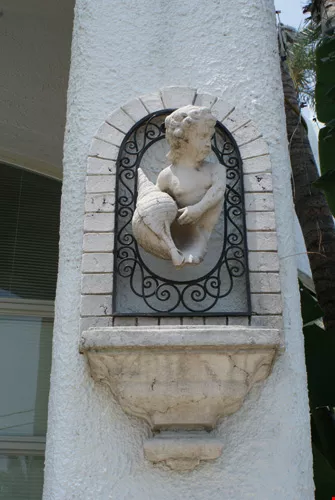
The exquisitely designed Shangrila Boutique Hotel is a favorite scenic spot of Ilan's wedding industry as well as soap operas looking for a place to film.
Tungshan River plus Mediterranean culture
Aside from time spent building Shangrila Leisure Farm, Chang Ching-lai spent an additional five years building another red-roofed, white-walled holiday resort hotel beside the popular Tungshan River Water Park, complete with a large windmill. With a romantic European atmosphere, not only did it become a hot spot for newlyweds to have their wedding photos taken, but also attracted numerous soap opera productions looking for places to film.
Noting the vast number of international conferences held throughout Asia each year, Chang Ching-lai feels that scenic Ilan could become a new choice as an Asian conference venue. In addition, because the Ilan area had long lacked a romantic location for wedding banquets, Chang himself went to the Aegean coast to import Italian furniture and oil paintings, and with the goal of targeting three sources of visitors-vacations, weddings, and conferences-built the Shangri-la Boutique Hotel, which has only 72 rooms but where common areas compose 55% of its total space.
"Our boss can really predict the future. Within two years of opening the hotel the proportion of these three groups of visitors was just as he had planned for," says the Shangri-la's director of public relations, Huang Hsiu-tzu.
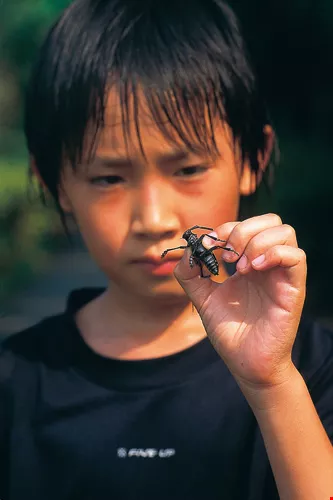
At Shangrila, where the source of income is tourism, the fruit trees Chang Ching-lai has planted all bear large quantities of fruit and are highly resistant to disease. This makes the use of pesticides unnecessary and creates a healthy environment where children and insects can naturally intermingle.
Not just land
When he was 25, Chang Ching-lai quit his "iron rice bowl" civil-service job and hadn't a possession to his name. Today he owns a 960-acre farm, and a 720,000-square-foot resort hotel that attracts 130,000 visitors and has a turnover of more than NT$100 million each year.
Nevertheless this wealthy boss still has the mindset of a farmer. Huang Hsiu-tzu gives an example: one time the hotel's pond attracted a pair of pheasant-tailed jacanas. Not only did it become a favorite spot for birdwatchers, but Chang was as excited as a little boy.
Although as a child Chang Ching-lai had desperately wanted to leave his poverty-stricken village, once he returned he developed a strong sense of purpose. Not only did he pay out of his own pocket in the early days to hold seminars for local farmers, more recently he has continued to sponsor lectures in the hopes that he can train even more professional managers of recreational farms. On average he hosts more than 100 lectures each year.
"Farmland isn't just land-it's scenery, and it's culture. If it's changed it can't be returned to its former state, it's a resource that if lost won't return." Aside from the main hotel building, there are no concrete structures at the Shangrila farm. Chang Ching-lai also hopes that even more people working away from their hometowns can return to live out their dreams by developing a farm or homestay where in the latter years of their lives they can find spiritual sustenance.
In his mind he has a plan for "salmon to return home." "When the countryside is beautiful, Taiwan is beautiful," he says. Chang hopes that there are more people like him to return to their villages and their farms to live in harmony with nature and share a beautiful old age.
"This way I will have more and more friends," laughs Chang, standing atop a hill on his farm and imagining the future.


@List.jpg?w=522&h=410&mode=crop&format=webp&quality=80)


