Guardian of Our Souls--A Century of Chinese Education in Malaysia
Coral Lee / photos Chuang Kung-ju / tr. by Chris Taylor
May 2005


Education can be said to be the most important issue in the history of the Chinese in Malaysia over the past 50 years. The suppression of Chinese education under the British colonial government had created a crisis of lost roots amongst intellectuals and a movement to protect them. Around the time of Malaysian independence, the Chinese came to affirm Malaysia's national status, and worked with other ethnic groups to build the new country. Nevertheless, the Chinese dream to be accepted as legitimate Malaysian citizens clashed with the hope of being educated in their mother tongue and upholding Chinese culture. This led to a long-running struggle with the authorities. The last half-century has seen a parade of champions for the cause.
From The Intellectual Elites in Malaysian Chinese History, one of a series of works sponsored by Academia Sinica's Program for Southeast Asian Area Studies, it can be seen that more than half the most influential Malaysian Chinese, whether active in political, commercial or cultural fields, were involved in Chinese-language education. That shows just how much effort has been put into education by Malaysia's Chinese.
On March 15 2005, all Malaysia's leading Chinese-language dailies and other headline media carried lead stories on Prime Minister Abdullah Ahmad Badawi's statement that creating more Chinese-language primary schools would not be beneficial to national unity. The result was a huge controversy. Chinese community leaders throughout the country appealed to the government to adopt a more enlightened policy, and be fairer to the development of non-mainstream schools. Many were deeply puzzled that Malaysia's supposedly moderate prime minister should have spoken out in this way.
The prime minister's staff came forward to clarify his position, saying that reporters had misunderstood, and that his actual words were that it would be inappropriate to build more "non-state middle schools." Because the focus of the subject under discussion at the time had been Chinese-language primary schools, it had resulted in a misunderstanding by reporters. Even though the furor gradually abated, Chinese-language education in Malaysia has always been a sensitive issue. Its future orientation and prospects are still a subject of worry for Chinese there.
From an outsider's perspective, the fact that the Malaysian government allows Malaysia's three languages, Malay, Chinese and Tamil, to coexist already appears impressively liberal. But it's no surprise that after a century of friction over education, and in view of its importance in establishing values and sense of identity, it is still an intractable issue in which politics and ethnicity are inseparably intertwined.

In the early 19th century, Chinese working hard in a foreign land set up home-style tutor schools for their children. This one is in the city of Kuala Lumpur, and today often hosts cultural events.
A tortuous path
Looking back at the development of Chinese-language education in Malaysia, it's not hard to see how this came to be so.
In the early 19th century, Chinese migrated with great hardship to the Malay Peninsula, where they set up many small, tutor-style schools that taught the Chinese classics, such as the Three Character Classic, Hundred Family Surnames and Four Books in various dialects. The tinkle of little scholars' voices resounded in clan association halls and ancestral shrines for almost a century.
In the early 20th century, the reform movement initiated in China by Kang Youwei and Liang Qichao, which included calls for education reform, and the subsequent overthrow of the Qing dynasty in the 1911 Republican revolution, resulted in Malayan Chinese coming under the influence of revolutionary trends of thought. This led to the rise of a new, modern style of school. The British colonial government at that time adopted a laissez-faire attitude to Chinese-language schooling, and the Chinese tradition of valuing education meant public donations and efforts were readily forthcoming to promote the opening of the new-style schools.
In 1919, with the outbreak of China's May Fourth Movement, Southeast Asia was swept by anti-colonial and democratic consciousness. Feeling threatened, in 1920 the British issued an education ordinance aimed at controlling the development of Chinese-language schools, which required the teachers, principals and directors of all schools to register with the government (at that time the Malays had no formally organized schools). The government later introduced restrictions on teachers' activities, and on the content of teaching materials, leading to fears in the Chinese community that their culture and ethnic identity were under threat. Chinese communities everywhere banded together to protest.
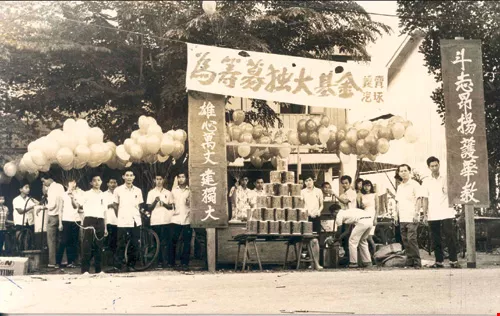
Private donations have always been crucial to Malaysian Chinese education. (courtesy of Dong Jiao Zong)
Under siege
Professor Tay Lian-soo, director of the Chinese Ethnicity and Culture Research Institute at Southern College, and author of The Development of Malaysian Chinese Culture and Education, points out that since the Opium Wars, China had been confronted with outside encroachment and the threat of cultural collapse. Despite frantic calls by intellectuals, it could not stem the onslaught of the Western powers. Thus Chinese of the time felt a strong sense of crisis, and the British suppression of Chinese-language education in Malaya aroused them to unite in defense of their culture.
This first self-defense movement was harshly suppressed and its leaders deported. That might have been the end of the story, except that it made Chinese communities more united, and Chinese-language education managed to flourish and develop out of sight of the authorities. By the outbreak of World War II there were more than 1,400 Chinese-language schools with over 120,000 students.
In 1942, the Japanese invaded Malaya. Because of the Malayan Chinese's ethnic identity and anti-Japanese stance, Japanese troops killed them indiscriminately. Chinese teachers and students were forced to flee for their lives, and schools were closed. It was the darkest period in the history of Chinese education in Malaysia.
"In this period, the balance of Chinese versus Malay consciousness reached a watershed," writes Hou Kok-chung, head of the Institute of China Studies at the University of Malaya. When the Chinese discovered that the British couldn't protect them, they not only wanted to fight for far-off China, but also for their home, Malaya.
After three years and eight months of resistance against the Japanese, Chinese feelings towards Malaya as the land of their destiny had deepened, and in the post-war period the big debate was, "Should Chinese identify with Malaya or China?" Later, as their identification with the country deepened, Chinese could not but be honored to be Malaysian citizens, but at the same time they also couldn't be indifferent to traditional Chinese-language education.
With Japan's surrender in 1945, Chinese communities again went back to their educational traditions, and within a year schools everywhere were coming back to life. But with independence brewing, in 1951 the British colonial government released the Barnes Report, which recommended the establishment of national schools with instruction in English and Malay to cultivate a sense of nationhood.
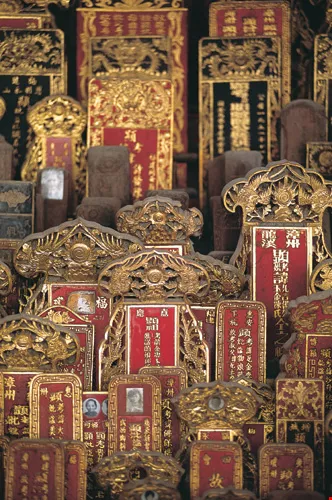
In Cheng Hoon Teng Temple, on the southwest coast of Malaysia's Malacca is a tablet consecrated to Hokkien ancestors. The traditional rites carried out here by Chinese are like those at a temple, and never ending.
A movement is born
Chinese communities that had valued their cultural inheritance were offended, and representatives of teachers' associations countrywide gathered in Kuala Lumpur to consult on the issue. This hastened the establishment of the United Chinese School Teachers' Association of Malaysia (UCSTAM). Within two years the boards of directors of schools countrywide had established a United Chinese School Committees' Association of Malaysia (UCSCAM). The two worked together, marking the start of a 50-year struggle for the right to Chinese-language education.
The first challenge was ensuring that Chinese became one of the four official languages (Malay, English, Chinese and Tamil) after independence, as well bringing Chinese-language primary schools into the government education system.
At that time UCSTAM leader Lim Lian-geok believed that given that the Chinese comprised about half of Malaya's population, it was only reasonable to insist that Chinese-language schools were brought into the education system. He traveled throughout Malaya calling on Chinese communities to unite, and sought cooperation with the Chinese political party, the Malaysian Chinese Association (MCA).
While throwing all their might into Chinese culture and education, Chinese educational leaders also repeatedly emphasized the importance of loyal allegiance to Malaya. But this was not enough to drown out opposing voices, making the campaign to make Chinese a national language a hot potato among ethnic issues.
Hou Kok-chung explains that before independence, because of the difficulty of finding teachers and the indifference of the British government, there was not a single middle school for the Malay people. This led to bitterness on their part at the comparative vigor of Chinese education.
Thus in the 1955 Malacca Talks, to support the election campaign of the Alliance Party coalition, of which the MCA was a member, Lim Lian-geok agreed not to raise the national language issue, on the understanding that laws unfavorable to Chinese education would be revised after the elections. Tunku Abdul Rahma, head of the Alliance's leading member, the United Malay National Organization, promised that Chinese education and culture would be protected after independence.
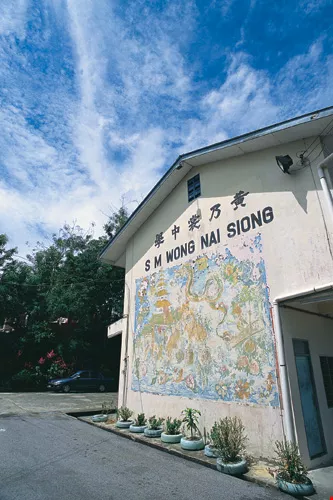
The name of Wong Nai Siong Secondary School commemorates a community leader who brought people from Fuzhou to the new regions of Sibu.
Chinese primary schools accepted
In the 1955 elections the Alliance was victorious, and as the leader of the new government Tunku Abdul Rahman revamped education policy in line with the Malacca commitments. In 1956, the influential Razak Report acknowledged the legality of the coexistence of schools teaching in the three languages of the country's major ethnic groups, while expressly stating that Malay was the national language. Yet the ultimate aim of national education policy was to bring the country's children together in a school system with Malay as the medium of instruction.
Although the Razak Report formally integrated Chinese primary schools into the education system, the position of middle schools remained ambiguous.
Around 1957, when Malaya became independent, the government was consistently pushing for Chinese middle schools to be reorganized into a national secondary school system with English as the medium of instruction. Schools that refused to change would be excluded from government funding, while government exams would all be set in English or Malay. When this policy became law with the 1961 Education Ordinance, the 72 Chinese middle schools were faced with a severe challenge.
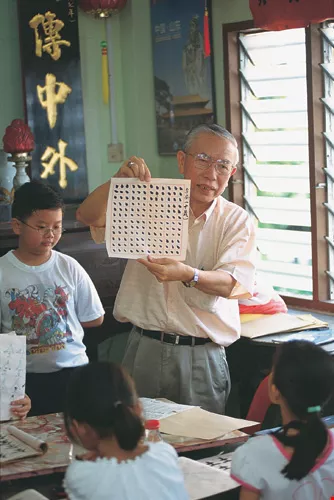
Every weekend, the community's inhabitants, young and old, come to the Confucian hall where old men teach the basics of calligraphy, dispersing the seeds of Chinese culture.
Divisions emerge
This attempt to reorganize the Chinese middle schools marked the beginning of divisions in the Chinese community. MCA president Tan Cheng-lock, an ardent supporter of Chinese education before independence, became ill and retired, His son Tan Siew-sin, who took over from him, did not agree with Lim Lian-geok's tactics.
Tan believed education policy had to take account of children's future employment and competitiveness. Too much emphasis on Chinese would leave Chinese students with a black-and-white choice between studying Chinese or English. How would those who studied in Chinese relate to other ethnic groups? How could they all be imbued with the common belief that they were citizens of a single country?
But advocates of Chinese-medium education continued to oppose unified education, arguing that loyalty to the nation was a question of ideas, not language.
"Before independence, we were expatriate nationals of the Republic of China. It was only after independence that we became proper Malaysian citizens," says former UCSTAM chairman Sim Mow-yu. Independence came through the combined struggle of Chinese, Malay and Indian comrades; its fruits should be equally shared, to allow each group to maintain its own cultural heritage and values.
The debate over Chinese middle schools raged for many years. Lim Lian-geok was eventually stripped of his civil rights after he called on the Chinese community to support independent Chinese schools at all costs if they were denied government funding, and embarked on a bitter war of words with government supporters. But it seemed the situation was irreversible. The majority of Chinese middle schools accepted the changes, and only 16 chose to do without subsidies and take the independent route. The lifeblood of Chinese education was seriously sapped.
At the same time, the directors of many middle schools that had accepted reorganization found that the official exam results of many students from Chinese primary schools were not good enough for middle school entry, and began offering middle school classes to such students on an independent basis in the afternoons. But in 1965, the government implemented nine-year mandatory education, and Chinese primary school students could automatically graduate to national secondary schools. The independent schools then faced a severe shortage of students, bringing some of them near to closure.
Kuala Lumpur's Chong Hwa Independent High School was one of the schools then operating both as a government middle school and as an independent school. Its principal, Tan Soon-hock, recalls the hardships of operating at the time, of feeling like a gang of beggars-having to run around not only to rustle up money, but also to find students. By 1972 the student body of the independent part of the school had dropped from more than 1000 to less than 200. They felt that to revive the school's fortunes they needed to break away from holding their classes in the afternoons, find a new location and undergo a major overhaul. "The 30 directors, the teachers and the students were all of one mind," says Tan. To raise funds for a new school, every year during the festival of the Nine Kings, for seven days straight the teachers and students would go to the temple to sell flowers and raise money.
When independent Chinese middle schools appeared ready to breathe their last in the early 1970s, a group of Chinese educationalists in the northern state of Perak, grappling with the problems of running such schools, decided that the only way forward was to change from being supplementary tuition schools to offering a comprehensive six-year academic curriculum. Perak's nine Chinese middle schools resolved to raise funds of RM1 million to assure their survival. As word got around, there was an enthusiastic popular response, with street vendors holding charity sales and fishing boats braving storms to catch fish for donations. People of all walks of life loosened their purse strings, and the fundraising effort spread countrywide, gradually evolving into a Chinese middle school revival movement that lasted several years. Many schools that had been offering afternoon classes established themselves as independent Chinese schools, bringing the total number to 60.
The way this movement was able to thrive in the 1970s was aided by an outside factor. At that time the Malaysian government was year by year transforming English-medium primary schools into Malay-medium schools, a policy that induced a sense of crisis amongst Malaysian-Chinese parents. Many worried that the next step would be to make Chinese primary schools national schools, and many families whose children had been studying in English primary schools began sending them to Chinese schools. The spirit of Lim Lian-geok was coming back to life.
The 1970s saw another major struggle in Chinese education, this time for the establishment of an independent Chinese university. This project attracted widespread donations from the Chinese community. But the MCA took a contrary position, with party president Tan Siew-sin sneering that pigs would fly before such a university was founded. The MCA paid dearly for this, suffering a crushing defeat in the general elections of 1969. But after the May 13 race riots all Malaysia entered a state of emergency. The Chinese university movement had to be put on hold.
Advancing in darkness
When the 1980s rolled around, the Malaysian government, still trying to realize the 1956 Razak Report's objective of making Malay the only language of instruction in schools, continued to attack the development of Chinese primary schools.
In 1987, the Education Department appointed Chinese with poor Chinese language skills as primary school principals and deputy principals. "We had a strong sense that the end of Chinese primary schools was imminent," recalls Sim Mow-yu. The result was that Chinese politicians and people gathered at Kuala Lumpur's Thean Hou Temple to protest, while primary schools carried out a strike. The authorities reacted with wide-scale repression, and more than 100 Chinese educationalists were arrested. This was the infamous Operation Lalang.
Malaysian History and Chinese Education Timeline
1896 Malaya becomes part of the British Empire
1942 Home to over 1400 Chinese schools prior to Japanese occupation
1951 British government issues the Barnes Report
1955 Malay and Chinese political party leaders hold the Malacca Talks
1956 Government issues the Razak Report, recognizing the legal status of Malay, Chinese, and Tamil primary schools
1957 Malaya becomes independent
1961 Malayan government passes Education Ordinance, forcing reorganization of Chinese-language schools
1963 Malaya, Singapore, Sabah, and Sarawak combine to form the Federation of Malaysia
1964 Singapore withdraws from the federation
1965 Malaysian government implements nine-year compulsory education; enrollment at independent high schools declines
1969 Race riots erupt in May 13 Incident
1970 Government announces 20-year New Economic Policy
1973 Chinese school restoration movement starts in Perak,spreading across the country and lasting ten years
1987 Malaysian authorities launch Operation Lalang, resulting in the arrest of over 100 Chinese educators
1991 Prime Minister Mahatir bin Mohamad proposes Vision 2020 Project
2003 Government pursues policy of English-language teaching of mathematics and science


