Taiwan's Feminist Movement in Search of New Vitality
Chang Chiung-fang / photos by Martha Tan / tr. by Phil Newell
November 2003


It looks right now like Fembooks, which was founded in April of 1994 as the first specialized feminist bookstore in any Chinese-speaking region, will soon close up shop.
Shih Chi-ching-once known as the Oracle of Divorce for her struggles on behalf of the rights of women in marriage and in divorce-had long been out of the public eye, but has recently come out with a new book about losing weight. Now she appears on the TV screen volubly relating her feelings about having dropped more than a dozen kilos.
One feels regret over the former situation, flabbergasted over the latter. Is it possible that Taiwan's feminist movement has already run its course?
The purple sign for Fembooks, located amidst the serene neighborhood of National Taiwan University, stands out like a call to arms, and has been attracting the attention of passers-by for many years. But with the news in July that the store may close, it appears that its familiar atmosphere-sometimes warm with the smell of coffee and the sounds of women in gentle discussion, sometimes charged by a feminist forum-will soon disappear into the mists of time.
Why? Bookshop decision-maker Su Chien-ling, chairperson of the Taiwan Gender Equity Education Association and an associate professor at Mingchuan University, says that those who have operated the bookstore-which was founded by activists in the women's movement-have been long on ideals, but short on business acumen, so they have run into financial difficulties. Fortunately, after a decade of fighting the good fight, the kinds of books for women now available in mainstream bookstores are no longer limited to childcare and cooking. Moreover, now that there are so many venues for artistic and intellectual events, Fembooks is no longer indispensable for the spread of the ideas and creative work that it has long promoted. It seems that the bookshop's mission, particular to its specific time and place in the history of feminism in Taiwan, has been accomplished.
But while the lights are being turned out at Fembooks, Shih Chi-ching, a leading early feminist, has reemerged from the dark into the footlights. "Movements are for younger women to run," says Shih, who virtually single-handedly created the Warm Life Association, an organization founded to help divorced women. Once the laws governing property ownership between husband and wife were amended, and education on gender equality began to be put into place, the specific missions she originally set for herself were achieved, so naturally she felt it was time to step aside and let others take the lead. She retired to the countryside in Nanchuang Rural Township, Miaoli County, where she began to study Chinese medicine and write books, living a rural lifestyle. Having run her health into the ground while working in the feminist movement, she decided half a year ago that she was going to get fit. She trained herself into a great physique, and-in line with her character of minding other people's business and being a missionary for what she believes-flashed her swimsuit-clad new body for the media. The result was immense controversy.
"The mission of the previous stage has been completed" is the reason given for both the changes at Fembooks and the passing of the baton by feminist pioneer Shih Chi-ching. Looking back over the last 20 years, what has Taiwan's women's movement achieved? What is next in store?
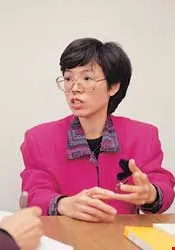
chairman of the National Union of Taiwan Women's Organizations: "There is still along way to go before we can eradicate gender prejudice." (photo by Diago Chiu)
Hand in hand
The women's rights movement in the West dates back at least to 1791, when France's Olympe de Gouges issued her "Declaration of the Rights of Women." Taiwan's feminist movement, restricted for decades by the authoritarian system, got a rather late start, taking embryonic shape only in the 1970s.
Early feminists concentrated on proclaiming the ideals of the movement. But in the 1990s, given new opportunities by a changing political system, the Taiwan women's movement, like other social movements, turned its attention to attaining strategic goals of getting new legislation passed or existing laws amended, aiming to use the machinery of state to improve women's rights. And indeed, the most visible achievements of the women's movement have been in rewriting the laws.
Many laws directly bearing on women have been passed or amended. Perhaps the two most important achievements have been the amending of the family provisions of the Civil Code (which establish the rights and status of women in marriage, and set norms for relations between husband and wife, and between parents and children) and the passage of the Gender Equality in Employment Law (GEEL). Each of these pieces of legislation required over a decade of hard work.
As for the former, Shih Chi-ching, then head of the Warm Life Association, and Yu Mei-nu, then convener of the working group on legislation at the Awakening Foundation, got the ball rolling back in the 1980s. They both felt that women were not being treated fairly within marriage. They found a number of provisions especially unreasonable: women and children had to take the husband's surname and reside with him, fathers were almost always awarded custody of children in the event of divorce, and all the wife's property before the wedding day became the husband's after marriage. They began trying to change the law, a goal which they achieved last June after 11 years of research and arduous lobbying.
The amended family provisions are more equal. There is now much greater flexibility for judges in granting divorces; any property acquired by a woman before marriage remains hers without the need for further proof that its ownership status has not changed; and the tradition of nearly always awarding custody of children to the father has been shattered, with the best interests of the child now the standard for deciding custody.
Beyond status within the family, in the past women also faced much inequality in the workplace, such as the unwritten rule that pregnant women had to resign. Taiwan's first ever women's organization-the Awakening Foundation, formed 17 years ago-decided to focus on workplace issues, hoping to improve the lot of women at work in such areas as discrimination against pregnant women, gender stereotyping for specific jobs, unequal wages based on gender alone, and sexual harassment. The group completed a draft of a GEEL in 1989.
It took 12 long years for the Legislative Yuan to finally pass this law. The reason? The issue came up at a time when traditional industries in Taiwan began facing problems of rising costs and wages, and capitalists did not want to take on the added costs the law would entail. Businessmen even sent a petition to the president in which this bill was listed as one of "ten evil pieces of legislation."
Thanks to tireless efforts by feminists, Taiwan finally passed the GEEL in 2001. Though this was much later than similar laws passed in the UK (1975), Italy (1977), and Japan (1985), considering that similar legislation has still not been able to get through the US Congress, Taiwan's women's movement still gets high marks for its work.
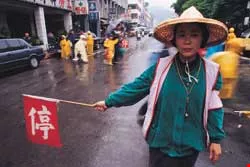
As wife to her husband and mother to her children, a woman in traditional society was called on to sacrifice herself unstintingly and invisibly. Sometimes she would even forget her own existence. (photo by Huang Lili)
The post-legislative era
But the passage of legislation alone should not be taken to mean that women have achieved autonomy, and that the feminist movement can take a rest. On the contrary, the laws have functioned to take the steam out of efforts for real change, by removing the most odious points of attack for the feminist movement. Now, say some, striking a blow against the system is more like "punching cotton."
Veteran women's rights activis Jennifer Wang, an attorney at Evergreen International Law Offices, reveals that as a result of budget and manpower constraints, many laws are poorly enforced. Take for example the laws on domestic violence. Every locality has established a commission and a center for prevention of domestic violence, but these typically lack adequate staffing. For example, there are only two social workers assigned to handling domestic violence cases for all the married women in Hsinchu County, so you can guess what the quality of services there is like. Some places have built prevention centers, but do not have a single soul manning them, so that they are good for nothing but breeding mosquitoes.
In hard times, ideals often can't overcome reality, so must be put aside. For example, though the law on gender equality in the workplace bans discrimination based on gender, most employers put first priority on costs. In an environment of intense competition, employed women must take reality into account and sometimes must sacrifice rights to which they are entitled.
For example, this year at the National Defense Management Institute, 81 men were accepted, and only two women. Obviously there was discrimination based on gender in violation of the law. But after representatives of the Awakening Foundation protested, they received a call from the wife of a military officer telling them: "What will happen if they take more women? I'll tell you what! They will refuse to work overtime [in order to be home when their kids get home from school], and this will only make things harder on the men!"
The words of the officer's wife are no different from the fears felt by employers: that women will not work overtime, or that they will take maternity leave, thereby increasing the workload for their male colleagues and costs for their employer. It's just especially depressing to hear these arguments from a woman.
Women now in the workforce do not, it seems, feel they have achieved gender equality on the job.
This March, on the eve of the first anniversary of the passage of the GEEL, the Awakening Foundation discovered in a survey that the workplace is still far from fair. Sixty percent of respondents said that they felt that advancement was slower than for their male counterparts (by an average of 2.7 years) and of those one-quarter said "there is no hope of promotion-ever." Also, few women take the legally permitted leave after the birth of a child, mainly because they do not believe that employers will really hold their jobs and responsibilities open for them until they return.
Another reason why the laws have not been fully implemented is that traditional attitudes remain unchanged. For example, while current law clearly gives women the right to inherit property, most women forego this right, because traditionally women could not inherit and many people still think it too uppity for a woman to claim an inheritance. For example, when recently a group of daughters sued their mother for allegedly committing fraud in order to ensure that the father's inheritance went exclusively to the sons in the family, most in the media criticized the daughters for a so-called lack of filial ethics, while few took issue with the mother's belief that the sons should get all the money.

As one of Taiwan's most important social movements, the feminist movement is the subject of great expectations as it seeks new directions and drive. (photo by Diago Chiu)
Women making it hard for women?
While there is still a long row to hoe before laws on gender equality actually become routinely implemented in daily life, the mere passage of these laws has left the women's movement without a clear focus. First of all, like all social movements, the women's movement faces the crisis of political "co-optation," caught between being drawn into politics and staying outside. Secondly, many people have the impression that the reputable women's organizations which once did the heavy lifting have either splintered into factions or have been keeping a low profile.
"In the past there were no opportunities; now there is no capability," says Jennifer Wang, getting right to the nitty-gritty. Faced with tasks that are much more complex and require much greater detail work, some feminist leaders have been "assimilated" or "co-opted," while others are not up to the new challenges now that the movement is past the stage of shouting slogans and organizing protest marches.
Wu Wei-ting, secretary-general of the Awakening Foundation, points out that with legislative work having reached a given point, many women's groups have turned to "subcontracting"-taking on the bread-and-butter implementation of government policies. The few who continue to be primarily "advocacy" groups are still trying to make their voices heard, but the fact is that the great ideological battles of the past are over. In the absence of the sound and fury of full-scale war, the media has lost interest.
Attorney Yu Mei-nu, who is also director of the National Union of Taiwan Women's Organizations (NUTWA), agrees that "media neglect" has been one of the main reasons why the women's movement has seemed so quiet in recent years. "Now when you put on an event, the biggest headache is getting anyone to come!"
At the end of August, two women's groups-Taiwan Women's Link and the Taipei Association for the Promotion of Women's Rights-held a press conference about a draft law to protect the health of women and children. Aside from the sponsors themselves, the only people who came were two or three cub reporters.
Wu Wei-ting says that today the women's movement can no longer simply appeal to the media as a group of tragic victims, but must move in a more mature direction. For example, it must come up with concrete policies and solutions, which take time for research and for consensus building.
Su Chien-ling argues, on the other hand, that with the coming to power of the opposition Democratic Progressive Party in 2000, there is now a mechanism in place within the system for dialogue between state and society. Now that women's groups have entree at the highest levels, it's natural that street activities have declined. Su notes that non-governmental activists are included on both the commission set up under the cabinet to promote the interests of women and the one set up under the Ministry of Education to pursue gender equality education.
But that's not the whole story either. It is true that now that the DPP, which formerly stood "on the outside" side-by-side with women's groups, is the ruling party, some feminist leaders wield influence inside the government. Unfortunately, some women's groups have begun to show the phenomenon of "blurred identity," with their work for a specific political party overshadowing their role as defenders of women's interests.
"Internal divisions based on political party affiliation or ethnicity are the bane of Taiwan's social movements, and the feminist movement is no exception," says Wu Wei-ting. Gender issues should naturally transcend party boundaries, but the feminist movement in Taiwan is also caught in the trap of putting party labels on people.

founder of the Warm Life Association: "Marriage is a product of agricultural society, so it's no wonder it can't adapt in modern capitalist society."
Fragmentation, or diversity?
There are more than 2000 women's organizations registered with the Ministry of the Interior. However, most of these are professional groups, such as those for young female entrepreneurs or for beauticians. There are 67 groups affiliated with the NUTWA that are still genuinely active. Moreover, there is a division of labor among these, with each group focusing on particular issues.
For example, the Awakening Foundation (founded in 1987 as the earliest feminist group in the country) is currently working on amending the Civil Code and on the problems of newly arrived immigrant women. The Women's Rescue Foundation, carrying on from its earlier focus on seeking compensation for Taiwanese "comfort women" (women forced into sexual slavery by the Japanese army in World War II), is now assisting victims of domestic violence. The Taipei Association for the Promotion of Women's Rights devotes its attention to health issues of importance to women, the Warm Life Foundation occupies itself with single mothers and widowed or divorced women, the Homemakers Union follows environmental issues....
While this scattering of attention in all directions can avoid overlap and therefore prevent wasting of resources, in recent years once-united women's groups have been more in a state of opposition than of dialogue. Owing to different outlooks and positions, they have varied views on many issues, such as decriminalization of adultery, licensed prostitution, and surrogate motherhood.
What's the underlying reason? "These days there is no one playing the leading role as spokesperson," says attorney Jennifer Wang, "so the discursive and explanatory power of the past is gone." Wang, whose credentials include former chairwoman of the Awakening Foundation and member of the Executive Yuan's Foundation for Women's Rights Promotion and Development, recently left formal participation in women's groups because of her deep disappointment with the situation (though she will continue to try to raise awareness of the gender inequities in law through specific cases).
Yu Mei-nu, on the other hand, says that democratization naturally results in everyone having their own say. "Conflict is inevitable, it's just that we have to learn mutual respect," she feels. Given the extent to which the media plays up controversy and extremism, minority opinions take on the coloring of mainstream views. The media gives only distorted representations of various views, making it even more difficult for those opposed to one another to engage in rational dialogue.
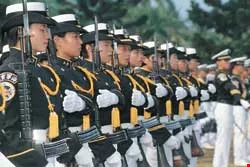
The Gender Equality in Employment Law has been passed, but enforcement remains problematic. Many professions still exclude women on the excuse that women are too physically weak or that the jobs are too unsafe. (photo by Diago Chiu)
Not dead, just on ice?
Given that some of the old generals of the feminist movement have decided to retire, leave the movement, or enter the government, plus the fact that the government's current financial situation has forced a cutback in subsidies, we are seeing both a reduction in manpower and the emergence of a new generation of activists in women's organizations. At the Taipei Association for the Promotion of Women's Rights, for instance, full-time staff has shrunk from six to two, while over at the Warm Life Association only three people get paid, while all other workers are volunteers. At most groups, almost all the staff, from the directors on down, are "little sisters" born in 1970s and 1980s.
"After doing this for more than 20 years, I'm tired!" admits Yu Mei-nu. The pioneering leaders all felt a powerful sense of mission, with everyone willing to sacrifice for the cause. You don't see this attitude anymore in the younger generation, who only are interested in their personal affairs and tend to be hedonistic. The sharp falloff in talented people joining the movement is a real concern.
"Feminist organizations must take what they've inherited from the past and find a new direction toward an era without strong leaders," states Warm Life's Rachel Wang. In the past, under the charismatic leadership of Shih Chi-ching, Warm Life successfully became a focal point of media attention. When Shih retired, members were devastated, and some of the directors also left, delivering quite a blow to the organization.

chairwoman of the Warm Life Association: "Warm Life plays the role of companion. When a marriage hits the rocks, sisterhood is the most precious thing there is."
Just a slogan?
Besides a fragmentation of ideals, at this point in its evolution the women's movement now faces the challenge of "deepening" the movement, both in the sense of getting more of the public to better understand and identify with its aims, and in the sense of having a deeper impact at the grass-roots level of society.
"Everyone now knows what slogans to repeat about feminism and gender equality, but at the same time we see Japanese porn starlets coming to Taiwan every day," says Chen Yi-ling of the Taipei Association for the Promotion of Women's Rights. The biggest problem facing feminists today is that deep-rooted attitudes remain unchanged.
Take for example the issue of women's autonomy over their own bodies. In 1999 the Taipei Association for the Promotion of Women's Rights proposed several amendments to the Genetic Health Law. After being submitted to the legislature for deliberations they aroused such controversy that they were sent back to the Department of Health to start the process all over again. The provision stating that adult women do not have to have the approval of their husbands before terminating a pregnancy proved especially hot-button. Some critics turned their wrath on "women who betray their husbands and then secretly eliminate the babies resulting from their adulterous affairs," and claimed that the law would likely encourage such behavior and "destroy family values."
It is sad that many men still do not "get it" when it comes to treating women as something more than household staff. Even more tragic, however, is that so many women themselves still remain in the dark.
There was a story in the newspaper about a woman who got breast implant surgery because her husband repeatedly had affairs with large-breasted women, and she thought this would be the way to get him back. Incredibly, her husband took the surgery as a sign that his wife was out playing the field, and in the end she had to have the implants removed.
New Awakening's Wu Wei-ting avers that deeply rooted traditional culture is the most difficult obstacle for the women's movement to break through. "The greatest drag on the movement comes from women," she says. Powerless women are inclined to accept their fate, while the most capable women are unlikely to feel that they are being treated unfairly.
For a long time now, the elite discourse in the women's movement has not spread widely among women in general, and there is even a larger gap between city and countryside.
Wu Wei-ting points out that in the past feminist groups mostly talked to the media, but didn't do much to relate to real women at the grass-roots level. Thus, when New Awakening held a series of seminars in northern, central, and southern Taiwan on property rights of husbands and wives, you could tell the large gap between city and country from the reception they received from the audience. It is now important for women's groups to consider how to better link up with women from the middle and lower strata of society.
"Setting down roots and deepening our impact is the real hard job," says Yu Mei-nu. To help close the gap between town and country, two years ago they began organizing women's groups in northern, central, southern, and eastern Taiwan to create the NUTWA, to create a platform for information and resource sharing. They are now moving to use the Internet to link women's groups across the island.

chairman of the Taiwan Gender Equality Education Association: "What the women's movement seeks is a transformation of the cultural structure, and not just a dialectic on the level of concepts."
Sisters, stand up!
Just as Rachel Wang says, Taiwan has been pursuing gender equality for many years now, but there are still too many women who do not enjoy independence and autonomy in the four main areas of knowledge, character, emotion, and economics. Therefore they are unable to really stand as equals with men.
It looks like there is still a long road ahead for the feminist movement in Taiwan. Besides setting down roots and deepening, how can the movement rejuvenate itself so that the torch can be passed on from generation to generation?
One answer is localization. Activists-who have generally been deeply influenced by Western thinking-have in recent years been trying to develop more "localized" topics of specific relevance to Taiwan. Examples of such issues include sexism in local religious life and the problems of new immigrants.
Let's look at religious ritual, for example. During the Tomb Sweeping Festival this year, New Awakening made efforts to draw attention to the phenomenon of altars for deceased unmarried daughters, in hopes that society would begin to devote more attention to gender inequality in traditional religious belief.
Wu Wei-ting explains that traditional custom forbids placing memorial tablets to deceased unmarried daughters inside the house. Therefore, when a young unmarried woman dies, her memorial tablet is placed in a guniang miao ("unmarried girls' temple"). In this context, the word guniang not only implies that the deceased girl is unmarried, but is also "orphaned" as well, with no place that her soul can properly call "home." "The guniang miao tradition clearly demonstrates the importance of marital status for women," says Wu Wei-ting, adding: "If commemorating deceased ancestors and family members is a form of respect and reverence, is it right that all women who remain single, get divorced, or choose a homosexual lifestyle are to be eradicated from the history of the lineage and forgotten?"
A volunteer at the New Awakening Foundation has written that after her divorce she was perplexed over how to cope with traditional rituals: Should she follow the traditional custom of married women returning to their parents' home on Lunar New Year's Eve? What (or where) would be her place on tomb sweeping day? What would happen after she died? "A woman, once married, is considered by tradition to have left her own family, but once divorced she also no longer belongs with her husband's family. So where should her memorial tablet go after she dies? Who will pay reverence to her soul and make the necessary prayers and offerings to see that it is well settled in the next world? This is how a paternalistic society punishes women who stray from the system!"
Warm Life's Rachel Wang says with a sigh that the fear of being a "wandering ghost with no one to look after her" deeply affected her own mother, encouraging her to hang on in her unhappy marriage to the bitter end. Wang, who got divorced two years ago, admits that she doesn't know what will become of her in the next world, but hopes that more and more families of divorced women will welcome them back home.
Besides paying more attention to issues of a peculiarly local nature, women's groups are also keeping up with international trends, hoping to draw on what is going on outside Taiwan to strengthen the movement here.
Yu Mei-nu says that in the past women's groups that had wide international contacts were often little more than social clubs for the wives of top government officials, whereas groups doing real grass-roots feminist work had no opportunities to get their message out or come in contact with foreign activists. She thinks that the time has come for women's groups from Taiwan to actively seek participation in international organizations, in order to broaden the perspective of the movement.
Women's groups got a start on Women's Day (March 8) of this year, when they gathered at the door of the ROC Ministry of Foreign Affairs to issue a declaration expressing opposition to the US attack on Iraq. After former "comfort women" and relatives of victims of the February 28 Incident spoke on the horrors of war, women came up to read the joint declaration in Taiwan's various dialects, and the event closed with the singing of an Atayal Aboriginal anti-war song.
Of course, the war was not in the least affected by the protest. But it is gratifying that on this subject at least there was a broad consensus among local feminist organizations, returning to the basic starting points of the women's movement: love, peace, justice, and human rights. Perhaps it is by returning to basic humane values that the women's movement in Taiwan will enjoy a resurgence.
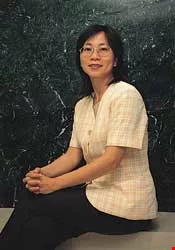
an attorney at Evergreen Law Offices: "in the past the feminist movement was mainly about shouting slogans. In the future it will have to get down to more precise and detailed work."

Everybody talks about gender equality, but everywhere you still see women commodified. Ideas about gender equality have not made themselves felt in many aspects of life in Taiwan. (photo by Jimmy Lin)

Fembooks, its mission completed, will likely close soon. Taiwan's feminist movement is at a turning point, with old leaders passing the baton to a new generation.


