

The saying used to run, "Happy New Year! Happy New Year! Sport new clothes and look your best!" Now it's more like, "New Year's here, New Year's here. Watch TV and fall asleep."
Housewives frantically rush around buying ready-made seasonal foods for the holidays, while office workers, who rush around all day anyway, simply pick up their bags and head overseas to "avoid the holidays." Holidays and festivals! Remember how our grandparents' generation used to say that "celebrating holidays is easy; it's getting through the rest of the year that's tough"? Why is it that people today seem to find it just the opposite? Is it possible to add some vitality to what seems tired and worn out and make these faded festivals bright and colorful again?
On New Year's Eve, after sending off the ancestral spirits to heaven, the head of the family tidies up the sacred altar where they reside the rest of the year. People in Taiwan and southern Fukien call it ching-chen, or "cleaning off the dust." The firecrackers that the family sets off are intended to drive away evil spirits, so in effect everyone pitches in a big spring cleanup of things both seen and unseen.
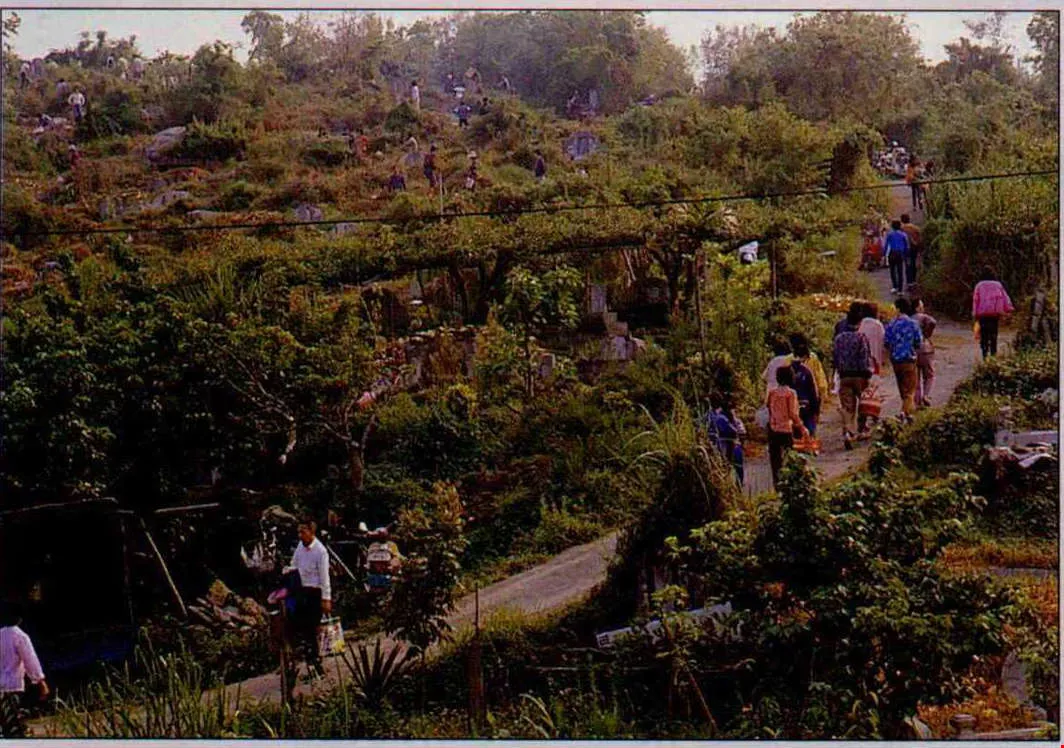
Nature comes back to life at the Ching Ming Festival, making it the perfect time for a spring outing. (photo by Lin Po-liang)
Shrunken New Year's Eve:
The New Year cake (nien-kao) and the steamed sponge cake (fa-kao) cooking on the stove exude a festive aroma. Over the doorway are hung spring couplets and New Year's pictures; on the coffee table are spring flowers and a bowl of spring rice, giving the whole apartment an auspicious atmosphere inside and out.
After New Year's Eve dinner, the adults play mahjongg or roll dice, while the children wave sparklers and set off bottle rockets--they're having a great time, doing things they're normally not allowed to. Traditionally, Chinese opera companies put on a year-end performance, where the normal roles are all mixed up. The evening reaches a peak when the older folks hand out gifts of money to the youngsters. The children are too excited to sleep and stay up all night "watching in the New Year"--signifying added longevity for their parents. On New Year's Day, everyone puts on new clothes and wishes each other a happy new year. The festive excitement continues right up to the third day after New Year's, when the spirits return from their celestial vacation and the daily routine slowly returns. On the next day everyone goes back to work.
Festivals are like that--characterized by religious taboos and romantic legends, by preparations and anticipation. They're occasions in which we engage in atypical activities that break the monotony of the daily grind, in which we share with others and let ourselves go.
In the commercial and industrial society of today, nine-to-fivers don't get off on vacation until the day of New Year's Eve itself, and then they have to fight their way through traffic back to their old hometowns to reunite with their families and relatives. The standard preparations have to be foregone, and the traditional holiday items are replaced by ready-made commercial products. Not only are the spring couplets and New Year cake store bought--even the big spring cleanup is contracted out to a professional cleaning company. All that's left of tradition is plenty of eating, drinking and gambling. Picnic outings and temple visits are replaced by watching the tube.
"Abbreviated, monotonous activities like these are naturally unable to give rise to a joyous holiday spirit," says Yu Teh-hui, a professor of psychology at National Taiwan University.
Chinese New Year becomes just another holiday that nine-to-fivers look forward to as paid vacation. Instead of returning home to see the relatives, more and more people simply travel abroad to avoid the hassle. According to authorities at Chiang Kai-shek International Airport, the number of travelers who left the country during New Year's last year totaled 158,000.
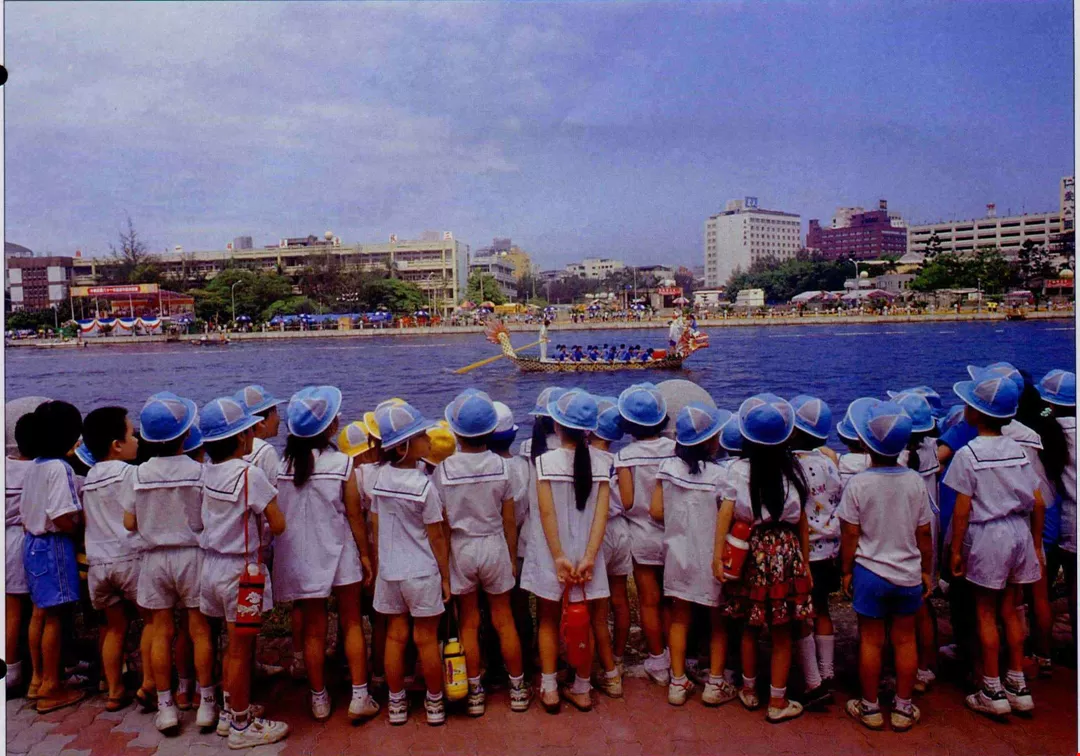
Dragon boats are now mostly sponsored by corporations and organizations.
New year's fatigue:
Chinese festivals originated in agricultural society, with its relaxed and orderly pace of life. In the hectic world of today, the pace of life and interpersonal relationships are both different from the way they were in the past, and some of the traditional ways of celebrating holidays are naturally no longer in line with the times.
"Festivals aren't celebrated the same as they used to be. They may seem to be losing color, but in fact they're also being re-created," says folklorist Wang Sung-shan.
In today's world of supermarkets and plenty, big holiday meals and holiday dishes like tzung-tzu (glutinous rice wrapped in bamboo leaves) and tang-yuan (glutinous rice dumplings served in broth) are no longer eagerly anticipated special treats.
The drama and excitement of a holiday, which people in the past had to go through a long period of waiting and anticipation before experiencing, are nowadays common in everyday life. There's drama and romance in every soap opera on TV, and you can be your own star at a disco or karaoke parlor. It's made people feel a bit "thrill fatigued."
"Treating New Year's as an important holiday doesn't necessarily mean keeping it as noisy and full of activity as it used to be," says Li Feng-mou, a professor of Chinese at National Chengchi University who has done a study of New Year's customs on Taiwan and believes we can break through the conventional images we have of celebrating New Year's.
The most important significance of the holiday lies in our reuniting as families and giving thanks for our blessings. The special feasting and merriment is just a way of enriching the pleasure of being together. In the tense and hectic world of today, the best way to celebrate the New Year is not to engage in a round of forced and empty visits but invite a few good friends over for a chat or to find some hobbies the whole family can share--to read together, listen to music, go on an outing or reminisce over the joys and sorrows of the past year.
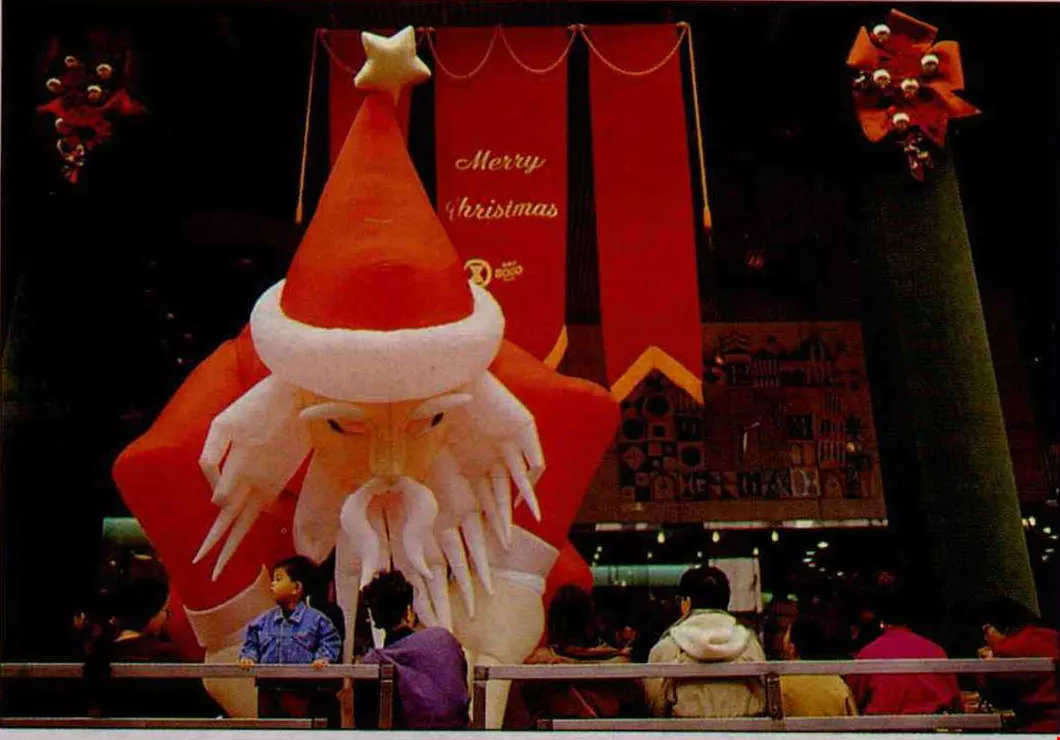
Santa's coming to town--the department store windows are full of toys. Regardless of religion, Christmas has become the most exciting new holiday for young people.
Mid-Autumn barbecue:
Urban life not only changes the pace of life--the environment is no longer favorable to spending holidays the way we did in the past.
When the Mid-Autumn Festival was celebrated in the countryside, the young men would compete swinging on swings, while the young women admired them on the side. Children ran around in the hills with bamboo torches or carried a washbasin off to the fields to play the game "striking Mid Autumn." In the city, children have no empty fields to play in and no playmates. Besides crowding out on the balcony and eating moon cakes, it seems the only thing people can do is go back inside and watch TV.
Cultural critic Nan-fang Shuo believes that the celebration of festivals can be divided into three stages. The first is the feasting and drinking of agricultural days. The next is making use of them in our personal lives. What we need to do now is move on to the third stage, which is finding new meaning in tradition and designing appropriate ways of celebrating them.
That is something like modernization, as Academia Sinica member Li Yih-yuan defines it in his book Cultural Change and Modern Life. Modernization, he says, is not the same as Westernization. Rather it involves building on an original foundation a lifestyle that can be constantly adapted to the present.
In the Mid-Autumn Festival, for instance, when people were no longer satisfied eating moon cakes or watching television, they turned it into the modern "barbecue festival." Whether in the city or the country, in the backyard or on a balcony, the whole family gathers around a charcoal grill and chats, laughs and admires the moon. It really brings out a sense of family togetherness, much better than simply eating moon cakes. Yu Teh-hui exclaims that the idea of having a barbecue is "really marvelous!"
What's marvelous is that people have finally moved forward past the stage of spending their holidays in front of the TV set. No matter how many specials are on or how big the stars are, watching television is only a one-way activity, after all. After a while, it saps the fun and spoils the holiday cheer. Passing up TV and getting together for a family barbecue "is person-to-person, face-to-face interaction, a rare and precious resource in modern society," Yu says with emphasis.
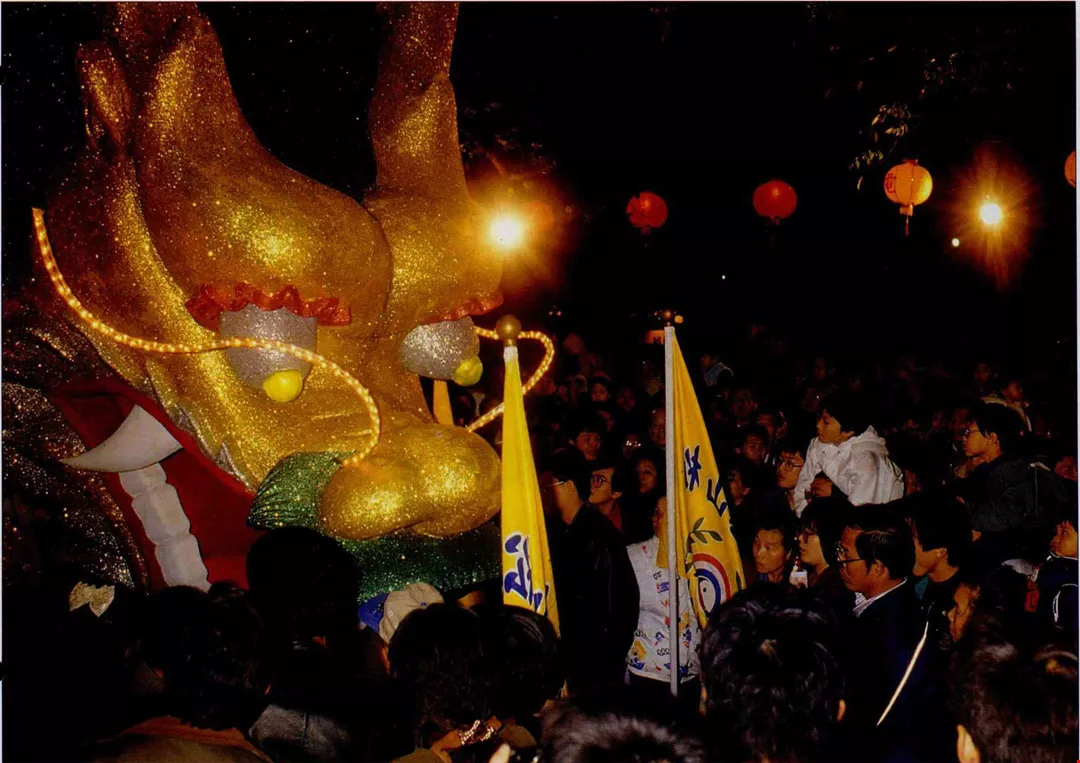
The Taipei Lantern Festival, sponsored by the R.O.C. Tourism Bureau, has become a popular attraction for tourists from both home and abroad. (photo by Diago Chiu)
Gifts without givers:
Traditional holidays and festivals have been passed on for centuries and millennia. In today's world of rapid change, some customs are no longer suited to the times and some are observed only in form, having lost their meaning after being passed on from generation to generation. "We have to find out what must be changed and what can't," says Juan Chang-jui, head of the anthropology department at the Taiwan Provincial Museum.
After Li Tung (the day that marks the beginning of winter in the Chinese calendar), people start eating all kinds of tonic foods loaded with extra nutrients. The custom originated because people in the old days overtaxed their strength during the harvest and needed extra nutrition to build themselves back up for the spring plowing. In the high-calorie world of today, exercise would probably be a better way to build up strength than eating tonic foods. But Li Tung is not only a time to start building strength. It's also supposed to remind us to start arranging plans for the coming year and is the time when many business people set up new contracts.
The first thing that reminds people of the approach of the new year is probably those ubiquitous advertising brochures and flyers. Gift giving originally was a way for friends and relatives to feel warmer and closer when visiting. According to the custom of Taiwan and southern Fukien, families in mourning are not supposed to make nien-kao or tzung-tzu for the holidays, but they can be given some as a present by their neighbors. The gifts are trivial in value but they're an expression of care and concern. Nowadays, gifts are given with no sense of feeling--or even "the gift arrives without the giver." It's like following the first part of the commercial jingle--"Mid-Autumn is the season for giving gifts"--without heeding the second--"and the season for reminiscing."
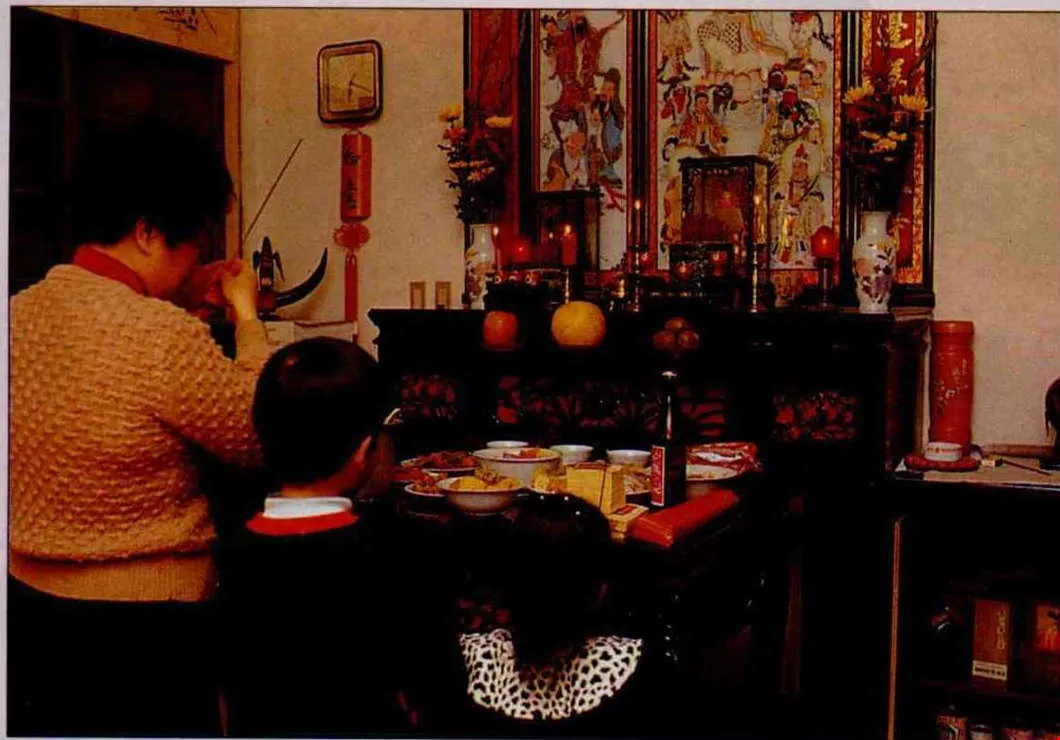
Presenting offerings to the ancestors and thanking them for the blessings they have conferred--taking part helps children acquire part of the collective memory.
Festivals through the seasons:
Our ancient ancestors filled tradition with many precious gems for us to discover. "We often overlook the reasons behind traditional culture," says Nan-fang Shuo.
Why do we sweep tombs and go for a spring outing on the Ching Ming Festival? Why do we hang up artemisia and drink realgar wine on the Dragon Boat Festival? And why do we climb a hill on the Double Ninth Festival? "If you explore the meaning behind them first, seemingly uninteresting festivals become much more warm and intimate," Juan Chang-jui says. Yu Teh-hui recommends that before we redesign the way a festival is celebrated, "we should find out about its contents first."
Ching Ming (Clear and Bright) is one of the 24 solar terms on the Chinese calendar, when "the air is clear and bright, and the myriad things are apparent." At this juncture between winter and spring, when all living creatures regain vitality, people head for the outskirts of town to tidy up the tombs of their ancestors and take the opportunity to enjoy a spring outing and celebrate nature and the continuation of life. Farmers believe that "the womb of the earth moves" and they can start plowing. The meaning of fertility is similar to that of the decorated eggs seen in the West at Easter.
Around six months later comes Double Ninth, which falls on the ninth day of the ninth lunar month. Scholars believe that ascending a height is a custom left over from prehistoric times, when people climbed hills to escape floods. The tradition arose during the Han Dynasty that "double nine" was an unlucky day liable to disaster, and the literati of later dynasties would climb a height and wax lyrical on the passing seasons. An example is Wang Wei's "Thinking of My Brothers in Shan-tung on the Double Ninth" :
Alone, a stranger in a distant land, I'm doubly homesick at a time like this.
Far away, I know you must be climbing a hill and wearing dogwood--one person missing.
The Double Ninth is a time when flowers are long past bloom. It is tinged with an air of melancholy and reflection, a time for examining life and thinking about one's loved ones.
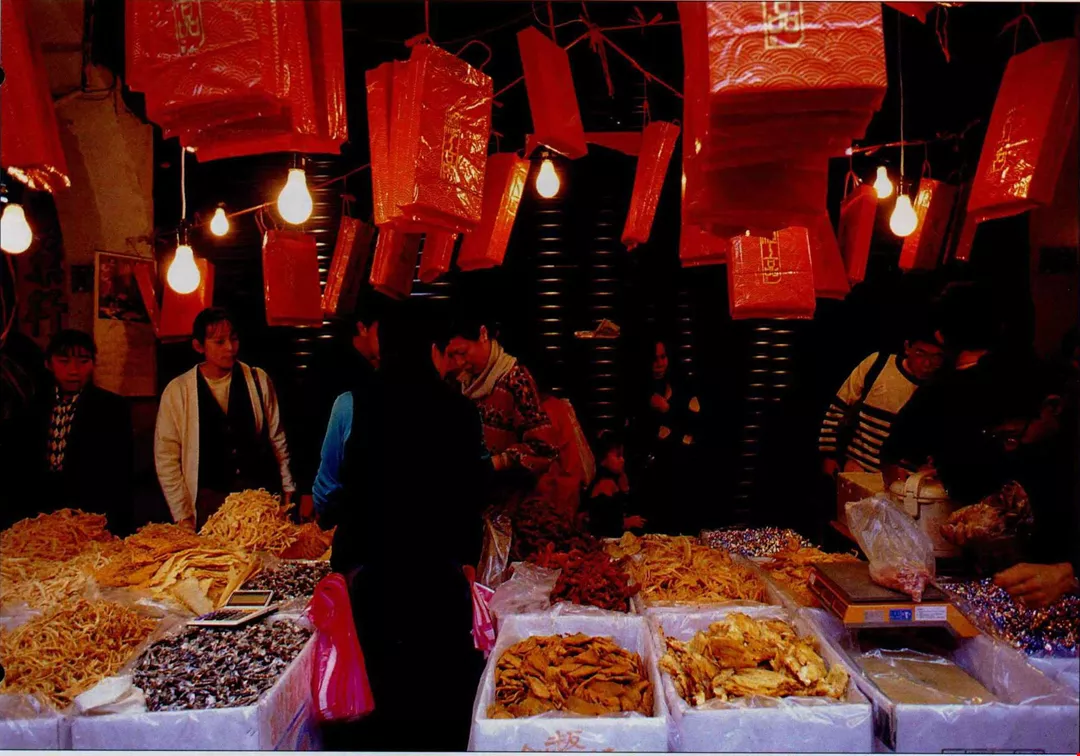
Tihua St. in Taipei is crowded with busy shoppers hurrying to stock up with holiday goodies. (photo by Pu Hua-chih)
Science in it, too:
Some festival traditions seem on the surface to be nothing more than voodoo. Hanging up artemisia and drinking realgar wine on the Dragon Boat Festival, for instance, arose as apotropaic practices to ward off evil spirits that the ancients believed were apt to prey on people and cause illness during a time they called "poison month."
Seen from today's perspective, the Dragon Boat Festival falls at the beginning of summer, when mosquitoes and other insects are rampant, when food is difficult to keep and when people are especially susceptible to disease, so it can serve as a reminder to practice summer hygiene.
After the Dragon Boat Festival comes the Tien Kuang Festival, which falls on the sixth day of the sixth lunar month, and is called "the day the emperor hangs out his robes" in Taiwan. Clothes and books aired out in the sun on that day are said to be protected from moths or worms, and dogs or cats washed then to be safe from fleas and diseases. Besides encouraging people to give winter clothes a good airing in the hot sun, the festival "implies care and concern among the common people for household animals -- a spirit of benevolence and humaneness," Juan says.
Taking a spring outing on the Ching Ming Festival or sunning out books and papers on Tien Kuang--the vestiges of traditional practices are still with us. Traditional festivals are not all obsolete old things unsuited for the times.
Wanted: an agent for holidays:
After rediscovering the contents and meaning of traditional festivals, what we need most is an "agent for holidays." Whether in the family, the community or the nation, holidays and festivals need change and variety. "That's what takes some thinking," Nan-fang Shuo says.
He cites an example off the top of his head: The Dragon Boat Festival is also called Poet's Day, so why not kick off a national poem-writing campaign involving the whole public, including children and even the president. Those with the training could write classical poems. The rest could write parodies. Young people could write free verse, and children could write nursery rhymes. Wouldn't it be fun!
In the 12th-century work Tung-ching Meng Hua Lu (The Eastern Capital: A Dream of Splendors Past) from the Sung Dynasty, it says that the emperor joined with the common people in riddle making to add to the festive atmosphere during the Lantern Festival. Or perhaps we could imitate the elegant custom of the Japanese in sipping wine while admiring cherry blossoms or follow the way Wang Hsi-chih of the Chin dynasty used to float cups of wine downstream for his guests when we observe the Dragon Boat Festival, because getting close to water is also a part of that festival.
We don't have to be too serious about redesigning festivals. "The main thing is to make it fun. It should be lively, with something to eat and drink, and something the general public can take part in, that maybe contains some uplifting or artistic value at the same time," Nan-fang Shuo says, encouraging all of us to come up with ideas for observing festivals.
An easy example is writing your own spring couplets for New Year's. You don't have to be too fussy about strict parallelism--just express what's in your heart. It's an excellent activity for the whole family. When the China Times newspaper held a "modern spring couplets" campaign last year, there were lots of fresh ideas and fine examples.
Country feeling in the city: At the 1990 Taipei Lantern Festival sponsored by the Tourism Bureau, the sculptor Yang Ying-feng used science and technology to add to the festive atmosphere by creating a giant stainless steel dragon that featured music, dry ice and a changing laser light show. The traditional lanterns at Lung Shan Temple in the city's Wanhua district likewise attracted thousands of visitors.
Participants in the festival weren't limited to Taipei. Besides students from all levels of the city's schools, there were also groups of performing folk artists from Lukang and illuminated floats sponsored by the tourist industry and temples around the island.
Bringing together people from different schools, walks of life and fields of interest is a new method of organizing festival activities. After all, the mobile urban population lacks the local cohesion of farming villages. Each village used to organize a team to compete in dragon boat races, for instance--now the teams are sponsored by clubs or corporations. Personal relations at work will represent an important part of modern festivals, Yu Teh-hui says. The traditional year-end company dinner (wei-ya) has become more and more common. In the West, Christmas celebrations have been extended to the workplace.
Cold and indifference: The ways they are celebrated may change, but festivals won't change in nature. Festivals weren't created by an individual. They are the common expression of the life experience of a people fostered over the centuries.
"Festivals are a kind of social memory," says Yeh Chi-cheng, a professor of sociology at National Taiwan University. Cohesion and identification depend on the shared memory of a common past, on people feeling they belong together like a family. When people lose their concern for the things they share in common, society naturally grows colder and more indifferent.
Two years ago in the suburb of Hsichih, which is wrapped in a swirl of dust from passing container trucks all day long, the Hsichih Traditional Arts Festival, based on two major aboriginal festivals--An Kung Sheng and the Ami Harvest Festival--was launched by Mayor Liao Hsueh-kuang. Many people harbored reservations about the festival at first and didn't think it would attract spontaneous identification among the populace.
Over the past two years, schoolchildren have been taught vanishing folk arts like Peikuan music and tiao-ku by elder practitioners. Parents who originally opposed the idea are now helping make costumes and actively taking part, and the festival continues to run twice a year. The trucks roar by all day long through the rest of the year. It's only during the arts festival that the people of Hsichih proudly invite out-of-towners over to have a look.
"Collective feelings don't have to be worked up to a pitch all the time," Yeh Chi-cheng points out. We can't celebrate holidays every day. The strength of festivals and holidays is hidden below the surface and awakened only on special days.
Festivals and holidays require shared memories to come about, but new ways of celebrating them can awaken or build up new memories. "Good festivals are a culture's lifeline," Nan-fang Shuo says.
Festivals are sometimes irrational. "They're a world of mystery created by the love of a people for their society," Yu Teh-jui remarks. The strength of a festival can't be measured only by its "utility."
It traditionally rains on the Chi Hsi Festival, the Chinese Valentine's Day, on the seventh day of the seventh lunar month, because that's when the Weaver Girl weeps for having to part from the Cowherd Boy. And that's why you're supposed to make a little hole in the tang-yuan dumplings you eat that day. Why? To hold her tears!
Tradition is memory. The legends and customs of festivals and holidays may no longer seem fresh or interesting to adults, but with each detail they absorb, children join with their elders in acquiring part of a long collective memory.
[Picture Caption]
p.74
Bowls of tang-yuan are set out as an offering after the winter solstice in anticipation of the new year.
p.76
Nature comes back to life at the Ching Ming Festival, making it the perfect time for a spring outing. (photo by Lin Po-liang)
p.77
Dragon boats are now mostly sponsored by corporations and organizations.
p.78
Santa's coming to town--the department store windows are full of toys. Regardless of religion, Christmas has become the most exciting new holiday for young people.
p.79
The Taipei Lantern Festival, sponsored by the R.O.C. Tourism Bureau, has become a popular attraction for tourists from both home and abroad. (photo by Diago Chiu)
P.80
Presenting offerings to the ancestors and thanking them for the blessings they have conferred--taking part helps children acquire part of the collective memory.
p.81
Tihua St. in Taipei is crowded with busy shoppers hurrying to stock up with holiday goodies. (photo by Pu Hua-chih)


@List.jpg?w=522&h=410&mode=crop&format=webp&quality=80)


