Mother-Tongue Instruction in Ilan
Huang Chun-ming / photos Vincent Chang / tr. by Robert Taylor
August 1993

"Local vernacular instruction " is one of today's hottest topics, and almost every city or county practicing it has its own favored teaching methods. But which is really best? Everyone has his or her own opinion, and it is very hard to give a definitive answer.
Of all the communities involved, Ilan County has the most unusual approach. Instead of having specially-written textbooks, its mother-tongue classes use the Mandarin textbooks intended for National Language classes. This method has proved remarkably successful. In this article the vernacular author Huang Chun-ming, who originated the ideas behind this approach, explains the concepts and methods involved.
Since Mr. You Hsi-kun became Chief-Executive of Ilan County, locally oriented education has been an established part of the County Government's education policy, and consequently Ilan County's geography, history and language teaching materials have been revised with a view to implementing all-round locally oriented education.
Three years ago, when Mr. You invited me to act as convener of Ilan's "Editorial Committee for Locally Oriented Language Teaching Materials, " I made my acceptance conditional on his placing local vernacular education work in the cultural and educational sphere, and resisting any attempt to put it on the political level where it could become a tool in the Democratic Progressive Party's political battles with the Nationalist Party (KMT).
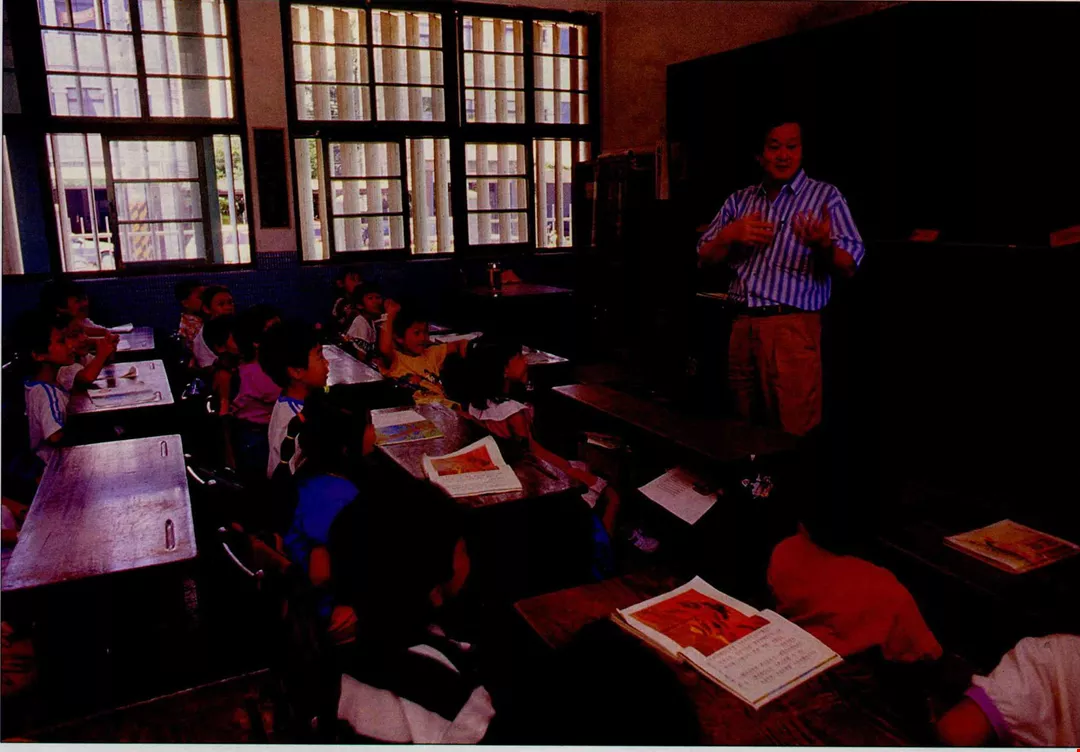
Huang Chun-ming led the planning process for Ilan County's mother-tongue courses. To avoid adding to the academic pressure on schoolchildren, he insisted that the teaching materials should not concern themselves with how to write dialect.
Equal weight for Mandarin and dialect:
My reasons for setting such conditions were as follows:
Mr. You belongs to the DPP, and increased local control is one of the DPP's political aims. In recent years the KMT has also wanted to allow greater local control, but has approached it half-heartedly, which has been exploited as a source of political capital by the DPP, not without some justification. But language is the most significant component of culture both culturally and educationally, and if it becomes a tool of political conflict, the value and significance of language will be obscured, which will be damaging to both language and culture.
Secondly, although the methods used over the last 40-odd years to promote Mandarin as the National Language have been inappropriate, creating lingering friction at the provincial level, the prevalence of Mandarin in Taiwan remains an undisputed fact. For anyone to learn another language has its own intrinsic worth and advantages, so we should continue to value Mandarin both as a language to be learnt and as a medium of instruction. When the local vernacular becomes a tool of political debate, then there is a clear tendency for some people to react by rejecting Mandarin.
In summary, our idea was to place local vernacular instruction firmly in the sphere of culture and education, and to give equal weight to Mandarin and local dialect.
Mr. You accepted these principles.
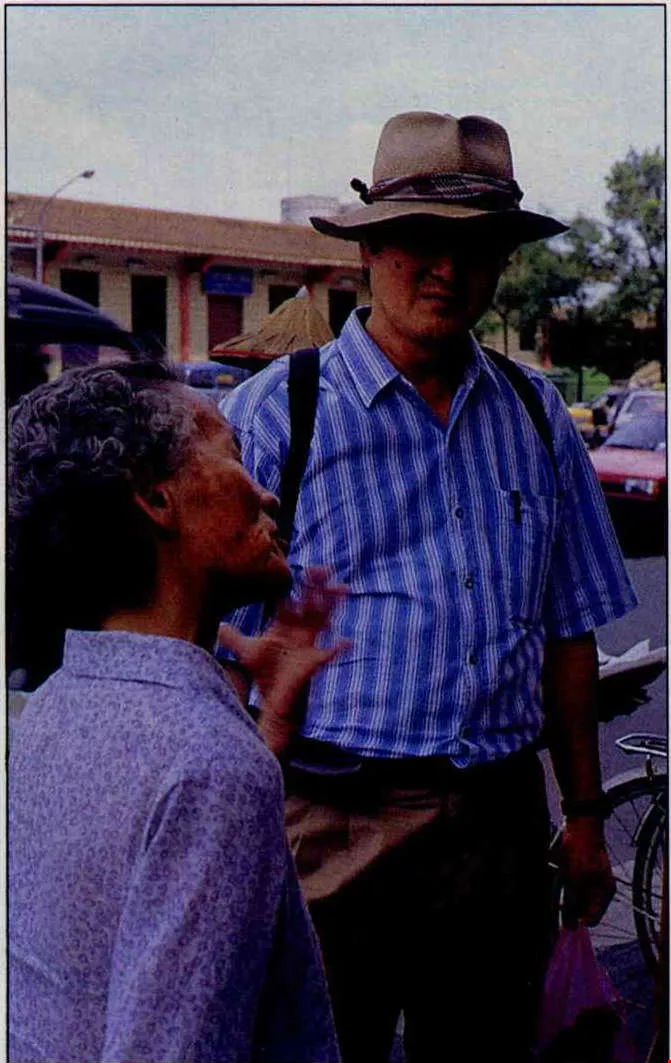
Huang Chun-ming loves to chat with anyone he meets. This is one reason for his mastery of the spirit of dialect.
Many practical difficulties:
If children are required to study additional subject matter which is not related to future examinations, then implementing local vernacular instruction in a situation where schoolchildren are already under heavy academic pressure is bound to provoke a reaction from many sides, including the children's parents, the pupils themselves, the schools and certain sections of society.
When we speak of studying a language, we immediately think of learning its writing and phonetic transcription. In our past experience of learning English, Japanese or any other language, it seems we always had to learn their writing and phonetics. But our local languages, especially within the Chinese language group, use ideographic rather than phonetic writing, and there is a clear separation between colloquial pronunciations and bookish pronunciations; also some words have no written form, and some pronunciations are far removed from the written form. All these problems go to show that if one wishes to study local vernaculars, one faces the problem of the lack of a standardized writing system and phonetic notation. It is true that many experts and scholars in this fields have been addressing this issue, but each supports his own pet theory with its own strengths and weaknesses, and there is no officially sanctioned or generally acknowledged standard.
If vernacular teaching were to move towards any of the systems now being developed, it would be harder and more complicated to study dialect than to study Mandarin or foreign languages, and this would inevitably place a heavy burden on pupils.
Furthermore, some teaching staff feel it is not their job to teach the local vernacular, with some alleging that they do not know how to teach it, while others say they have no teaching materials, and so on.
Separating spoken and written language:
In the past, when studying other languages, we really did start with the writing and phonetic transcription. But learning one's own mother tongue is different. Never mind how many people in the past were illiterate and couldn't read even the simplest characters, they could speak their own dialect perfectly well all their lives. When have the old folk in the countryside today ever been to local vernacular classes? From all this we can see that in the past they learnt language from life; they didn't start from books or school, and certainly not from writing and phonetic transcriptions. One can say that they learnt directly from the environment in which they lived, which is why their language is vibrant and vivid.
Recognizing these facts helped us to clarify the principles by which we defined the scope and methods of vernacular instruction.
In vernacular instruction we only teach speaking; for the present we do not get involved with writing. In the absence of a standardized writing system and phonetic transcription, we only have the children study the spoken language.
The main focus of our teaching method is to recreate the natural environment for language. In the past the schools were forbidden territory for the local dialects, but now the County Government has ordered that ban to be lifted. Apart from Mandarin lessons themselves, schools can teach other classes bilingually.
Within Ilan County, children's ability to use the local vernacular has not been too seriously impaired, and society's linguistic resources in the local vernacular are still rich, so that simply ceasing to forbid children to use dialect will quickly reverse that impairment. That is why I believe local vernacular instruction is the key to restoring the local dialects to health.
Apart from classroom teaching, we should design as many opportunities as possible for children to use language. For instance, we can set children special assignments for which they need to go home and talk to their grandparents, for they are the best teachers of the local vernacular.
In principle, we do not prepare special teaching materials. In elementary and junior high schools, one hour a week of extracurricular activity time is reserved for local vernacular classes, but no textbook is used.
Teaching aids for the teachers; no exams for the pupils:
To enable all teachers to cooperate with the local vernacular instruction policy, the language teaching materials include a set of teaching handbooks for teachers to refer to. Teachers who know the local dialect can use them as a basis on which to freely improvise, while teachers who do not speak dialect can use the handbooks and the accompanying tapes for preparation before lessons.
The recorded material mainly comprises texts from the National Language textbooks for the particular grade. The texts are read in the local dialect, using colloquial rather than bookish pronunciations. In this way we do not depart from the standard course content, and can review the texts at the same time as letting the children learn how Mandarin translates into their local dialect, how to express themselves in dialect, how to translate dialect into Mandarin, and so on. Songs, folk tales and proverbs, etc., can provide additional material.
Apart from one lesson a week of specific teaching time, other subjects can be taught bilingually, and topics which arise can be used as a teaching opportunity. But the children are not examined on what they have learnt, so that there is no extra academic pressure on pupils.
Applying these ideas and principles over three years of work aimed at reviving the local vernacular, we have not encountered the adverse reaction we had initially feared, and the vast majority of schools have cooperated very well and have achieved satisfactory results.
[Picture Caption]
p.83
Huang Chun-ming led the planning process for Ilan County's mother-tongue courses. To avoid adding to the academic pressure on schoolchildren, he insisted that the teaching materials should not concern themselves with how to write dialect.
p.84
Huang Chun-ming loves to chat with anyone he meets. This is one reason for his mastery of the spirit of dialect.


@List.jpg?w=522&h=410&mode=crop&format=webp&quality=80)


@List.jpg?w=522&h=410&mode=crop&format=webp&quality=80)
