

Wang Ting-lan came to Taiwan as an exiled student in 1949, after the Chinese Civil War. On the meager salaries of an elementary school teacher and an education official, she and her husband Hsiung Chih-jui raised five children, all of whom earned doctoral degrees, an achievement that won Wang a place of honor in Guinness World Records as the woman who brought up the most PhDs in Taiwan. Her success, though, lay not just in her children's academic achievements, but also in her own virtue and compassion for others, which inspired a sense of appreciation in those who knew her.
"From my early youth-and I don't know why-I understood your inner world, especially your sentimental side. And also-again, I don't know why-I've always felt that my greatest accomplishment was making you happy. ... Now that you're gone, I'm like a performing monkey that has suddenly lost its applauding audience: I have no reason or interest to continue with my tricks.
"Sometimes when I walk in the streets of Toronto and see an Asian woman of average build with salt-and-pepper hair walk by me, I can't help but take a closer look at her face to make sure she isn't actually you. In my heart I secretly hope that, just maybe, I'll see you again."
These are memories of her late mother, written in the essay "Endless Longing for my Mother" by Hsiung Ping-chun, Wang Ting-lan's second-oldest daughter, who is a professor of sociology at the University of Toronto.
The availability and openness of higher education in Taiwan in the last couple of decades means that the streets are filled with PhDs. But in the economically strained 60s and 70s, it was not an easy feat for a family to send even one child overseas for doctoral studies, much less five, as Wang Ting-lan and her husband Hsiung Chih-jui did. Their eldest daughter Hsiung Ping-chen is a research fellow at Academia Sinica's Institute of History and Philology, their second daughter Ping-chun is a sociology professor at the University of Toronto, their eldest son Ping-kang is the president of an American software company, their second son Ping-yuan is a renowned legal economist and a professor of economics at National Taiwan University, and Ping-chuan, the youngest daughter, is an associate professor of social work at NTU.
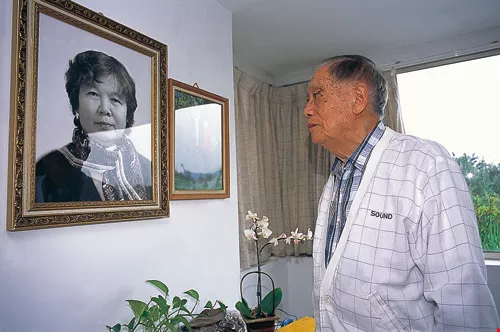
To her husband Hsiung Chih-jui, Wang Ting-lan's kindness and conduct were to be cherished forever. Even though it has been two years since his wife's passing, he describes each day's events to her funerary photograph.
Perseverence in hard times
"The first thing she taught our children was that they had to have good character," says 83-year-old Hsiung Chih-jui, a former special committee member at Taiwan's Provincial Department of Education, shedding a tear as he solemnly describes his wife, who passed on two years ago.
For instance, in the Hsiung household, following Chinese custom the siblings were not to address each other with their given names, since names were for outsiders to use. The siblings called each other "big sister," "second sister," "big brother" and so forth. Hsiung Ping-kang remembers that he and his brother Ping-yuan carried clean handkerchiefs prepared by their mother, who made sure they were neatly dressed when they went out. And when crossing the street, Wang always held the children's hands tightly to keep them safe. She would tell them, "You're the children of a school principal, so you have to set an example in everything you do." Interestingly, due to his mother's influence, 50-something Hsiung Ping-kang holds his wife's hand even now when crossing the street.
At the same time as Wang required her children to be well educated, she also held herself to high standards in her deeds and conduct. With her direct personality and knowledge of right from wrong, Wang did her utmost in everything she did, to the extent that she would leave others speechless. When the children were young, Hsiung Chih-jui served as a principal and a school superintendent, often traveling around Taiwan on inspections, so the burden of upbringing fell on Wang. During those lean years, never-say-die Wang would rather sacrifice herself to make sure her family and guests were comfortable.
Hsiung Chih-jui remembers the time he was transferred to a position at Sun Moon Lake. They often had friends over, so he and his wife would eagerly prepare noodles with eggs for them. But after the friends left, the family of seven would eat rice with soy sauce. Wang would not allow poverty to limit them, instead finding resourceful ways to live life and cut expenses.
Concerned about her children's nutrition, she would trek five kilometers to buy fish at the market, then walk back home to make dried fish floss.
"She always packed rice and vegetables in her children's lunches, but in her own she would just add a little red bean paste to her rice. She also had only two sets of clothing, alternating between them," says Hsiung Chih-jui, remembering the tough life of public employees.
Even though Hsiung Chih-jui had received his job at the Department of Education on the recommendation of Professor Chao You-pei, the family was unable to make ends meet. At the start of each school year, Wang had to go around borrowing and scraping up money to pay for tuition and living expenses. Their daughters in high school had to wear worn-out trousers and unmatched shoes to school; her sons in college didn't even have money for bus fare, instead walking to campus in the hot sun for half an hour on empty stomachs. "But we never complained, and we abided the scornful looks people gave us," says Hsiung Ping-yuan.
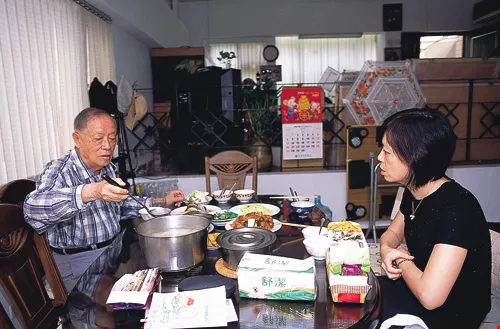
These days successful sons and daughters are often too busy with their work to care for their aging parents. But Hsiung Ping-chuan, the youngest daughter of the Hsiung clan, shares a meal with her father every Monday and chats with him about the trifles of life.
Simplicity in words and deeds
The second thing Wang taught their children was to respect others. Wherever one may be, "Men shouldn't impose their will on women or take advantage of them, and women shouldn't act like spoiled children or take advantage of men. Gender equality must be heeded." Wang and her husband served as an example in this regard. Hsiung Chih-jui remembers when he said to his wife when he was a young man, "I'd like take you to a play," and Wang immediately corrected him, saying, "You mean you'd like to accompany me to a play."
Hsiung Ping-kang appraises his mother thus: "Mom was a resolute, courageous, caring person who lived a full life." One of her last students, Chu Hsiao-sang, remarks that Wang was a person with the courage to transcend herself. With all her children abroad, she decided at age 60 to get her first driver's license, rising each morning around five to practice driving while the streets in her neighborhood were devoid of cars and people. She finally passed after two years and five driving test attempts.
"When problems come up, you need to find solutions!" This was something Wang would say, after which she would add, "There are many limitations for women, but we don't need to put limits on ourselves. It's more practical to be self-reliant." Even when she was dying of illness at age 79, she spent two months memorizing Li Ling's "Letter to Su Wu," the longest selection in the Qing-Dynasty classical literary anthology Guwen Guanzhi.
An unforgettable figure
In March 2003, Wang developed pulmonary fibrosis as a result of years of breathing in chalk dust while teaching. Due to breathing difficulties, she wore a brace tightly around her waist to minimize pain, and when riding in a car she needed a wooden board attached to the seat to keep her body straight. She lived in a Yangmingshan convalescence home for an extended period before finally departing this world at the end of 2006.
"Where's Mom?" Faced with the passing of her mother, 50-something Hsiung Ping-chun repeatedly asked this question in tears. And suddenly losing one's true love is unbearable for most, but Hsiung Chih-jui, who had been with Wang for more than half a century, suffered a total breakdown, barely getting out of bed for six months, and undergoing three major surgeries from self-inflicted wounds caused by his depression.
"My facial appearance changed, my skin becoming dry, rough and pale. I couldn't hold a bowl in my hand and could barely walk: it seemed as if I were top-heavy and would topple over after taking a few steps. I lost ten kilos and my hair went completely gray. Pretty much every night I dreamed that my departed wife had returned," says Hsiung Chih-jui. The Hsiung family, with five PhDs and numerous remarkable accomplishments, was shrouded in hurt and collective depression for a long time from Wang's passing
Wang, featured by Academia Sinica's Institute of Modern History as one of the leading characters in its book series "20th-Century Wartime Experiences of Chinese Women: An Oral History," may be gone, but her compassion lives on. More than 20 years ago, she and Hsiung Chih-jui set up a scholarship for the poor at Taichung County's Li Ming Elementary and Junior High Schools, and after retirement they founded a community book club and educational workshop. After her death, her family honored her wishes by donating their old house of more than 130 square meters as a children's library.
Wang, who had devoted her entire life to teaching and focusing her mind on what she was doing, did more than raise five PhD holders. Thanks to her work, countless children experienced the beauty of learning and learned how to improve their lot in life through knowledge. This is her most worthy accomplishment.


@List.jpg?w=522&h=410&mode=crop&format=webp&quality=80)


@List.jpg?w=522&h=410&mode=crop&format=webp&quality=80)
