"Casting a Long Line to Catch a Big Fish"--An Interview with Lee Yuan-tseh.
Interview by Elaine Chen / photos Vincent Chang / tr. by Brent Heinrich
September 1994


The finest example of "reverse brain drain," of talented individuals coming back to Taiwan often achieving success abroad, is probably Dr. Lee Yuan-tseh, who returned to his home country as the president of Academia Sinica.
After Academia Sinica's Meeting of Academy Members concluded, Dr. Lee granted our magazine an interview. Upon meeting, he apologized for his cold "Is it that the meetings have been too tiring?" I asked, seeing that he has sprouted quite a few white hairs since returning from America.
"No, it's probably that after the meetings were over, I went to three middle schools to give lectures over the weekend, so I haven't rested enough."
After Lee Yuan-tseh came back, what has always been in his mind is the issue of human resources in Taiwan. He thinks that for Taiwan to catch up with Western countries, two sorts of personnel must be relied on: Taiwan's entrepreneurs and overseas scholars. Planning and establishing the Foundation for Development of Outstanding Fellows is a way of bringing these two forces together: raising funds from business circles to attract high-quality personnel to come back to the country.
As for himself, he finds his greatest comfort in his three children, who quietly engage themselves in social work in California where they grew up--"continuing our family's heritage of idealism." And in the ROC, Mrs. Lee often finds herself bathed in perspiration from the hot task of cooking the meals. This is the simple life behind all the glory that they lead for the benefit of Taiwan.
Q: After you came back, you devoted yourself to encouraging talented people from Taiwan who now live overseas to return home, and you established the Foundation for Development of Outstanding Fellows. A while back we went to the mainland to conduct interviews and discovered that you are the chairman of the Tan Kah Kee International Institute, which was established in honor of the famous Southeast Asian Chinese who founded Xiamen University. It strikes me just how similar in nature these two endeavors are. Could it be that establishing the foundation in Taiwan is a way of "continuing the Tan Kah Kee spirit"?
A: Both of these concerns are designed to help us catch up with Western countries. During the second year of the Republican Revolution, Tan Kah Kee returned to his hometown Jimei. near Xiamen City. Seeing the backwardness of Jimei, he realized that educational development was necessary to catch up with the West. Therefore, he established a lot of schools with the money he earned overseas.
In today's Taiwan, how can we catch up with the advanced Western countries? After I came back home, I found that there were two pools of human resources that we could rely on. The first group is the many entrepreneurs cultivated during Taiwan's economic takeoff. They have been making business trips around the world, are equipped with an international perspective and know the importance of giving something back to society. In the past three or four years, every time I came back to Taiwan, I saw a lot of second-generation young entrepreneurs working very hard and proving to be very capable. I felt that Taiwan has the power to catch up with the West.
Secondly, I stayed in America for 32 years, and I deeply felt that from the early 1960s to the present day we've been building a reservoir of manpower overseas. In 1959, when I had just finished my graduate studies at National Tsing Hua University, Taiwan had not set up any doctorate programs, so many people who wanted to continue studying could only go overseas. Back then, Taiwan's environment wasn't so favorable, and not only in terms of economics; there was also the White Terror in the political realm. A lot of people went out to America in search of a society which upheld freedom, democracy and equality. Few were willing to go back to Taiwan.
Today these people are playing a very important role in the United States. For example, at the technical institutes and medical colleges of many famous universities, you can see lots of successful professors and academic administrators who originated from Taiwan. Furthermore, after graduating, many people from Taiwan have gone on to work at such private corporations as IBM, Bell Labs and Dupont. For instance, Dupont employs several hundred Taiwanese who originally left to study abroad. If one day all of them left the company to return to Taiwan, Dupont could not conduct research. A lot of highly accomplished professional Chinese can be found in Silicon Valley, as well.
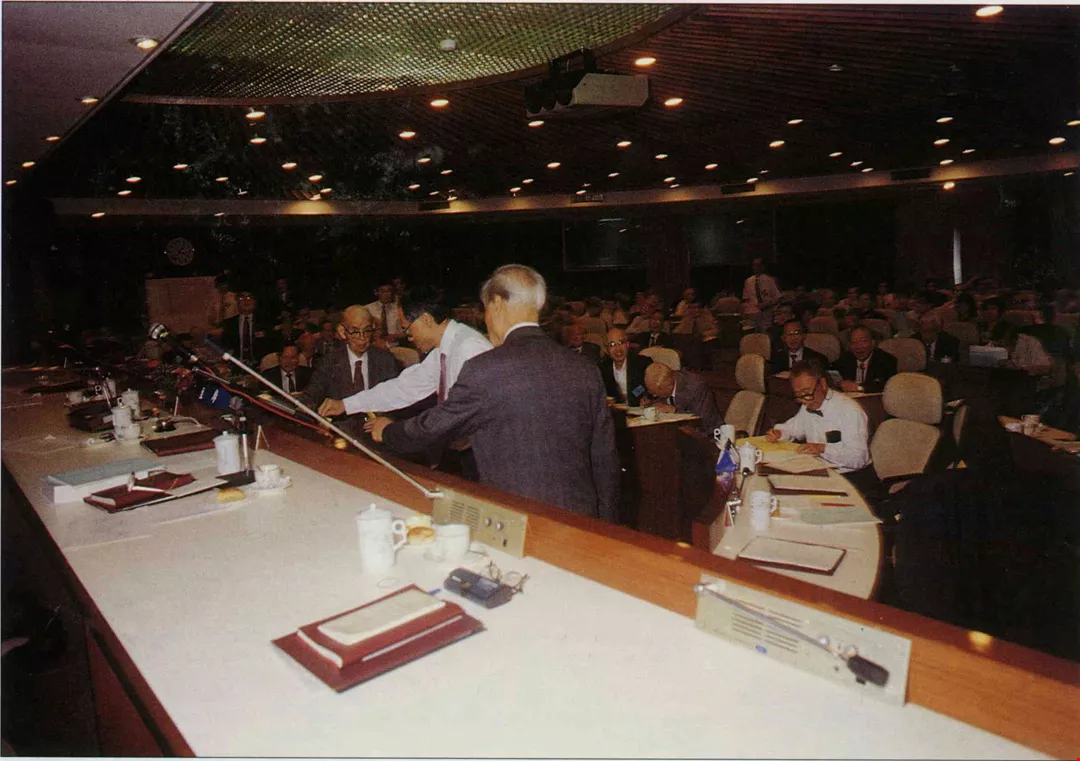
At this year's Meeting of Academy Members, quite a number of the Academia Sinica members expressed their intentions to return to Taiwan.
Can Japan compete with Taiwan
I feel very deeply that this is our most useful attribute. Japan, Korea, and even the mainland cannot compare with Taiwan in this regard. A very famous Japanese scholar went to America on a tour, and later he came to my office and said to me, "Professor Lee, if one day, most of these people return to their home country, Japan will have no way to compete with Taiwan."
We have a great asset overseas. But if we have no means of drawing these highly educated people back, their usefulness to us will be extremely limited. When I came back, more than a few people said to me, "l want to go back with you and work by your side." I hope that many more people act in this way.
Q: Lately we have seen the phenomenon of many well-educated people from overseas returning to Taiwan. Many of them have not had an easy time finding work. In your opinion, how many more professionals who are now living overseas is there room for in Taiwan? What are the kinds of personnel that we still need and that we ought to invite back home?
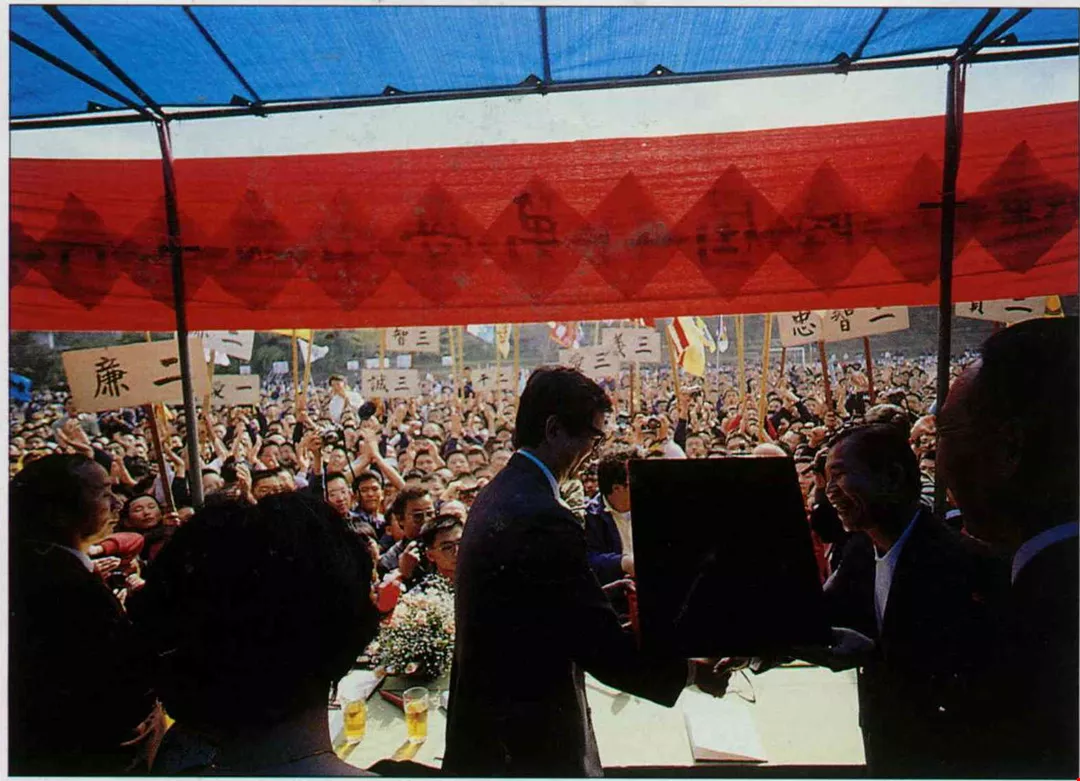
Lee Yuan-tseh is rather concerned about middle and high school students and often delivers speeches at various schools, offering encouragement. The photo shows Dr. Lee at his alma mater Hsinchu Middle School, taking part in its anniversary celebration.
A scientist's results are all or nothing
A: Some people might consider what we are doing to be strange. Every year there are already enough overseas personnel returning--why should we spend so much money inviting more to come home? It is because so many of those who have returned from overseas are young people, and we want them to mature in a very good way. We want to provide a fertile scientific soil. So we have need of older "gardeners" with greater experience.
Many people don't realize that there is a great difference between scientists who can solve a problem and scientists who cannot. It is not the same thing as a strong farmer who can plant an acre of land and a farmer who is not so strong who can only plant half an acre of land. Often a scientist's results are all or nothing. For example, the whole world is researching ways to solve the problems of cancer and AIDS. If someone researches a solution. it will benefit all of humanity. When doing science, you can't imitate other people and accomplish only 80% of what they do. You definitely need to be out in front; otherwise, no one will respect you.
In recent years overseas students returning to Taiwan have been numerous, especially young people who have just received their postgraduate degrees. Recently in a single year more than a thousand PhDs returned to Taiwan. On top of that number were more than 700 people who earned PhDs in Taiwan. There were nearly 2000 PhDs in all. These young scholars are just at the beginning of their professional careers, and they don't have much experience. If they are able to work with more mature professionals, it will greatly serve future development.
In the last half year, many Academia Sinica members have returned from abroad, and we are very excited about this. Two days from now, the paleontologist Chang Kwang-chih will return to Taiwan to assume the post of vice-president of Academia Sinica. Six months ago, if I had said I wanted to invite Chang Kwang-chih to Taiwan, people would have said it was impossible, that I was just indulging in wishful thinking. Right now it has become a big trend for members of Academia Sinica to return to Taiwan. The electron physics expert Frank Fang will return in September, and Hsu Cho-yun will return at the end of the year. Furthermore, Academia Sinica member Cheung Wai-Yiu originally returned on sabbatical, and I managed to get him to stay on permanently. Yang Shang-fa, another Academia Sinica member, is also a professor at the National Academy of Sciences in the United States, and he has a great deal of experience in researching plant hormones. He is a former recipient of Israel' s Wolf Prize. In February of next year, he will also return. All these people had to overcome great difficulties to come back to Taiwan.
Throwing a long line to catch a big fish
Q: This brings me to the third question that I wish to ask you, Dr. Lee. You yourself have returned from overseas. What do you believe is the biggest point of consideration for professionals returning from abroad? What kind of forces or elements influence people abroad to decide to return? And what can people living in Taiwan do to help?
A: What they are most concerned about is the research environment in Taiwan. If they run into problems, will there be people in Taiwan who can help them find a solution? Since I have returned, they trust that the situation has changed. Academia Sinica member Wu Jin has also recently returned. He saw that I came back, and he became very excited and also wanted to return. Then National Cheng Kung University sought him out to be their chancellor. He came to me to talk things over many times, and I said to him, "Don't worry. If you run into problems, I'll do my best to help." There are still many other Academia Sinica members who are considering coming to Taiwan, and we are right now in the process of throwing out a long line in order to catch a big fish.
Q: When the Foundation for Development of Outstanding Fellows was established, were these Academia Sinica members the people that it was designed to sponsor?
A: Those who are not Academia Sinica members are not necessarily ineligible. Actually, if there is a very famous person, but the work he or she does cannot be put to use, we are not really anxious to ask that person to come back. On the other hand, if some university or research organization indicates that they definitely want a specific kind of person to come back and perform a specific task, they may ask for our help. After we make an assessment and decide that some person will be of genuine assistance to Taiwan, then we will provide the funds to sponsor them.
For example, the Atomic Energy Council's Synchrotron Radiation Research Center had a certain accelerator that worked quite well. But the young researchers there had little experience and could think of no method to put it to good use. They expressed many times that they wanted to bring in a senior scientist from abroad with a proven track record to guide their research in Taiwan, to point them in a good direction.
Finding their cupboards bare
The people at this level and at this age probably have children in high school. If they return to Taiwan, they will not be able to transfer into one of the better high schools, such as Chien Kuo Boys' High School or Taipei First Girls' High School. And if their children do enter one of Taiwan's higher status schools, they will probably have no way of competing. Perhaps such a person might say, "Okay, I am willing to come back, but I want my son or daughter to go to the Taipei American School." There are still openings at the Taipei American School, but the tuition for one year is between NT$200,000 and NT$300,000. To send two children to the Taipei American School costs around NT$600.000. Furthermore, Academia Sinica and National Taiwan University do not provide faculty housing. So rent and the children's tuition alone may completely use up all their salary, and they may find their cupboards bare.
On the other hand, the wages and benefits in Taiwan are far better than they used to be. The salary structure, however, is not ideal. If you have just received your doctorate, you're not married, and you live by yourself in a small apartment, the pay is adequate. But for those professors who are in their forties or fifties and have already achieved some fame, their salaries in America can be two or three times higher than newcomers. Professors here reach the highest salary bracket after teaching for 13 years, after which their salaries cannot increase.
Furthermore, in Taiwan no matter how well you do your job, the salary is the same. There is no system of evaluation. So, another mission of the foundation is to reward people from Taiwan who have devoted themselves to scholarship and have become well-known in their field internationally. We want to sponsor them as a way of expressing our respect. Our goal is to support 100 outstanding persons every year, in order to fortify leadership in Taiwan.
A spotless record
Q: Taiwan's recent political atmosphere has seen a number of new trends, including growing support for Taiwanization and calls for Academia Sinica members to possess ROC citizenship. Does this have an impact upon the willingness of people living overseas to return to Taiwan?
A: I think those who are a bit older, who are already over 50 and who left Taiwan a long time ago are probably more concerned. Those under the age of 50 more or less have grown up in Taiwan and largely agree with these trends. Provincial sentiments are not a problem. But this dilemma is generally not a common one. Several middle-aged scholars such as Frank Fang and Hsu Cho-yun have returned. I'm certain they have a lot of faith in Taiwan's democratization process.
Taiwan is becoming internationalized at an extremely rapid pace. This is because of the internationalization of the economy. You can see, many of our entrepreneurs are investing in the Philippines, Thailand and Vietnam. In every place all over the world they are very active. They are all citizens of the Republic of China, but in terms of their fundamental nature they are actually citizens of the world. I believe that in the future, mainland China will truly be the same. When their economy has been drawn into the world economic circle, everyone will become residents of the global village.
I'm sure that most research fellows possess dual citizenship and can conveniently travel to virtually anywhere in the world. And they have no cause to give up this privilege. But a person such as myself who often represents the Republic of China should relinquish his foreign passport. As soon as I returned to Taiwan, I voluntarily gave up my foreign passport, because I didn't want to wait one or two years until somebody said of me, "Why does Lee Yuan-tseh still have dual nationality?" I hope that I can keep my record spotless.
Still not used to Taiwan's bacteria
Q: Dr. Lee, after you returned to Taiwan, have you managed to adjust to the life here? How are your children doing in the United States?
A: After I came back to Taiwan, I found that the hardest aspects to readjust to were the traffic and the air pollution. Sometimes if I wasn't careful with what I ate I could find my intestinal system a little loose. I don't know. Perhaps my system has just not become accustomed to Taiwan's bacteria, or maybe I'm not getting enough rest. Right now in Taiwan. I'm here alone with my wife. The temperature is very hot, and sometimes my wife will cook dinner in the kitchen and she gets completely soaked with perspiration. In the United States, of our three children, only our youngest daughter is still in graduate school. None of them really needs for us to worry about their well-being. Our children often involve themselves in social service work. Our oldest child goes to the San Francisco district prison two evenings every week and reads books for the inmates there or chats with them, helping them to relax emotionally and to go to sleep more easily. I'm very happy that our children are continuing our family's heritage of idealism.
[Picture Caption]
p.22
Currently, Lee Yuan-tseh is planning funds for the "Foundation for Development of Outstanding Fellows." It anticipates sponsoring 100 specialists every year to provide leadership in their particular areas of expertise. (photo by Li-li Huang)
p.24
At this year's Meeting of Academy Members, quite a number of the Academia Sinica members expressed their intentions to return to Taiwan.
p.26
Lee Yuan-tseh is rather concerned about middle and high school students and often delivers speeches at various schools, offering encouragement. The photo shows Dr. Lee at his alma mater Hsinchu Middle School, taking part in its anniversary celebration.


@List.jpg?w=522&h=410&mode=crop&format=webp&quality=80)


