People Do That?! Atypical Part-time Jobs
Andre Huang / photos Jimmy Lin / tr. by Scott Williams
August 2008


According to a 2006 Council of Labor Affairs survey of university students' part-time work, the majority of student part-timers work in restaurants, give extra tuition to schoolchildren, or serve as administrative assistants.
But, as the saying goes, every trade has its masters. Every job really does have its own body of knowledge and skill set. As society has diversified, so too have the jobs available to students. Many interesting experiences await....
You've almost certainly heard about the many student part-timers who work in telephone customer service, but have you heard about those who work on sex lines?
Curious about the phenomenon, a Taipei student surnamed Wang responded to a newspaper ad for sex-line operators. The employer who interviewed her didn't bother to ask any questions; he simply explained the pay scheme and asked her to start the next day.
As with other telephone customer service positions, she had to learn a script, most of which involved introducing herself and eliciting the clients' information (to avoid freeloaders). But it was up to her to develop the bulk of the conversation. As long as she kept callers on the phone, she could do anything she wanted.
Unlike standard phone jobs, which aim to resolve issues quickly and keep call times to a minimum, sex lines, which charge by the minute, try to drag out calls and encourage clients to call back repeatedly.

Playing house is a part-time job!? In the photo, two student part-timers, under the arrangement of a wedding planning company, play "virtual newlyweds," testing how wedding scenarios work and making NT$500 per session.
Another world
At first, Wang thought that all sex-line callers were sex-obsessed men looking for titillation, but she soon learned that only about one-third were calling for phone sex. The majority just wanted to chat with a member of the opposite sex.
"Some called to tell ghost stories; some wanted to get secrets off their chest; and some were groups of middle-aged men and women just goofing around," laughs Wang. "There were curious girls calling to find out what a sex line was like, bored drivers wanting to shoot the breeze, and even people so shy they didn't know what to say, who'd just listen to you talk."
The phone sex aside, Wang soon learned that her NT$70-per-hour wages were subject to many deductions that went unmentioned when she was hired.
Her "office" looked like something out of one of those study centers where students rent a space to study on their own. Everyone had their own tiny room in which to take calls and five minutes of break time per hour. Workers were subject to penalties if their phone rang more than three times before being answered and for calls that lasted less than five minutes. They were even penalized NT$500 if they forgot to remove their name plaques from the door to their "office" when they finished work. The rules nickeled and dimed them badly, and a moment's carelessness might cost them the entirety of their already miniscule wages.
Fed up with the rules, Wang soon left the job. Looking back, her strongest memories are of the other girls who worked there. "They had nice voices, but generally weren't anything to look at," recalls Wang. "You could tell that some were from the margins of society, but they were doing their best to make it through the day just like everybody else, trying to eke out a living in spite of their frustrations and troubles."

Many students are drawn to modeling by the exceptionally high rates of pay offered to models at exhibitions. But they need to be careful not to be snared by the industry's many traps and frauds.
Guinea pig
A medical student surnamed Chu took on a more risky job working as a guinea pig in human trials of pharmaceuticals.
Chu says the large biotech companies often have these kinds of jobs available, but they come with conditions. Participants must be healthy, undergo a pre-trial physical exam, and accept a strict dietary regimen. In addition, they cannot have any hidden medical conditions or have participated in another drug study in the previous three months.
What distinguishes these studies from other jobs is their short-term nature and relatively high rate of pay. Participants typically receive NT$8,000-15,000, with rates scaled to the number of times blood is taken. Time commitments vary with the drugs under study. Some studies require an entire day in the company's offices; others allow participants to return home immediately after taking the drug, then have them return at regular intervals for blood tests. Unlike restaurant jobs, which require long hours for little pay, these studies offer relatively high pay in exchange for a small amount of risk.
The risk in question is that the drug may harm study participants. But Chu argues that human trials are relatively safe because they represent the last stage or two of the drug testing process. Moreover, Taiwanese drug tests frequently involve generic drugs that have been used abroad for many years and for which the patents have now expired. In such cases, human trials are conducted just to demonstrate that the drug in question is effective on Taiwanese. Besides, he says, participants sometimes aren't even given actual pharmaceuticals; instead they receive placebos intended to measure a drug's effectiveness against a baseline.
Interestingly, "Students at technical schools make up the majority of people doing this kind of work," says Chu. "Medical students, who are familiar with pharmaceuticals, are few and far between. But that's probably because most medical students come from fairly well-to-do families and don't really need to work."
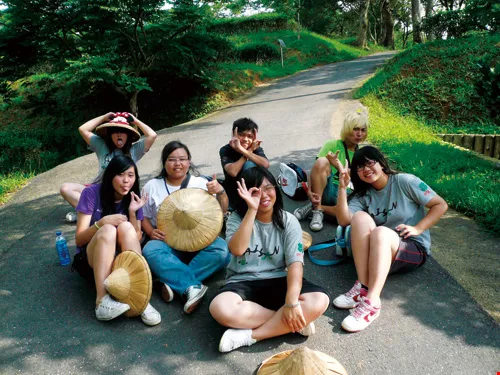
Some part-timers make money working with kids at a summer camp. The job doesn't pay much, but compensates with other rewards-new friends and interesting activities.
Earning money from the arts
Are you a talented chess or Go player? A painter? A pianist? Congratulations! In addition to being cultivated, your skills may be able to earn you a part-time income.
Chang Kai-hsiang, a Tunghai University student and skilled flautist who plays traditional Chinese music, has turned years of diligent practice into a part-time job playing the flute at weddings, funerals, and other events. Chang makes NT$1,000 for a funeral and up to NT$1,500 for temple fairs and weddings, which require the musicians to play more difficult pieces and liven up the atmosphere. "I often play several shows on auspicious days," says Chang. "If I wanted to do it full time, I could make more than NT$200,000 over summer vacation."
Most of the people playing these kinds of gigs are student members of traditional Chinese music clubs at universities. Not many are actually music majors. "If you play a lot of funerals, you get too used to moody melodies, which wrecks your musical sensibility," explains Chang.
Cheng Hsiang-wen, meanwhile, earns a living from his Go skills, teaching the game to children at a Go center. But Cheng is quick to note that Go skills are only the first requirement for such a job. The real challenge is figuring out how to interact with the kids.
"With math, English, physics, and chemistry courses, it's easy to provide an explanation, write up some questions, and see results," says Cheng. "But Go teachers have to settle kids down so they can learn how to think about the game. And there's no way to score them. It's like teaching philosophy."
The majority of university Go club members who teach kids can only teach short classes with few students. They're simply too young themselves to inspire confidence in either students or their parents.
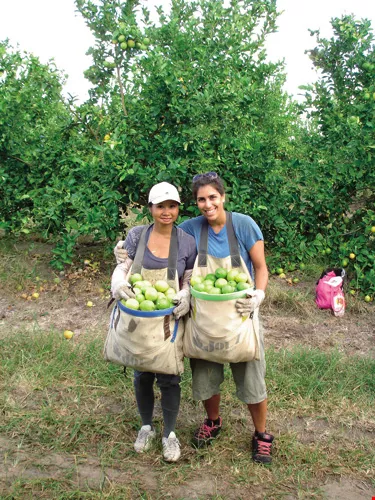
Peng Hui-chin (left) overcame numerous challenges on her way to realizing her dreams with a ten-month working vacation in Australia.
Work while vacationing?
Many people dream of traveling the world. For those who can't travel abroad, a couple of months in a scenic spot nearer to home, say Orchid Island or Penghu, also offers the prospect of a memorable experience. But where will the money come from?
No worries! It doesn't take much, as long as you're willing to work part-time.
Working vacations have been growing in popularity in recent years. They provide part-time work that gives the vacationer access to the local community, and wages to cover living and travel expenses. Such vacations attract many young people of limited means who thirst for the experience of living abroad. Since Taiwan concluded a 2004 agreement with New Zealand and Australia that allows Taiwanese 18-30-year-olds to take working vacations in those nations, some 8,600 young people have done so.
Don't work too hard
Lin Yu-shan used to work in a bookstore. When he happened upon a magazine story about young Taiwanese being permitted to take working holidays in New Zealand and Australia, he gave up his boring job and headed to New Zealand for a year in 2005. He went on to spend 2007 and 2008 in Australia. Lin prepared for his travels with three months of study at a language school, then set off, working and walking his way across Australia and New Zealand with guidance from backpacker hostels and other backpackers.
Though Lin did repair urban roads for a time, most of his work was as a temporary farm hand, doing things like picking grapes and kiwifruit. His strategy was to work at a farm until he had saved a bit of money, then go traveling again. When his money ran out, he'd take another job. At one point, Lin earned enough to buy a secondhand car to run around in, and ultimately returned to Taiwan with nearly NT$50,000 in his pocket.
He says that he chose to do farm work because of the scenery and because such jobs were easy to get. It is exhausting but simple work, and its seasonal nature is well suited to a working holidaymaker's needs. But many of these temporary positions are under the table: the employers often don't insure or take responsibility for their part-timers. Lin says you've got to be careful; you really don't want to work so hard that you injure yourself.
"The point of a working vacation is to have a vacation," he says. "But Asians tend to work too hard relative to European and American working holidaymakers. Their focus becomes work and making money. That's just backwards."
Overcoming hardships
There's no need to be intimidated by the many challenges of working and traveling in an unfamiliar country.
Though Peng Hui-chin, a former language-center worker, was diagnosed with cancer during her junior year at university, her ordeal with the disease did nothing to dim her determination to travel abroad. In late 2006, after recovering from her illness, she headed to Australia for a ten-month working holiday. The decision to take a working holiday is often driven by just this kind of determination to turn a dream into reality.
In our diverse society, working part-time has long since moved beyond the waiting of tables and the mopping of floors. Your dreams, talents, and even your passion to explore may provide you with job opportunities, becoming a source of income and a gateway to new worlds.
These kinds of positions may not account for a large percentage of the part-time work available, but, the next time you're seeking a part-time job, take a moment to think about yourself. Do you have any useful and unusual skills? A part-time job might be just the ticket to develop potentials you didn't even know you had.


@List.jpg?w=522&h=410&mode=crop&format=webp&quality=80)


