A Cultural Bastion--Chinese Education in Malaysia
Coral Lee / photos Chuang Kung-ju / tr. by David Mayer
May 2005


Malaysia has over 1200 Chinese primary schools and 60 Chinese-medium private secondary schools. Some 90% of all children of Chinese descent receive their primary schooling in Chinese, and 30% continue with their Chinese schooling all the way through senior high school. There's probably not another Chinese community in the world quite like the one that has grown up in Malaysia.
Could these people, carrying their Chinese educations in their minds and Chinese blood in their veins, be the catalysts in multi-ethnic Malaysia for intercultural synergy and the emergence of a diverse and open society?
When travelers from China, Hong Kong, or Taiwan set foot in Malaysia, the place invariably strikes us as both familiar and foreign at the same time.
As soon as we get off the airplane, everywhere in the ultramodern Kuala Lumpur airport we encounter Chinese signs and Asiatic faces. Many have Chinese features, but the feeling of being in an exotic land is strong, for Malay women walk about wearing headscarves, and everywhere we encounter youths with the alert, intelligent eyes of India.
Chinese architecture, in the form of old private schools and temples, dots the crowded urban landscape of Kuala Lumpur, while Malay and Chinese shop signs stand side by side. On a visit to Kuching, the historic capital of Sarawak in East Malaysia, we find that the same holds true there as well. Most ethnic-Chinese cab drivers speak Chinese, and we are generally able to communicate in Chinese at the department stores. At our hotel, the person at the counter asks which Chinese newspaper we would prefer.
The strong standing of the Chinese language in Malaysia is the result of two centuries of Chinese-medium education there. Through untold toil and struggle, the system now covers the entire gamut, from primary to tertiary education. Malaysia has the highest percentage of Chinese speakers among its ethnic Chinese of any country in the world outside China, Hong Kong, and Taiwan, outdoing even Singapore.
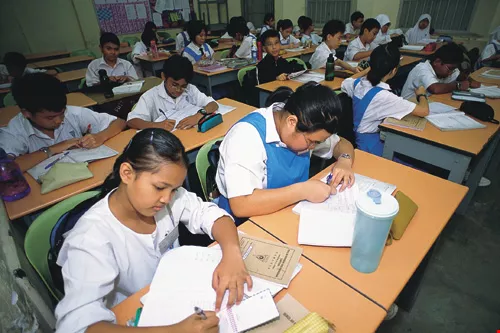
Children of Chinese descent in Malaysia have to learn three languages, and in recent years the Chinese-medium schools have attracted many non-Chinese students, giving the kids even more opportunities for multilingual interaction.
A land of trilinguals
Chinese-medium schools are a constituent part of Malaysia's diverse education system. To meet the needs of the country's three major ethnic groups, primary schools employ one of three languages as the principal language of instruction: Malay, Chinese, and Tamil. The Malaysian government runs them all. Because Malay is the national language, schools that teach in Malay are called "national primary schools," while the others are called "national-type primary schools." The same nomenclature used to apply to junior and senior high schools as well, but the word "type" was dropped in 1990, and all secondary schools run with government support are now known as national junior (or senior) high schools. In addition, however, there are also independent Chinese-medium secondary schools that operate without any financial support from the Malaysian government.
Non-Malay education takes place mainly at the primary level. Because mainstream secondary instruction is in Malay, children of Chinese or Indian descent have to learn three languages in primary school: their mother tongue, plus Malay and English.
On a visit to Kuala Lumpur's Kuen Cheng Chinese Primary School, amidst the crowds of Chinese faces we notice one or two Malay schoolgirls wearing headscarves. Compared with schoolkids in Taiwan, there is a slightly more innocent air about the youngsters here. Above the doorway to each classroom hangs a little plaque inscribed with the name of a school donor, sometimes an individual, in other cases the benevolent association of this or that town back in the ancestral homeland.
We enter a class that is currently in session, taught in Chinese. On the blackboard are drawings of an onion-domed mosque, a Christian church topped by a cross, and the like. The teacher is giving a lesson about the religious faiths of different peoples, and stressing the need for mutual respect. We stroll over to another classroom, where a woman wearing a Malay sarong switches back and forth between English and Chinese as she teaches kids in one of the lower grades how to add double-digit numbers. The math workbooks on the students' desks are in English. In the class next door, the subject is reading and writing in the national language, Malay. The teacher is using Chinese to explain the Malay text. There's a bunch of Malay written on the blackboard.
"I understood from a very early age that I'd have no future if I didn't have a good mastery of Malay. I also knew I'd have to learn English since it's the international language. And I couldn't be ignorant of Chinese because it's my own language." So explains a Chinese woman who teaches Malay. Because she worked so hard on languages as a child, she's very aware of her students' difficulties, and knows all too well how difficult secondary school will be for anyone who doesn't achieve a good grasp of Malay during primary school. Given only three classroom hours per week, she often spends long hours in advance preparation to make sure she can use her class time to best effect.
In the past, Chinese-medium primary schools taught Chinese and Malay from primary one, then started teaching English from primary three. But in 2003, in an effort to improve the nation's English proficiency, the Malaysian government began vigorously pushing the use of English for math and science instruction in all primary and secondary schools, regardless of the main medium of instruction. Since then, Chinese-medium schools have had nine hours of English-medium instruction per week, including two hours of reading and writing, four hours of math, and three of science. Another nine hours of math and science are still taught in Chinese. This is the "2-4-3" approach that has caused so much controversy in recent years.
"It's the teachers who've got it toughest," says Moh Fok-choi, principal of Kuching Chung Hua Primary School No. 3, who explains that a single teacher is usually responsible for all math and science courses, regardless whether they're taught in Chinese or English, so the new system naturally adds to the teacher's workload. And what about the results of the new policy? Moh acknowledges that increased exposure to English naturally improves the children's proficiency, but feels that the jury is still out on the question of whether the change will whittle away at the edge in math and science that Chinese students have always enjoyed.
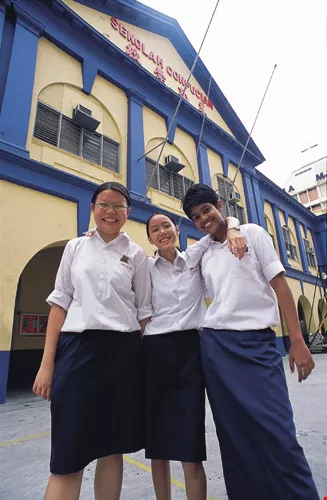
A new generation of Chinese children, free of the baggage of history, are in a position to absorb a diverse range of cultural "nourishment." We can look forward to them showing a more gregarious spirit in interacting and making friends with people from other ethnic groups. Pictured here are members of a student volunteer team at Kuala Lumpur's Confucian Private Secondary School.
Public-private partnership
Strangely, although English has become the international language, more and more non-Chinese families have been enrolling their children in Chinese-medium primary schools in recent years. It is generally estimated that some 60,000 non-Chinese children attend Malaysia's 1200 Chinese primary schools, accounting for about one-tenth of all students. Because the Malaysian government does not encourage the opening of new Chinese primary schools, this has led to "star" schools in many areas becoming full to bursting.
Why are so many non-Chinese children attending Chinese-medium primary schools? The most common interpretation is that, in addition to China's rise as an economic power in recent years, which means that mastery of Chinese will make a person more competitive in the job market, a second key factor is that the teachers at Chinese-medium primary schools are very serious about their jobs, the schools are very tightly run, and students' academic performance is outstanding. Also, Chinese-medium schools have a board of trustees that works to support school development, which is another big plus.
At most Chinese-medium primary schools, the government pays teachers' salaries and regular expenses, while the board of trustees is responsible for operating expenses, physical maintenance, expansion of facilities, and the like. Principal Moh, for example, reports that his school, in response to an increase in the number of non-Chinese students in recent years, asked the board of trustees to build a kindergarten next door to give non-Chinese pre-primary youngsters exposure to Chinese and reduce their linguistic difficulties upon entry into primary one.
Malaysia's 600,000 students in Chinese-medium primary schools (who account for 90% of all primary-age children of Chinese ethnicity) can go one of three routes after graduation. Over seven in ten will go on to a junior high that instructs primarily in Malay, and will thereafter have little exposure to Chinese. Fewer than two in ten will go to a "national-type" junior high offering a Chinese curriculum, and one in ten will enroll in a six-year independent secondary school where Chinese is the main medium of instruction.
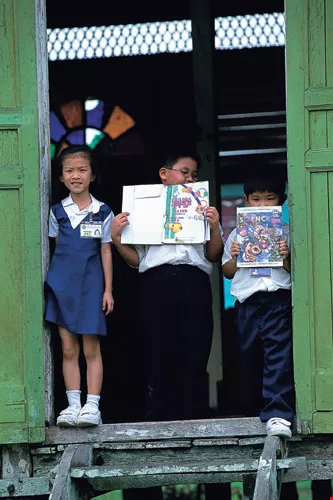
Chinese-medium primary schools are all over Malaysia, in big cities and little towns. There are only 23 students and four teachers at Kai Dee Primary School in the town of Sibu, but the teachers still work hard in this school built on stilts!
A burden that doesn't weigh
Malaysia's independent secondary schools, numbering 60 nationwide, are a unique product of the country's Chinese society. Operating without any government subsidies, they rely completely on the Chinese community for financial backing. Their development is overseen by the "Dong Jiao Zong," comprising the United Chinese School Committees Association of Malaysia (Dong Zong) and the United Chinese School Teachers Association of Malaysia (Jiao Zong). The Dong Jiao Zong, often called a "private Ministry of Education," has an Independent Secondary Schools Commission that directs the activities of a Curriculum Bureau, Examination Bureau, Teacher Qualifications Bureau, and Student Affairs Bureau.
The huge expense of running the schools has long been a big burden for the Chinese community, but the success of the undertaking is also their greatest source of pride, and the 55,000 students at the independent schools are seen as a "bastion of Chinese culture."
Fu Mi, a first-year junior high student at Tsun Jin High School, comes from a family in which both parents were schooled in Chinese. Asked about her rather unusual name ("Mi" means "rice" in Chinese), Ms. Fu explains, "Rice is a traditional Chinese staple. It's very important!" Mi earned admission to Tsun Jin by getting outstanding grades in her primary six graduation exams. She says most of her classmates would have liked to enroll at Tsun Jin, but their parents wouldn't let them because of the huge expense, and because it's tough to get into an independent secondary school unless your Chinese is really good.
Students at the national junior high schools only have to go to school for a half-day, a far cry from the long hours at an independent secondary school, where their counterparts have to learn three different languages. But Fu Mi and her older brother Fu Yi don't seem bothered. They both say that another language is another skill, and besides, they've been learning the languages since they were little, so it doesn't seem difficult. But what about classical Chinese and poetry? When the mood hits, Fu Mi is apt to toss out a famous passage or quote a bit of poetry when trading instant messages with friends on MSN, and her older brother likes to include quotes from classical Chinese when writing a Chinese composition.
Staying the course
The Unified Examination Certificate issued by the Dong Jiao Zong is accepted by several hundred universities around the world and by 500 private colleges in Malaysia, but remains unrecognized by the Malaysian government. To ensure that their students are able to get into Malaysian universities, many independent secondary schools have adopted a dual track system, preparing their students simultaneously to take the government test. In addition to coursework in Chinese, therefore, the students also have to study everything over again in Malay textbooks. Their homework load is thus practically double that of students in regular secondary schools.
Mr. and Mrs. Chin Yok-pin are engaged in work closely related to the maintenance of Chinese culture, one reporting as stringer for Taiwan's Central News Agency, the other employed at a Chinese publishing house. The Chins enrolled all four of their children in the independent secondary school system. "Our thinking was quite simple," laughs Mrs. Chin. "Written Chinese is more difficult than other languages, so children need to master it while they're young. There's all the opportunity in the world to learn English later on."
Some friends asked her at the time what would be wrong with just letting the kids learn English so they could get local jobs. They didn't see the point in paying all that tuition and then having to worry about getting the kids into overseas universities. But Mrs. Chin had confidence in the quality of education at the independent secondary schools, and was determined to stay the course, even though it may have seemed a rather tough row to hoe. In the end, none of the four children let her down, for all sailed right into university. The eldest went to National Taiwan University and from there to a master's degree in the US. The second eldest got into a twinning institution and received an American university degree. The two youngest went on to gain a master's and a bachelor's degree at a public university in Singapore. Mrs. Chin says with pride, "Our family's experience shows that the education received at an independent secondary school is up to international standards."
New post-graduation trends
According to Saw Guan-kung, head of the Dong Jiao Zong Student Affairs Department, until the early 1990s most graduates of independent secondary schools entered institutions of higher education in Taiwan, including universities, the National University Preparatory School for Overseas Chinese Students, two-year junior colleges, and five-year upper secondary schools. But then in the mid-1990s the Malaysian government approved the establishment of over 500 private colleges, many of which have established degree twinning programs with universities in Britain, the US, Australia, New Zealand, and elsewhere. Under these arrangements, students can study in Malaysia for two years then spend their latter two years overseas and receive a diploma issued by the overseas university. With the new system in place, over 60% of independent secondary school students who go on to further study stay in Malaysia after graduating, while only 18% study in Taiwan and 7% in Singapore.
But the superiority of independent secondary schools has come under serious question in recent years. One challenge, for example, is the big debate over bilingual education. Foon Yew High School, an independent secondary school with 8000 students in the southern Malaysian state of Johor Bahru, decided last year to follow the government's lead and began teaching math and science in English. The move has sparked considerable controversy.
Many schools and parents support the change, and feel that "it had to be done to respond to the trend of internationalization." But others disagree. Fang Hon-kai, a scholar of Chinese education based in Kuching, writes that parents send their children to independent secondary schools because they want them to have a solid command of three languages. Asking for more instruction in English, argues Fang, is highly inconsistent with the raison d'etre of an independent secondary school. In his view, if the independent secondary schools lose the unique character and identity of Chinese-medium education, there will no point in running the schools. English and Malay are important, to be sure, but Fang calls for putting top priority on Chinese.
Education reform
In addition, while the independent secondary schools have built a reputation for excellent education on the strength of the Dong Jiao Zong's Unified Examination system, many people charge that their longstanding emphasis on test scores has prompted them to overlook the true essence of education. Chinese educators have become vociferous in their calls for education reform.
Goh Kean-feng is principal of Confucian Private Secondary School, the oldest independent secondary school in Kuala Lumpur. He explains that the main objectives of education reform in the independent secondary schools are threefold. Because of their excessive emphasis in the past on science and on rote learning, the schools didn't pay enough attention to the cultivation of a diverse range of wisdom. For that reason, opines Wu, the reform effort must seek to "build well-rounded character" and "cultivate robust wisdom." Egalitarian education is another goal of reformers, who seek to correct excessive elitism and ensure that the schools will support the less gifted and respect students for their differences.
But despite heated calls for education reform, the independent secondary schools still have a special significance for the Chinese community. It is readily apparent that Chinese residents and educators in Malaysia are quite supportive of the schools and want them to keep pace in a constantly changing new century.
But one can't help wondering, in multi-ethnic Malaysia, about the impact of Chinese-medium education on ethnic relations. Does it engender a gulf between the many Chinese who've received education in Chinese, and the nation's Malays and Indians? Or is it a seed of hope, a catalyst for intercultural synergy and the emergence of a diverse and open society?
In the view of Lam Chee-kheung, senior research fellow in the Institute of East Asian Studies at Universiti Malaysia Sarawak, multiracial integration is inevitable in Malaysia. However, "it wouldn't work if we attempted the 'assimilation' approach adopted in the past by Thailand and Indonesia." Integration, says Lin, must be the product of equality, respect, and interaction. There is plenty of evidence attesting to the Malaysian government's intent to spur interaction. Notable examples include the government's efforts to encourage each ethnic group to invite people from the other groups to take part in their traditional festivals, and the adoption of interest-free loans to encourage people to move into the cities and learn about entrepreneurism from their Chinese compatriots.
Dialog
According to Chew Mei-fun, parliamentary secretary for the Minister of Women, Family and Community Development and an up-and-coming star in the Chinese political community, people from differing cultural backgrounds sometimes see things differently, but interaction and dialog can spark entirely new things and lead the way to a better future. In her opinion, as the country develops and progresses, the economic clout of the Malays will grow, and their self-confidence will grow with it. She is thus optimistic about the future prospects for healthy interaction among the different ethnic groups.
Hsu Tsan-li, a member of the Sarawak United People's Party that rules in East Malaysia, stresses the importance of sharing and reciprocity in the march toward social diversity. The ability to not only keep the mother tongue alive but actually develop it, says Hsu, makes the Chinese in Malaysia much more fortunate than their compatriots in other countries. And in a multiracial nation, the art of give and take is something that must continually be learned. The New Economic Policy of 30 years ago, for example, unilaterally favored the Malays, but this enabled the Malays to elevate their economic status, and that is the only reason Malaysia was able to get through the 1997 financial crisis that erupted in Southeast Asia. If the Chinese would be willing to share their business experience, it would be to the benefit of all.
Many Malaysians hope to see their country leave behind the historic legacy of ethnic strife, move toward the goal of multiracial harmony and prosperity, and establish the country as a model for other multiracial nations. So what kind of role will the Chinese play? How will they contribute? We will all be looking on with hope.


