Lu Li-yung's Love Affair with Mountain Lakes
Kuo Li-chuan / photos courtesy of Lu Li-yung / tr. by Jonathan Barnard
April 2006


Alpine photography has always been one of photography's most demanding genres. In addition to needing a strong will and body, an alpine photographer must turn a blind eye to fame and fortune, ignoring the gap between the hard work put in and the scant rewards received in return. As a result, few make a real go of the profession in Taiwan, and fewer still pick a main theme and stick with it. Lu Li-yung, who specializes in photographing high mountain lakes, is one of them.
Entering Lu Li-yung's photo studio in Hsinchu, one feels like an explorer discovering a trove of jewels in some primitive jungle. Here you can gaze upon one high mountain lake after another, treasures that show off alpine scenery to its best effect: a translucent emerald lake in the snowy mountains encircled by Yushan junipers; a group of lakes on Ilan's Mt. Chialuo spread across the land like a string of pearls; Taitung's Chiaming Lake, its blue water gleaming like a sapphire; Hualien's Chitsai Lake, catching the light of a glorious sunset like the facets of a diamond....
When you settle down to appreciate these works in greater detail, their charms only grow: Here is Nanshih River's Sungluo Lake looking as bright and unsullied as a 17-year-old maiden; Green Pond, near the north peak of Mt. Hohuan, which when full is shaped like the outline of Taiwan; Sky Lake on Mt. Tahsueh with its ancient forests under the protective care of Mt. Hsueh's 1400-year-old "sacred trees"; the solitary White Rock Pond in the grasslands of the Nengkao Range....
In a corner of the studio there's a rucksack, tent, tripod and other photographic equipment. But somehow it's hard to connect this heavy gear with the delicately built Lu Li-yung standing before you. To photograph alpine lakes deep in mountain forests one often needs to camp the night. The equipment and food can run easily to several dozen kilos. It's hard to imagine this man, who weighs only 50 kilos, shouldering some 35 kilos of equipment in order take photos in the mountains.
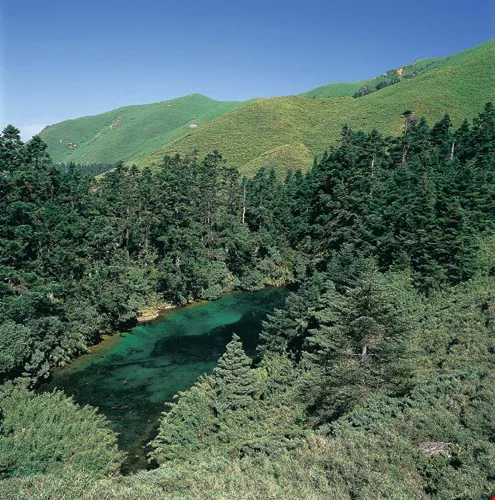
Nestled amid a fir forest on the north peak of Mt. Hohuan, Green Pond at high water has a shape that resembles the outline of Taiwan. Hence, it is also known as "Taiwan Pond."
Night climbing
When Lu was young, mountaineers--those rakish figures in their hiking boots and packs, machetes dangling from their waists--enthralled him. They were what first got Lu Li-yung interested in the mountains.
"The first mountain I climbed was 3529-meter Mt. Tahsueh. Probably because I was young, the guide gave me a lot to carry. But it was too heavy, and I was totally exhausted that first night," laughs Lu, as he recalls the harsh treatment he endured on his first climb, when he was 23.
Young people, however, rise to challenges. The harder the test, the more it piqued his interest. In the 1970s and 1980s mountaineering in Taiwan was taking off, and the ROC Alpine Association, hoping to encourage the pastime, offered trophies for climbing the "30 Peaks," "50 Peaks," "80 Peaks" and "Five Peaks and Three Summits." The creme de la creme, meanwhile, joined the "100 Peak Club." Members were ranked accordingly. Like many of those mountaineers, Lu set "100 Peaks" as his goal, and within three and a half years he had conquered 82 of them.
"Back then I would only take a simple point-and-click camera, which I'd use to take shots from the triangulation point to prove that I had climbed the mountain. Concerned only with reaching the peak, I climbed and descended in a hurry. As soon as I scaled one mountain, I'd rush off to the next. Often I'd have to feel my way through the dark in the middle of the night. Never stopping to enjoy the scenery, I'd even ascend summits by the light of the stars and moon." But once he neared the 100-peak target, mere numbers couldn't satisfy him anymore, and he began to reflect upon the joy and purpose of mountaineering. In particular, when he saw the beautiful slides taken by fellow mountaineers, he decided to slow his pace and use a camera to make a record of the beautiful green mountains.
In 1980, Lu bought his first single-lens-reflex camera. Returning to the mountains he had already conquered but slowing down to enjoy the beauty of the scenery, he clicked away. While conquering the "100 Peaks," he had worked as a guide, and some mountains he had climbed time and again. As a result, he became very familiar with the lay of the land and had opportunities to find unusual photo angles and vantage points off the beaten path. The job allowed him to stake out his own special ground as a photographer of mountain lakes.

Autumn colors of the green maple (Acer serratum).
First brush with the mountains
Lu Li-yung was born to tenant farmers in the Hakka-populated hills of Hsinchu County. Although his family wasn't well off, he spent a happy childhood climbing trees and playing in mountain creeks. After graduating from high school, Li-yung, who was the eldest son, decided not to continue his studies but instead to help his father with his general contracting business. In his leisure, he enjoyed listening to classical music and browsing in bookstores.
After catching the alpine photography bug, Lu would once spend as many as 22 days of a month up in the mountains. His family, displeased with his allocation of time, were concerned about his safety and felt he lacked a "true profession." His father, who envisioned him taking over the family business, wanted him to focus on contracting.
It wasn't until Li-yung had his first solo exhibition in Taipei's Rainbow Gallery in 1993 and was invited by Hsinchu mayor Tung Sheng-nan to put on a show at the Hsinchu Municipal Cultural Center the following year that the elder Lu, seeing his son's wonderful photographs, reconciled himself to Li-yung's career choice.
When Lu first started, there were virtually no photography courses given anywhere in Hsinchu County. Consequently, he had to grope his way toward proper technique, acquiring basic skills through trial and error.
"Whenever I had any cash to spend back then, I'd buy film, substituting energy and film for experience," he recalls. "As soon as I came off a mountain, I'd develop what I had shot, examining the results carefully to see what I needed to improve or do differently. Then I'd turn around, march back up, and start shooting all over again!" At exhibitions many senior photographers suggested that he select a specific theme to focus on. In his mind's eye Lu recalled the breathtakingly beautiful lakes that he had seen scattered among the mountains.

Formosa lily.
Sungluo Lake--teenage maiden
Lu Li-yung emphasizes that experiencing alpine lakes in person needn't be the exclusive preserve of experienced mountaineers. Taiwan has several mid-elevation lakes located in rich forest ecosystems--such as Sungluo and the lakes of the Chialuo group--that are easy to reach for the average visitor to the mountains.
Sungluo Lake, at an elevation of 1300 meters, is located at the headwaters of the Nanshih River in Tatung, Ilan. Carrying a light pack, you can hike there and back in a day. If you're carrying heavy camping equipment, the trip will take about six hours from Yulan Village. A dense forest, cool and damp in every season, surrounds the lake, and the branches of its trees are covered with green lichen. Because mist and clouds so often obscure the lake, some have likened it to a shy maiden hiding herself behind a white veil. Hence, its moniker: "the 17-year-old lake."
Apart from its aura of youthful innocence, the 17-year-old lake has another special feature: an especially large number of wild frogs, mostly green-bodied tree frogs and olive frogs. If you come during the summer mating season, the huge number of these frogs croaking their mating calls in turn attracts large numbers of their predators, snakes.
"When you camp at Sungluo Lake during the summer, you've got to be able to stand the high-pitched mating calls of the frogs and be able to keep the frogs all around you from jumping into your picnic. And when you go to draw water from the lake, watch out for water snakes. The sight of darting black tadpoles massing in the water is likewise magnificent."
Lu Li-yung stresses that unlike most mountain lakes, which only reveal high and low watermarks, during the fall and winter Sungluo Lake also reveals the changing curves of the riverbed just below the surface of the water. They're very striking. The banks are covered in lush green moss and water plants, rendering the lake even more beautiful.
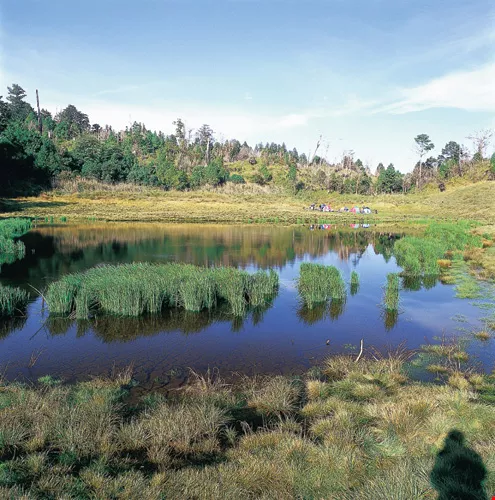
According to a Forestry Research Institute study, the Chialuo group of lakes in Ilan's Tatung may be located in Taiwan's only peat bog remaining from the last ice age. It's a precious natural resource.
Chialuo--mirrors of light
The Chialuo group of lakes, which is also in Ilan's Tatung, is found where the Nanhu and Sanhsing mountain groups of the Central Mountain Range intersect. The lakes are scattered on all sides of Mt. Chialuo. During the era of Japanese rule, this area was part of the Mt. Taiping Forestry District. Today it is managed by the Forestry Bureau.
Since 1987, when National Taiwan University's mountaineering club first brought this area's beauty to people's attention, naming the largest lake Chialuo, the mountaineering community has discovered and named 18 of the lakes, including Weitan Pond, Haomai Pond, Sky Lake and Green Lake. According to a legend of the local Atayal tribe, a beautiful fairy in Heaven was applying makeup when she accidentally dropped her mirror. It fell and shattered around Mt. Chialuo, creating these lakes.
In April 1999 some careless hikers caused a forest fire that burned 50 hectares of forest hereabouts. In the process it uncovered evidence that that these lakes may be remnants of a peat bog that formed during the last ice age. The Forestry Bureau report on the lakes notes that peat bogs are found mostly in Russia, Finland, Canada and Ireland, and cover about 3% of the world's land surface. A precious natural legacy, many a rare plant species is making its last stand here.
If you are carrying heavy equipment, the hike from the Ssuchi Forest Road to Chialuo Lake will take seven or eight hours. "The journey features abundant changes in the forest ecosystem along the way. It's nature's special gift to hikers." Lu explains that the Ssuchi Forest Road, which is wide and fairly straight, provides excellent access to the forest. In early spring, the yellow flowers of may chang (Litsea cubeba--what the local Atayal call "makauy") make for a nice contrast with the bright red blooms of the Taiwan cherry.
From the trailhead, ferns predominate in the understory. Higher up, on the ridge, the forest disappears, giving way to grassy slopes of dwarf bamboo upon which are scattered a few charred trees--some standing, some fallen--from the 1999 fire. The flourishing dwarf bamboo and the forlorn burned old trees provide a contrast of the lush and the parched, the living and the dead. There are numerous birds in this precious high mountain bogland, and the vegetation is dense. The dry season in fall and winter provides a closer look at peat bog topography.
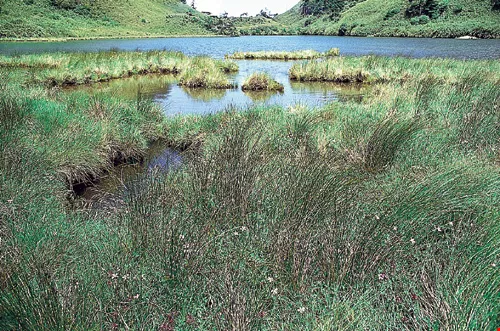
Wanli Pond in the Nengkao Mountains of Nantou is in one of the few high mountain lakes in Taiwan that is continously fed by a stream. In early summer Geranium hayatanum blooms around its shores.
Green Pond, glacial keepsake
Above 3000 meters there are also some lakes that are fairly easy to approach, such as Green Pond and Tienluan Pond near the north peak of Mt. Hohuan. In the 1960s, when the Cross-Island Highway opened and connected with the Wushe branch road, it cut through Wanting at Mt. Hohuan's shoulder. It was the first public road providing a way in to the high mountains. Ordinary people were thus provided easy access to the five peaks of Mt. Hohuan, which are among Taiwan's "100 Peaks."
The North Peak's Green Pond, at an altitude of 3422 meters, is an alpine glacial pond, something rare indeed in Taiwan. Under the dappled shade of the dense forest, Green Pond reveals itself in the shape of Taiwan. It never fails to impress visitors.
Descending along the Peishen branch ridge of Mt. Hohuan's North Peak, one can reach Tienluan Pond. When the pond is full, the lush foliage of the huge Taiwan fir trees is reflected on the pond's surface, which is as clear and smooth as a mirror. Hiking farther north, you'll reach Mt. Wufa-naiwei in about 15 minutes. Its summit offers broad vistas. You can see Mt. Nanhu and Central Peak, the ridge from Mt. Hsueh to Mt. Tachien, Mt. Fushou and Mt. Paikuta, and the north peak of Mt. Chilai.
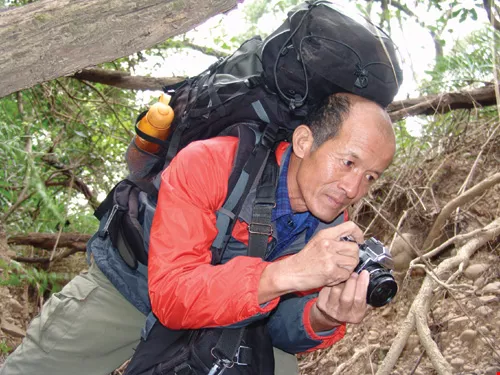
Devoting himself to alpine photography for 15 years through thick and thin, Lu Li-yung has striven to make a record of Taiwan's high mountain lakes in all their splendor.
Meteor meets treasure isle
When the US space agency NASA sent its rocket Deep Impact to a comet in July 2005, meteor impact craters on earth once again become a topic of conversation. Chen Chao-hsia, director of the General Geographical Survey of the Ministry of Economic Affairs, and his researchers discovered in 1999 that Chiaming Lake (elevation 3310 meters) may in fact be the crater of a meteor that crashed into earth tens of thousands of years ago. In Haituan, Taitung, about half way up the southeast side of Mt. Sancha in the southern Central Mountain Range, it is the only meteor crater thus far found in Taiwan.
To reach Chiaming Lake, you start at the Hsiangyang Ranger Station. The hike along a mountain trail will take about a day and a half. Because the rugged mountains hereabouts are rough going with dramatic changes in weather conditions, people are few and far between. Chen's interest was piqued when he read an Yushan National Park introduction to the lake, which noted that it was an oval pit about 120 meters deep and 80 meters wide, with banks composed of shattered black and brown rocks.
Chen brought back samples of the rock layers. Detailed observation and analysis revealed that the glass-like black, white and brown rocks were created in a high-temperature explosion. The samples contained large amounts of nickel, which was absent from the neighboring strata. Because meteor craters typically have large amounts of nickel, this finding confirmed the likelihood of Chiaming Lake being one.
According to overseas research, there are some 120 meteor impact craters in the world. In the Asia-Pacific region, they had been found in Australia, Indochina, and Sumatra. But the chance of one in Taiwan, with its small area, was slight, so the claim has been greeted with some skepticism.
The water in Chiaming Lake is as clear as at a coral reef. For Lu Li-yung, watching the play of light on its surface is far more pleasant than analyzing the geology. There is a shelter about two-and-a-half hours by foot from the lake. But the problem for photographers is that the hours around dawn and dusk provide the most interesting changes of light. Although staying at the shelter reduces the hard labor involved in carrying equipment, groping along a mountain trail to take in the sunset or feeling one's way back to a shelter after dark is not conducive to photographic creativity.
"In alpine photography the worst thing you can do is rush things," Lu explains. "If you're anxious or tired, you won't be able to settle your mind to come up with a good composition." He stresses that you have to lug heavy camping equipment in order to have a chance to experience a lake intimately. If you're really lucky, you might see some Formosan sambar. And photographing the same lake in all seasons of the year is a better way to capture all its guises.
Take, for instance, Chiaming Lake. In the summer it features flowers Gentiana scabrida and swathes of dwarf bamboo, and in the fall there is a sea of clouds rising from the Laonung River. In the winter the sedge Baeothryon subcapitatum waves in the wind along its banks. Each of these offers great material for photographers. "There are no large trees along the lake's banks; all the eye can see is a continuous stretch of dwarf bamboo. Among high mountain lakes, it's an especially outstanding natural vista." Lu points out that the grassy expanses, azure lake and snow-white clouds create tremendous contrasts in color, so paying attention to the light is essential.
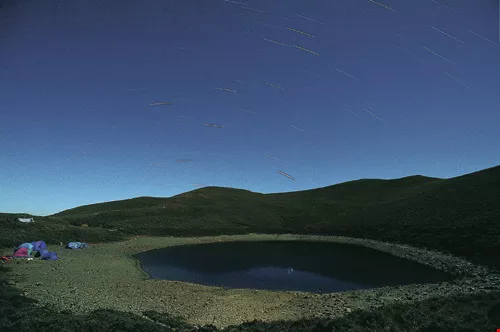
Chiaming Lake under the night sky. Photographers regard the changes of light on a mountain lake at dusk and dawn, as well the tracks of the stars through the night sky, as first-rate creative material.
Rainbow and White Rock
Rainbow Lake (elevation 2870 meters) in Wanjung, Hualien, is another of Lu's favorites. In years past herds of sambar would come to drink, so it used to be known as "Deer Lake." Legend has it that the setting sun reflects in rainbows across the lake--hence its name.
"The seasons are very distinct on Rainbow Lake: in late spring and early summer, the slopes are full of ferns. When the plum rains saturate the soil, you can photograph from the path that encircles the lake or from neighboring mountains. In June there are the white flowers of the Yushan rose and the Formosan lily. During the dry season in autumn, the water level drops and you can camp on the dry banks of the lake. You get a 360-degree view of the beautiful miscanthus grass surrounding the lake. In the winter you have the white clouds and Formosa pine."
Lu, who likes to capture the changes in alpine lakes through the seasons, especially likes to photograph White Rock Lake in the snow. At an elevation of 2750 meters, it is located at the border of Nantou's Jen-ai Township and Hualien's Wanjung Township. You must approach from Tunyuan in Wushe. From the Nengkao Cross-Ridge Historic Trail near the boundary tablet, following the ridgeline on up, you pass Mt. Kaho-er, Nengkao's main peak, Nengkao's south peak (which is one of Taiwan's "ten steepest peaks"), and finally Bald Mountain, with its expanses of dwarf bamboo. It takes about three days on foot.
Lu has long hoped to shoot scenes of White Rock Lake in winter but the stands of dwarf bamboo have stymied him. "You've got to get past dense dwarf bamboo on Nengkao as tall as a man. Once they get covered in snow, they're impossible to pass." So far no one has succeeded in shooting White Rock Lake in the snow.
Speaking of White Rock, Lu's voice becomes infused with admiration and longing. This photographer in his early fifties has given all his passion to alpine lakes. Never married, he just laughs with embarrassment with asked about romance and says: "That's fate!"
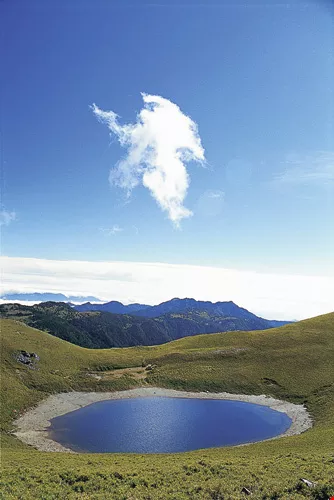
Research indicates that Chiaming Lake in Taitung's Haituan Township may be the crater of a meteor that hit earth tens of thousands of years ago. It is the only known impact crater in Taiwan.
Alpine photography classroom
Five years ago, in the journal of the Chinese Society of Natural Photography, a woman mountaineer whom Lu had refused to take up to the mountains expressed her displeasure at being rebuffed in her attempt to study alpine photography. It spurred Lu to recall his own early frustrations at groping his way toward technique. Consequently, Lu decided to open his Alpine Photographic Studio, where he conveys the wisdom gained from many years of photographic experience.
"Say you're shooting at Rainbow Lake under a full moon and starlight. Under the light of a full moon, for instance, you can heed a kind of formula: a 30-second exposure and an aperture setting of 2.8...." Lu, usually a man of few words, takes his class up into the mountains, where he teaches everything he has learned, revealing even his favorite private vantage points. His hope is to encourage more young people to pursue a career in alpine photography and enter the ranks of this lonely but worthwhile profession.
He suggests that those with an interest in high mountain photography should first acquire ample mountaineering experience, so as to avoid getting lost or suffering from altitude sickness. When he was younger, Lu kept himself in shape by jogging. In recent years he has switched to speed walking. Before he hikes up into the high mountains, he trains by walking up Hsinchu's 18 Peaks Mountain with a pack filled with six large bottles of spring water. It keeps him in pretty good shape.
Lu explains that many photographers, especially those just learning the craft, find it too easy to fall in love with equipment.
"If you're always changing equipment, you can't get familiar with how to use it. What's more, if you are lugging too many lenses around, you'll be too tired to enjoy the scenery once you reach your mountain destination--let alone compose creatively."
With regard to subjects, Lu suggests the fewer the better. Some people, seeking to gain glory by climbing as many peaks as possible, continually climb different mountains. Lu advises taking a different tack. "You should take many shots of the same mountain, shooting it in different seasons," he says. "Only then will you become really familiar with the mountain so as to advance to shooting special topics and angles, and thereby create truly outstanding work."
If you hike up into the mountains and hit inclement weather so you can't shoot, don't be crestfallen, Lu emphasizes. Instead, take advantage of the chance to study the lay of the land and survey nearby vistas, looking for the best vantage points. Once the weather takes a turn for the better, you can get right to the best spots and start shooting.
From his state of panic upon hearing bird calls when he first camped alone, to the photographic mastery that now enables him to capture breathtaking images of high mountain lakes, Lu's personal interest and determination are what have kept him going these many years. Alpine photography may not have provided him with a comfortable living, but, holding true to the ideal of "working with joy and enduring hardships willingly," the slightly built Lu keeps lugging his heavy pack through the bone-chilling winter wind, marching toward the mountain forests he loves.

Wild Taiwanese ferns.
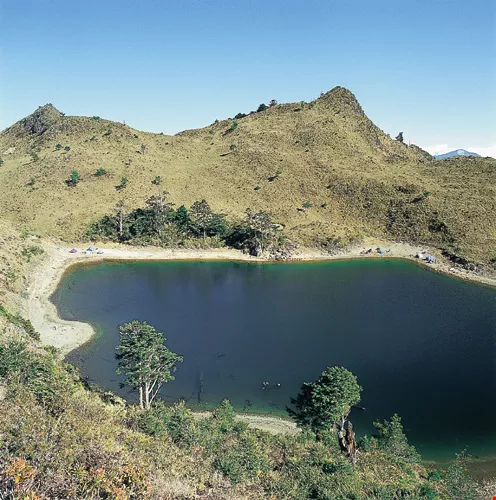
Chitsai Lake is located in Hualien's Wanjung Township. During the autumn dry season, you can camp on its shores and capture a splendid panoramic view of the flowering miscanthus grass surrounding this desolate lake.


