Yuguang Elementary--Taiwan's First Name in Domestic Study Tours
Tsai Wen-ting / photos Chuang Kung-ju / tr. by Scott Williams
June 2006


To some, Yuguang Elementary School is a five-star educational resort. Others call it a training ground for creative "purple cows" that stand out from the herd. Yuguang's claim to fame is that it initiated Taiwan's domestic study-tour trend when it began inviting students from all over the island to its campus to study its natural environment. In so doing, Yuguang transformed itself from one of Taiwan's smallest schools into one of its largest.
We often see events organized to send books out to rural schools, but sending books from the countryside to schools in the city is something new.
Make no mistake, Yuguang Elementary School is very remote and very small. But on March 21, this primary school in a Taipei County mountain village kicked off its own effort to send 20,000 books to urban areas as it hosted its first annual study-tour exhibition. Yuguang itself compiled the books in question--The Floating Classroom, The Study Tour Pasture, The Hands-on School, The Magic School--and plans to donate copies to all of the nation's primary schools.
To date, more than 40,000 students have taken part in little Yuguang's study tours, and the school has become widely known throughout Taiwan.
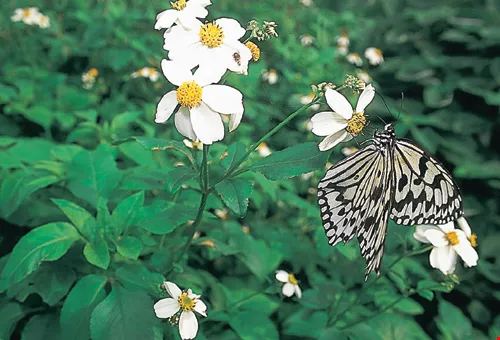
The children have nicknamed the slow-moving monarch butterfly the "big stupid butterfly," a play on its Mandarin name.
Three classes, eight students
Yuguang Elementary is located on the shores of Lake Tashe in Yuguang Village, Pinglin Township, within the Feitsui Reservoir's catchment zone. Before the school was founded in 1920, village children had to walk for miles to attend Pinglin Primary. Bothered by this, area parents, tea growers for generations, leased a piece of land and built their own small school. Now, 86 years later, the school and its landlord are still neighbors.
The construction of the Feitsui Reservoir in 1981 led to restrictions on building in communities within its catchment zone. Many residents began leaving the area, which resulted in the closure of several mini primary schools--Pishan Primary in 1981, Taiping Primary in 1991, and Yungting Primary in 1996. Yuguang, meanwhile, has become Taiwan's smallest primary school as its enrollment has plunged from a high of more than 200 to a low last year of only eight students split among three grades.
Though the school's location within a protected catchment zone limits enrollment, it does provide it with a rich and diverse biosphere.
When you first enter the school grounds, your eyes are immediately drawn to a 100-year-old cherry tree in full bloom. The song of a streak-breasted scimitar babbler drifts over from the upper branches of another tree by the athletic field. Cicadas and saturnid moths are everywhere. And, on summer evenings, you can watch stag and rhinoceros beetles crawl slowly across the athletic field.
When the weather begins to warm in early spring, caterpillars wriggle along the pipevines in the flowerbed in front of the classrooms. A single swallowtail butterfly of the species Byasa alcinous mansonensis, fresh out of its cocoon, quietly dries its wings while resting on the fingertip of a child, waiting for the moment when it can extend them and fly away. Two crested serpent eagles superciliously circle the children playing on the field below.
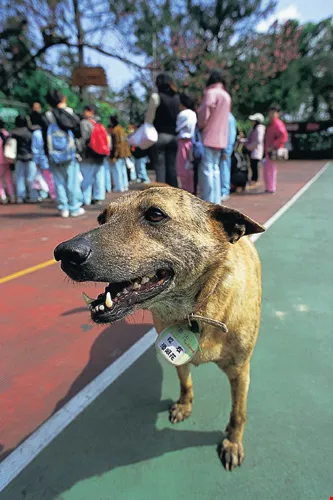
Ten-year-old Yu A-hua, one of Yuguang's campus dogs, is a star alumnus.
A principal's hopes
On Kuo Hsiung-chun's first day as principal of Yuguang in 2002, the local media described him as the school's last principal. Rumors about the school's imminent demise had been circulating among parents, teachers and even students for some time, and this uncertainty had grown into an unshakeable, niggling fear in the back of everyone's mind.
With enrollment at Yuguang falling from year to year and an annual budget in excess of NT$10 million for just eight students--more than NT$1 million per student per year--Kuo knew that the government couldn't continue to fund his school forever. When he recalled that his predecessor had graduated only 11 students in his four years at the school, he decided something had to be done. "If they did shut down the school," he explains, "I wanted it to go out in style. If we had the good fortune to stay open, I wanted to create more value and enable others to share its unique resources."
When Kuo proposed the idea of study tours, he wasn't surprised to find that half his faculty and staff weren't interested in the extra work. He met with them one on one, and, three months later, he had three teachers and two campus dogs (Yu A-hua and Yu A-pi) who were willing to help. He then began putting together materials for the nation's first study-tour program hosted by a local school.
The first item on Kuo's agenda was developing a curriculum from the school grounds. They built lesson plans based on the school's strong point, the natural environment of the campus--the firefly nesting area, the treefrog pond, the eco pond, and the vegetable garden. They also incorporated the natural and cultural environments of the surrounding area, yielding 20 modules that included activities such as a tea tour and moon viewing, and subjects such as cherry blossoms, fireflies, and the rivers and streams that feed the reservoir.
.jpg?w=1080&mode=crop&format=webp&quality=80)
Little first graders bound down the Grandpa Goes to School Trail. Can you tell which of them just moved back here from the city?
The idea takes root
Where did the idea for domestic study tours come from? Kuo says that when he became the director of academic affairs at Yuguang, the parents of a student at Taipei's Kuangfu Primary School took time off from work to bring their two children out to Yuguang to study for two days. Kuo couldn't get over the fact that Yuguang's setting, which the locals were so used to, would be so cherished by city children.
"Why go all the way to rural villages in Australia or New Zealand to study when you can come to Yuguang?" he wondered. Such was the seed from which Kuo's concept of local study tours grew.
Yuguang's study tours differ from a typical study tour in that they incorporate the area's natural and cultural setting into the curriculum and focus on teaching through play. These traits are key aspects of the Yuguang study tour "brand."
Taiwan spends an estimated NT$1 billion per year on educational tours, including travel, lodging, and participation fees. Whether this spending actually leads to learning remains open to debate.
"We typically encourage our children to read more," says Kuo. "And 'brand-name classes' at unique schools turn whole campuses into big 3D textbooks." Kuo suggests that one way to produce a really outstanding Taiwan-centric curriculum would be for all of Taiwan's schools to work with their communities to create study-tour lesson plans, then exchange them with everyone else.
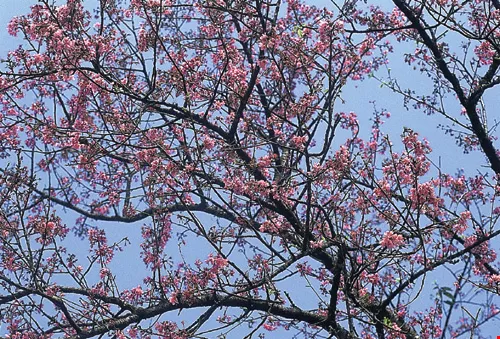
This 100-year-old cherry tree is Yuguang's guardian, and a testament to the school's long history.
Commercializing a curriculum
Once Kuo and his teachers developed their own localized educational materials, their next step was to commercialize the curriculum. This meant taking ideas about operations and marketing from the corporate world and applying them to their program. In Kuo's view, two issues had to be addressed when they introduced the program to the public--it had to work, which was an operational issue; and they had to present it, which involved marketing. Showing the program became both a means of disseminating his ideas about how to run a school, and of motivating his own people.
Yuguang's marketing strategy involved giving courses interesting titles and inviting major Taiwanese newspapers and education-industry periodicals to report on the school. By all accounts, it has been a resounding success that has, over the last couple of years, turned Yuguang into a media darling.
The names they've given local roads exemplify their approach--the farming road that circles the tea hills is called "5000 Playgrounds," and the old trail down to the edge of the creek is called "2000 Playgrounds." Then there are the school's dogs, named by the students themselves, which are perhaps the school's most photographed attraction. One of the original pair, Yu A-pi, died last year and now rests in a grave beside a grassy campus footpath. But ten-year-old Yu A-hua still roams the campus as a "senior alumnus" along with the school's newest canine "student," Yu A-niu.
The school has also made the most of its distinctive size. A case in point is last year's one-student graduation ceremony. Huang Hung-chih, the school's head of general affairs and leader of the study-tour program, frequently mentions it in his opening remarks to visiting students, telling them: "Our school originally planned to have the entire graduating class and all their teachers circle the island on a single motorcycle." The audience always responds to what they presume is a joke with snickers and murmurs of "yeah, right," but the school really is that small.
In addition to getting school events both large and small into the papers, the school has its own custom-made line of souvenirs, including cups, athletic shirts, and pottery flutes, that feature the "Yuguang Study Tour" logo. When study-tour participants return to their urban homes, the souvenirs will serve as reminders of their trip to Yuguang, and will perhaps inspire them to share their stories with friends.
Kuo's strategy is to highlight the difference between tiny Yuguang, with a graduating class of one, and the giant urban primary schools that have a dozen classes in each grade. He wants to make Yuguang stand out as the "purple cow" in the educational herd.
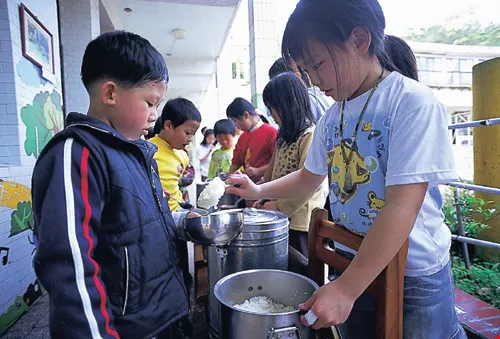
Yuguang has so few students that it feels more like a family than a school. Here, everyone helps out with lunch.
Yuguang's little hosts
The study-tour students clearly benefit from their visit to Yuguang, but what about the school's own students and teachers?
After allowing for free visits by academics receiving training and students from special schools, the program's 40,000 participants over the past four-years have generated surprisingly high revenues of NT$6-7 million. But once you deduct the cost of faculty and staff salaries, souvenirs, lunches, and the tea museum's entry fees, little of the tuition money (NT$300 per person) remains. Nonetheless, this has been enough to compile course materials, construct the school's ecology classroom, maintain the footpaths, and build wood-floored dormitories, making Yuguang's own students the program's biggest beneficiaries.
The process of systematizing the curriculum and leading the groups of visiting students has been a spur to teachers who previously lacked a sense of achievement. Huang Hung-chih, a graduate of the Institute of Marine Resources at National Sun Yat-sen University, taught for a time at a well-known urban cram school, but strongly disliked its exclusive focus on getting students promoted to the next level of study. After receiving his teaching certification, Huang visited a number of innovative small schools before finally choosing to put down roots at the pastoral Yuguang.
"If there's even just one or two kids in a tour group whose eyes shine with curiosity," says Huang, "you feel as if your every sentence takes on greater meaning."
The study tours also give local kids and visitors a chance to check each other out.
"One time, a Public Television Service crew was out here taping a show," says Huang, "and when the host went to rest his hand on a student's shoulder, I noticed that the student dodged away." Huang realized that the paucity of kids at the school and their limited contact with the "outside" world had made them shy and reserved. Since the study tour program has gotten underway, Yuguang's students have become so much more comfortable greeting guests that they now boldly introduce themselves with name cards. Scrambling along the old footpath talking about the insects, the kids have discovered something they're good at and gained confidence in themselves.
"The city kids are like chickens raised in a coop," laughs one of the children bouncing down the slope on the old footpath leading down to the creek. "But we're local free-range chickens!"
Yuguang has won any number of awards over the last few years, including MOE awards for the effective use of resources and for being a national leader in campus innovations, as well as two major educational awards in 2004, one for additions to the curriculum and the other for educational excellence.
This September Yuguang, which is hardly more than a ten-minute drive from Pinglin Primary, will enroll only two new students. In consideration of this, the Taipei County Department of Education has decided to incorporate Yuguang into Pinglin Primary. When all of Yuguang's current students graduate in six years, the school will close.
Parents and the local township representative have reacted sharply to the news. Yuguang PTA chairman Liu Chih-shih brought his two children back to Yuguang from Taipei because he approved of the school's educational philosophy. Now, alarmed and reluctant to see the school closed, he says, "Pinglin's population has been moving away. If the school goes, young people are going to be even less interested in moving back here."
"In any case," says Huang Hung-chih, "we'll continue to promote the study tour program." Huang, who came to Yuguang filled with idealism, says that the teachers have gotten past the question of whether the school remains open. With Yuguang entering its twilight, they want to be sure that the memory of its light lingers on in the hearts of its students.
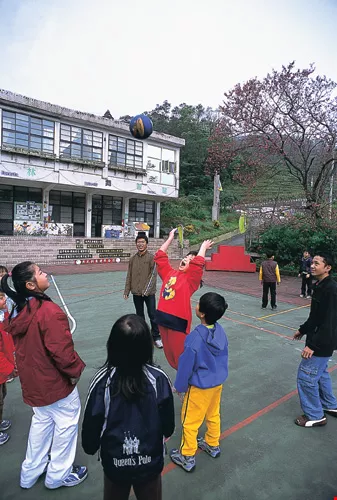
In spite of its wide renown, Yuguang Elementary is to be closed in six years. In the brief time left to it, the school's students and teachers will do their best to ensure that its memory lingers.
Yuguang Primary School's Study Tour Packages
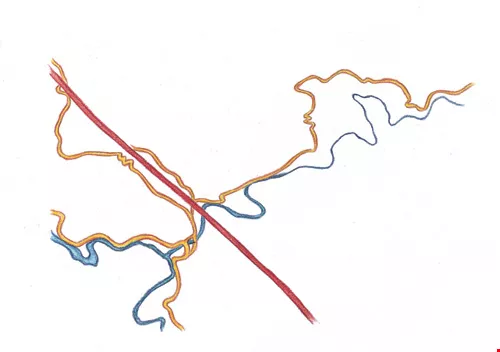
Little first graders bound down the Grandpa Goes to School Trail. Can you tell which of them just moved back here from the city?
Four themes, 20 module
1.Local Industry: Tea-garden visit; tea tasting; tea-themed meal; tea guide; tea township tour
2.Natural Ecology: The language of Yuguang's ecology; birds, flowers, bugs and frogs; the sound of Feitsui's waters; cherry blossoms and fireflies; 5,000 Playgrounds
3.Hands-on Exploration: Moon viewing; nighttime exploration; pottery flutes; camping and cooking-out; creative works
4.The In-depth Story: The Hutung Historic Trail; the fish of Gold Creek; the wide water's beauty; calling on history; local legends
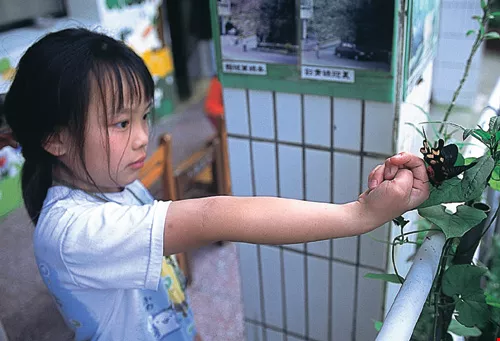
Spring has arrived! A highland red-belly swallowtail butterfly fresh from its cocoon suns itself on a child's finger.
Package Options:
1.Study tours for teachers and students: Monday through Friday. Groups are led by teachers or parents. NT$300 per person.
2.Study tours for family groups: Saturdays. Groups of 40-60. Eight modules. NT$800 per person.
3.Summer and winter vacation groups: Groups of 40-60. NT$2500 per person. (Third through sixth graders may register individually.)
Yuguang Elementary School
Tel: (02) 2665 6508
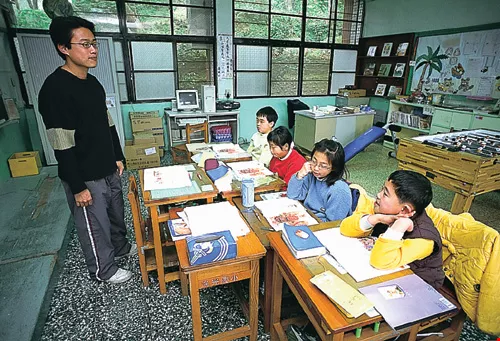
Yuguang has a total of only four third- and fourth-graders, and just 20 students in its entire student body.
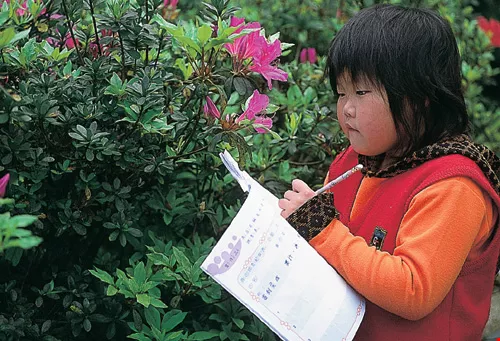
A child from Yuguang Elementary focuses intently on recording the growth of local plants.


@List.jpg?w=522&h=410&mode=crop&format=webp&quality=80)


