A Green Legacy--The Japanese Houses of Taipei
Tsai Wen-ting / photos Chuang Kung-ju / tr. by Anthony W. Sariti
May 2005


If you were a bird looking down on Taipei, where might you find a nice tree-shaded area to sing your songs in peace and gaze up at the blue sky? If you were a bird, you would know to fly to those spare and simple old Japanese-style homes and listen to the old trees in the courtyards as they tell tales of days past.
Tucked away in the city's prime real estate area, "unused" Japanese-style homes offer unexpected breathing space for a suffocating city.
In June 2004, three buildings in the Japanese housing complex at the old customs terminal that had stood overlooking the Tanshui River for 70 years were razed to the ground with lightning speed by parking lot owners who were renting the land from the Bank of Taiwan. This came just as writers and historians from Tanshui were petitioning the Taipei County Government to list the complex as an historic site.
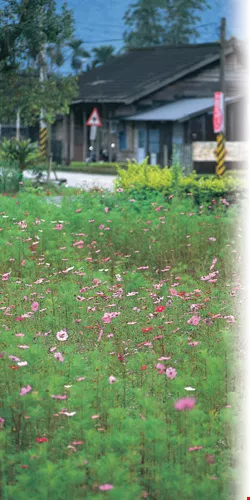
Delicate cosmos flowers waft gently in the wind as the Japanese houses, with their plain yet sophisticated styling, come slowly to life in anticipation of spring.
The early bird wins?
At 3 a.m. on September 21, 2004, the very day the designation of a Japanese housing complex in Taipei's Chitung St. as an historic site was to be considered by the city government, a construction company that had bought part of this property from the Bank of Taiwan, fearing that after daybreak the land would in fact be designated an historic site and they would be powerless to move, stuck first and razed two of the buildings on the theory that "the early bird catches the worm."
The Cultural Affairs Department strongly condemned this move. All it could do, however, was to set up some 20 closed-circuit TV cameras and hire security personnel to keep a 24-hour watch in the hope of preventing the remaining old buildings meeting a similar fate.
Although the Cultural Affairs Department spends a great deal of effort fighting for preservation, the fact is that under the current Cultural Heritage Preservation Act, historic buildings per se have no legal status. As for the construction company that tore down the houses, the city government could only fine them NT$30,000 for demolishing buildings without a permit. Even if the razed buildings had been on an official list of historic sites, the punishment might have amounted to up to five years of imprisonment, but then again, it might have been no more than a fine of NT$30,000. Compared with the enormous profits of developing the land, the company's choice was obvious.
If you open a map of Taipei you will see the plan is for streets to run east and west, north and south. But Chitung St., formerly "San-itabashi St.," runs northeastward through the checkerboard pattern of the city center's streets.
"Why does it run diagonally? This pattern is a relic of the city's history," says Assistant Professor Shiue Chyn of Chung Yuan Christian University's Institute for the Conservation of Historic Sites. Chitung St. was the main road from Taipei to Keelung. It is a road with more than 260 years of history.
Japanese houses that over the years have become underused or no longer used at all provide city residents with a place to breathe freely and enjoy nature.
The death clause
The primary reason public-sector entities possessing Japanese houses are so anxious to sell off these long-forgotten properties is the "program for improved management of unused, under-used, or occupied national public-use real estate" proposed by the Ministry of Finance's National Property Bureau.
In 2002, the National Property Bureau began to conduct audits of 10,701 state-owned houses in Taiwan. At the end of the following year, the audit revealed that unused or "low-use" (under 50% occupancy) units amounted to 76% of the whole. The overwhelming majority was made up of Japanese houses. In Taipei alone there were more than 1,200 of them.
Under this program, public-sector organizations holding state-owned property, including the Bank of Taiwan, the Taiwan Sugar Corporation, the Taiwan Railway Administration and National Taiwan University, had to come up with utilization plans within a certain period of time, otherwise they would have to return the unused property to the National Property Bureau. As soon as this ultimatum was issued, the organizations, for whom it was impossible to produce a usage plan in such a short time, began a race to sell off property to increase their income.
Intending to safeguard national property, the National Property Bureau had conducted a full-scale audit to recover unused space, but instead created a situation where public sector organizations lost no time in a rush to raze houses. The provisions were thus termed by cultural observers the "death clause" for Japanese houses.
Apart from the effects of policy, Associate Professor H. J. Heidi Wang of National Taiwan University of Science and Technology's Department of Architecture anxiously points out that "50 years after the end of the war, these wooden Japanese-style houses have now reached a critical point for their survival, and we must face this situation head on."
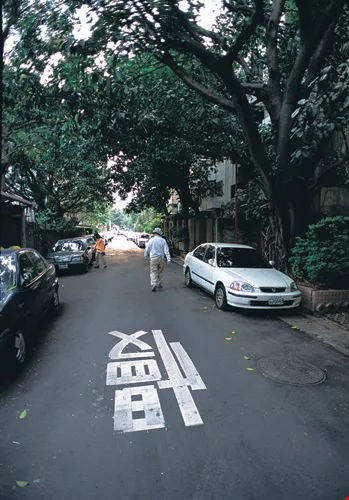
Turning into Taipei's Chingtien St. you find yourself slowing down as you are enveloped in a tunnel of green formed by trees on either side.
Eyewitnesses to history
We are all familiar with these Japanese houses that poke their heads over the wall from behind old trees to greet us. Some people think the glory of Taipei City is represented in these alleyways. But there are also residents who strongly disagree that these neglected and abandoned old houses, home to all manner of insects and vermin, with grass as tall as a person, are anything of the kind.
"They're just designated historic sites without supporting measures. Thieves and vagrants have moved in and set fires, and the places have become a security no-man's land. Should residents have to accept such risks?" Su Hung-jen, borough warden for 30 years on Chitung St., holds a contrary opinion.
And ultimately, what is the value in preserving such broken-down old buildings?
"These old buildings are eyewitnesses to history," points out Professor Li Chien-lang of Chinese Culture University's Department of Architecture and Urban Design. The Japanese houses have great value not only as examples of period architecture, but also because they embody the human record of the Japanese occupation and the 60 years of the post-occupation era.
The 34-building Japanese housing complex on Chingtien St. was designed and built by the professors from Taihoku Imperial University (now National Taiwan University) themselves. Because the Japanese highly valued education, professors enjoyed extremely high social status and were very well paid. Naturally, they were especially demanding when it came to architecture.
Many of the pioneers whose names figure in the annals of Taiwan humanities, science and medicine pored over their books and formulated their thoughts beneath the eaves of these buildings and conversed with their students as they reclined against the huge rocks set out in the garden. For example, Alley 6, #7 was the residence of Japanese microbiologist Professor Jin Adachi, who taught at Taihoku Imperial University. In the early years Taiwan sugar cane had insufficient sugar content because there was too much ammonium sulfate in the soil. It wasn't until Professor Adachi used microbiological techniques to improve the soil that there was a significant increase in sugar content, which was an enormous contribution to the Taiwan sugar industry. The house he built had a Japanese-style exterior but inside had a Western-style decorative caisson ceiling, and in the courtyard there was not only a European flowerbed but also a rare swimming pool.
"Before the renovation, the Chang Hwa Commercial Bank building standing at the alley entrance used to be the residence of Yu You-jen, a major government figure and former president of the Control Yuan. Buddhist studies master Nan Huaijin also once taught here, and Professor Lin Chao-chi, who discovered the Shihsanhang archeological site, lived in Alley 9," relates Hung Chiu-chia, warden of Lung-an Borough, where Chingtien St. is located, who knows the houses' history by heart.
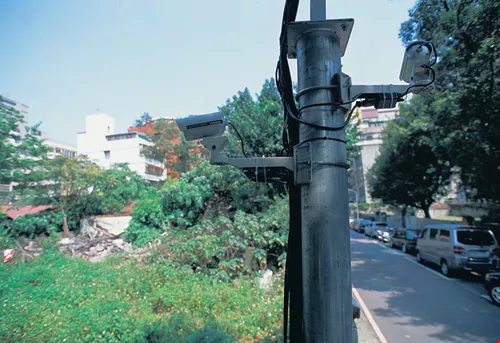
A construction company that bought prime real estate along Taipei's Chitung St. rushed to tear down the properties, forcing the city's Department of Cultural Affairs to set up CCTV cameras and hire security personnel to keep a 24-hour watch over the site.
Lungs of the city
Not just an historic gathering place for the cultural elite, Chingtien St., which borders Ta-an Forest Park, boasts older trees than the park itself. The spreading, intertwined branches of a 100-year-old bodhi tree, an 80-year-old Formosan michelia tree, a ginko tree full of nuts, a rubber tree and breadfruit tree from the South Pacific, plus wisteria, much loved by the Japanese, bathe the back streets and alleyways in a carpet of cool, jade-green shade.
To adapt to Taiwan's humid climate, the Japanese made a point of enlarging their courtyards and planting trees. Today after 70 or 80 years these small trees have become flourishing giants. "If there is a Japanese-style house near where you live, you are sure to hear the sound of birds chirping away," points out Wang Hui-chun. In addition to the old houses, another jewel of Japanese architecture over the years has been the old trees.
"In March and April the pomelo flowers bloom and give off their sweet fragrance," says Hung Chiu-chia. Every month on Chingtien St. a different tree bursts into fragrant flower. "Our neighborhood even has Muller's barbet birds!" The lush growth of trees is a paradise where birds can rest and feed. In addition to the commonly seen Chinese bulbul, Japanese white-eye and sparrow-the "three heroes of the city"-flitting about the trees, migrating shrike, White's ground thrush and pale thrush feed in the piles of fallen leaves. And one year close to 100 doves flew down into a liquidambar tree in Alley 7!
According to a survey conducted by the Department of Architecture at Chung Yuan Christian University for the Taipei City Government's Department of Cultural Affairs, the Taipei municipal districts of Chungcheng, Chungshan and Ta-an contain over 900 Japanese houses. Each house is planted with an average of 5.2 old trees, thus giving these districts alone a total of close to 5,000.
"If you climb a tree, you'll get a 360-degree view of the world and will understand that the Japanese houses cannot be separated from the old trees, that together they create a priceless natural resting place in an urban setting," says avid tree-climber Su Chun-lang, in support.
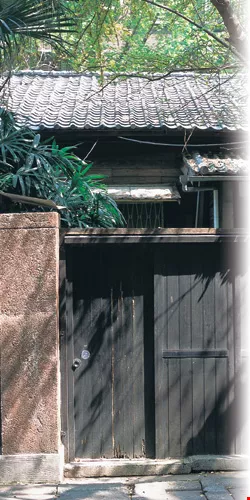
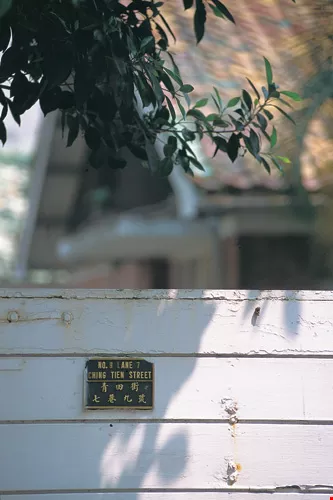
Within the expansive courtyards of the Japanese houses, concealed behind simple wooden gates, lived many famous scholars during the Japanese occupation and the early period of the National Government.
"Too much!"
Cultural and natural assets have no price, but not so prime real estate. For organizations with Japanese houses or for greedy real-estate brokers, the land under those buildings represents "astronomical" prices that take your breath away.
At a Chingtien St. public hearing organized by the Taipei Cultural Affairs Department a Ms. Chou, a resident of more than 20 years, is totally frustrated. "There are three things on Chingtien St. we have too much of: too much advertising, too much movie making and too many real estate brokers."
Located next to an educational and cultural center like National Taiwan University (NTU) and part of Taipei's most popular Xinsheng Elementary bilingual school district, you could say that every inch of Chingtien St. real estate is pure gold. One real estate ad reads: "For 100 years Chingtien St. has been a favorite spot for leaders of industry, government and academe." And what they say is true. A Japanese house on a 7,000 square-foot plot has a market value of several hundred million NT dollars.
NTU, with more than 500 buildings in Taipei, drew up multiple large-scale plans, including those for a large research park in the Chingtien St. area, a center for international academic youth exchanges on Kuling St., and a student dormitory on Chinhua St., lest these unused and underused school properties be reclaimed by the National Property Bureau. But this has drawn the opposition of residents who want to preserve the Japanese houses of Chingtien St.
As for the school property being designated historic structures or historic sites, NTU officials have been sending out constant calls for help. Currently NTU must provide 50% of its own buildings budget. If one day the many Japanese houses on Chingtien St. were to be designated historic sites, the university would be forced to spend tens of millions of dollars every year to maintain them-a serious financial burden.
The National Property Bureau, the organizations that control these properties, scholars, residents and builders are all locked in a see-saw battle of ideas.
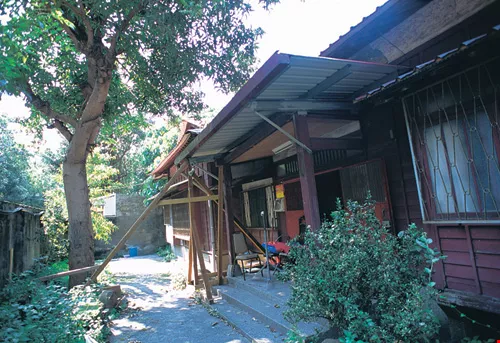
After more than 60 years of braving the elements, these wooden Japanese houses have reached a critical point in their survival.
Heritage is priceless
Public entities are anxious to sell off property and university officials fear school holdings will be declared historic sites, but does the public have no other choice in all this? As for public entities miraculously considering the Japanese buildings "their own property," Professor Hsueh Chin strongly objects. "As far as that's concerned, these entities are only 'stewards' of national property. For them to now just think about tearing the buildings down and selling the land is really too crass."
So-called "state-owned" property is not only owned in common by the 23 million people living in Taiwan, it is the joint property of the countless generations to come. "To auction off these Japanese houses at cheap prices is to sell off Taiwan's historical quality of life and that of future generations!" says one resident angrily.
"The root of all the problems is that people have not seen land as a non-renewable asset but rather only as property to be owned." This arresting statement was made by Professor Hsing Woan-chiau of National Taipei University's Graduate Institute of Urban Planning during the course of a survey investigation.
Taipei City long ago reached its "mature stage" of dense population and full land use. If these structures and spaces that have been handed down for almost a hundred years are destroyed based on some notion of "development," it will mean a loss of history for the city, less green space and the disappearance of a unique character.
"Life in a city is not just about economic benefits. Sometimes such benefits are not fully realized, yet it is possible to achieve even greater benefits," believes Professor Hsueh Chin. Faced with the extremely critical situation of Japanese houses, people should take the long view, see it from the angle of overall urban planning and let these structures return to the public fold as open spaces.
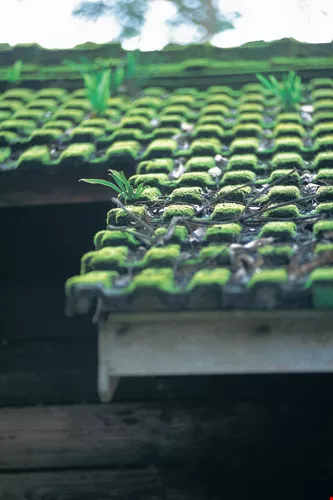
A small plant persists in growing on a black roof tile, a witness to the ebb and flow of history.
Reawakening
In fact, there are examples of the successful re-use of Japanese houses throughout Taiwan. They may become small theaters, city coffee and tea houses, exhibit spaces or community activity centers. It is not at all certain that these old houses have to be financial "burdens" that break the bank. Seen from a different angle, they can be a priceless treasure.
On April 2, 2002 the fires were banked and the machinery turned off at the Hua-lien sugar refinery in Hualien's Kuangfu Township. The sugar industry, which had represented Taiwan's No. 1 export product, could no longer cover costs due to the high price of labor, and after free competition was introduced into the market, the Taiwan Sugar Corporation (TaiSugar) had no choice but to reinvent itself. From an original number of close to 50 sugar refineries, only four remain in operation today, and after 2007 only two will be left.
TaiSugar decided to have the Hualien plant, built in 1913, strike out on the tourist road. The "ice products" made at the plant using the crystal mountain spring water of eastern Taiwan and the plant's own cane sugar have long gained fame far and wide, but aside from its popsicles, the refinery has a secret weapon-its perfectly preserved complex of Japanese houses.
The Hualien plant has 27 houses with some 73 rooms plus an additional 23 small single units. By the beginning of the year they had finished renovating the first group of these houses and opened them up for outside occupancy. They have become a great favorite among tourists with a penchant for nostalgia, and during holidays it is always difficult to find a place.
Lai Chun-ta, Hualien's director of tourism, says newly constructed wooden cabins can be found all over and, if you want to spend the money, you can build a five-star hotel, but only in Hualien can you find Japanese houses with their 80 years of history. "How many things are there around that are 80 years old?" These Japanese houses are our most precious asset, and our chief selling point."
Aside from hotels, coffee houses, art galleries and museums, Japanese houses can also play a lead role in revitalizing an area and once again drawing in new residents.
The number of residents of the Lintienshan tree farm, located in Hualien, fell from a high of 2,000 in the years of the forestry industry's prosperity to only some 200 today, with an average age over 65. The few middle-aged people who remained organized a community culture studio and proposed a plan for a "Lintienshan cultural park" in the hope of using local history to attract like-minded people to move in and live there. "Only in this way can we really bring the soul of Lintienshan back to life," says Chuang Ming-i, the spirit behind the rebirth plans. "We don't want it to become another highly commercialized mountain town like Chiufen."
In March this year the Lintienshan food service center, located in a renovated Japanese building, formally opened its doors. The manager is Hsieh Yu-chen, warden of the local borough of Senjung. There's also a young man named Hsieh Ming-hai from outside the area who has fallen in love with Lintienshan and settled there.
In April they will hold a school reunion in the service center for the now-defunct Senjung Elementary School, calling back their fellow students, long since gone, who used to play on the railroad tracks at Lin-tienshan and who grew up in forestry company housing there.
"Without culture, it's not a city; without the shade of trees, it's not a place of ecological value; without participation, it's not a place people can live." These were the words community residents projected up on the wall during the Chingtien St. public hearings. These Japanese houses that provide such a sense of emotional identification, these bearers of cultural tradition and refuges for old, stately trees-can they be cherished and preserved, handed down from generation to generation as a quiet patch of green in the concrete jungle?
A small plant persists in growing on a black roof tile, a witness to the ebb and flow of history.
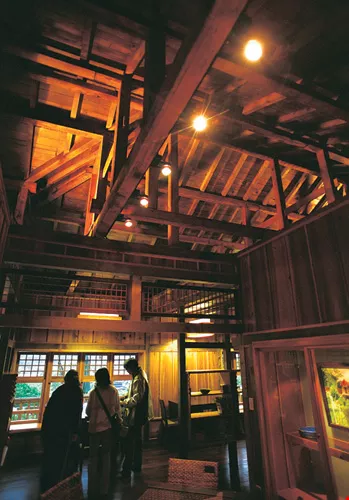
Converted from a Japanese house, with an open roof exposing the entire wooden structure, the food service center in Hualien's Lintienshan is a place where visitors and local residents can get together and chat.
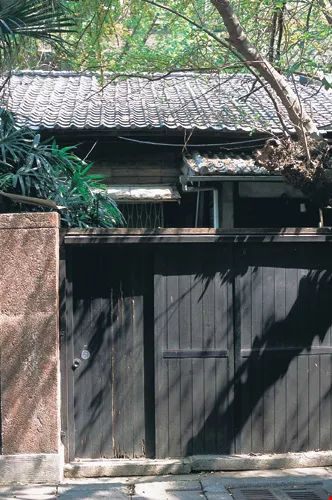
Within the expansive courtyards of the Japanese houses, concealed behind simple wooden gates, lived many famous scholars during the Japanese occupation and the early period of the National Government.
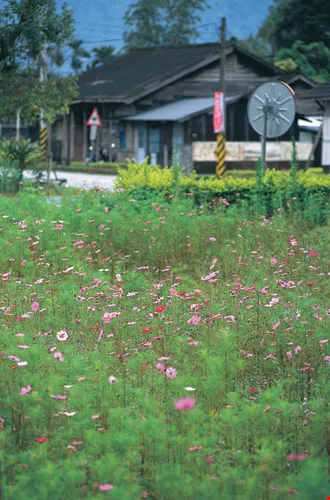
Delicate cosmos flowers waft gently in the wind as the Japanese houses, with their plain yet sophisticated styling, come slowly to life in anticipation of spring.
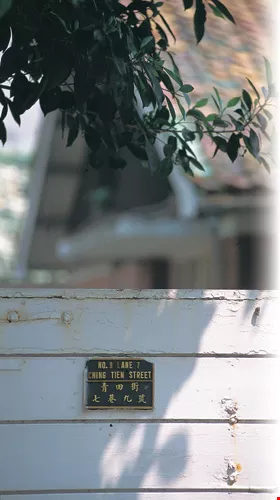
Japanese houses that over the years have become underused or no longer used at all provide city residents with a place to breathe freely and enjoy nature.
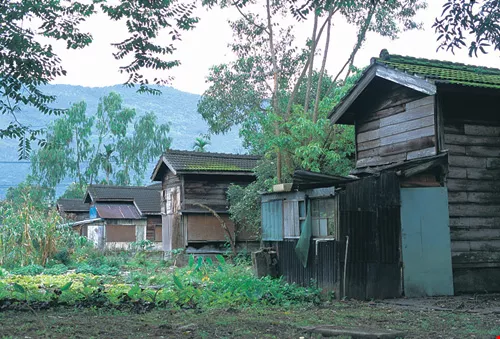
Following the decline and restructuring of the sugar industry, hundreds of Japanese-style rooms at the Hualien Kuangfu sugar refinery quietly await renovation and transformation into a unique tourist hotel.


@List.jpg?w=522&h=410&mode=crop&format=webp&quality=80)


