Cutting to the Bone:The World of Anorexia
Yang Ling-yuan / photos Chi Chiu-chi / tr. by Minn Song
August 2005


Has your belly ever grumbled from hunger, gnawed at from the inside as if by thousands of ants? Can you understand why a young woman in the prime of life would starve herself until she was match-stick thin, even while constantly complaining that she is "too fat"?
Twenty-two years ago, Taiwanese fans of Western pop music were shocked to hear of the death from anorexia of Karen Carpenter of the brother/sister duo the Carpenters. The vast majority found this event completely inexplicable, with no comparable cases having been known in Taiwan's medical history.
This disorder, which was recorded as long as 316 years ago, was only given the name anorexia nervosa nearly 200 years later, though it had afflicted Western societies for much longer. Ten years after Karen Car-penter's death, it was reported that Japanese entertainers Rie Miyazawa and Akina Nakamori were also victims. Photos of their emaciated forms were featured widely in gossip magazines, and it was at that time that Taiwanese finally began to understand what anorexia was.
Turn on the television, and ads espousing ways to slim down, testimonials by people who successfully lost weight, and interviews with such people are everywhere. "Losing weight" has become a virtual rite of passage of women in these affluent times. Unless blessed with a naturally slim figure, an average woman will use at least two different weight loss methods during her lifetime, according to medical estimates.
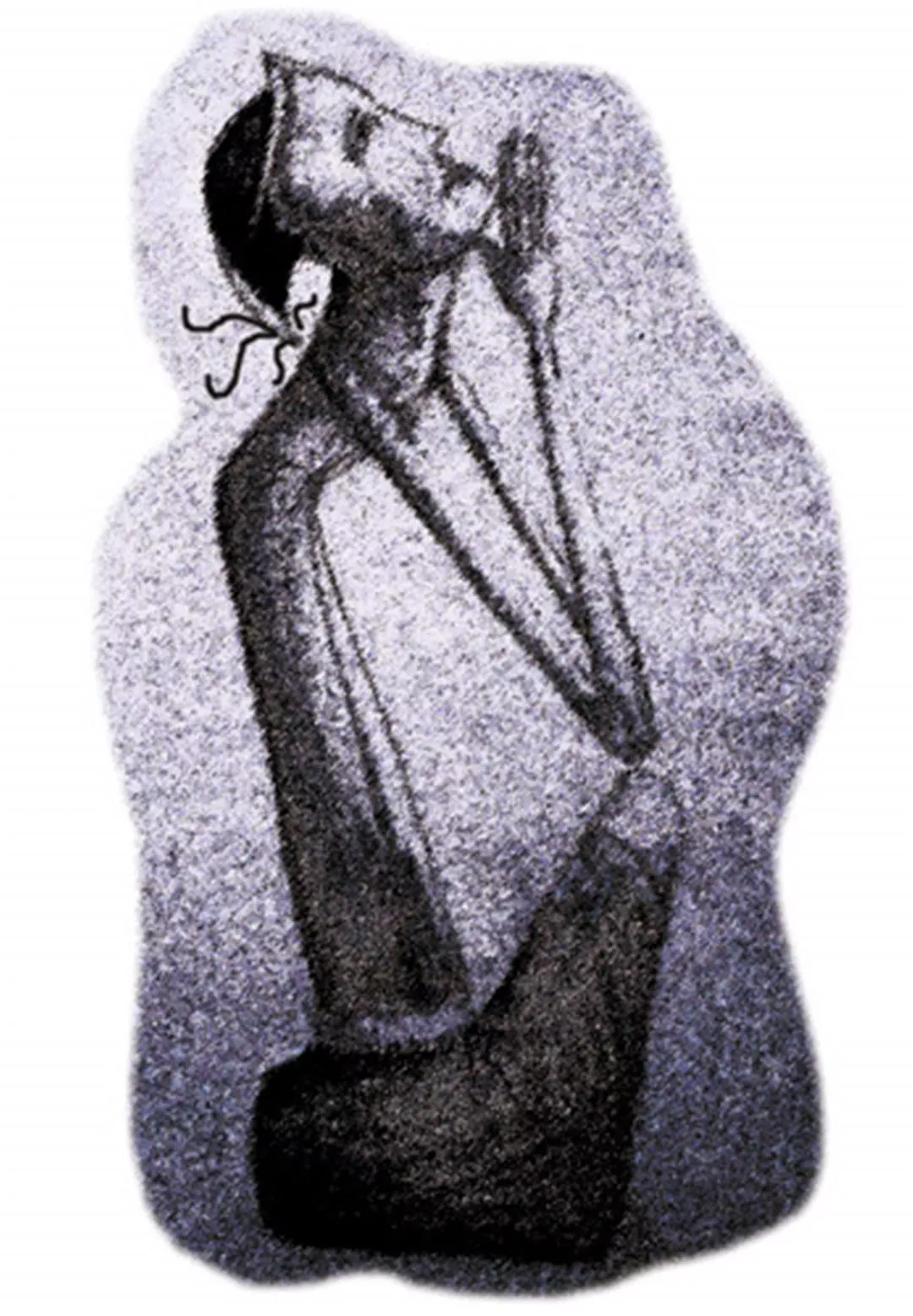
Currently in Taiwan, only National Taiwan University Hospital offers in-patient care for anorexics. However, it mostly treats severely afflicted patients with a BMI below 15. (BMI-short for "body mass index"-is calculated by dividing body weight in kilograms by the square of height in meters. Normal values for women are between 18.5 and 24.)
Voluntary starvation
In the past, losing weight was done for health reasons. However, in recent yers the "normal body weight" has been continually revised downwards. A lithe entertainer weighing just 45 kilos loudly proclaims herself too fat in the media. And there are stars who teach everyone how to diet, or even fast, even as they proudly boast of how they endured many days of eating nothing in order to achieve their "beautiful" 40-kilo frame. Through the media, these deceptively reasonable ideas about weight loss have become ingrained among youth. If an intense desire to diet happens to coincide with a vulnerable personality, it can easily lead to that person becoming anorexic.
Looking at Western countries, anorexia was prevalent to a shocking extent even earlier. Seven or eight years ago, the purveyors of the youth-oriented Calvin Klein brand of clothing used a rail-thin model to advertise their products, winning the approval of anorexics, who believed themselves to be at the cutting edge of fashion. Two years ago, so-called pro-ana websites that stress the importance of being very thin began to proliferate. They urged everyone to avoid eating for three weeks, listing various types of weight loss methods, from taking laxatives or diet pills to using enemas, and not even neglecting such details as how to self-induce vomiting.
According to research conducted abroad, most anorexics share similar characteristics: girls who are originally obedient, submissive, and not opinionated, but who become irritable and bad-tempered as their anorexia worsens and hormonal imbalances occur. Some anorexics have other people who are afflicted in their family, and there are cases where sisters receive treatment for anorexia at the same time. However the question remains: does anorexia result from genetic factors or the influence of the environment? There is no definitive answer at this point.
It has only been in the past ten years that the health care field in Taiwan has seen resources devoted to research on anorexia. The problem is that, faced with a patient with drastic but unexplained weight loss, internists typically look only at physiological disorders when seeking a diagnosis, but cannot discern the true cause: the patient's refusal to eat.
Chen Kuan-yu, director of the Department of Psychosomatic Medicine at Taipei City Hospital's Songde Branch, has treated approximately 300 patients with eating disorders over ten years. He indicates that 95% of the anorexics he has seen are female, with ages ranging from as young as ten to the mid-30s. The most vulnerable group is women aged from 12 to 18, a time when young girls are most obsessed with their appearance. For every 200 teenage girls, there may be one anorexic, and it is estimated that in Taiwan as a whole, there are likely over 10,000 people suffering from anorexia-a situation that merits attention.

Physician Tseng Mei-chih says that many anorexics are also addicted to various types of diet medicines and even laxatives. Unable to self-induce vomiting, they must rely on medication to expel food from the body.
Inside the mind of an anorexic
From a sociological perspective, there is already a long, tragic history of women who have harmed themselves in an effort to make themselves more beautiful and to please others. Anorexia is simply a more extreme, more serious form of such practices. As for why women choose anorexia, besides the unbearable pressure that society puts on women by inculcating the misguided belief that they must make themselves thinner, "women often habitually use eating as a way to relieve stress and deal with unpleasant feelings. Therefore, women who suffer from eating disorders are particularly common," points out Tseng Mei-chih, a physician in the Department of Psychiatry at National Taiwan University Hospital.
Moreover, it is very difficult to discover in the early stages that someone is anorexic, as their appearance may be normal and they may be quite vigorous. Although overly thin, they are often the envy of their peers. "These women may dress chicly, and be very health-conscious. For example, they may eat only boiled greens or salad, or exercise frequently, and therefore are looked upon as fashionable people with a good understanding of healthy living." Chen Kuan-yu points out that because anorexics believe themselves to be "thin to just the right degree," and greatly enjoy this sensation, they will not acknowledge that they have a problem.
However, behind the beautiful facade, the anorexic's secret mental world is in disarray: they are usually not close to their families, having a dysfunctional relationship with their parents. In particular, the father is often missing, or in emotional terms is a distant and detached bystander. There are also some anorexics whose parents were overprotective, or whose homes were filled with constant conflict; or, conversely, their families may have seen no conflict at all, with an artificial sense of harmony concealing a tense atmosphere. These types of life background, combined with the anorexic's own emotional makeup and personality, finally cause distress to the anorexic. Because they do not know to whom they can turn for help, they focus all their unhappiness on their own weight.
Some use their anorexia as a form of rebellion against their parents, or even manipulate their own body shape to declare that they are no longer their parent's possession. Some girls who lack self-confidence become habituated to using their appearance to gain the approval of elders and peers. There are also scholars who believe that some ano-rexics use their illness to reverse their physical and emotional development, as a way of avoiding the responsibilities of adulthood. Additionally, some models or other people working in the entertainment industry fall victim to anorexia because their profession calls for them to stay thin and there is a prevailing sense that "everyone is doing it."
Although the motives and objectives that underlie anorexia are not completely alike, victims share characteristics such as a desire for perfection while simultaneously lacking self-confidence, possessing amazing persistence, and having difficulty in maintaining intimate relationships. Their use of extreme dieting methods in order to achieve weight loss goals gives rise to anxiety, which subsequently leads to ailments such as depression and compulsiveness, or even self-injury and suicide.
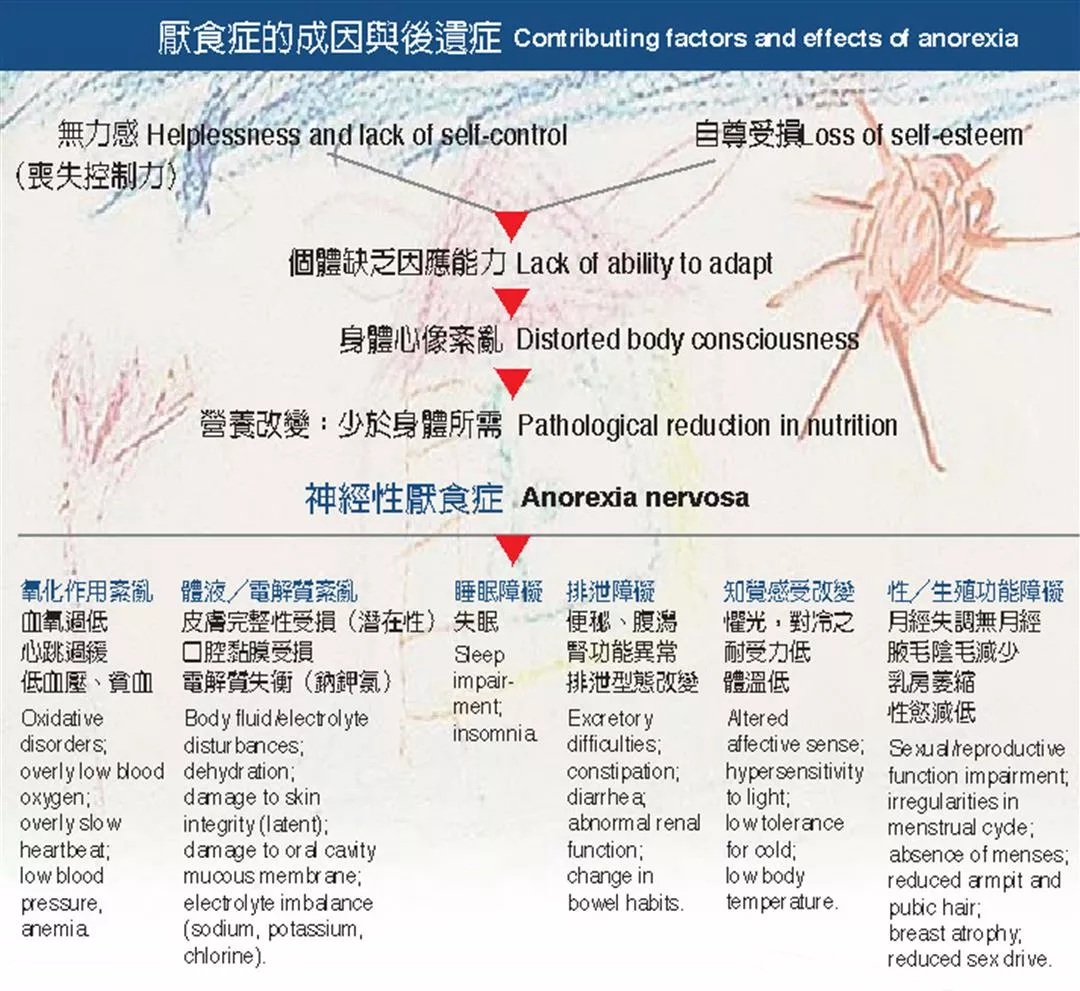
Contributing factors and effects of anorexia
Source: Kingnet Second Opinion Web Hospital
Sudden death
Generally speaking, anorexia can be divided into two types: restricting and purging. Restricting-type anorexics dislike eating, and when their condition is severe may be unable to accept any food at all. Purging-type anorexics do not reject food, but feel deeply guilty after eating, using their fingers to induce vomiting and purge the food they have just consumed.
"Anorexia generally appears only after a long period of suppression, when the person is suddenly faced with a situation that induces heavy stress. About half of anorexics also display binging," says Chen. Transferring schools, separation from one's family, physical illness, emotional pain-these are all possible proximate causes of anorexic behavior. Some anorexics may suffer from the disorder for as long as ten years before seeking treatment, while others may be persuaded to do so after a few months. However, for an anorexic to have the motivation to seek treatment, she must recognize that she is indeed ill.
Chen Kuan-yu points out that anorexics reduce their food intake day by day, so that an extended period of time is needed before family members realize that the victim might have become too thin. Although there are cases where an anorexic's body weight suddenly drops by 15% or more over just a few weeks, the medical profession uses three or more consecutive months without a menstrual period as one of the diagnostic thresholds for anorexia. Furthermore, patients with severe anorexia may die from excessively low levels of potassium in the body. This type of death without warning is the most frightening aspect of anorexia. (See figure.)
By the time signs of anorexia appear, the patient's physical health has usually already been severely compromised. Because she has eaten too little, often limiting herself to liquefied food, the anorexic may suffer from such physiological problems as dry skin, anemia, osteoporosis, swelling of the joints, low blood pressure, slow heartbeat, sensitivity to cold, brittle fingernails and hair, and the absence of menses. Patients are repulsed by their love/hate relationship with food, and dislike themselves for furtively gorging themselves and then self-inducing vomiting. Consequently, quite a few anorexics also suffer from depression.
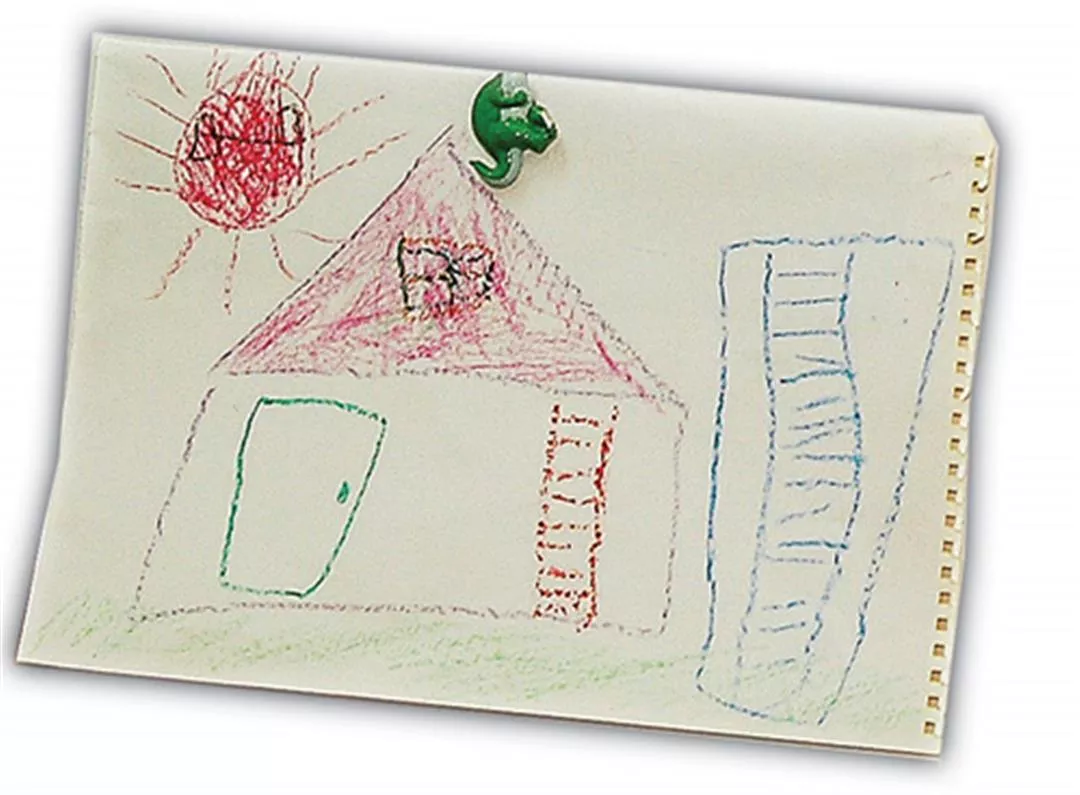
A test of wills
The clinical course of anorexia nervosa varies greatly, with most cases showing fluctuations between periods of improvement and worsening. In a minority of cases, there may be an acute deterioration leading to death, but there are also cases of nearly total recovery. Most research shows that the recovery rate for anorexia is around 30%, with a 5% mortality rate for patients who have suffered anorexia five to eight years. The death rate for patients with a history of more than 20 years of anorexia is 13 to 20%.
At present, medical experts generally believe that the reason anorexia is relatively difficult to cure is that it is simply a pathological variant on the perfectly normal desire to control one's food intake, and many anorexics cannot acknowledge that they have crossed the line. In contrast, bulimia, which is another eating disorder, is recognized even by sufferers as being abnormal behavior, and they therefore respond better to treatment.
Chen explains that bulimia is an eating disorder in which patients show addictive or compulsive behavior concerning food. They often use binge eating to relieve stress, but subsequently regret their behavior and purge themselves of the food by inducing vomiting. To be diagnosed as bulimia, this behavior must occur at least twice a week and continue for three months or more. Because vomiting normally occurs only when someone is sick, and the upward flow of stomach acid causes painful irritation to the esophagus, it is easier for the bulimia sufferer to acknowledge that she has a problem and therefore accept treatment.
On the other hand, dieting is something that society encourages and that is prevalent. Anorexics may simply feel that they have superior willpower, so they are loathe to admit that a problem exists. Because of this, it is very difficult to find anorexics who voluntarily seek medical treatment, and their recovery rate correspondingly tends to be low.
Treatment for anorexia consists chiefly of one-on-one counseling or family counseling. Although some hospitals tried using group therapy, these efforts were abandoned because it was difficult to gain the assent of patients. For more severe cases, partially forced feeding during hospitalization provides better success rates. Currently in Taiwan, only National Taiwan University Hospital offers a relatively specialized team for in-patient care of anorexics.
The main reason for hospitalization is usually that the parents find themselves at wit's end attempts to persuade the child to eat have been defeated by their child's resistance, and they therefore seek the hospital's assistance. "Parents don't usually have the heart to force-feed their children, so home treatment is not very effective," says National Taiwan University Hospital's Tseng Mei-chih. Anorexics are usually teenage girls, and they are still highly dependent on their parents, so that if parents can set clear rules for the anorexic child who likes to socialize-for example, that unless she gains at least two kilograms in a week, she will not be allowed to go to school or to go out with friends-it will be effective in motivating her to eat.
"Unfortunately, we often see families with a recalcitrant child and tentative parents. Because the child resists furiously, the parents are forced to yield, and the best opportunity to successfully treat the anorexic is missed," says Tseng ruefully.
The first meal is the hardest
Under these circumstances, the advantage of a hospital stay is that it allows nursing staff to have control over the anorexic's actions and food consumption. Before hospitalization, the doctor will discuss three areas with the anorexic: the setting of a goal for weight gain, the requirement that three meals be taken regularly, and the nutrition and calories absorbed from the meals. Only when an anorexic meets the requirements discussed will the medical staff let her go out or engage in other social activities. During meal times, a nurse will be on hand to monitor, and if the patient is prone to engage in self-induced vomiting, will strictly restrict the patient from going to the bathroom in the hour after eating.
"The first meal is always the most difficult," says Tseng. Because they have eaten only liquefied food for a long period of time, anorexics usually have great difficulty in accepting solid food the first time. Some anorexics must first ingest high-protein liquid nourishment to replenish essential nutrients. For the few unusually uncooperative patients, if their condition deteriorates to a certain level, the hospital may consider forced tubal feeding.
"While in the hospital, we will discuss the relationship between the patient's weight and stress or family issues," says Tseng. Anorexia is the result of a number of complex problems, so that there is no possibility of using a single dietary approach or medication to treat it. What is required is concurrent "behavior therapy"-such as helping the anorexic to realize what other people really think about her body's appearance, and thereby overcome the erroneous image she has of her own body; and also allowing her to understand the harm that anorexia or bulimia inflicts on the body. Anti-depressant medication can be used with patients also suffering from depression, not only improving the anorexic's emotional state, but also promoting weight gain as a side effect.
"It is impossible to say how long any given patient should be hospitalized. Some patients are in and out of the hospital many times. But in any case, follow-up tracking shows that about two-thirds can gradually return to healthy eating habits after completing hospital treatement," says Tseng.
Each patient progresses at a different rate, and there are many variables. For example, some individuals can't break away or escape from dysfunctional interpersonal relationships, and others are unable to change behaviors such as spending money wastefully or lying. Patients such as these must come back for continuing outpatient visits. Another key is family support. "If a child is lucky enough to have responsible parents, she will have the motivation to continue treatment and finally get on the path to recovery."
"Thin is in" seems to rule the day. Fashion display windows are filled with clothes that are a size too small and that reveal every curve, strongly conveying the message that it is important for women to slim down.
Getting to know oneself again
"Other non-language therapies such as art therapy are also very important, and can help anorexics to get reacquainted with their bodies and learn how to express their emotions," points out Chen Kuan-yu. It may be hard for most of us to understand, but the fact is that anorexics ignore what their bodies are telling them, simply disregarding the anguish of long-term hunger, until they virtually lose all sense of reality about their bodies. Even if the doctor places an object on their body, they feel nothing.
In like manner, under the influence of powerful repression, anorexics forget how to express their emotions appropriately. Therefore, outside Taiwan, approaches using such elements such as music, dance, and sculpture are used to help anorexics get reacquainted with and facilitate expression of their sense of their own bodies and emotions.
Regrettably, there is a severe shortage of medical personnel in Taiwan, and a shortage of professionals with experience in caring for anorexics in particular. General resources for behavior and psychological therapy are even more deficient, not to mention such specialties as art therapy.
"Foreign doctors receive training in both psychosomatic medicine and psychiatry, making them better equipped to provide appropriate assistance to anorexics," observes Chen. Originally an internist, Chen later gained admission to the advanced program in psychosomatic medicine at Germany's Freiburg University, subsequently discovering that foreign medical students spend two to four times as much time studying psychological and social problems as medical students in Taiwan, very few of whom pursue a multi-disciplinary curriculum. Therefore, GPs at the front line of the health care system generally lack the ability to recognize anorexics, while there are not enough psychiatrists to handle the demand for integrated somatic and psychiatric therapies.
It also doesn't help that the National Health Insurance program pays too little for clinical visits in comparison to major procedures like surgery, so that most hospitals neglect their departments of psychiatry. There is clearly a great deal of room for improvement in the treatment of anorexia within Taiwan's medical care system.



Physician Chen Kuan-yu suggests that the importance placed on physical appearance and youthfulness in Western conceptions of the body are perhaps the main reasons for the increasing numbers of anorexics.

"Thin is in" seems to rule the day. Fashion display windows are filled with clothes that are a size too small and that reveal every curve, strongly conveying the message that it is important for women to slim down.



@List.jpg?w=522&h=410&mode=crop&format=webp&quality=80)
