

At a time when The Frog Prince and Snow White are long out of style, and Sleeping Beauty and the Monkey King have been blown asunder by the gales of globalization, a new generation of children's books, addressing various social issues, have come forward with a fearless innocence....
Mention children's books (those primarily targeted at ages 15 and under), and the general notion that springs to mind is that of warmth and inspiration, with the subject matter confined to the home and school life so familiar to children and teens. Even the popular "Harry Potter" series, though filled with magical elements, still retains school as its setting, following the traditional formulas of children's literature with themes of adventure, growth, and the struggle of good versus evil.
Such self-censored subject choices and writing styles can no doubt shield children from excessive exposure to the hurly-burly of life, but the social reality outside children's books is, after all, not so glamorous, what with numerous conflicts and contentions already quietly affecting children's lives. These include drugs and pollution, which can seriously damage children's health, as well as problems like unemployment and debt which affect the lives of adults and inevitably pull children along into the morass.
At the same time, just as an individual cannot avoid being part of society, the origins of many of the problems children face in their lives can perhaps be traced to social structure, such as their parents' divorce, competitive pressures in the workaday world, and the weakening of family bonds. Problems adapting to school life may also be connected to issues like school systems and the distribution of educational resources. But most children's books of the past stop at psychological coping skills and developmental stages while sidestepping certain background structural elements to imperceptibly "desocialize" social issues. This greatly diminishes children's abilities to truly deal with problems.
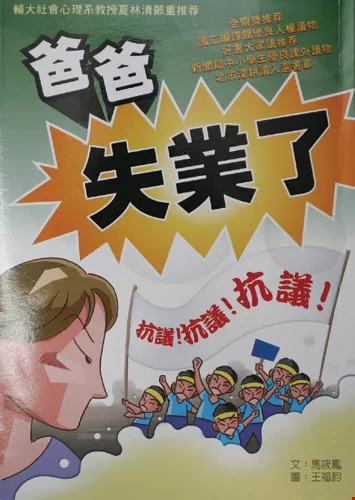
Happily, the tendency of children's books to avoid the serious and embrace the safe has met with challenges in recent years at the hands of certain authors and publishers. A representative example is Daddy Lost His Job, published in 2005 by Little Soldier Publishing, which deals with labor issues.
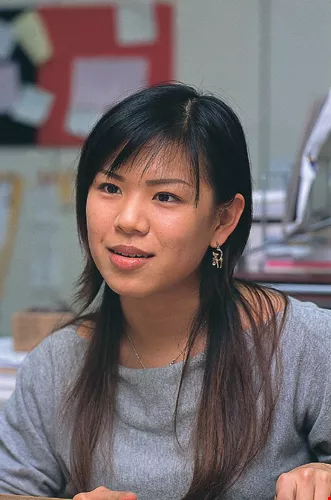
Chang Ya-han, who started working as an editor for a publishing house upon graduation from National Taiwan Normal University, is a recipient of a Golden Tripod award for Best Editor. More recently she has been writing, earning excellent reviews.
A child's perspective on job loss
This book is about Hsiao Li, a child from a working-class household. The textile mill where her father works is closed down maliciously, and the out-of-work employees occupy the factory in protest, demanding their jobs and pensions back. The story is about Hsiao Li's concern for her father and gradual understanding of the work situation and life history of textile workers, and also learning how to marshal people power to counter corporate oppression, producing a clear experience with social justice. It's a realistic social lesson not generally taught at home or in school.
This book presents many details of the lives of textile workers in Taiwan. For instance, throughout the factory one sees the slogan "90 steps a minute," revealing the frenetic pace of work required of employees. The book discusses the fact that, due to poverty, many female workers drop out of school before completing junior high and leave home to work; it conveys the joys and sorrows of dormitory life as they share communal meals and communal showers; and it unveils occupational hazards such as hearing loss from factory noise and lung disease from dust inhalation. These are lifelike scenes not found in your average children's book.
The mother in the book, in particular, is shocked at first by her husband's sudden job loss, but then conflict develops between them when she vigorously opposes her husband "wasting time" taking part in the protests, and while coming to accept the situation she remains filled with anxiety, often flying off the handle from the stress of looking after her two children. These scenes, which frequently play out in working-class families, are presented forcefully in the book, so that young readers can experience the plight of out-of-work households and learn how to view their parents' negative feelings such as anxiety, anger and fear, and transform such emotions into opportunities for parent-child communication.
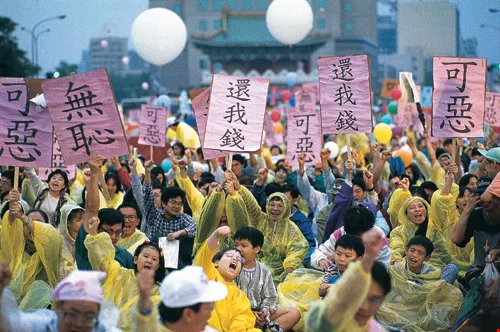
In today's complex and changing society, children often bear the brunt of social problems. Their faces can be seen at protest marches of all kinds.Shown here is a protest held on September 27, 1999, and organized by the National Teachers' Association,in support of preserving the minimum education budget in the constitution.
Telling "our" story to kids
Many of these poignant details come from author Ma Hsiao-feng's personal experience. Born and raised in a working-class family, she worked part time in factories, a bakery and a laundry, and also as a street vendor while growing up. When she later served as a journalist, the owner of the newspaper company she worked for shut down operations with the intention of stiffing the employees of the severance pay they were due. Mild-mannered Ma thus had her first experience demonstrating in the streets. Thereafter, at the invitation of the Taipei City Department of Labor Affairs, she co-edited the book The Life Stories and Protests of Shinkong Textile Workers. During the book's development, she formed the idea of writing realistic books for children to read.
"There were a lot of children on site at the Shinkong protests, and I often brought my own 12-year-old daughter along to take part in the marches. But when I explained the meaning of the labor movement to her, I realized there wasn't any suitable reading material, so I thought I might as well write something myself," she says.
Ma, who by now has had seven books published, says frankly, "This is not a happy book, and some have even said they had a bad feeling upon seeing the title Daddy Lost His Job." But thanks to word of mouth and recommendations from campus book clubs, the book has sold 7,000 copies since its release in 2005.
"People have told me they were sobbing as they checked out the book in the bookstore because the experiences described in the book were similar to their own, and for this reason they bought it for their kids to read," says Ma. But even though many people worry that this kind of subject matter is too heavy for children, Ma carefully weaves humorous dialogue into the narrative. Furthermore, the overall tone is kept positive, active and gentle. Consequently, it has received the approval of many parents. And the acceptance rate of young readers is also very high, inspiring them to learn more about the topics of pension, severance pay and labor standards legislation discussed in the book.
Indeed, because of their innocent thinking, children are usually able to look at social issues like job loss and protest rallies easily without bias. Adults, on the other hand, have been around in the real world for years, becoming set in their ways, making it hard for them to rid themselves of ingrained ideas such as "worker's rights advocates are nothing but troublemakers" or "it's futile to stand up to your boss." The effects of this book on adults might not be as strong as on children.
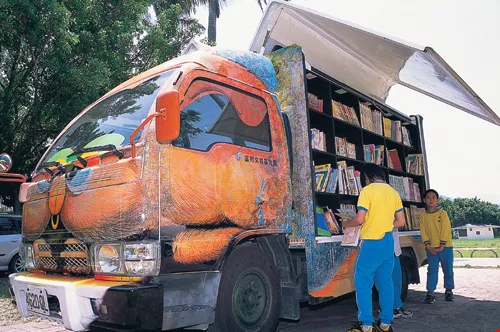
As the boundaries of the subject matter expand, the gap between urban and rural children's book readership needs to be bridged. Shown here is a mobile library sponsored by the Fubon Cultural and Educational Foundation, bringing books to local children in Chutung Township, Hsinchu County.
Think globally, act locally
Thanks to years of effort by environmentalists, environmental consciousness has grown considerably among Taiwan's populace. Community movements have also been following the trend of localization, broaching issues like nature conservation and concern for local culture, and many children's books on these subjects have come into vogue. The majority of them are translations of existing works, but local works are also gradually coming to the fore.
The Old Tree Is Weeping, winner of the 13th annual Chiu Ko Publishing award for children's literature, employs Taiwan's currently burgeoning community movement to explore the relationship between people and the environment. The book is based on the true story of the 1999-2000 reconstruction of Wenchang Park in Taoyuan. Author Hsieh Hung-wen at that time hosted a radio show in Taoyuan, and through long-term observation of community cultural and historical activities, his radio reports and personal participation bear witness to the government's "urban beautification" attempts, which ignored the practical needs of community residents and existing local cultural and historical heritage as it strong-armed the felling of an old tree and the renovation of the park.
This book is written from the point of view of a junior high school student, realistically describing the process of this community movement from its origins to its ultimate failure, comparing the circumstances before and after the renovation, and depicting the impact on different park users, such as ordinary residents, elderly folks, vagrants and even prostitutes. Though the written style of the book is slightly awkward, it clearly communicates that the issues of park planning and whether or not to remove an old tree are not simple questions regarding physical objects and administrative technicalities, but involve veins of thought including memories, historical value and the lives of real people, which are helpful in eliminating bureaucratic thinking and fostering cultural concern. And the feeling of closeness to the people and the locale in this local work is more infectious and deeply felt than in translated works.
What about sexual identity?
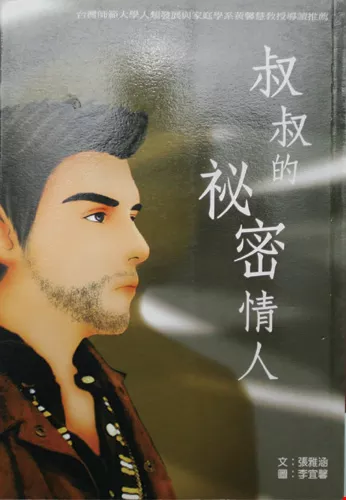
In 1973, the American Psychiatric Association removed homosexuality from the Diagnostic and Statistical Manual of Mental Disorders, officially acknowledging it as normal human behavior. Despite this, in conservative Taiwan there are still many who believe homosexuality to be an illness and find it hard to accept it when they find their own child is gay or has transgender tendencies. In 2006, Little Soldier published a teen novel, Uncle's Secret Lover, which delves into the highly explosive issue of sexual identity.
The book cleverly sets the main character as a junior high school student, who is still exploring his sexual identity, observing his gay uncle as he makes a psychological journey from extreme secrecy toward being compelled to come out of the closet, and the tortuous development of the family elders from initial shock and strong resistance toward a final softening of attitude. This allows young readers to understand the numerous family and social pressures facing gay people.
While this is going on, another emotional thread in the book follows the protagonist's struggles with his own sexual orientation, describing his feelings for another male character, which he denies and represses for fear of being "abnormal," even joining in with his classmates to bully a "sissy-boy" classmate and resorting to violence to prove his manhood. As he faces the reality of the homosexuality of his uncle, who he had always idolized, he finds this too hard to accept at first, but his mind gradually opens after he hears a doctor's explanation. In the end, the boy has an open and frank talk with his uncle, leading him to realize how to deal with these multiple sexual identities, and is no longer hesitant to explore his own sexual orientation.
Due to the controversial nature of the subject, many children's book writers turned down the opportunity to write this book while it was being planned. But since sexual identity is an issue that teens frequently grapple with, Chang Ya-han, a former planner and editor, boldly took on the duty of writing the book at the behest of numerous schoolteachers.
This was her first time as a writer, so 80s-born Chang did extensive homework, even venturing far into the gay community to better comprehend the realities of their lives. She repeatedly meditated on the plot criteria, striving to present the material realistically and accurately while also seeking a balancing point of acceptance by parents and teachers. On its first publication it received a 2007 Human Rights Publication Award, and now it's in its third printing, a gratifying achievement.
Gender, class and ethnicity
Taiwan's rich and varied ethnic culture has served as an important source of material for literary works of all kinds, children's books not excepted. Aboriginal subjects are one of them. Past works mostly focused on the idyllic charm of Aboriginal village life and depictions of exotic culture, but there was little about the "urban Aborigines" who move to the cities in search of work. But Goodbye, Bridge, Goodbye, winner of the 2001 Chiu Ko award, breaks this new ground.
In the book, a little girl from the Sedeq tribe recounts the life of their family who followed their father from a mountain village to the big city. With no money to rent an apartment, they set up a tent in one construction site after another as temporary housing, before later moving to a shanty under a bridge by a river at the edge of the city. There they met other destitute Aborigines and together they created a simple "bridge village." Finally, due to the lack of work in the city and police harassment, they moved back to their mountain villages. The story is very moving: apart from its happy ending, the story reconstructs the characteristic struggles of the urban Aborigine to make a living. Author Wang Wen-hua makes extensive use of Aboriginal self-mocking speech patterns in the narrative, lending the reader a sense of amusement amid the sadness.
For instance, the girl describes life at the building worksite, with no utilities available, as follows:
The new building was still being built. It had no water or electricity, and even in the daytime it was pitch dark inside. My brother and I rushed to do our homework before sundown, lying on our fronts beside the balcony to finish it in the last snowflake-like glimmers of sunlight. My teachers always complained about my ugly handwriting. I remember my third grade teacher liked to watch me, shaking his head, saying, "Tang-tang! You're a cute kid, but your handwriting... your handwriting... looks like chicken scratches!"
"Chicken scratches?" I looked at my writing: the characters were big and fat, each stroke wanting to break outside the bounds of the box. Maybe it had to do with my position when writing: when I write I need to lie on my belly on the floor of the balcony, and who can write well when you're lying on the floor?
Sometimes our whole family gathers on the balcony at night to look at the city lights, and Dad will say, "We live in a new building every day. Aren't we lucky?"
"If we stayed in a building where the walls block the sun, we wouldn't have such a beautiful view," Mom would say.
Wang, who has had over 40 children's books published, taught in a Sedeq village in Nantou County for many years. Having worked alongside his studies while growing up, he made many Aboriginal friends while working in factories and on construction sites. After the 921 Earthquake of 1999, he, also a victim of the disaster, came upon a settlement of urban Aborigines in Taichung, and the idea of using them as material for writing was spawned. The book describes the lives of destitute Aborigines working in the lower echelons of physical labor and living in illegal shanty towns, a problem that even now exists in many parts of Taiwan-in Taipei County alone there are Hsichou Village, Huanho Village and Sanying Village-but in the book market it's nearly impossible to find material about them. Instead, this little children's book has become a mouthpiece for the aspirations of the urban Aborigine.
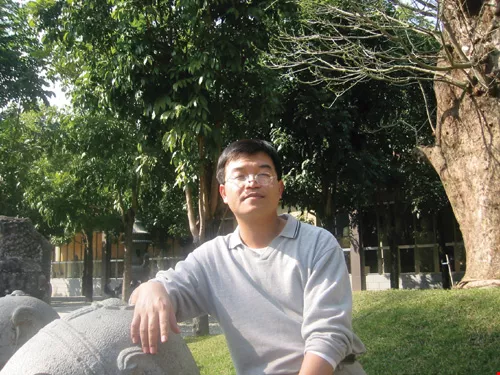
Unlike another Wang Wen-hua (Morton Wang) in the world of popular urban fiction circles, this Wang Wen-hua is skilled at writing children's books. Wang grew up working while studying, gaining exposure to people of all social strata in Taiwan. His rich experience has been a copious source of material for writing, and his long-term service as an elementary school teacher has given him a profound grasp of children's intellectual growth.
Understanding newcomers
Beyond the long-extant issue of urban Aborigines, the subjects of foreign spouses and foreign labor have become the most contentious new issues in the last decade or so in Taiwan.
Liu Mei-yao's After Peeling the Tangerine, recipient of the 12th Chiu Ko award for children's literature, deals with the issue of mainland Chinese spouses in Taiwan, which has become increasingly pervasive since the opening of cross-strait relations. Compared to other foreign spouses, those from China, due to the cross-strait political standoff, are often forced to bear looks of doubt and suspicion. While traveling in China the widowed grandfather of Hu Min, the book's protagonist, marries a woman from Sichuan young enough to be his daughter. At first the neighbors endlessly gossip, spreading rumors that she came to con him out of money. Even Hu Min's father is unable to abide the situation, and due to different living habits there is a great deal of additional friction. But after many twists and turns, the whole family finally accepts this "new grandma."
Besides this main storyline, the author also deals with Hu Min's friendship with a new classmate from the United States, Fan Chih-an, developing another storyline. Her father is a Taiwanese man who went to work in the US, and her mother is a woman from Vietnam who grew up in the US after being adopted during the Vietnam War by an American soldier who was guilt-ridden about his involvement in wartime massacres. Due to the effects of the Agent Orange sprayed by the US Army during the war, Fan's sister was born without hands or feet and is mentally retarded.
By interlacing and advancing these two storylines, the author expands the scope of the narrative from the framework of the traditional issues of foreign spouses and cross-strait divisions to a broader commentary on the Cold War and international affairs, and makes connections to the Vietnam War experience. Such originality and depth is refreshing. The book's strong critique of wartime invasions, inequality among nations and interpersonal prejudices, and the contrast set off by the key symbolism of the tangerine and the orange, are particularly moving.
My Auntie Lisa, which won the 14th Chiu Ko children's literature award, is the first children's book to attempt to deal with the issue of foreign nannies in a major way.
Author Cheng Cheng-chun uses a slightly exaggerated writing style, using child-like language to describe a family of four with both parents busy working, and the changes that take place after the arrival of their Filipina nanny named Lisa. The author vividly describes the gradual substitution of "Auntie Lisa" as the primary mother figure. Starting with simple planning of the children's daily lives and helping the children with their homework, she graduates to assigning household chores, and even attending school meetings in place of the parents. Thus Lisa slowly takes over the role of mother. As she wins the children's trust and dependence, the real mother becomes quite anxious.
For instance, when the mother is away on business, she finds time to return home hoping to surprise her children, but she finds that Lisa has made a full schedule of activities, and the children react coldly to their mother's unexpected gesture. Disheartened, the mother goes away, but Lisa asks the children to write thank you cards to their mother, bringing an end to the stalemate.
Cheng states that the intention of the book is to satirize neglectful parenting in Taiwan, but this style of writing may evoke a sense of crisis in parents, even leading to wrong conclusions on how to set boundaries for a nanny's responsibilities, indirectly increasing the control that an employer has over a domestic worker. Caution is important.
Lan Pei-chia, a professor of sociology at National Taiwan University, has studied the lives of domestic workers for a long time. She points out that this kind of condemnation for neglect of duty often misses the point, because patriarchal ideology still places women in charge of childcare and housework, causing mothers to feel moral anxiety, so that they in turn attempt to increase control over the nanny (also a woman). If the father is endowed with the same responsibilities, and if caring for the next generation is seen as a social responsibility and supported by national policy, then the misgivings of the mother in the book might be mitigated.
Indeed, says Lan, "It's not a bad thing for nannies to share household responsibilities, so there are more people taking care of the children. But domestic workers are often not treated as equals, leading to overt classism, racial discrimination and oppression within the household, forming a harmful example for the children. This is the area we need to worry about most."
Social issues pervade kids' lit
Despite the good sales in Taiwan of the above books, children's books dealing with social issues have not become an overall trend. But Hsu Chien-kun, an associate professor of Chinese literature at Tunghai University who specializes in children's literature, says, "Children's books on social issues have long been a major trend in overseas children's books," including a dazzling array of books recently translated for Taiwan's market like Junk, which realistically presents the drug use process; The Hole, which explores prison administration problems; Steingesicht, which boldly depicts gay sexuality; and A Door Near Here and Bud, Not Buddy, which critique the foster care system and child abuse problems.
"Parents in Taiwan are used to seeing children's literature as candy for their kids, habitually tending toward non-controversial subjects. But little do they know that children learn about the many darker aspects of society from TV news broadcasts or first-hand experience. Recently children's literature has begun to deal with social issues, teaching children how to handle problems and instilling the values of compassion, fairness and adherence to their ideals. This is worthy of strong promotion," says Hsu.
Crossing boundaries
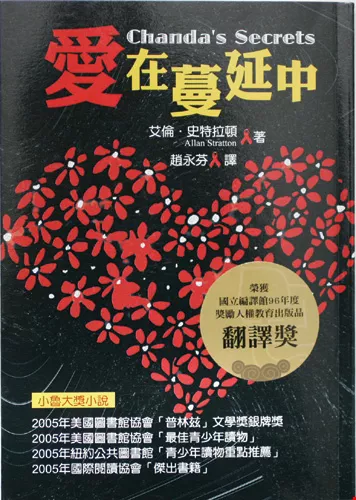
Because of the importance of the subject matter, plus masterfully executed writing, many overseas children's books on social issues are aimed at the general population, spanning age boundaries. For example, Chanda's Secrets, translated and published by Tien-Wei Publishing Company and dealing with the AIDS problem in Africa, and The Book Thief, which in Taiwan was pitched as a work of popular fiction and became a bestseller, were originally categorized as teen novels overseas, winning numerous children's literature prizes, but the readers were not limited to youngsters.
Hsu notes that the spread of readership across age groups and the blurring of boundaries between issues of concern to children and adults is a sign of social improvement. "We should squarely face the comprehension skills of children and dispense with the ingrained notion that children's literature should be innocent and simple," says Hsu. Naturally, since children are more fragile than adults and teens may be quite rebellious or moody, lacking the judgment and tenacity to cope with complex problems, children's books when dealing with social issues should still convey the positive values of tolerance, courage, sympathy and humor which are considered passe in adult literature, especially not wallowing in doubt and malcontent, thus preventing children from losing hope and the confidence to solve problems. Otherwise what is supposed to be a "shot in the arm" would instead negate the educational nature of children's books.
In today's increasingly complex society, in which children are being drawn quickly into the adult world and we face the disappearance of the "childhood years," the appearance of children's books on social issues is an inevitability. But for adults, beyond encouraging children to read, is there any harm in reading children's books ourselves to reflect on what kind of society we are bequeathing to our children? Or thinking about how we and our children can change society together? Surely this is the most serious topic raised by these revolutionary children's books.


@List.jpg?w=522&h=410&mode=crop&format=webp&quality=80)


