Treatment for the AilingDoctor-Patient Relationship
Chang Chiung-fang / photos Jimmy Lin / tr. by Jonathan Barnard
April 2005


Doctors complain of rising conscious- ness of patients' rights, and patients accuse doctors of losing their medical ethics. Neither side is happy with the way things now stand.
Rather than longing for the good old days, doesn't it make more sense to look to the future? A new era requires a new doctor-patient relationship. How can mutual understanding foster new rules for the game and new ways of relating to each other? Like an unhappy married couple, doctors and patients need to experience a second spring and start to hold hands again. Doctors, patients and the government all need to think carefully about how to reach this goal.
The Large White Tower, a popular Japanese TV serial in which doctors are portrayed as competitive schemers who often neglect their patients, and a string of well-publicized doctor-patient conflicts, have made the relationship a staple of conversation. Although viewers have often found that the Tower's portrayals of the medical world ring true to their own experiences, some members of the medical community are enraged about it, holding that the drama slanders the medical world unfairly.
Let's not debate how much the show differs from the real world. It's enough to say that in the eyes of most people the medical world is like a tower-lofty and unapproachable.
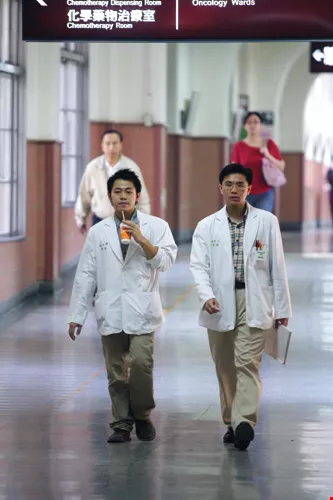
Medical education reforms need to start from selecting the right candidates to be doctors, as humanity is one thing that cannot be taught.
A revolution in the tower
Fortunately, however removed or unapproachable the tower may be, there are quite a few good people within it who are standing up and calling for a revolution.
"The Taiwanese medical world needs comprehensive reforms," says Andrew T. Huang, president of the Koo Foundation Sun Yat-Sen Cancer Center (SYSCC), who has repeatedly made such calls.
Where do you start? "First of all, you've got to pick the right people to be medical students," states Huang, who doesn't mince his words when stating that half of Taiwanese doctors "aren't suited to their jobs." "Picking the wrong people" is the main source of the problem.
"Doctors need to be well organized, care about other people, have logical reasoning skills, manage their time well, be good communicators, and possess a spirit and drive to get to the bottom of things. These various characteristics can't be evaluated by a written examination," Huang says. He points out that would-be medical students in the US, after taking their standardized medical school entrance exams, are interviewed for medical school. The schools can thus select people who are truly suited to be doctors. In Taiwan, on the other hand, where "one test decides all," until recently there has been no mechanism for interviews. As a result, the test selects many to become doctors who are ill suited to the profession. Although the Ministry of Education now allows medical schools to select some students by interview, the number selected in this way may only grow by 5% per year, and is limited to 30% of the total.
Huang Kun Yen, chairman of the Taiwan Medical Accreditation Council and a member of the Committee on Medical Science Education, has for several years been pursuing various channels to publicize his views on medical education.
"Picking the right people to be doctors is key," says Huang. The manufacturing industry always brings everything back to the quality of the raw materials. For the medical profession, "If the people entering it aren't right, how can you expect them to end up as good doctors?" In the essay "SARS, a Case Study: Analysis and Suggestions about Taiwan's Medical Education," Huang Kun Yen argues that medical students in Taiwan have two main problems: The first is that more than half are studying medicine on their parents' orders. Students of this kind don't have a strong sense of mission. When they become doctors, their primary concern is too often not their patients. Second, both the public and the education authorities believe examinations are the fairest way of selecting talent. But exams admit many into the medical ranks who are arrogant, poor communicators, only interested in money, or have no true understanding of what a doctor's job entails.
After selecting suitable candidates for medical study, Huang believes medical students must receive a balanced general education. Unlike American medical students, who already have undergraduate degrees, Taiwan's doctors-to-be enter medical school fresh from high school. Without the experience of a balanced college education, they end up as "medical artisans."
What's more, "strengthening education in medical ethics" and "letting clinical education take root" are two key goals that medical reformers-such as Huang Kun Yen, Andrew Huang, and Lai Chi-wan (executive secretary of the Medical Education Council)-are advocating.
"To be a doctor," says Huang, "you've got to first understand how to deal with people, and then become a professional. First study general medicine and then study a specialty."
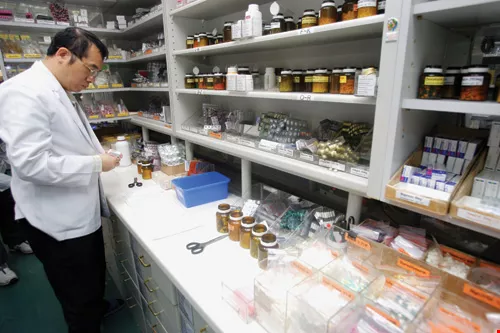
Drug errors are the leading cause of problems in medical treatment, so pharmacists need to be extra careful when dispensing medication.
Building bridges
In a peaceful revolution, concerned individuals in the medical community are quietly influencing many younger arrivals into the profession. Moreover, the arbiter in the doctor-patient relationship-the Department of Health-is supposed to be serving as a bridge between doctors and patients and can't pass the buck.
Chu Tung-kuang, deputy director of the DOH's Bureau of Medical Affairs, says that the bureau has been gradually implementing several measures to improve the relationship between patients and doctors. These have included promoting new versions of medical procedure authorizations, providing details about drugs on pharmacy bags, creating Chinese names for drugs, and making copies of simplified medical histories available.
Chu points out that although patient authorizations of medical procedures have been required for a long time, the signature from a patient or relative has long been regarded as a routine matter. Patients often haven't understood the impact, results, and side effects of surgery. They often have lacked sufficient understanding of the meaning of their authorization. And even if they had questions, they might not dare to ask them. Last year a new agreement about these authorizations was reached, and the duty of explanation was clearly assigned to doctors. To reduce the number of disputes that arise out of poor communication between doctors and patients, doctors are obliged to give patients a clear understanding of the procedure.
What's more, after several major medical malpractice cases were uncovered, the DOH established a patient safety committee in 2003, and last year drew up five major guidelines for patient safety that it required all hospitals to implement: "preventing the intake of the wrong drugs," "preventing the spread of infectious disease in hospitals," "preventing surgical mistakes," "preventing misidentification of patients," and "preventing patients from suffering falls."
Take, for instance, efforts to stop surgical mistakes. On the day before surgery, doctors put marks on the patient's body to indicate the surgery to be performed. By so doing, they both avoid performing the wrong surgical procedure and put the patient at ease. Marking is already being done for orthopedic procedures, and will gradually be expanded to all departments.
Apart from these measures to improve communication and reduce mistakes, the DOH is taking other steps too. Seeing that the number of medical disputes is rising year by year and that more of these cases are heading to the courts with more time and resources devoted to them, the DOH is seeking to facilitate negotiation between doctors and patients, providing a path toward resolving conflicts. To this end, it is currently drafting a medical disputes law outlining rules for mediation and arbitration. Only after exhausting these channels, can the parties go to court.
Holding hands
What's more, Taiwan's National Health Insurance (NHI), which provides coverage to a world-leading 97% of the population, has come to be regarded as an "unbearable burden" by the medical community, which has been steadily calling for reforms.
"The NHI system undermines medical quality," says Lai Chi-wan, a doctor in the neurology department at the SYSCC. Lai describes how he works from nine in the morning until three in the afternoon without a break to rest or eat, but can only see ten patients. Some doctors in skin clinics, on the other hand, can see 100 patients in a morning. But the NHI gives both the same per-patient compensation, whether for a first-time patient or a repeat patient. This system of identical financial rewards for different kinds of work ends up damaging the quality of medical care.
"The insurance system ought to reward doctors for doing a good job of treating their patients, and make quality of care a chief consideration," says Andrew Huang. The goal of medical treatment should be quality, not quantity.
After hospitals raised this issue with the authorities several times, the National Health Insurance Bureau (NHIB) developed its "pay for quality" plan. It aims to give another option to hospitals seeking to provide quality medical care.
Huang points out that the SYSCC treats an average of 1000 cancer patients a year, with a success rate (no recurrence within five years) of over 90% for breast cancer patients.
In 2001, the center signed a "pay for quality" agreement with the NHIB based on the effectiveness of its breast cancer care and follow-up. Huang explains that care for other forms of cancer or chronic diseases, such as diabetes and high blood pressure, might be included in this type of plan in the future.
"In treating chronic diseases, there is a chain of responsibilities, with doctors, patients and government each playing their part," says Chang Ly-yun, chairman of the Taiwan Health Reform Foundation. The responsibilities, roles, and functions of each must be spelled out clearly if one is to unravel their tangled web.
Indeed, the health care system and the medical community both need reforms, but the public cannot remove themselves from what's going on. As Andrew Huang puts it: "Medical treatment is the responsibility of doctors, but the public must be active participants."
Only by joining hands and turning enemies back into friends can both doctors and patients benefit.


