Chen Lai-hung--No Stay-at-home Mom
Layout by Wei Chin-hua Sharon Wu / photos Jimmy Lin / tr. by Scott Williams
August 2001


Known for her advocacy of "collaboration among women," Chen Lai-hung is perhaps not the most famous of the early-1990s leaders of Taiwan's women's movement, but she has certainly been one of the most active. Chen has long been an advocate for change at all levels of society, from the political down to the nitty-gritty of daily life. In the early days of the women's movement, she was involved with the Awakening Foundation and the Homemakers' Union and Foundation, and has since organized the Kanga Mothers' Reading Club and the Taipei County Books and Reading Association. More recently, she has become a strong proponent of co-ops for women. Yet, in spite of all her activism, Chen has remained a homemaker with a strong sense of the traditional role of women.
Just what kind of Superwoman is Chen Lai-hung? How can she wear so many hats with such seeming ease? Where does she find the time to do so much? What set her on this path and gives her the strength to follow it?
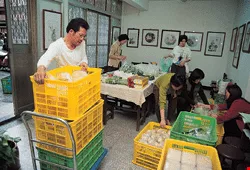
The Green Advocates Collective Buying Center in the Taipei suburb of Hsintien crackles with a feminine energy from top to bottom. The women sharing their life and work inside the 40-ping co-op are each busy with their own tasks-one woman is playing with a child, another is fixing a wooden door, a third is busy sorting just-delivered fruits and vegetables, while a fourth is quietly reading a book on painting-yet the feel of the place exudes cooperation.
A smiling shorthaired woman carrying a large box of fruit calls out to her colleague from the back garden. The woman is Chen Lai-hung.
Why? Why? Why?
Chen's age is tough to pin down from her looks, but she laughingly reveals, "I'm already a grandmother!" She is in her fifties and her children are grown, but she is comfortable with being an "empty nester." She says, "You have to learn to let go."
Chen says she plans to use this phase of her life to delve into life's big issues, to reflect on how to change herself, and to examine the approaches used by earlier social movements. "Being involved in a social movement taught me that, at their core, most social problems come down to the fundamental character of human beings. So having been part of an organized movement, having worked within a group, I've gone back to the beginning and am looking at myself." Even as a child, Chen was introspective and given to challenging anything she perceived as unfair. Chen smiles and says, "Even when I was young, I liked to think about what kind of life was best for people." As a result, she began her fight against social inequities at an early age.
Chen recalls a time in her early teens when her older brother told her that girls were supposed to sleep at the foot of the bed. Incensed almost to the point of leaving home, she demanded that her brother present a rationale. Looking back on the event, Chen says, "I believe that challenging that which is unreasonable is a force for human progress." This belief pushed her to become a social activist and still empowers her.
Chen's childhood was also characterized by a deep interest in the world of philosophy, and she spent much of her youth slogging her way through seemingly impenetrable texts: "I always had my head buried in some abstruse philosophical work. I almost drove myself crazy trying to understand them!" Today, she is fond of quoting the philosopher Alan Watts, who held that we are not born into the world but are produced by it, as a tree produces a leaf or the ocean a wave. Chen says that to Watts, every individual is an expression of the entire natural world, a unique act of the universe.
In the factories
Chen's early work experience was also grist for the mill of the future social activist. From 1967 to 1969, Taiwan's textile industry was booming, and Chen, a middle-school graduate in her late teens, decided to go to work.
Chen knew a little about sewing and sought work at a textiles factory belonging to the famous Shan Tung Group. While waiting for an interview, she saw a short, affable-looking man in a uniform standing by the door. Thinking he worked in the factory, she struck up a conversation. She had no idea that the man was Wang Ya-ming, then the director of the factory and later the founder the Kwong Fong Group.
In the two years Chen spent working for Shan Tung, she "discovered that all successful entrepreneurs had a very approachable manner. In those days, the factory director and the factory owner often ate with the workers and were even accessible in their private lives. They allowed us to learn from all aspects of their life." It was a very positive experience from which she learned not only pattern design and garment assembly, but also management and people skills. She also earned a then-generous salary of NT$1,200 a month.
But not all of Chen's factory work left happy memories. She once worked for an underground factory where the staff never got paid. In addition to getting stiffed, she saw at first hand how kids from rural areas who came to the city to work were underpaid and exploited, but didn't have the will to find something better. These early experiences planted the seeds which later grew into her concern for the underprivileged and hastened the start of her career as a social activist.
"Mother's Academy"
By the 1980s, Chen had become a mother and was faced with her child's troubles at school. In those days, Taiwan was just starting down the path to educational reform. The new ideas then in circulation got her thinking again and reawakened her long-held doubts about social conventions. Unable to remain on the sidelines any longer, Chen joined the debate over the raising and educating of children, thus taking her first steps on the road to social activism.
Educational reform was the first area in which Chen became active. She recruited people into the movement and joined non-profit organizations such as the well-known Kumon Study Center. In addition, Chen got involved with the Awakening Foundation and with a movement to expand homemakers' self-awareness. She also gathered together a number of neighborhood mothers to form the Mothers' Self-Education Academy, and set up a fledgling women's organization in her living room.
Chen feels strongly about the importance of parenting to children. "I believe that both internal and external factors play a role in forming an individual's personality. Genes are the internal factor, while environment is the external. And the first environment that a person is exposed to is their home." From 1980 to 1989, Chen set up the ROC Youth Development Association, and taught math by the Kumon method. Her classes were a great success, and the number of students skyrocketed from an 19 initially to more than 260.
When her financial situation began to stabilize in the 1990s, Chen took her life savings of NT$500,000 and used the money to buy a brand-new black jeep. Taking advantage of her new mobility, she went zooming around the larger townships of Taipei County encouraging women to read, fostering their sense of self, and building bridges between rural women and government resources.
Chen's Taipei County campaign was a great success. She established mothers' reading clubs in 10 major townships including Yungho, Hsinchuang and Hsintien, and attracted a great deal of media attention to the club. Having achieved her goal of setting up reading clubs in all the county's major townships, Chen chose not to rest on her laurels. Instead, she established a related organization, the Taipei County Books and Reading Association, to bring the pleasure of reading to even more housewives.
A grassroots movement
Through lectures, study groups and the writing of columns, Chen was able to bring together the women's movement and efforts to strengthen rural culture in a relatively short time. Special interest groups focusing on painting, writing and children's books took root under the umbrella of the Taipei County Books and Reading Association. Moreover, the association's nearly 1000 members provided tangible proof of the potential of the women's organizations.
For Chen, who grew up in a small town and remains a country girl at heart, the experience of organizing these rural reading clubs ignited a passionate concern for rural people. Her memories of her childhood and the warmth of her neighbors called out to her. "I remember the stores that lined the streets in the neighborhood I grew up in. There was a rice thresher's, a sewing shop, a Chinese apothecary, a greengrocer's, a shop selling thick mitaimu rice noodles, a carpenter's, a store for bamboo products, a dried tofu shop, a noodle shop, a tombstone carver's, a butcher's, a brothel. . . . We had everything."
Chen's memories of her childhood pushed her to take the women's movement to an even more grassroots level. But she first made a fact-finding trip overseas. Seeing Japan's women's cooperatives at first hand was an eye-opening experience. Chen says that the Japanese women's co-ops are built around thousands of cells, each of which consists of five to ten households. These cells help build a sense of community through cooperative buying and collaboration.
The Japanese co-ops inspired Chen to bring women's organizations to the grassroots level. Thinking in terms of a "community window," Chen and a few female friends put up NT$1.2 million to establish the Green Advocates Collective Buying Center a few years ago. Modeling their co-op on those Chen had seen in Japan, Chen and her friends put branches in neighborhoods, not only creating a link between the neighborhood and the larger society, but also tying the women's movement to women's workaday lives.
Mother-rule
Feminist issues have multiplied with the changing times. Since the 1980s, different branches of the feminist movement have taken their own unique paths within Taiwanese society as they attempt to meet these different needs. Some of these branches use the arts to explore women's issues, taking women's bodies, writings and fashion as their materials. Others share the substance of their daily lives with their "sisters" in a cooperative setting.
In the eyes of other members of the women's movement, Chen Lai-hung's groups are models of how to help women with very basic issues. Lee Yuen-chen, one of the early leaders of the women's movement, notes that Chen is both intelligent and adept at running grassroots organizations. Lee adds that Chen would be the ideal person to bring the women's movement into the political arena, and notes that Chen's women's cooperatives directly address the havoc that capitalism wreaks on people and the environment.
On the other hand, while Lee believes that the grassroots approach makes for the most lasting change, it takes time. She feels that changes to society's values and a resolution to women's issue require more rapid political reform. "The Awakening Foundation, the Homemakers' Union, the Women's Study Group and campus-based feminist clubs, even the Peng Wan-ru Foundation, would benefit from Chen's participation."
But Chen has little interest in politics, and says she has always thought of herself as a mother who simply wasn't content to stay in the house. However, society's many injustices have recently prompted her to modify her view of herself. She now remarks that her lifelong passions have been giving women more power in society and resolving Taiwan's social ills. And when asked about her own ambitions, she thinks for a time before determinedly stating, "In the future, I'll do whatever Taiwan needs me to do."
"With society in such a mess, who can be content to sit at home?" Chen Lai-hung's sense of mission has changed her own life and the lives of those around her. She hopes that more of her "sisters" will join the ranks of those not content to stay at home and will instead work together to broaden the horizons of Taiwan's women.
p.079
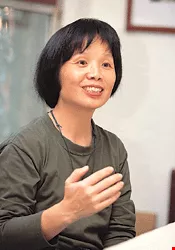
She may be a grandmother, but Chen Lai-hung radiates energy when the subject of collaboration among women is raised.
p.078
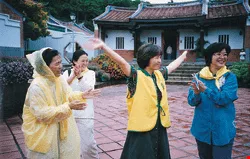
(facing page) Chen Lai-hung took to the streets with the Homemakers' Union to protest the use of nuclear power and fight for the Taiwan she loves.
p.080
The co-op has local outlets throughout Taiwan. From there the team leaders and other members pick up the food and distribute it on their own. It's very much a self-service concept.
p.081
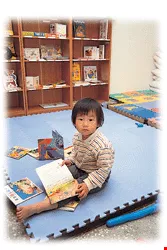
The co-op outlet in the Taipei suburb of Sanchung has a reading room for parents and kids. Mothers who come here to buy food can take a break and read with their children.
p.081
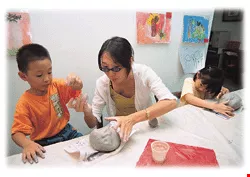
Chen is also an ardent proponent of bringing parents and children together through educational and creative activities.
p.082
A veteran of grassroots movements, Chen Lai-hung is a warm and caring leader of women seeking the betterment of Taiwanese society and the preservation of the environment.
p.083
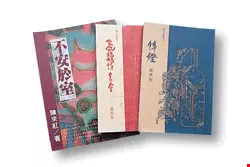
Well known for her advocacy of women's reading clubs, Chen Lai-hung is also an author whose signature works include No Stay at Home Mom, Passing the Torch, and Kanga Mothers' Reading Club.


@List.jpg?w=522&h=410&mode=crop&format=webp&quality=80)


@List.jpg?w=522&h=410&mode=crop&format=webp&quality=80)
