Critical Mass--An Interview with Yang Chao
Interview by Laura Li / photos Diago Chiu / tr. by Phil Newell
February 1994


When you first meet Yang Chao, you just see the round baby face and the warmth that comes through when he smiles. He looks like the classic fresh-faced youthful artist. It's strange that you can't pick up a clue of the rigor and incisiveness he shows when writing criticism. Yang (whose real name is Li Ming-chun) is just over 30, and is studying Han dynasty history in the Graduate School of East Asian History at Harvard University. During his six years abroad, his pen has never slowed down; he has succeeded at novels, short literary pieces, and criticism. Last year he was the winner of the "Lai Ho Prize for Literature." A Record of Dissent, a collection of his critical essays, was nominated by the China Times for the Ten Best Books competition.
Q: This is an age of specialization. You study history, and are a PhD candidate at Harvard University, so a lot of readers might think that your works are rich in "historical perspective." Yet it turns out they are not. Why is that?
A: In fact, I don't think my background in history gets reflected in any way in my writings. I feel that training in history is just a type of specialized training, like physics or chemistry. It does not provide any general truths and is not a key that can open all things or which can explain everything from ancient times up to the present. For example, my dissertation is on the study of the classics in the two Han dynasties, but my understanding of the Han doesn't necessarily help me to understand contemporary society.
In normal interactions, people are usually recognized through their specializations, their titles, or their status. I have come to find this very tiresome. Can these things really identify where a person is coming from? For example, I study history, so I should be staying in touch with the other people who study history, and should have little in common with those who study economics. In fact, within any given specialty every person has their own style, and these divisions between fields then become an obstacle to interaction between people.
Because of this, to get past the myth of "specialization," I rely on an identity, without specialization, and without the glamour of any famous school or title. The only thing that counts is the article itself. Only when you get past these things can you really unfold the writing itself, and talk only about how the words stand up, and how the evidence stands up on its own. In the end this is a more direct way of communicating with readers.
Q: Looking at your essays, one is rather struck by their "critical spirit." How does one cultivate this spirit?
A: I think that perhaps it is rooted in the fact that I have been very unwilling to "follow the straight and narrow" since I was a small child. I never liked reading textbooks, and wasn't on good terms with school. For example, I often hear people thanking this or that teacher for their guidance way back when. But I never had any experience like this. From one point of view, I was "unteachable." But if someone just accepts every word, every norm, and every relationship they're taught from the time they are small, naturally they won't develop a critical spirit.
I especially would point to the way my father used to teach me. For a while I was a "mess," and gave the teachers and the guidance counselors fits. But my father didn't put very much pressure on me. He felt that if parents provide a free and informative environment, and the child still doesn't do well, that's not something you can fix by shouting or hitting. This was a very special feeling of "trust," and has been very helpful in letting me go my own way and in working hard to succeed at this path.
Q: It seems like nothing is beyond the range of your criticism in A Record of Dissent; it hits on everything from popular reading material to films to feminism to cultural phenomena. You can find something valuable to say about all of them.
A: In fact this is a misunderstanding. Readers see that I've written so many critical essays, and they think I must be mad at the world. In fact that's not true. I agree with most of the things in society. It's only the things I don't like that I feel compelled to write about. In fact, I've really only criticized a very small number of things. Further-more, critical essays aren't my whole life, and even my wife, who studies with me at Harvard, has more of a spirit of protest than I do. When I'm with her, my role is often turned around, and I end up defending and upholding most things.
Q: It seems that critical writing is not highly developed in Taiwan, and there has been very little protest writing since Lung Ying-tai's Prairie Fire Collection. What do you think?
A: Actually, I know a lot of friends about my own age, like Chiang Hsun, who used to be with Nanfang Magazine, who are excellent critical writers. It's interesting, because right about the time that martial law was lifted and the ban on new newspapers was lifted, media space increased dramatically, and some young writers seized some opportunities to have their say. In the past the social structure was such that people didn't trust young people because they were felt to have insufficient experience. But once they got into the structure, and got older and more experienced, they didn't dare to criticize this system.
The times called for such things around the time of the lifting of martial law, so a group of people came forth and showed themselves. But that time passed quickly, and readers' tastes have changed, so critical essays that won't suck up to the powers-that-be naturally find reduced channels for access to the media. Recently social movements and student movements have cooled off, and "critical writing" has become a research topic in the halls of academe, even as it has lost its vitality and space.
Q: The media likes quick and easy pieces. But what about readers? Are you getting a big response from readers?
A: Very little, extremely little. Sometimes I have to force myself not to wonder, "Where are the readers?" Sometimes to attract readers I will use a somewhat more provocative writing style, using extremely pointed terms, and try to figure out how to defend myself when I expect there will be objections. But usually the provocation fails, and very rarely does anyone offer an opposing view.
Perhaps few people in this society are accustomed to opening themselves up to an exchange of ideas. But in fact opinions are debatable, and people can be persuaded to change their minds. I am a rather easily persuaded person myself. We have left some essays out of this collection, sometimes because I have been persuaded of something else, or perhaps I've changed my own point of view. Take for example the rebuttal essay written by Chang Chuan-fen, a reporter for the book reviews section in the China Times. I think it's excellent, and specially included it in the collection.
Now that we're on the subject, I have a group of friends at Harvard with whom I can frequently discuss and debate all kinds of ideas. They are very helpful in helping to keep my critical faculties sharp. But I don't like my friends to know that I am the Yang Chao who writes essays, and sometimes I deliberately prevent my friends from discussing my articles, because I would feel embarrassed.
But on the public stage, I feel that exchanges of ideas are essential. It's just that in Taiwan there are few channels for publishing critical essays, and there is even less room in the popular media. Based on my personal contacts, there are quite a few people with a critical consciousness, but very few people actually pick up their pens and do something about it. The place you most often see them is in the "Letters From Readers" sections. However, because they don't have the status of "commentators," they don't get the attention they deserve, which is really a shame.
It's just like what you were saying. In A Record of Dissent there are a lot of book reviews and movie reviews. In fact, that's just me taking advantage of a chance to throw my critical essays out there; I'm trying to find some space in a situation of narrowing channels for expression. For example, I often accept invitations to write book reviews for the China Times, and naturally I take advantage of the book review format to express my critical viewpoint. Moreover, when you have a single book or film to serve as your medium, it's more casual, and there is a single focus, so readers find it easier to accept.
I often say that critical essays are "parasites" on the bodies of the editors of newspapers and journals. When editors move about, we jump with them. When they resign, we lose a channel of expression. We have absolutely no power of our own to continue on. Perhaps I am one of the lucky ones. I've been writing novels for a long time now, so I have a lot of contacts in publishing and media circles. That's the only way I've been able to continue to find channels to express my views.
Yet, though my work appears in a hodgepodge of different forms, when you strip away the exterior screen, there is great consistency in the viewpoint and the critical principles, which is to say they adhere to "nativist" and "leftist" principles. "Nativist" of course means that Taiwan serves as the center. As for "leftist," that's a bit more complicated. Generally speaking you could explain this as the principle of social justice. Moreover, it rejects purely abstract arguments, and argues that everything must be grounded in a standard of testable reality.
Q: You just mentioned "nativism." But some people have criticized you for commenting on various social phenomena in Taiwan despite the fact that you haven't been in the country for six years. What do you think of this point?
A: In fact, as far as I am concerned, being outside of Taiwan but aiming my comments at Taiwan is good training for me. This is because you have to be modest, and not have blind confidence that "what I see is Taiwan." You have to thoroughly and realistically collect all kinds of objective data for analysis to support your point of view. You can't just think, "well, this is obvious."
Of course, many people might wonder: I'm not a specialist, and I don't live in Taiwan, so what basis do I have for writing so many articles? In fact, when I am writing my drafts, I feel that my specialization is in Taiwanese society. The foundation for my ideas and my courage is my concern for and observation of Taiwan. And as for my nearly religious faith in the "nativist" and "leftist" value systems, they are my greatest motivation for not stopping my writing despite my heavy courseload.
Q: In terms of your critical writing style, Chang Chuan-fen has described you as a "know-it-all." Some readers also definitely have the impression that you criticize everything and despise everything with the "arrogance of the intellectual." It's not like Lung Ying-tai, who passes her criticism along in refined and amusing stories. What do you think about this point?
A: I know, and I've thought about this, and it's really frustrating. I don't feel that using the "intellectual" point of view makes me any better than anybody else. It's just that this is my limitation --that's the range of my capabilities to express myself. I'm just used to using "linear thinking" to structure my critical essays. This isn't something you can change just through self-reflection and training.
Then there are those who say that since I can write very "literary" novels, why don't I just adopt a midpoint between literature and criticism. But this is quite difficult. Just because you can appear at point A or point B doesn't mean that you can just pop up anywhere you want between points A and B. So I simply accept this type of criticism.
Q: Although you are not willing to be limited by any boundaries, you plan to move back to Taiwan permanently. Are you afraid that after you return you'll lose the transcendent position of being in the United States and being at Harvard, thus losing authoritativeness in your essays?
A: I can only answer this question by being the "compulsory optimist." Right now I am under contract to work as a research assistant at a domestic research institution. When my PhD dissertation is finished, I will leave the glamour of Harvard. At that time I will look for a formal job. Seeing as how there are too few jobs and so many applicants, I will probably be a lecturer at a private technical college.
But this is truly a test. Because critical exposition is a "self-destructive" process, because you have to have a critical spirit toward everything in life, you have to resist the system and topple authority. How can such an author think to build a little system or authority structure? I have always criticized using an externally imposed status to assess a person's value, so how can I secretly hope that I have status myself when it comes down to my personal case?
Of course, this is a very pragmatic issue. I even have some friends who have, with the best intentions, tried to convince me not to say anything for a couple of years, to be more polite, and to not offend people. They say it's the only way I'll have an opportunity to get a relatively good position. But right now I can't get worried about this stuff. If it works out that I am just an ordinary teacher, without the glamour, ignored by the media or by readers, well I can accept that. I'll just find something else to do.
Basically I don't think that a person can be completely obliterated by a given structure or system. I don't imagine that in the future I'll be in a position where there will be no job for me to do. Perhaps the content of the work will be radically different. But if you are willing to do something, then you can always find something to do.
[Picture Caption]
p.89
Underneath the baby face and fresh smile is hidden Yang Chao's sharp mind and incisive critical faculties.
p.90
Expressing objections in writing and exchanging ideas in public forums can make public discourse smoother and more rational.
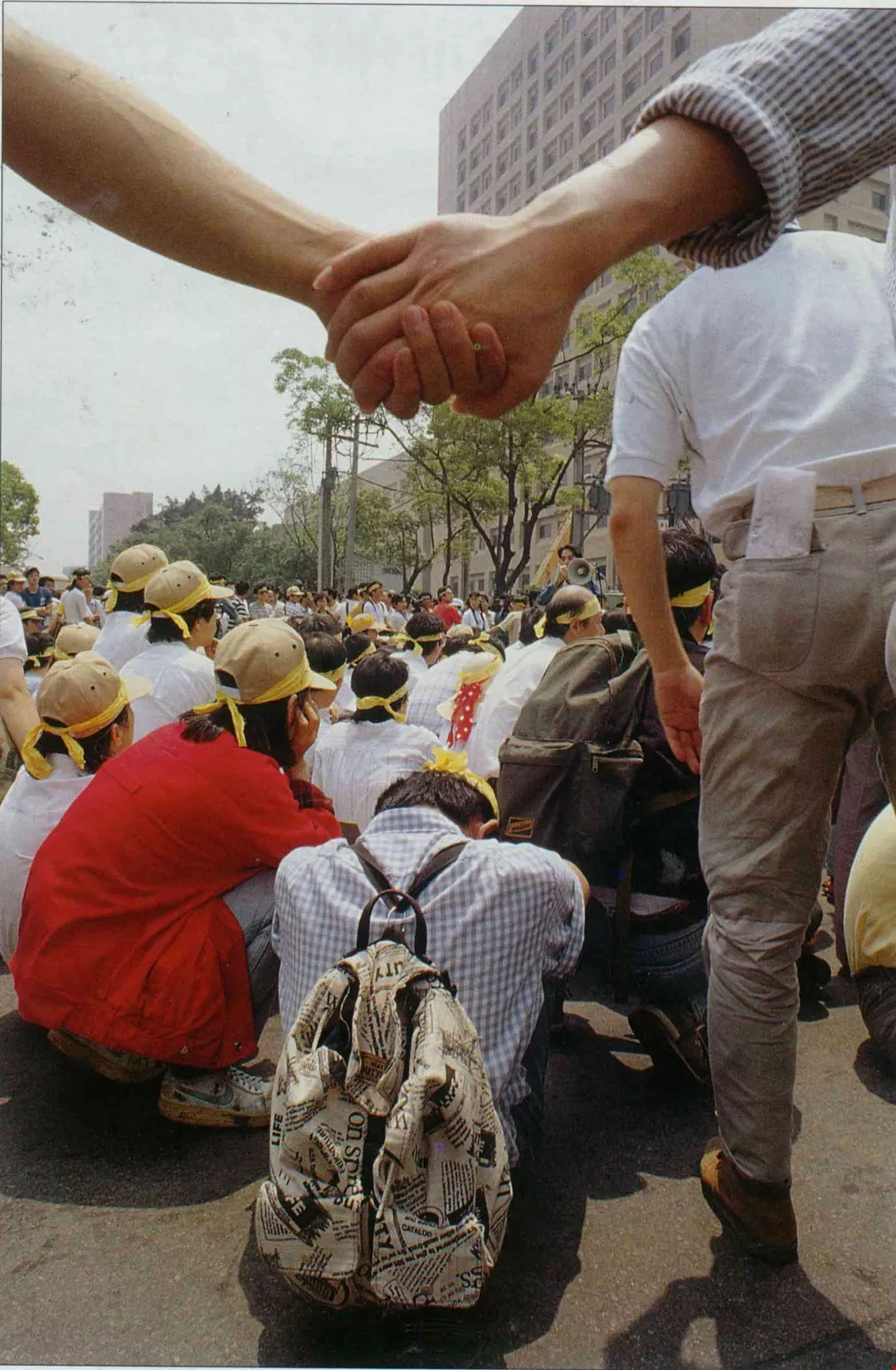
Expressing objections in writing and exchanging ideas in public forums can make public discourse smoother and more rational.


@List.jpg?w=522&h=410&mode=crop&format=webp&quality=80)


@List.jpg?w=522&h=410&mode=crop&format=webp&quality=80)
