It Ain't Over Till It's Over:Rewriting the Rule Book on Marriage
Laura Li / photos Hsueh Chi-kuang / tr. by Phil Newell
August 2002


Love one another, but make not a bond of love.
Let it rather be a moving sea / between the shores of your souls.
Fill each other's cup / but drink not from one cup.
Give one another of your bread / but eat not from the same loaf.
Sing and dance together and be joyous, / but let each of you be alone, / even as the strings of a lute are alone / though they quiver with the same music.
-from the chapter "Marriage" in The Prophet, by Khalil Gibran
"The institution of marriage is dead!" This startling declaration was made by an American author in the 1930s, and still resonates today.
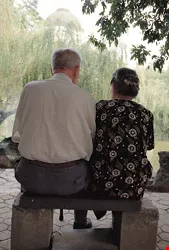
It's best to have someone to grow old with. Let us hope that all lovers will enjoy long and peaceful marriages, sharing all that life has to offer.
A worldwide epidemic
More than half a century later, most people still hope to walk down the aisle and make a home and family. Nonetheless, while the institition of marriage is by no means dead, individual marriages are dying all the time. Indeed, the extent to which marriages are falling apart has reached epidemic proportions. No wonder many marriage experts rank "the divorce tide" right up there with depression as the two most serious problems of post-industrial life.
A French proverb, well-known among Chinese through a novel by Chien Chung-shu, says: "Marriage is like a fortress besieged; those outside want to get in, those inside want to get out." According to statistics from the Ministry of the Interior, last year in Taiwan 57,000 couples divorced. That means one couple abandoned the "fortress besieged" every ten minutes on average. The marriage "death rate" is nearly twice as high as the death rate from cancer (about 30,000 people per year). It is impossible to even estimate the extent of problems that are byproducts of divorce, including health risks, economic losses, neglect of children, and loss of balance in the social structure.
Taiwan's divorce rate began escalating sharply in 1996, with the crude divorce rate going from 1.68 to 2.53 couples per thousand persons in the total population. Calculated per thousand married persons, the number of divorced people doubled to 11.
Comparing the number of couples married and the number divorced in 2001, you get an even more shocking ratio: For every three pairs walking down the aisle, one couple was calling it quits! Compared to Asia as a whole, Taiwan's divorce rate is a dubious "first" in terms of both the basic divorce rate and also the rate of increase. (See table.)
What are the causes of the rising divorce rate? If traditional marriage concepts are bankrupt, what new ideas or systems can better fit the needs of modern people?
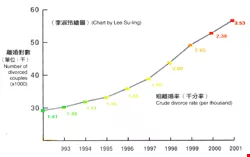
Number of divorces and crude divorce rate in the Taiwan area (1992-2001)
Pluralized and flexible
"A pluralized society needs 'pluralized concepts of marriage,'" is the strident call of Peng Huai-chen, associate professor and chairman of the Department of Social Work at Tunghai University, who has published more than 20 books and has seen it all when it comes to marriage.
Peng says that modern society takes "change" as the norm. Professions, jobs, interests, friends, financial situations, and residences can change overnight. In other words, no one really can control his or her fate, so how can one expect to maintain a marriage by relying on abstract concepts of morality or social norms? The only way to resolve the current marriage stalemate is through pluralized values and flexibility.
What is meant by "pluralized marriage concepts"? Peng takes the "ten types of marriage" proposed by the American scholar Burr as an example.
If the husband and wife feel true love and and are true soulmates, that is that most enviable of all wedded states. If two people are not so well matched, or there are objective circumstances that make things difficult, there are second-best types: the "traditional marriage," with traditional roles; the "functional marriage" in which one or both partners make career success the main goal; the "religious marriage" in which faith is placed in some higher power; the "stage-two marriage" in which people get married after a trial period of living together. . . . All are possible options.
Asian societies tend to be more conservative, and the Western idea of pluralized marriage concepts cannot be imported whole. Thus Peng is more reserved about the ideas of trial marriage or living together, which lack promises or guarantees. "What we hope for is pluralization within the structure of legally constituted marriage."
At the same time Peng emphasizes that these choices need not be made once for a whole lifetime. Different concepts fit different stages in life or in relationships. So long as whatever is done is done on the basis of mutual love, and is decided through communication and consensus between the two partners, then anything can be acceptable.
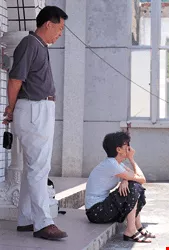
Middle-aged couples, most at risk for extramarital affairs, are also going through career and physical changes. They need to tread carefully to keep their marriages from being sacrificed in the process.
Paternalistic heaven?
Sounds good in theory, but can different forms of marriage really give people what they want from wedlock?
James C. T. Hsueh, a professor in the Department of Sociology at National Taiwan University, says that for thousands of years Chinese esteemed the "three-in-one" ideal combining "sex, marriage, and clan." Marriage was traditionally a functional tool for the creation of the next generation to carry the clan name. The emphasis was on succession along the "paternal axis," and there was little encouragement of romance between husband and wife.
Under the "sex, marriage, and clan" scheme, men who needed sex outside of marriage could formally take concubines. But, however much a concubine may have been treated affectionately, she could not lightly disrespect the first wife or challenge her authority.
In this way, a man could have a wife who would serve his parents and raise his children, and also a concubine who would flatter and please him. But what about the women? Women received a "permanent meal ticket," so that their economic situation was guaranteed. Also, having a husband secured their social status, and after death they would be included in the husband's clan's ancestral hall, so that they would not end up as wandering ghosts.
Today, after only a few decades of prosperity, the functions of traditional marriages are already obsolete.
"Women of my generation, who are now in their 50s, were raised with such doctrines as 'it's more virtuous for a girl to lack ambition' and 'if you want to hang on to a man, hang on to his stomach.' But when we became mothers, we taught our daughters that they should have their own careers and income, and never have to depend on a man!" says Liao Ching-pi, director of the Yoyuen Social Welfare Foundation and a professor of social work at Soochow University. In only a generation, expectations and standards have changed radically, both in the way society sees women and the way women see themselves. So how could the marriage system remain unchanged?
If modern marriage is no longer needed to guarantee a woman's livelihood, it is also no longer the privileged source of sex. In the "condom culture" there are numerous channels for sex for men and women, including pre-marital sex, affairs, virtual sex on the Internet, one night stands. . . . So who needs the sanction of marriage?
Finally, as for carrying on the clan name, "while there's a high demand for sex today, there is little demand for offspring, with many people even feeling that it is best to have no children at all," says Peng Huai-chen. Last year, the birth rate for women in Taiwan reached a new low at 1.4 children per couple. Meanwhile, childbirth out of wedlock has been steadily increasing, now accounting for four percent of all births. In sum, then, the three main functions fulfilled by traditional marriages-economic, sexual, and reproductive-are no longer in demand or can be fulfilled in other ways.
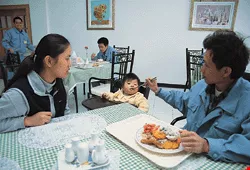
In the age of globalization, hundreds of thousands of Taiwan business people have been sent overseas, especially to mainland China. How do they keep their divided marriages alive? Take the family along, or risk the separation? The photo shows a Taiwanese family in a restaurant in Shanghai. (photo by Jimmy Lin)
Love, partnership, security
The decline of traditional marriage functions means, however, that romantic love, traditionally considered unimportant or even deliberately repressed, is now of increasing importance. One of the main ills of modern civilization, loneliness, is pushing unmarried men and women to seek love, and is the main factor in encouraging them to enter the state of marriage.
Ms. Yuan, 40 years old this year, has a PhD from a well known US university, and teaches in a college in northern Taiwan. For many years now she has been continually searching, and in America even lived for a while with a guy ten years younger than herself. But in the end something has always gone wrong. Especially now that she has her doctorate and is a professor, even fewer men see her as a potential partner.
"I trust that I will still have the opportunity to get married," says Ms. Yuan. She does not want to have children, and has no worries about income. It's just that every night when class is over and she goes home, she feels empty.
"Nobody cares whether I come home or not, whether I have eaten or not, and there's no one with whom I can share my joys and sorrows. In fact, if I were to die, who knows how long it would be before my body was discovered!" This summer, Ms. Yuan went to the US as she usually does, and there met with a friend she made over the Internet, making yet another attempt to get inside the "fortress besieged." If it works out, they could try to maintain their relationship by flying back and forth across the ocean, or she could resign her position in Taiwan and start a new home in the States.
Marriages with husband and wife living in different cities, transnational and cross-cultural marriages, marriages between older women and younger men, between women with doctorates and less well-educated men. . . . Yet even as the marriage values of the younger generation become increasingly pluralized, many of their parents cling ever closer to tradition. Many Western-trained marriage experts admit that the thing that makes them feel most powerless is the relationship across generations-between in-laws and spouses.

Modern women have careers and families, and are trying to keep the candle burning at both ends. More than ever they need support from their husbands.
Cross-generation friction
"Chinese people often say that marriage is 'an arrangement between two surnames,' with the husband and wife being little more than pawns in the marital strategies of their respective clans," says Jane Wu, director of the Family Wellness Center at Tunghai University. During the current transitional period in which new and old concepts of marriage are mixed, if the two generations have different ideas about marriage, this will create different expectations, leading to anxiety and friction, and ultimately bringing down the marriage. At this time, the key to success or failure is closing the gap between the marriage concepts of the individual and the family.
Chang Wei-wei (a pseudonym) is a case in point. Before getting married at age 30, Chang enjoyed her life as an office worker. Though she was kept very busy at the furniture design company were she was employed, she conscientiously arranged her own life, studying yoga, quilting, and going abroad with her female friends for vacations.
Six years ago, Chang's family arranged a xiangqin (introductory meeting with the express purpose of scouting out a partner for marriage) for her with a Mr. Lin of Taoyuan. Within half a year they were married. On the first morning after their wedding, she was awakened at 6:30 by loud knocking at the door; it turned out that his whole family was waiting for the new daughter-in-law to get up and make breakfast!
"What century is this? I really couldn't believe that this kind of thing could happen!" recalls Chang. She was worn out and frustrated by the end of the first half-month she spent living with her mother-in-law after the marriage. This experience put an end to her original plan to quit her job in Taipei and become a full-time homemaker, and laid the seeds of animosity between mother-in-law and daughter-in-law. Three years after the wedding, she insisted on moving out of her husband's family home, and asked her husband to withdraw their slim savings to buy a home. At this point, not only was her mother-in-law infuriated, but even her own mom began to nag her.
"My husband's family has a great deal of stature in their local area, while I was just a kid from a not very wealthy city family. This was not a question of right or wrong, but of the different expectations each side had," analyzes Chang Wei-wei.
To break the impasse, she urged her husband to take her and the children to Australia where he would pursue his studies. Her mother-in-law, seeing her son advancing with his education, and thinking that she herself could move to Australia when she got old, gradually came to accept the fact that "young people have their own ideas and methods," and she stopped interfering in their lives.
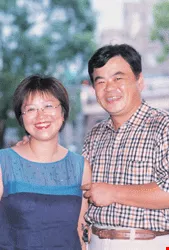
Ting Yao-tsung and Wu Hui-ling have been through some rough times in their marriage, but now they treasure each other even more and life is better than ever. They urge warring couples to be willing to learn and change, so that they too can experience a "second spring" in their marriages.
A marriage crutch
Alternative forms of marriage do not exist merely by conceiving of them, of course. In practice they require a high degree of self-awareness, as well as constant communication and adjustment. Once expectations of marriage differ, or one cannot find one's role in the marriage, then there will be a crisis in relations between husband and wife.
Ting Yao-tsung and Wu Hui-chen of Taichung have been married for 18 years. For several years Ting ran a building supply firm in mainland China. He was there for eight years, leaving Wu, a nurse at Veterans General Hospital in Taichung, to raise their two children alone. Although the days apart were difficult, the marriage really only ran into trouble after Ting returned to Taiwan.
Ting recalls that after he wrapped up his business and came home, his wife was in the process of changing her career path. His wife's whole family is in the business of running nursery schools and day-care centers, so building on that experience and those contacts, they also opened a day-care center, with Ting named as the operational director.
"On the surface everyone treated me as if I was in charge, but in fact it was my wife's family that made all the decisions." Ting reveals that at the time he began to feel "psychologically out of balance" and very unhappy. What's more, during his long years in the mainland he had gotten used to living well and being in charge of his own life. Now he was making less money, and was constantly asking himself, "Who am I doing all this for?" He had mixed feelings, to say the least.
Fortunately, both Ting and his wife place great importance on family values. Through the introduction of friends who are churchgoers, they began half a year of marriage counseling, traveling from Taichung to Changhua every weekend rain or shine. After understanding how each of them arrived at their current state of mind and improving their patterns of interaction, today they are an ideal couple praised and envied by others.
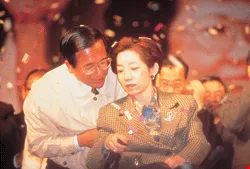
The affection between President Chen Shui-bian and First Lady Wu Shu-chen has never waned, despite Wu's ten years confined to a wheelchair. It is a heartwarming reminder of the contract by which two people agree to grow old together.
Honesty is the best policy
In parallel fashion to the "learning organization" and "multitasking" common to contemporary corporate life, modern marriages also require the husband and wife and even the children to have strong problem solving capability and the ability to act independently, in order to do role substitution or provide support at a moment's notice.
Especially interesting is the place of feminist consciousness, long considered the "main culprit" in today's divorce tide, in the new marriage system. If this consciousness is applied intelligently, it can be very effective within the structure of pluralized marriage values.
Luo Chiung-yu, director of the Warm Life Association, a support group for women, whose mother "prophesied" that her marriage would never last because she didn't know her way around a kitchen and had little interest in traditional female virtues, is a case in point.
Luo's husband was recently transferred to Shanghai. Well aware of the frequency with which Taiwan businessmen there have extramarital affairs, she organized sisters from the Warm Life Association to form a "mainland research team." In the spirit of "know yourself, know your enemy," they hope to better understand marriage laws in mainland China, the situation of support groups for women there, and the structure and culture of the Taiwan business community in the PRC. However, Luo is not considering accompanying her husband to mainland China.
"What would I do in mainland China?" she says, adding bluntly: "If my marriage would require me to give up my career, my lifestyle, and even my future, then why would I want to be in a marriage like that?"
Luo feels that in a high-tech age, a couple separated by their careers can stay in contact by email and videocon-ferencing, in order to reduce the sense of separation and distance. So long as there's no sharp break in the feelings between husband and wife, then the risk of extramarital affairs can be kept to a minimum.
Of course, not all problems are subject to rational control. She has accepted her husband's statement that he "could not guarantee that he would not have an affair," with the corollary of "absolutely no deception." In addition, Luo and her husband have encouraged each other to make the most of their time apart and to live well, in preparation for even better days together to come.
"Many things in the objective environment are beyond our control. Rather than complain and accuse one another, it is better to communicate and adjust," says Luo. Modern women are educated and self-supporting. A lot of things just depend on how you look at them, and there is nothing that you can't get through.
Give me liberty or give me death
Of course, feminist consciousness is a two-edged sword. It can be a powerful force in supporting pluralized concepts of marriage, but it can also destabilize a marriage.
"Some women, before getting married, think: 'give me love or give me death.' In order to keep the affection of their boyfriend, they act childish and obedient. But after marriage when they come across practical problems, they are transformed and feel 'give me my self, or give me death,'" sighs writer Annie Chen, who has written a set of marriage counseling books. Half-way feminism can actually hasten the disintegration of a marriage. You can get a glimpse of this from the increasing number of divorces initiated by the wife.
Luo Chiung-yu deeply understands this point. She points out that in the past most people had the impression that the Warm Life Association was a group of women complaining to each other about their husbands' extramarital affairs. But the latest figures indicate that only about 30% of Warm Life members who have sought marital help have done so because of unfaithful spouses. While this is still the number one cause, as a percentage of the total it has already fallen significantly.
Besides infidelity, the next most common reasons are "incompatibility" and "inability to communicate." These are problems that are highly personalized and emotional. Like the Meryl Streep character in the film Kramer vs. Kramer, many women have already given up on their marriage to an extent no less than if their partner was having an affair.
Women themselves have questions about the "rights and responsibilities" they should enjoy and bear in a marriage, and most men are reluctant to adapt. Peng Huai-chen is quite concerned about this point.
Peng points out that pluralized marriage values emphasize that marriage is a dynamic system. It is very important to clarify what role one should play at what time. Laughing, he offers the following example: Every time his wife plays mahjong with the in-laws, he takes the initiative to make the tea so that everything goes smoothly and everybody stays happy.
"But modern husbands and wives both put their faith in individualism, and emphasize the self," sighs Peng. Especially in small families, when children have few brothers or sisters, they not only grow up insensitive to interpersonal relations, but have even less exposure to compromise and cooperation. This is why group education in schools is exceptionally important.
The 70% solution
Interestingly, author Annie Chen, also coming at the subject from the "pluralized marriage" angle, concludes that there is generally little to be gained by divorce. She says that only if one sticks to promises can one build a marriage with a stable foundation.
"There's no marriage in the world that you can ever completely leave!" In her book series "The Immunology of Divorce," Chen says that making the legal break does not mean that all emotional or familial attachments cease. Many unhappy partners, after finally getting the divorce they wanted, only then discover that divorce is not the end of their troubles, but in fact the beginning of even more problems.
Taking the "stress index" commonly used in psychology, Chen says that among the top 20 sources of stress, 13 are related to married life. Of these, the top three are the death of a partner, divorce, and separation. Arguments between husband and wife, on the other hand, rank only 19th. Also, whereas the recovery period for the loss of a spouse is three years, full emotional recovery from a divorce can take as much as ten years!
"People in society do not understand the costs of divorce," says Chen. Reading about scandals and breakups among celebrities every day in the media, many people get the erroneous impression that divorce is something fashionable, even an essential part of an interesting and colorful life. They imagine that after divorce a man will be surrounded by beautiful women, while a divorced wife will be free to travel to some romantic location, and both will enjoy a new lease on life.
"Rampantly infected by 'the aesthetics of separation,' many people simply cannot think clearly, and before they have even really made a serious effort, they give up on their marriages, in the end suffering even greater regret and pain," says Chen. Marriage is not all or nothing, but is the art of compromise.
In recent years, Chen has been strongly promoting the idea of the "70% perfect marriage." She doesn't want people to return to the traditional mind-set of "fate." People have to learn how to see the world as it really is, and try to find the joy in an imperfect world.
Emotional career planning
Faced with the chaotic marriage situation, sociologist James C.T. Hsueh advises men and women that they should manage their marriages with the new concept of the "emotional career." "Nobody takes their career lightly, so why shouldn't they devote the same attention to their marriage?"
Hsueh thinks that people should apply the spirit of "career commitment" to marriage, from carefully selecting a mate to maintaining communication and passion between the partners, compromising with and supporting one another, and learning new skills. If people would only give half as much attention to their marriages as they do to their careers, a lot of breakups could be avoided.
Hsueh meanwhile offers a different take on the rising divorce rate in Taiwan, and is cautiously optimistic about the future.
He points out that the first year which showed a marked rise in the divorce rate, 1996, was the first year after revisions regarding child custody in the Civil Code went into effect. The new provisions meant that after divorce children would not always go with the father, as had previously been the case, and also included stipulations for no-fault divorce and for allowing children to take their mother's family name. Many women who had long been dissatisfied with their marriages but didn't want to part from their children consequently made the choice in 1996 to take the kids and walk out. These new laws have contributed to the increase in the number of divorces, with one side effect being that the average age of women getting divorced is higher in Taiwan than in other countries.
In other words, the rise in the divorce rate at present is a kind of "stock clearance," says Hsueh. This won't last long, probably no more than five years, at which point the divorce rate will have peaked and will no longer climb.
However, it may soon become easier for men to file for divorce as well. Proposed legislation, which passed a preliminary reading in the legislature in June, says that a petition for divorce can be filed if the husband and wife have been living apart for more than three years. Overseas, this provision was meant to protect the rights of women whose husbands had abandoned the family. But for many Chinese, for whom problems of living apart and extramarital affairs are common, this could force many older wives who have for years been putting up with a bad situation to accept divorce. Feminist groups displeased with this form of "stock clearance" are likely to fight the bill.
Courageously facing marriage
As a sociologist well aware of the rising divorce rate and the unwillingness of young people to even get hitched because they have seen too many unhappy couples, Hsueh gives some practical advice. While people should make as serious a commitment to marriage as they do to a career, as in a career one can change course or start again. When a marriage really cannot be xxxxsustained, divorce should be a socially acceptable alternative, and does not symbolize personal failure or moral bankruptcy.
"While an 'emotional career' needs to be managed carefully, in fact terminating an 'emotional career' requires even more judiciousness to avoid making a failure out of one's entire life." He says that he has seen too many cases of husbands and wives continuing the struggle even after divorce-fighting over homes, property, and children. This "revenge mindset" brings out the worst in people, and causes greater destruction to one's humanity than any other aspect of the marriage system.
In an age of change, more choices means more challenges. No matter whether you are inside or outside the fortress besieged, are you ready to face them?


@List.jpg?w=522&h=410&mode=crop&format=webp&quality=80)


