The New Taiwanese
--Opening the Doors to Immigration
Chang Chiung-fang / photos Vincent Chang / tr. by David Mayer
September 1999


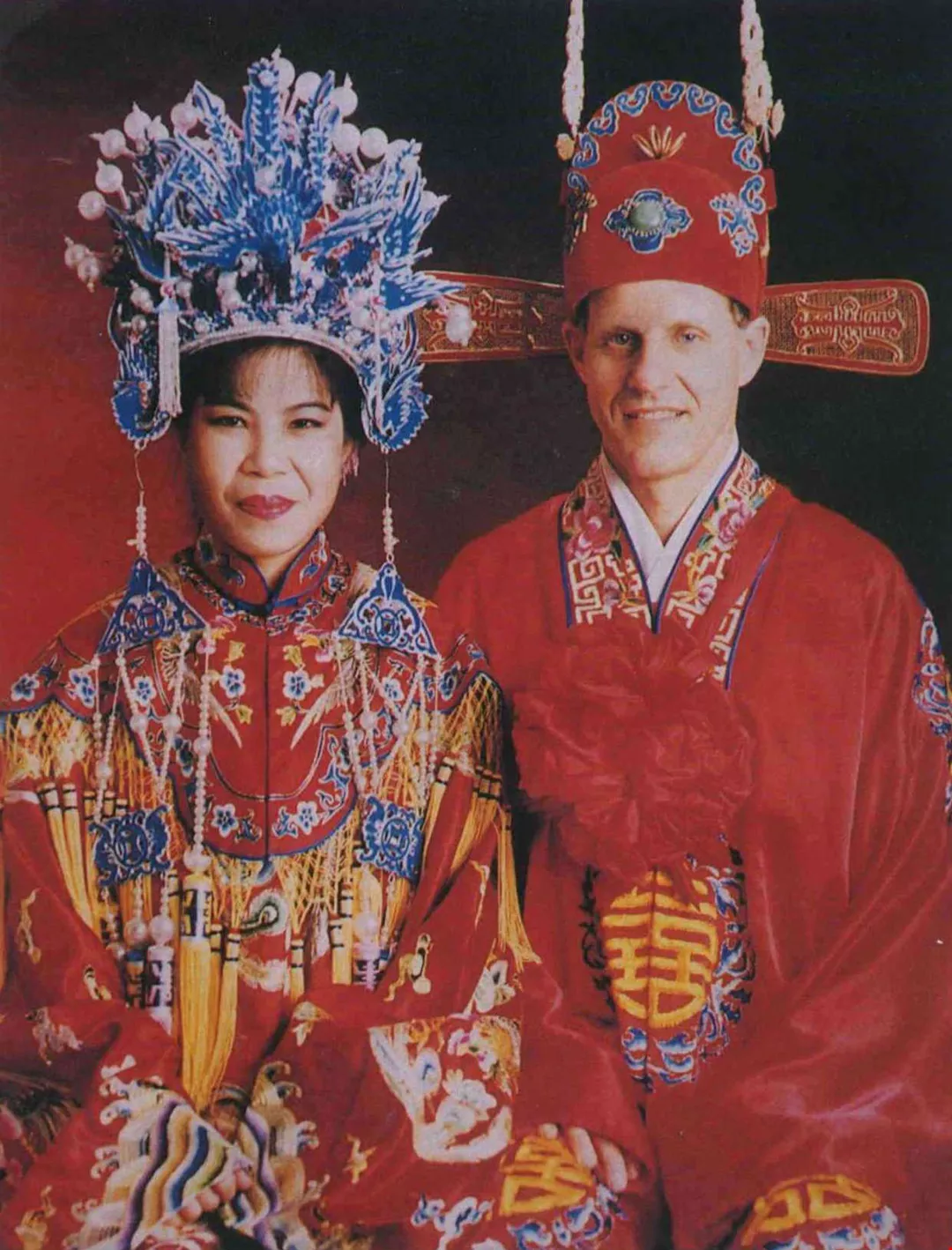
This is R.J.'s wedding day. The American bridegroom poses here in traditional Chinese garb for a photo to commemorate the blissful occasion, but he steadfastly refused to go along when they asked him to change for pictures in a Japanese kimono. (courtesy of R.J.)
When a Chinese woman gets married, her family thinks of itself as having gained "half a son." In the eyes of the bride's family, the bridegroom is "one of us." Due to legal restrictions on residency and employment, however, foreign men who marry Taiwanese women have long found life in Taiwan extremely difficult .
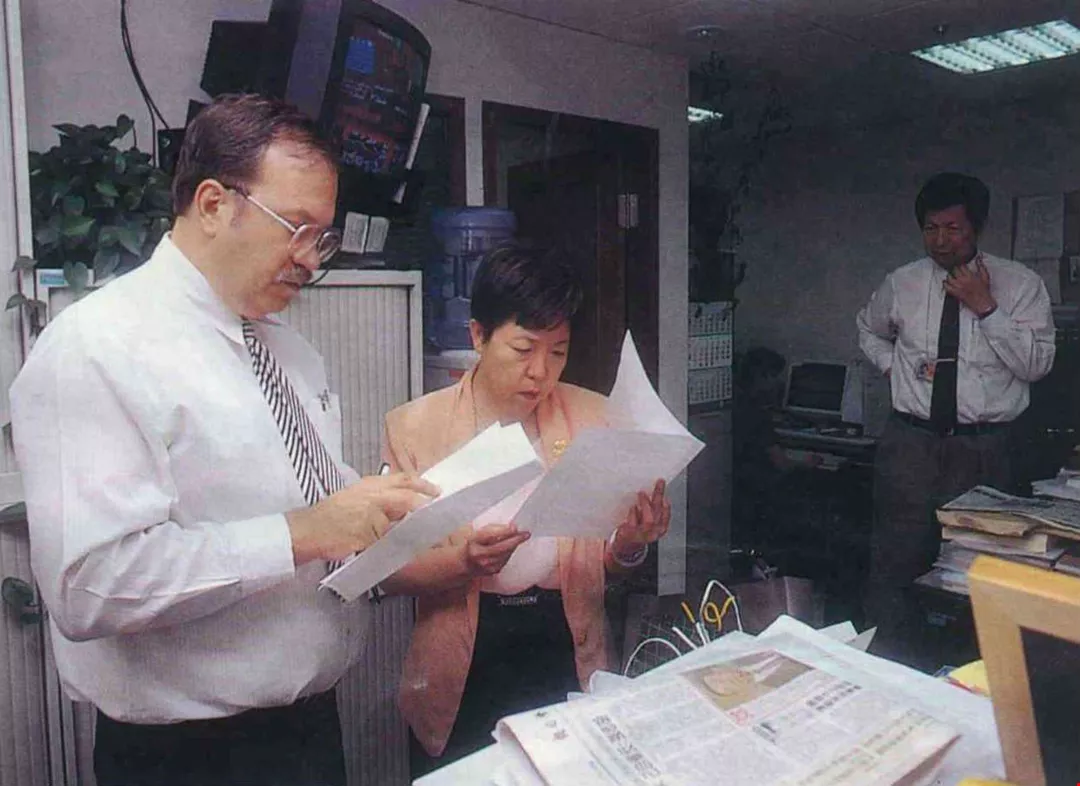
Richard Hartzell, who knows China better than many Chinese, worked tirelessly to win foreign spouses the right to permanent residency in Taiwan. He is shown here calling on legislator Hsieh Chi-ta. The two worked together to push for passage of the Entry, Exit and Immigration Law.
The situation has improved recently, though, thanks to passage of the Entry, Exit and Immigration Law. Foreign spouses now have an opportunity to join the ranks of "the new Taiwanese."
Several years ago, David Mayer went to Siwei Market with his girlfriend to buy some groceries. While the couple was looking over the produce, an older Chinese man approached his girlfriend and asked, "Is he your boyfriend?" "Yes, he is." "Is he American?" Receiving another answer in the affirmative, the man launched into a tirade: "If it hadn't been for America, China wouldn't be in the mess it's in today. . . ." The young couple left the scene in a hurry.
Connie Anderson, whose husband works as a church minister in Taiwan, has even been physically attacked by a mentally unstable woman at a traditional Taiwanese market.
These sorts of incidents are actually extremely rare in Taiwan. Most foreigners here feel that the Taiwanese people are very warm and hospitable. The incident at Siwei Market certainly didn't deter David Mayer from marrying his girlfriend, and he agrees that "most Taiwanese are very friendly to us."

Now that the world has turned into a global village, foreigners are to be seen everywhere in Taiwan. They all like Taiwan a lot, especially the warmth of its people.
Forever the outsider?
Although foreign spouses do not feel that they are treated any differently than the locals in the course of their daily lives, the law does not regard them as "one of us."
Generally speaking, the husbands of Taiwanese women run into difficulties regarding residency, employment, and the ability of their children to reside and work in Taiwan after they have grown up.
During an interview last year with human rights activist Richard Hartzell, a reporter from a cable TV station asked Hartzell's second-grade son: "Did you know that when you get to be 20 years old you won't be able to stay in Taiwan with your mother any more?" The boy started crying on camera.
Taiwan's immigration laws became the subject of sharp controversy several years ago after a plane traveling from Taiwan to Japan crashed in Nagoya. One of the crash victims was a Taiwanese man whose Japanese wife had been living with him for 30 years in Taiwan. In spite of her 30-plus years of residence and the fact that she had a business and children in Taiwan, her right to stay here rested solely upon her status as the spouse of an ROC citizen. She was legally required to leave Taiwan within a few weeks after her husband's death.
Hartzell, a long-time private English school proprietor here, established the National Network of Foreign Spouses in 1994 in order to fight for the right of foreigners to obtain permanent residency. The Network has a membership of some 500 foreigners with Taiwanese spouses, and has been working hard on behalf of foreigners in Taiwan married to Taiwanese spouses. Richard Hartzell even closed his English school two years ago in order to devote all his energies to the Network's activities. Says Hartzell, "Our lives and livelihoods depend on this. We simply must succeed. Permanent residency makes all the difference in the world for families!"
Richard Hartzell and his associates organized no fewer than ten public hearings and managed to get a bill introduced in the national legislature. After meeting more than 20 times to discuss the bill, legislators finally enacted the Entry, Exit and Immigration Law on May 14th. For the first time ever, foreigners and foreign spouses meeting certain criteria gained the right to obtain permanent residency in Taiwan.
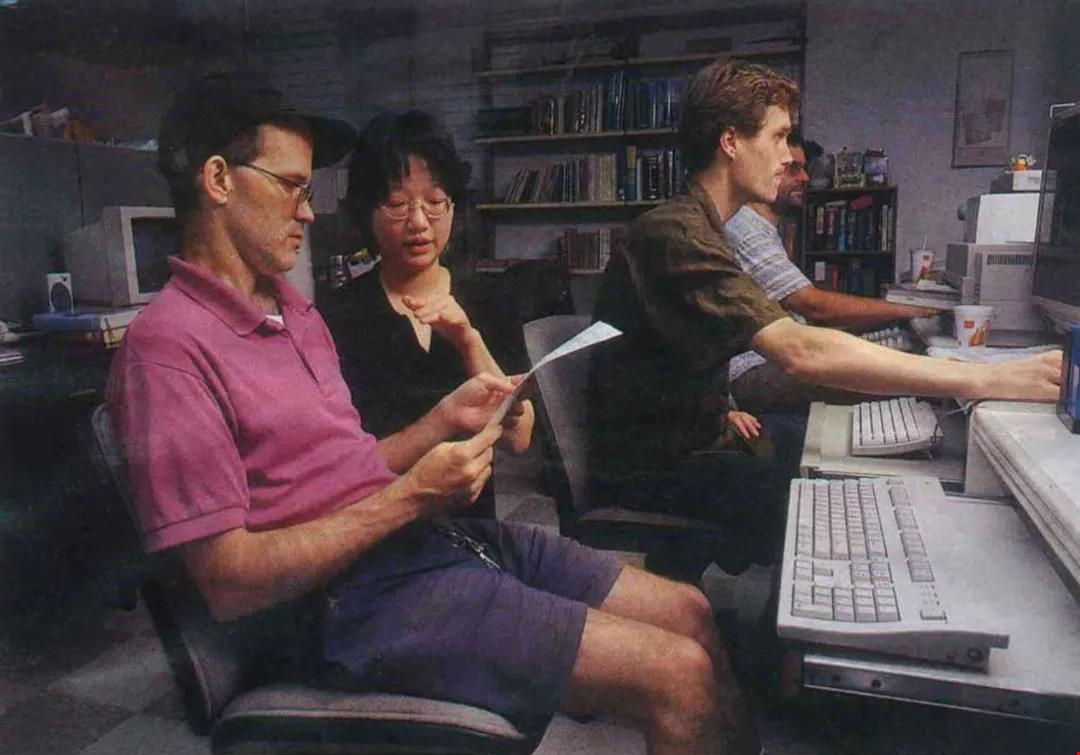
Foreigners in Taiwan are restricted in their work activities by the provisions of the Employment Services Act, which apply even to spouses of ROC citizens. Besides teaching English, many work as translators.
The new law stipulates that the following people are entitled to apply for permanent residency in Taiwan: (1) foreigners who have resided legally in the ROC for seven consecutive years; (2) foreign spouses (and their children) who have resided legally in the ROC for which they have spent more than 183 days in Taiwan. In addition, for humanitarian reasons, foreigners residing in Taiwan on a spouse visa five consecutive years; or (3) foreign spouses and children who have resided legally in the ROC for at least 15 years, during eight of are allowed to apply for continued residence in the event the Taiwanese spouse dies while they are resident in Taiwan. "Taiwan isn't an immigrant nation!"
Nearly 30,000 foreigners hold spouse visas issued by the Ministry of Foreign Affairs. Over 3,000 of these are men. While there are about 500 members in the National Network of Foreign Spouses, Richard Hartzell estimates that there are tens of thousands of foreigners living in Taiwan for the sake of marriage or employment.
"Taiwan is not an immigrant nation!" This was the response that Hartzell received from an official at the Ministry of Foreign Affairs when he went there four years ago to discuss the issue of permanent residency for foreign spouses in Taiwan. That is why it is so difficult for many foreigners in Taiwan to apply for a residence permit.
Brent Heinrich, a 12-year resident who married a Taiwanese woman four years ago, points out that it used to be extremely difficult to apply for a residence permit, for it required trips to the hospital, the American Institute in Taiwan, the police department's Foreign Affairs Division, and many other agencies. Says Heinrich, "Applying for a residence permit a bit over four years ago was practically a part-time job for me."
Eric first came to Taiwan in 1992 on a two-month tourist visa. As a student of Chinese, he was able to obtain a couple of two-month visa extensions, but he would have to leave Taiwan once every half-year and re-enter on a new tourist visa. On one of his trips to the police station to have his visa extended, the police tested him, asking him to write a passage in Chinese.
Eric got married two-and-a-half years ago to Hu Chen-ni, a Taiwanese woman. In accordance with the law, he was able to apply for a spouse visa after residing in Taiwan for 11 months following his marriage. The spouse visa is valid for three years.
Documents required for the application include passport, marriage certificate, and proof of sufficient financial resources. In addition, foreign spouses applying for a residence permit must also provide a medical certificate proving that they are in good health, and a statement certifying that they have no criminal record.
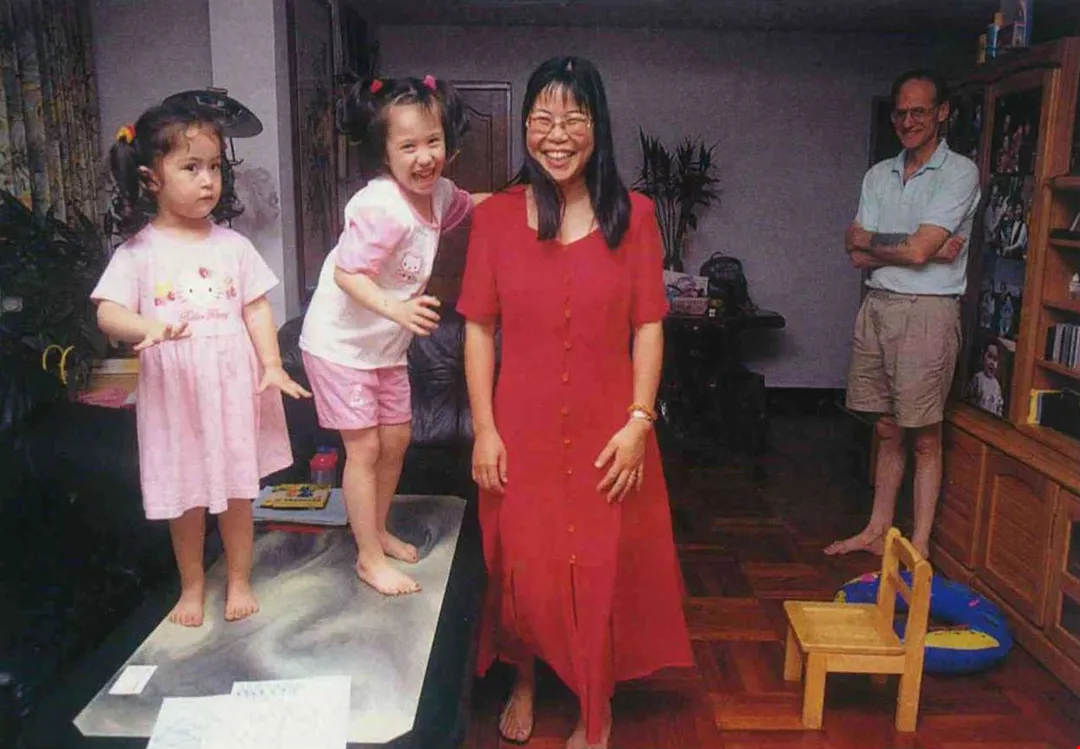
Says R.J., "There's more of a family feeling in Taiwan." For the sake of this feeling, he plans to stay here indefinitely with Chen Chin-fang and his two daughters.
One foreign spouse grumbled in an interview with the news media, "The government discriminates against foreign husbands. Why should we be treated any differently from Taiwanese husbands? Why is that we are the only ones who have to be so morally upright and free of any criminal record?" Beyond the spouse connection
According to Jonathan Barnard, who has been in Taiwan for over a decade, "The passage of this law doesn't make a big difference to me or my family." The main difference is that he and his daughters no longer have to apply for a new residence permit once every three years. "But that wasn't such a big hassle anyway," says Barnard.
Although the new law does not seem to make a big difference for some people, it carries great significance for others who until now have always relied on a spouse visa to stay in Taiwan. "From now on," says Richard Hartzell, "we are no longer non-entities who depend on a marital relationship for legal status."
This difference is crucial to Tom J. (pseudonym), who is separated from his wife. In order to stay in Taiwan and help out with parental responsibilities, he formerly had to stay married, for a divorce would have put an end to the spouse relationship upon which he depended for residency. Now that the new law has passed, however, divorce has become a possibility. Says Tom, "This law is even more important to my daughter than to me." Once his daughter has been in Taiwan for five years, if Tom decides to leave Taiwan, his daughter will be able to choose whether to go abroad with her father or to stay in Taiwan with her mother.
Although the law's passage has resolved the problem of residency, a more pressing problem remains to be addressed.
Says Richard Hartzell, "What everybody has wanted all along is the right to work, but when we were all outsiders, what could you say to the government to get them to let you work?" Foreigners needed to obtain residency before they could receive the same treatment as ROC citizens.
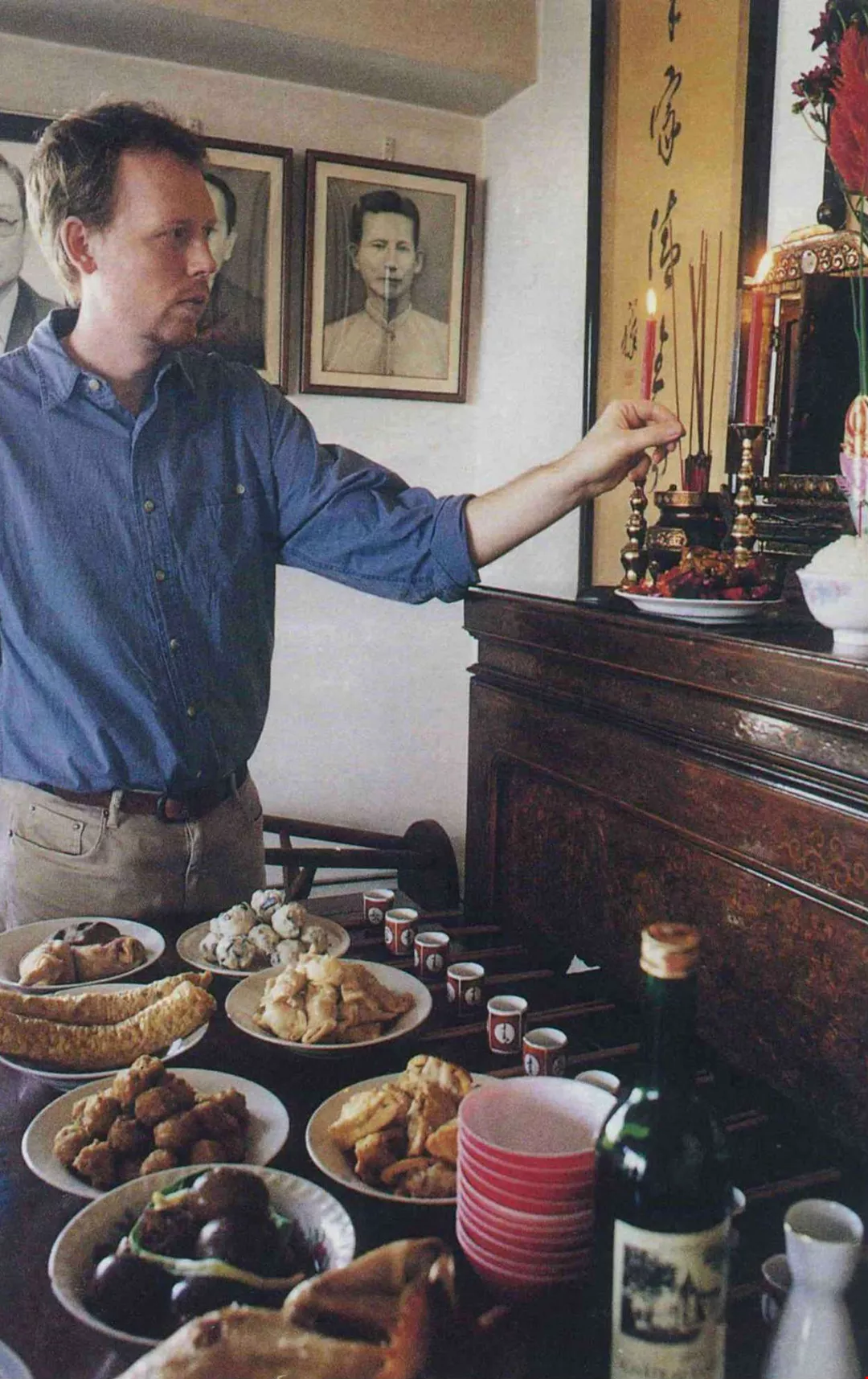
Eric knows well that "when in Rome, one does as the Romans do." He takes part with his wife Hu Chen-ni in family affairs on all major holidays. (courtesy of Hu Chen-ni)
Can't live on love alone
The Employment Services Act, which was passed in 1992, seeks to protect the interests of ROC citizens by placing tight restrictions upon employment for foreigners in Taiwan. The types of employment for which foreigners are eligible in Taiwan are limited to nine categories, including: teaching; coaching and athletics; domestic help; religious, artistic, or performing arts work; and jobs for which there are no qualified ROC citizens available. In addition, the employer must collect all necessary documentation from a prospective foreign employee and submit it to the appropriate central government agencies in order to apply for authorization to hire a foreigner.
Even though a foreigner married to a local citizen can now obtain residency, he or she is still regarded as an outsider when it comes to employment, and is thus subject to the restrictions of the Employment Services Act, which clearly stipulates the penalty for violators: "Police agencies must require persons who violate the provisions of this act to leave the country within a specified period of time." Foreign spouses can obtain residence permits, but they can't necessarily find legal employment, which is why they are sometimes jokingly referred to as "dependent spouses."
Says Brent Heinrich, "Although it's generally true that a foreign spouse with a residence permit can find 'temporary employment' with no problem, there's always a looming sense that your employment status is in jeopardy." He once worked at an agency with a quota for foreign employees that had already been filled. Because his employer couldn't sponsor his work visa, he ended up working there on a "temporary" (illegal) basis for three years.
Chen Su-yen's husband is from Thailand, and has been in Taiwan for ten years. For several years he worked illegally as a welder. It wasn't until he married Su-yen three or four years ago that he was able to obtain a legal residence permit. He is now working as a translator.
According to Su-yen, she and her husband are in frequent contact with about 15 or 20 other families in which a Taiwanese woman is married to a Thai husband, and all of them generally agree that their main problem is not with visas, but employment.
Most Thai spouses work in restaurants or factories. It is difficult for them to find work because most people in Taiwan are unfamiliar with the procedures for hiring foreigners. "Everywhere we go, people always ask suspiciously: 'Are you really eligible to work? Is it legal for me to hire you?'"
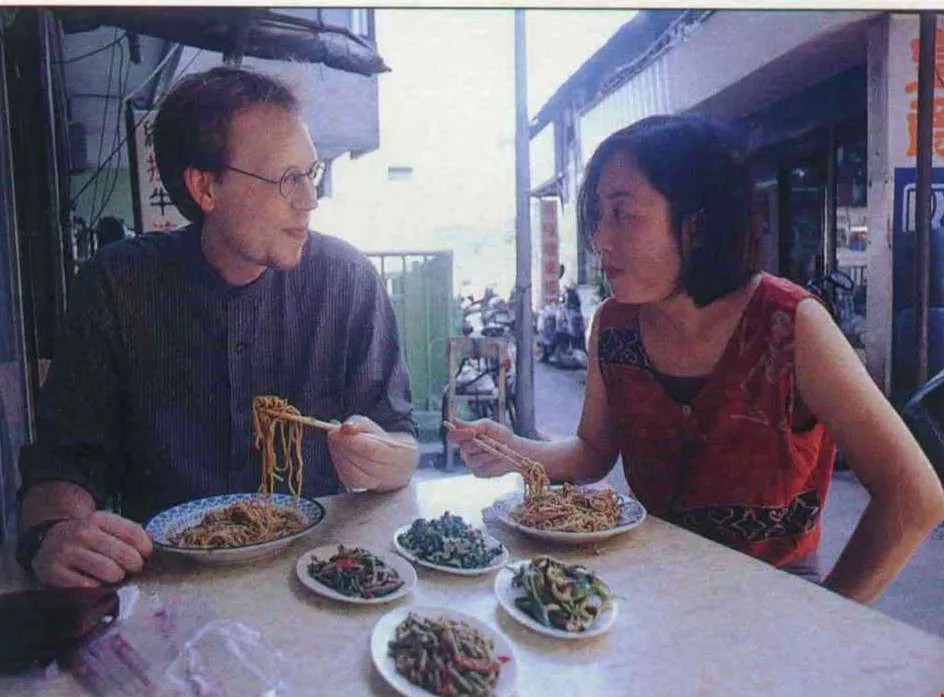
Foreigners who stay for long in Taiwan become quite proficient with chopsticks, and even develop a taste for the local food.
Taiwanese-born "tourists"
When a foreigner marries in Taiwan, it isn't just the foreign spouse who must deal with residency and employment problems. Taiwan's citizenship law defines nationality strictly on the basis of paternity. When a Taiwanese woman marries a foreigner, her children are foreigners in the eyes of the law, just like their father.
Unless the identity of the father is unknown, or the father renounces paternal rights and allows his children to be adopted by the mother, the children of foreign fathers cannot be included in the family's household registration. Chen Chin-fang, who has been married to R.J. for eight years, points out that hers is the only name on her household registration; the names of her two daughters and her husband do not appear. "When they get to school age, we won't receive a notice of admission in the mail like everyone else does. We'll have to go the school ourselves and apply for it."
It used to be that children of foreign fathers were allowed legal residence on account of their mother's ROC citizenship only until age 20, after which time their visas would switch to tourist status unless they held a student ID or a working visa for overseas Chinese. As tourists, they had to leave Taiwan once every six months. Now that the new Entry, Exit and Immigration Law has gone into effect, they can obtain permanent residency, but that is not a complete solution, as Chen Chin-fang states: "Just having permanent residency doesn't help a whole lot. The most important thing is equal right to employment." As 'foreigners,' her children will one day be subjected to far greater employment restrictions than those faced by other people.
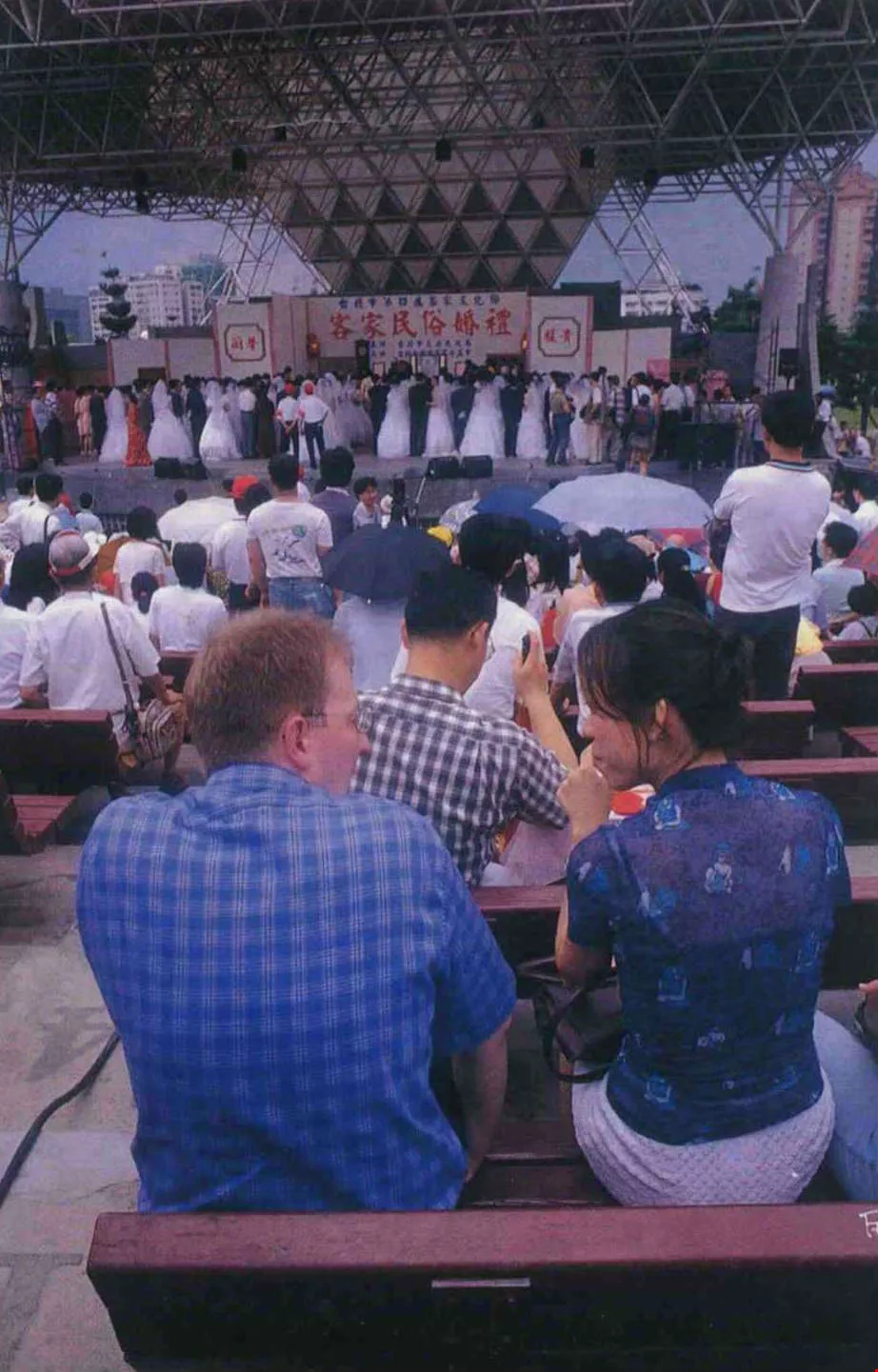
What happens when East meets West? International marriage doesn't necessarily entail cultural conflict; the key is attitudes and aspirations.
Most foreign spouses originally come to Taiwan quite by chance, and getting married here is generally the last thing they expect to happen. This wasn't in the plans
According to Jonathan Barnard, who came to Taiwan in 1987, "I had never imagined I would be getting married in Taiwan. I thought I would only be here for a year or two." His family in the United States does not have any objection to his marrying someone from another country, but they do feel disappointed that he is living on the other side of the world. However, he suspects they might feel the same way even if he were living somewhere in the United States far from home.
Brent Heinrich came to Taiwan 12 years ago as a history major with few job prospects. The original plan was just to teach English and travel for a little while. He confides, "I had heard that you could teach English and have a good time in Taiwan." He had never figured on staying in Taiwan for long, but he met the woman he would marry, and the rest is history.
R.J. has been in Taiwan for 12 years, the last eight of them married to a local woman. Like many others, he had not originally intended to come here. "I had read a lot of Chinese historical novels and books on Daoist religion, and had always wanted to go to mainland China to see firsthand the things I had read about." After traveling for four months in the mainland, he decided to stop over in Taiwan on his way back to the United States. Little did he know that his "brief look around" would extend to 12 years and include marriage and children. His elder daughter Manwen is now five years old, and his second daughter Manyun is two-and-a-half. Both of his girls are quite Western in appearance, but they speak Taiwanese and Mandarin, and Manwen is learning to read Chinese.
James Murray hails from Scotland and has resided in Taiwan since 1986. Except for an odd twist of fate, however, he would never have come here at all. Before coming, he didn't even know where Taiwan was, but the happy-go-lucky young man jumped on a plane with his girlfriend, who came to study Chinese. Within a year the relationship with his girlfriend had ended. She learned Chinese to her satisfaction and left, but Murray stayed on. He married Chen Chiu-ping after a ten-year relationship, and the two had their first child this year.
Says Hu Chen-ni, who married Eric two-and-a-half years ago, "Foreigners who come to Taiwan don't intend to stay for long, and marrying someone from another country is definitely an unexpected turn of events." Very few foreigners come here with the express purpose of marrying a local woman, although there are quite a few Taiwanese women who do set their sights on marrying a foreigner. "Some people end up being pressured into marriage by the woman's family," says Chen-ni. In fact, this is exactly what happened in her own case. After she and Eric had spent a half-year traveling together in India, her family felt that they should get married.
In-law troubles
Marriage between people from different countries is extremely commonplace in today's world, where international society is rapidly turning into a global village. The older generation, however, is not always totally prepared to accept such marriages.
When Jonathan Barnard was preparing to marry, his future father-in-law demanded that his parents come over from the United States to give proof that Barnard had not been married previously abroad.
Mrs. MacDonald, a former physical education instructor at the Taipei American School who now lives with her husband in America, recalls with a laugh the apocalyptic warning her father delivered when her boyfriend approached her parents to ask for her hand in marriage: "We Chinese don't like divorce. If you ever abandon our daughter, our family will kill you!"
Hu Chen-ni's parents, on the other hand, did not have much objection to her marrying a foreigner. "In fact," says Hu, "they felt that I would have fared very badly had I married a Taiwanese man because I'm a total klutz with household chores." The biggest problem in her marriage has stemmed from differing Western and Chinese attitudes toward family affairs. Eric often complains that he and his wife spend too much time with her parents, and that they have very little time to themselves. "I must admit," laughs Hu, "I did pull the wool over his eyes. I had told him that there were only three holidays a year when the whole family absolutely has to get together. It wasn't until later that he found out that my family gets together every month."
Says Brent Heinrich, "My mother- and father-in-law are used to me not paying any attention to their wishes." He recently let his hair grow to shoulder length, and the new look displeased his father-in-law, who asked his wife to call their daughter and get her husband to have a haircut. Heinrich pretended he never got the message, and there was nothing his father-in-law could do.
"The most distinctive characteristic about Westerners," says Heinrich, "is that once we grow up we become independent entities." When his in-laws "suggest" that he buy a house, buy a car, or have children, he always answers bluntly, "I don't want to right now, and even if I want to at some point in the future, it'll be to please myself, not you."
Chen Su-yen's husband gets along very well with her family these days, but there had initially been opposition to their "Sino-Thai" marriage. Says Chen, "My family was really worried about me marrying a foreigner from a place so far away." Several years of marriage have put their fears to rest, however. "Besides," laughs Chen, "although he has a slightly darker complexion than the Taiwanese, no one can tell when he walks down the street that he's a foreigner."
When East meets West
Except for some fundamental differences, such as concepts concerning the rights of the individual, foreign spouses are usually quite willing to go along with local customs in Taiwan, but it is easy to trip up in the effort.
Richard Hartzell says that he often infuriates his wife with his gaffes. When the phone rings during dinner, for example, he often plants his chopsticks in his rice bowl before jumping up to answer the phone. For the Chinese, it is totally taboo to do this with chopsticks because it brings to mind the incense sticks that are planted in a bowl of rice and burned at the grave of a loved one. And then there was the time he and his wife invited a group of friends over for the evening. Everyone was informed that dinner would be served at 6:00, yet no one had shown up by dinnertime, so he started eating by himself. Says Hartzell, "My home is my castle, and I'm the master."
Even people who share a common linguistic and cultural background have problems getting adjusting to married life, so wouldn't people from East and West have even more problems? That is what most people generally think.
Tom J. feels that his marriage hit the rocks due to purely personal factors rather than cultural differences. In his opinion, the biggest hurdle facing spouses from different cultures is linguistic. Even though he speaks Mandarin so well that one cannot detect any hint of a foreign accent, he confides that when tempers flared, he and his wife still had problems with communication.
Anita Yu has been married for ten years to an English-speaker from South Africa, and together the two have managed to build a trading company of considerable size. Yu serves as general manager. Her husband is very much a partner both at home and in business, and the couple enjoys a very strong relationship. Yu feels that different cultural backgrounds have enabled her and her husband to grow that much more. Her husband is ten years older than her, and she has nothing but respect for the way he deals with people, treats his wife, and handles family matters. Describing herself as very temperamental, she feels that she has changed a lot over the course of her marriage. Showing deep feeling and a strong sense of gratitude, Yu says, "Being married to my husband has made me a better person." Putting down roots
"Why should a foreigner want to stay in Taiwan?" This is a question that puzzles many.
Says Brent Heinrich, "We often talk about whether to go to the United States, but we never come to a definite decision. If we went back, it would be more difficult for me to get a good job, and my wife would also have fewer job opportunities there." His hometown is in rural Louisiana, so even if they went back, it wouldn't be to his hometown. They would have to start all over in a new city. Says Heinrich, "That would be no different than staying in Taiwan as far as I'm concerned." After much thought, it appears that they will most likely stay in Taiwan. As Heinrich attests, "The food's great, shopping is convenient, and there are mountains and sea. It's a very fun place. I really like life in Taiwan, and I'm in no hurry to leave."
Like Heinrich, Richard Hartzell cannot go back home because he comes from a rural area of the United States. Says Hartzell, "Americans may have big yards, but your neighbor will tell you: 'Keep off my property.' In rural Taiwan, by contrast, the neighbors still enjoy very warm relations. When you pass by someone's home in a rural area, they'll invite you in for tea."
Hartzell also relishes the diversity of Taiwanese culture. "On my way home every day, I run across all kinds of restaurants, from the economical to the high-class, serving every kind of Chinese and Western cuisine. It's great having so many types of restaurants all on a single street. And it's the same with religion-the Chinese and Western exist side-by-side in complete harmony."
Joining "the new Taiwanese"
Once they've had children, though, many foreign spouses begin to think about going back home.
Says Jonathan Barnard, whose daughters are five and three years old, "I worry that Taiwan's education system, with its emphasis on rote memorization and its pressure-cooker tests, would cast a gloom over their lives. I would like to have my kids go to the American School, but it's extremely expensive in Taiwan, so we may move to the States in a few years."
R.J. and Chen Chin-fang plan to either send their children to the American School or move to the United States. "Since they'll eventually have to go to the United States," says Chin-fang, "English proficiency is very important for them."
L.J. Lamb, a former lawyer who now serves as an English-language consultant for the Government Information Office, first came to Taiwan in 1973. His two sons are now 24 and 25. Both took their schooling at the Taipei American School before returning to the United States for university. The older son now works at an architectural firm, and the second son is still in school studying finance and Chinese.
Regardless of whether foreigners opt to stay in Taiwan or return to their home countries, the passage of the Entry, Exit and Immigration Law has changed their lives by giving them a choice in the matter.
Richard Hartzell has lived in Taiwan for 24 years, and married here ten years ago. He now has a son in elementary school. He points out that locally born Taiwanese can leave the country for 15 or 20 years and still come back without anyone regarding them as anything other than Taiwanese, while foreigners who marry in Taiwan and stay here for years are still seen as outsiders. However, says Hartzell, now that the Entry, Exit and Immigration Law has taken effect, foreigners who decide to stay in Taiwan "have a chance to become one of 'the new Taiwanese.'"


