Local Heroes- Taiwan's Earth Gods
Tsai Wen-ting / photos Pu Hua-chih / tr. by Christopher MacDonald
April 1999


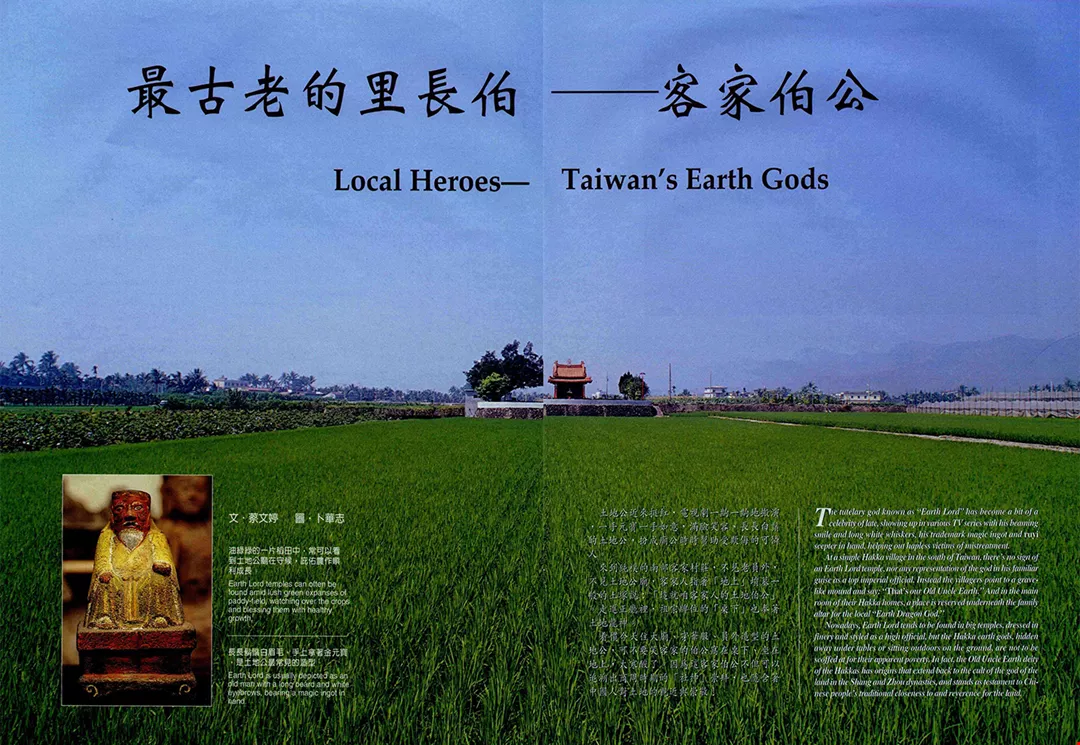
Earth Lord temples can often be found amid lush green expanses of paddy-field, watching over the crops and blessing them with healthy growth.
Earth Lord temples can often be found amid lush green expanses of paddy-field, watching over the crops and blessing them with healthy growth.P
The tutelary god known as "Earth Lord" has become a bit of a celebrity of late, showing up in various TV series with his beaming smile and long white whiskers, his trademark magic ingot and ruyi scepter in hand, helping out hapless victims of mistreatment.
At a simple Hakka village in the south of Taiwan, there's no sign of an Earth Lord temple, nor any representation of the god in his familiar guise as a top imperial official. Instead the villagers point to a grave-like mound and say: "That's our Old Uncle Earth." And in the main room of their Hakka homes, a place is reserved underneath the family altar for the local "Earth Dragon God."
Nowadays, Earth Lord tends to be found in big temples, dressed in finery and styled as a high official, but the Hakka earth gods, hidden away under tables or sitting outdoors on the ground, are not to be scoffed at for their apparent poverty. In fact, the Old Uncle Earth deity of the Hakkas has origins that extend back to the cult of the god of the land in the Shang and Zhou dynasties, and stands as testament to Chinese people's traditional closeness to and reverence for the land.
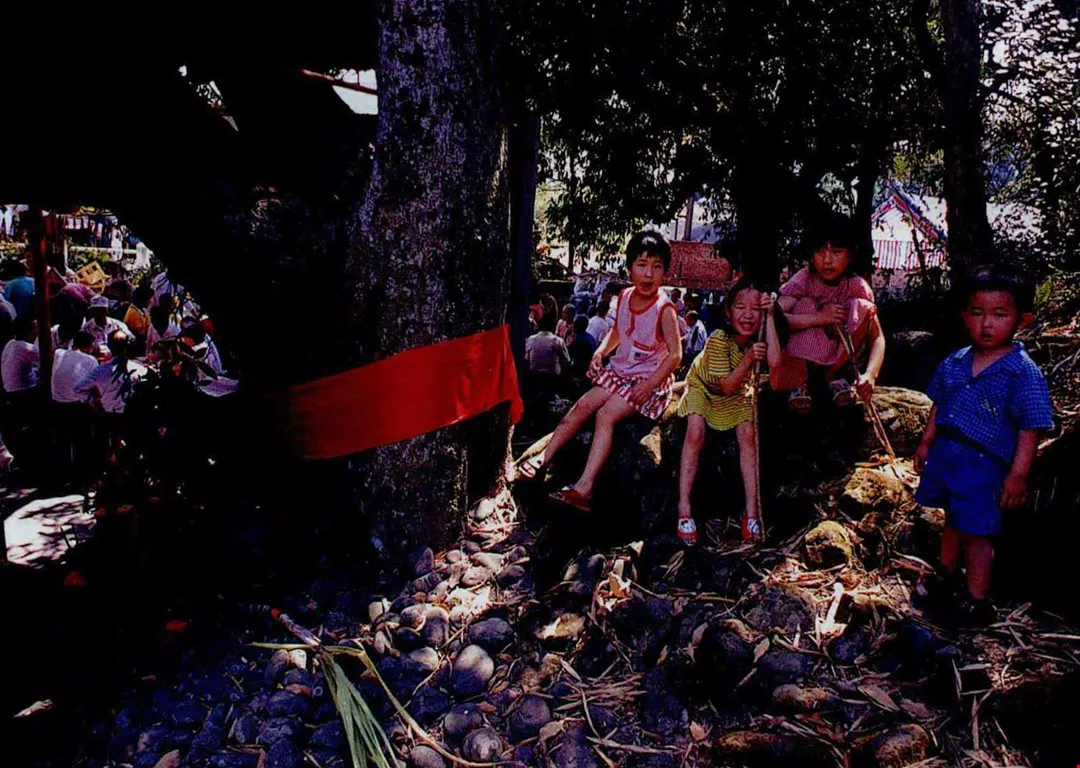
Old Uncle! Old Uncle! To children, the god is like an old member of the family. They can play about on his altar without fear of being told off by the grown-ups.
There's a saying in the Min'nan (southern Fujianese) dialect of Chinese that warns: "If you offend Earth God, your chickens will surely expire!" Since no-one who hopes to get rich through business can afford to neglect Earth God, many people honor the deity with offerings of meat and fruit on the second and sixteenth days of every lunar month, while in any procession of popular deities, Earth Lord is the one handing out ingot-shaped candies as he goes. Much loved by the business community, he is effectively its God of Wealth. When the Dajia Le lottery craze was at its height a few years ago, hopeful punters often crowded in front of tiny Earth Lord shrines at night, waiting for the god to favor them with a winning number. Guess who?
From his origins as a nature spirit governing farming matters, to personification as the divine guardian of local communities, Earth Lord has evolved to fill differing needs in every district.
Legend has it that Goulong, son of the Water God and grandfather of Kuafu (whose body became the mountains and rivers of the world), was honored as the first tutelary god due to the help he provided early agriculturists in settling virgin territory. He was first conceived of as an expert old farmer, and later as a faithful old servant. Because of his character as the "patron saint" of the locality, Earth Lord's form varied according to requirements. The eminent Tang dynasty writer Han Yu was posthumously venerated as Earth Lord of the Hanlin Imperial Academy, and the famous Song dynasty general Yue Fei similarly became Earth Lord to the Lin'an Imperial College. The Qing dynasty emperor most associated with Taiwan, Jiaqing, is said to have encountered bandits several times during his travels on the island, but each time was saved at the last minute by the surprise intervention of an old man with a staff in his hands.
Since then, Earth Lords in Taiwan have been permitted to wear yellow imperial
robes and a mandarin's headdress. Little wonder that whenever Sun Wukong, the Monkey King in Journey to the West, arrives in a new place, he stamps his foot on the ground to summon the local Earth Lord for news about the district.
Although there are myriad mythical versions of Earth Lord, he tends nowadays to be represented in very much the same way everywhere. According to Wang Chien-wang, who designs the Earth Lords seen in TV costume dramas and who wrote his Master's thesis on Taiwan's tutelary god beliefs and iconography, the representation of the god as an imperial official is connected to the widely used religious text The Scripture of the True Deity Fude.
The scripture records that Earth Lord was originally a Zhou dynasty tax official named Zhang Fude, who was born on the second day of the second month in the second year of the reign of the Wuwang emperor. Zhang treated his people with paternal affection, and performed many good deeds. He lived to the age of 102, and it was reported that his face retained its ruddy complexion for three days after he died. The official who succeeded Zhang was wicked and tyrannical, however, and the people longed for a return to the days of Zhang Fude. One destitute family built a little shrine to him out of four rounded stones-three for the walls and one for the roof. That year the family had an unexpectedly good harvest and went on to become rich, with the result that everyone else in the district took up the worship of Zhang Fude. The story may not have any historical basis, but it does show how Earth Lord has consistently been viewed as siding with the people and having sympathy for the poor.
In villages and towns throughout Taiwan, the making of offerings to Earth Lord is almost universal among businesses and stores. According to a three-decades-old Gazetteer of Taiwan Province, there were over 600 officially registered temples on the island devoted to the worship of Earth Lord, more than for any other deity. But in fact the majority of small Earth Lord temples scattered throughout the countryside remain unregistered. Lai Chih-chang, assistant professor of applied arts at Fu Jen Catholic University, who has conducted a survey of temples in Taoyuan County over the last two years, reports that there are close on 2000 Earth Lord temples in that county alone, with a probable total for the whole island of well over 10,000. As the saying goes: "Wherever there's land, Earth Lord is there."
So who actually is this ubiquitous character, the Earth Lord? A visit to the Hakka town of Meinung in Kaohsiung County, and to the remote township of Kuanyin in Taoyuan County, may not lead to any gilded figurines portraying the god in his mandarin garb, but it can help us to trace Earth Lord back to his original, authentic appearance.
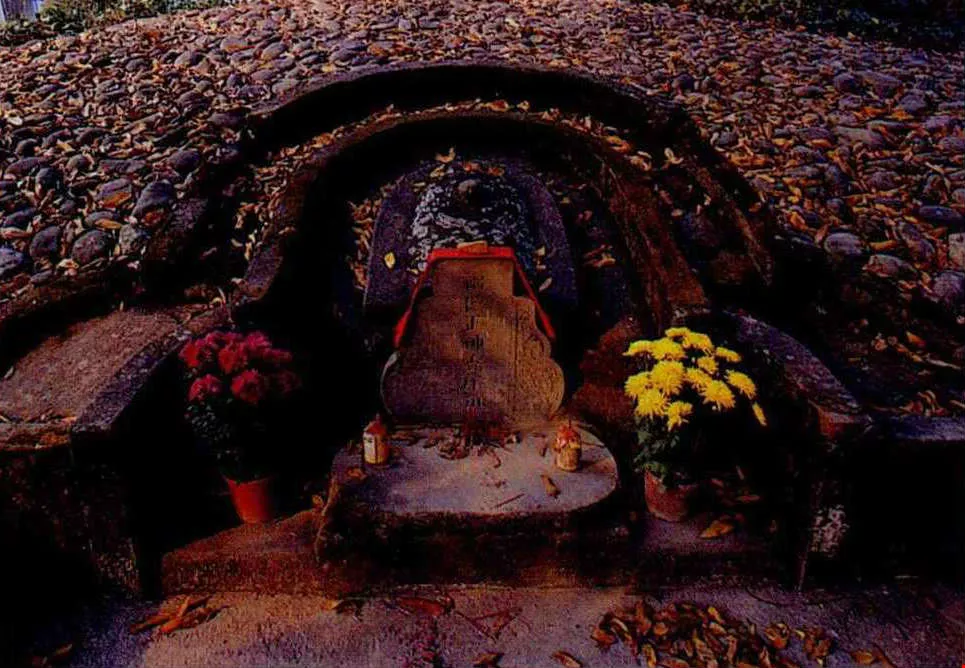
No gilded figurines, and no temple for shelter--the "Old Uncle Earth" of the Hakkas in Meinung is but a mound on the ground, fully exposed to the elements.
The authentic Earth Lord
"Old Uncle" is what the Hakka people call their earth god, and the role played by the god in their lives is as close as that of any uncle. When the women of a Hakka village have finished their day's farming work and had a thorough wash, the first thing that they do is light incense and offer tea at "Old Uncle's" altar. Their children, meanwhile, are taught from a young age to pause and venerate the god any time they pass the altar. Rather than being meant for sending specific prayers to the god, these routine acts of worship are simply expressions of deference, just as one might inquire, both morning and evening, after the well-being of senior family members.
Altars and shrines to Old Uncle are dotted throughout the Hakka village and surrounding fields, as well as at bridges and beside running water. According to the recently revised Annals of Meinung Town, there are over 300 such sites of earth god worship in Meinung alone.
As well as using a different name for their earth god, the Hakkas have other elements to their worship that are seldom seen in Min'nan communities (which form the majority in Taiwan), such as burial-mound-type altars, and "Old Uncle Dragon God," an earth god guardian of the home who lives on the floor of the main room. Hakka culture is particularly well preserved in Meinung, which is enclosed by mountains on three sides and has a 90% Hakka population. The town even retains holdovers from the ancient culture of China's central plains that have died out elsewhere, including three shrines-the only ones of their kind left in Taiwan-dedicated to the Lishe-Zhenguan Lord, a god who guards the local supply of water.
Next to Meinung's East Gate, the town's most famous landmark, a 150-year-old banyan tree tempts people to rest under its shade. But the attention of an outside visitor may first be drawn by the curious sight of a big burial mound alongside the gate itself.
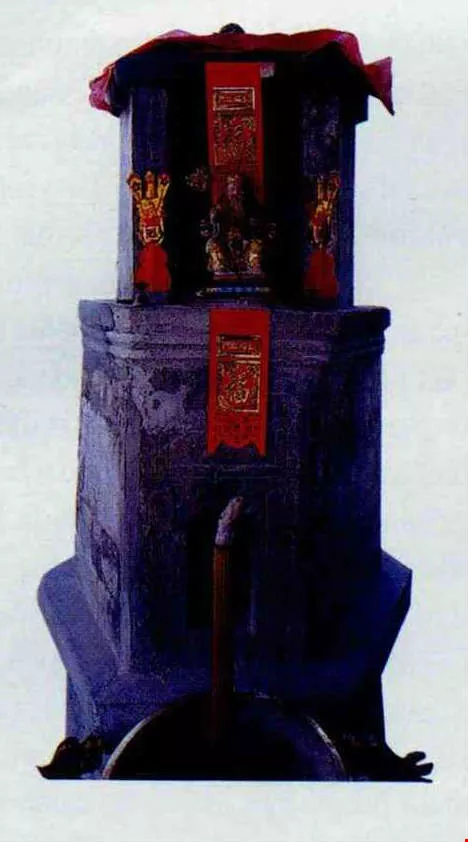
Old Uncle Earth can be found throughout Hakka villages. This "booth for venerating the written word," formerly used for the respectful incineration of paper with writing on it, is dedicated to "Old Uncle.".
Sitting on the ground, looking at the sky
Closer inspection reveals a stone tablet in front of the mound, embraced on both sides by stone balustrades-called "curved arms,"-and bearing the inscription: "Meinung Village's Founding Uncle." Hung Hsin-lan of the town's neighborhood association explains that the forefathers of today's Meinung residents settled in this location 260 years ago, and built their first "Founding Uncle" at the foot of Lingshan mountain. Later, as the settlement grew, they built the present Founding Uncle next to the East Gate. The history and location of the founder's altar thus testifies to the early history of the town itself.
As Taiwan has developed economically, its mound-shaped Earth Lord altars have gradually disappeared from the landscape, partly because people pitied the poor god stuck outdoors exposed to wind and rain, and partly because worshippers wanted more convenience. It also became a fashion to rebuild the old altars. Some were converted into little shrines where offerings are made to gilded figurines of the god and his "earth god wife." Meinung's much-revered Founding Uncle was not rebuilt, however. As Mr. Chen, a "rites-master" in this year's New Year Blessing ceremony for Old Earth Uncle explains: "We did consider building a big temple for Old Uncle, but repeated casts of the divination blocks indicated that the god was firmly opposed to this idea." What's more, adds Chen, Founding Uncle is a vegetarian, and he doesn't want a wife.
The mound form of Meinung's Founding Uncle can actually be traced back to the worship of the "God of the Land" in the Shang and Zhou dynasties.
When people first began to learn farming and to develop a close relationship with the soil, they believed that the land gave birth to all things for the nourishment of mankind, and hence they started worshipping gods that governed the land. In some places, a heap of earth was used to directly represent the greater world, and in others, trees were planted or standing stones erected-symbolic of the earth from which they came-as the focus of earth worship. The mound-altars of the Hakka people are descended from just such "earth gods," and similarly the great leafy trees that usually grow alongside today's Earth Lord temples are themselves a throwback to those early "tree gods." The building of covered temples and the personification of the deity were much later developments.
As to the refusal of Meinung's Founding Uncle to have a proper temple built around him, historical writings testify to the special significance for Earth Lord of sitting directly on the ground under the open sky.
Wu Yi-te, director of the Traditional Arts Center at Shu-te Institute of Technology near Meinung, refers to a quotation from the Book of Rites: "Imperial worship of the god of the land must take place outdoors, under the elements, that it be open to the vapors of the cosmos." In ancient Chinese history, whenever a country was overrun, the invader would complete the annihilation by raising its enemy's national god-of-the-land altar from the ground on a bed of timber, and covering it over to cut off contact with the sky.
One old grandma who has come to worship at the outdoor altar may not know much about the historical antecedents, but she exclaims: "Rain? Who cares? It's just a face wash for Old Uncle!" Huang Hung-sung, who compiles educational materials about the Meinung locale, says: "Compared to those Old Uncles stuck indoors in temple niches, some even barred off in case of thieves, a traditional god sitting outside on the earth itself, with an open view all around, gives much more sense of the unity of heaven, earth and mankind."
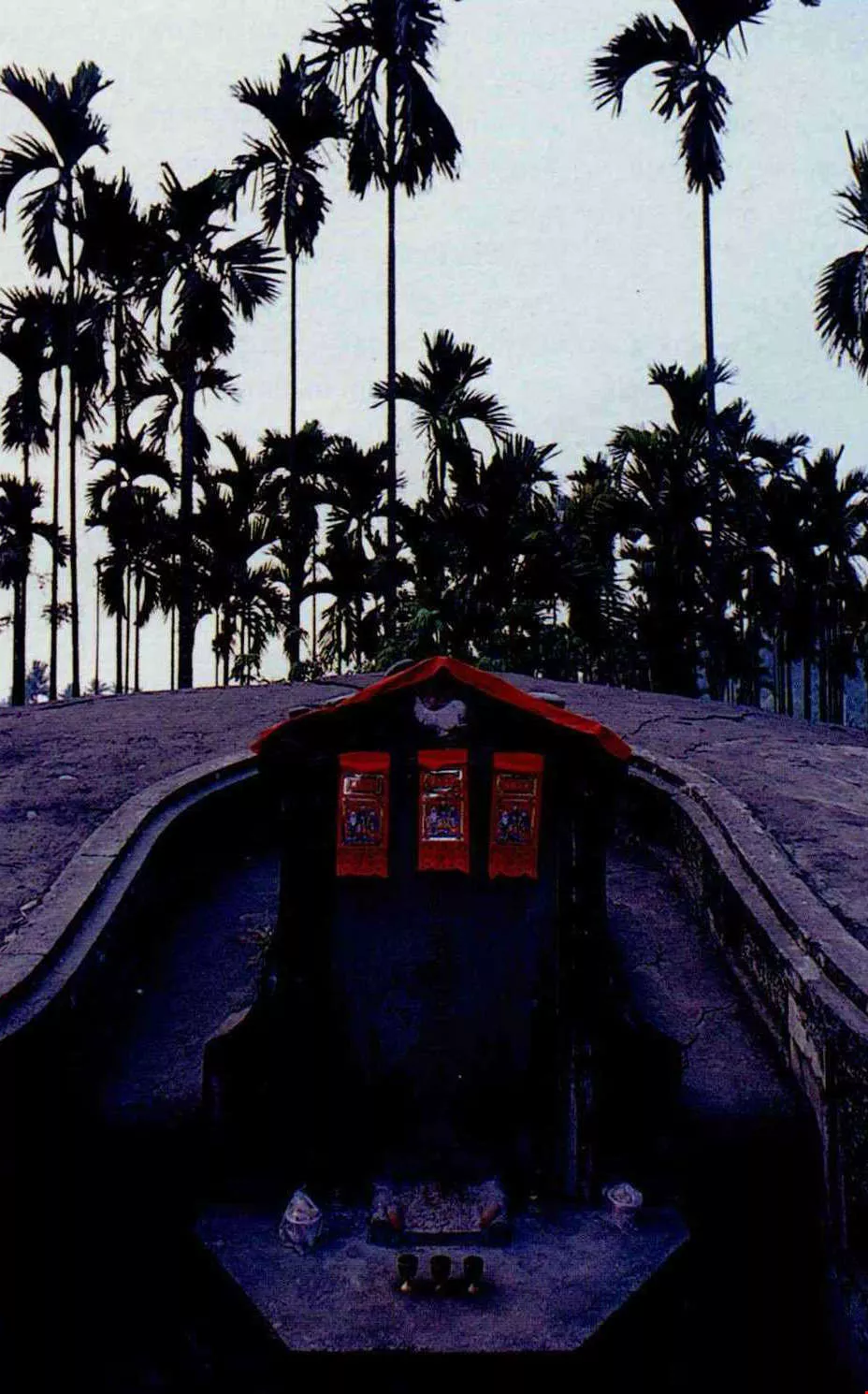
Lishe-Zhenguan is the earth god who watches over the local water supply. Meinung is the only place where the god and his ancient title have been preserved intact.
The Old Man of the Land and Water
Grave-shaped altars are not the only feature of earth god worship that date back for millennia. A few years ago the planned widening of County Highway 184 between Meinung and Liukuei threatened to slice right through a mound-shaped altar to the "Lishe-Zhenguan Lord" in Lungtu, near Meinung. Fortunately, local residents were able to save the altar, the best-preserved example of its kind in Taiwan, and at the same time have it designated as a county-level site of historical importance.
Who is the Lishe-Zhenguan Lord? Lin Mei-jung, a researcher at Academia Sinica's Institute of Ethnology who has studied Earth Lord beliefs in the town of Tsaotun, Nantou county, explains that in ancient times, sacrificial rites for the god of the land took place at all levels of society, from the emperor, to the dukes, to the common people of every district. The smallest unit of such worship was the lishe, a li being a single community of 25 households, which indicates how prevalent such worship was among the ancients. Since lishe ritual was handled by the local people themselves, it can be considered a precursor of today's Earth Lord observances in Taiwan. As to the Zhenguan, or "True Official," this was a name for the Water God, so the Lishe-Zhenguan Lord was in effect the earth god in charge of local water resources.
Water supply was the most important determinant of success for early agriculturists, and competition for water resources was often the cause of pitched battles among groups of settlers. This is why Old Uncle Earth is often found alongside watercourses, guarding the precious flow at its "tail end," where it exits from the village. As Lin Mei-jung points out, this use of Earth Lord to "guard the water's tail" shows how important water resources were for people in the past. Sure enough, Meinung's three Lishe-Zhenguan shrines are all located next to running water.
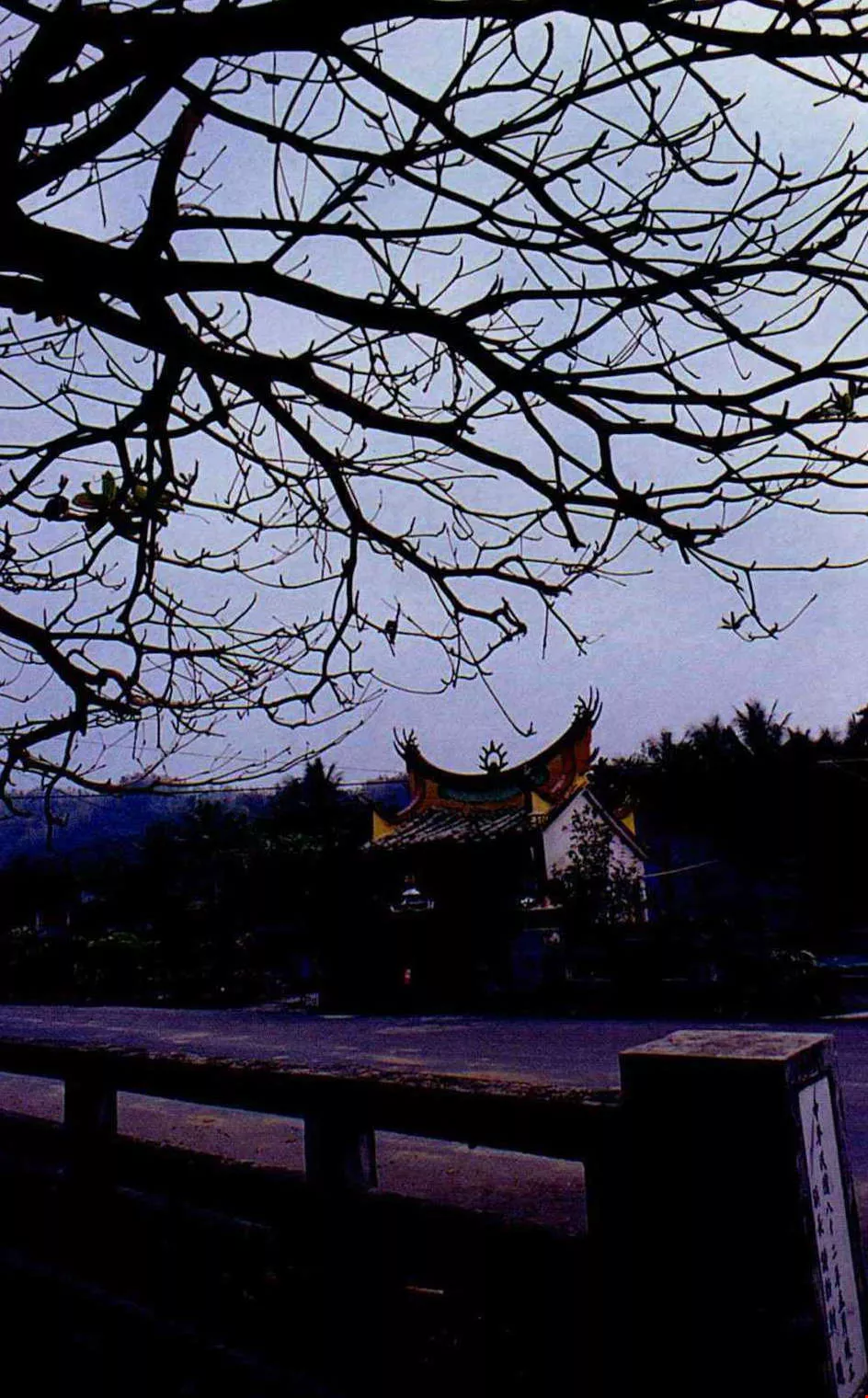
At the entrance to the village, in the fields, by the waterway, next to bridges. . . wherever there's earth, the earth god is there.
In the Hakka community of Tunglochuan, Taoyuan County, there is a temple dedicated to Old Uncle Shuimei ("Water-beauty"), which likewise stands guard over the channel where water flows out of the village. As 80-year-old villager Hsiao Ah-hai explains: "Shuimei is actually just a nicer way of saying shuiwei ('water-tail')." Another old lady from the village, who lives at some distance from a source of water, recalls that girls of the district would weep inconsolably when they married into Tunglochuan. Instead of wringing out freshly washed clothes, Tunglochuan women carried them home where they squeezed out water for the ducks to drink. Such was the difficulty of obtaining water, that the villagers all came to the shrine at New Year to thank Old Uncle Shuimei. In fact, water and land are inseparable for farming peoples, which is why Earth Lord himself doubles as the custodian of local water resources, and settlements with certain Chinese characters in their names, meaning "-pond" or "-pool," almost always have an Earth Lord who is connected with water. But outside of Meinung, nowhere else has kept alive the ancient name of the Lishe-Zhenguan Lord. Earth Lord under the altar
From the fields, bridges and waterways, to the gardens, vegetable plots, forests, cow-pens and pigsties, Earth Lord is there for them all, blessing the whole district with healthy domestic livestock and an abundance of grain.
As is written in the Book of Rites: "Zhongliu is master of the home, and She [god of the land] is master of the state." "Zhongliu" is the name of the earth god that people keep in their houses, a custom that still plays a part in Hakka life.
On entering the main room of a Hakka home, where the family altar stands, one may notice a simple stone marker or strip of red paper underneath the ancestral memorial tablet, inscribed: "Earth Dragon God."
As Hakka family elders confirm, "the Earth Dragon God is another version of Earth Lord, but he's only responsible for the area inside the home." On either side of the Dragon God's tablet, a couplet reads: "Good fortune (fu) as plentiful as the earth; Virtue (de) as boundless as the land," or "Good fortune multiplied, like the mountains and rivers; Virtue eternal, like the sun and moon." The use of two characters at the head of each line that combine to form Fude, Earth Lord's name, underlines the fact that this Dragon God, who governs the inner fengshui of the house, is in fact none other than Old Uncle Earth himself.
As to why the Dragon God has to content himself with a place underneath the altar, the legend is that emperor Zhu Yuanzhang of the Ming dynasty was traveling incognito among the people on one occasion, and stopped for refreshment at a busy inn. Since he couldn't find a proper place he sat down at the table used for making offerings to Earth Lord, first removing the icon and putting him on the ground. The innkeeper later lifted the god back on top of the table, but that night he dreamt that Earth Lord spoke to him, saying: "The emperor put me on the ground, I dare not get back on the table."
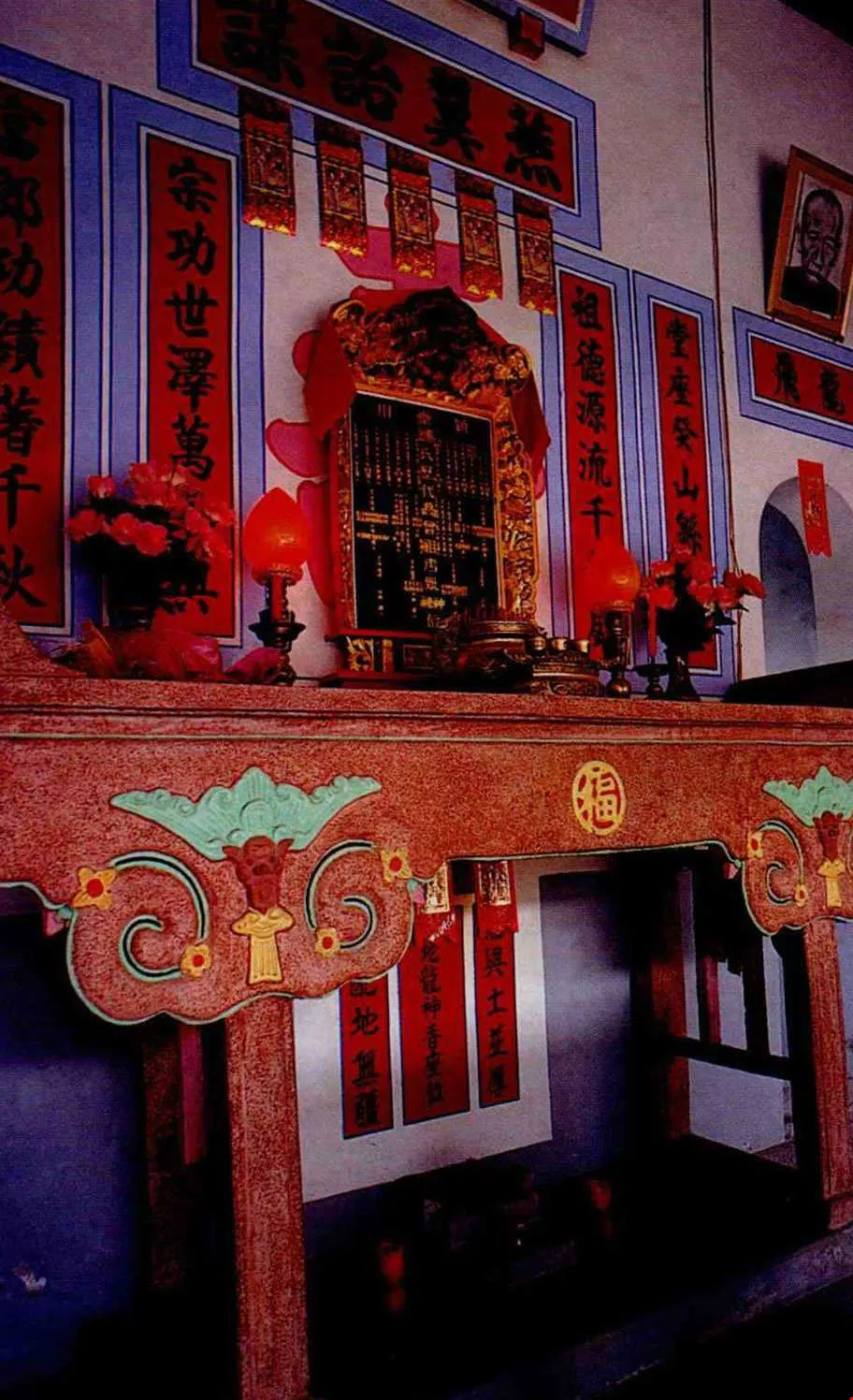
In Hakka homes, the Earth Dragon God dwells underneath the family altar in the main hall, from where he blesses the house with good fengshui, and ensures that successive generations enjoy well-being and brilliant achievements. Families that are especially serious about their observances also have a special "Dragon Door' at the rear of the hall, through which the god can enter and exit.
It may be just a legend, but it demonstrates that the custom for keeping Earth Lord on the ground, under the altar, is one that dates back to ancient times. As it says in a poem by the Qing dynasty man of letters Feng Xianghua: "Don't raise the god up high to venerate him, it's easier for him to operate down on the ground; He'd rather meditate in peace unmolested by the world, so stash him below the altar to avoid common mortals." In fact, Earth Lord is neither afraid of the emperor nor worried about being bothered by people, says Lai Chih-chang. "It's simply that as the earth god, he needs to be in contact with the ground." Womb of mother earth
Among both the Hakka and the Min'nan peoples, when a new house is ready, or if there is some sort of disturbance in the district, a ritual is performed in the home or temple to "pacify the dragon and thank the earth." But it is only the Hakkas who place the Dragon God tablet underneath the family altar at the end of the ceremony, so that as they pay their routine respects to the ancestors and the earth god, they can ensure peace and safety for both their forebears and their descendants.
During the dragon-pacifying ceremony, the officiating Taoist priest heaps dry rice on the ground and spreads it into the form of a dragon, using eggs for its eyes and coins for its scales. Later, he guides the spirit of the Dragon God into the house along a red thread. At the end of the ceremony, paper models of the dragon's head, tail and claws are burned in a pottery urn. The urn is then carried out through the "dragon door" at the rear and buried under a mound at the back of the house. This mound, called the huatai (meaning both "incubator" and "raised flower bed") is where the Dragon God dwells in peace.
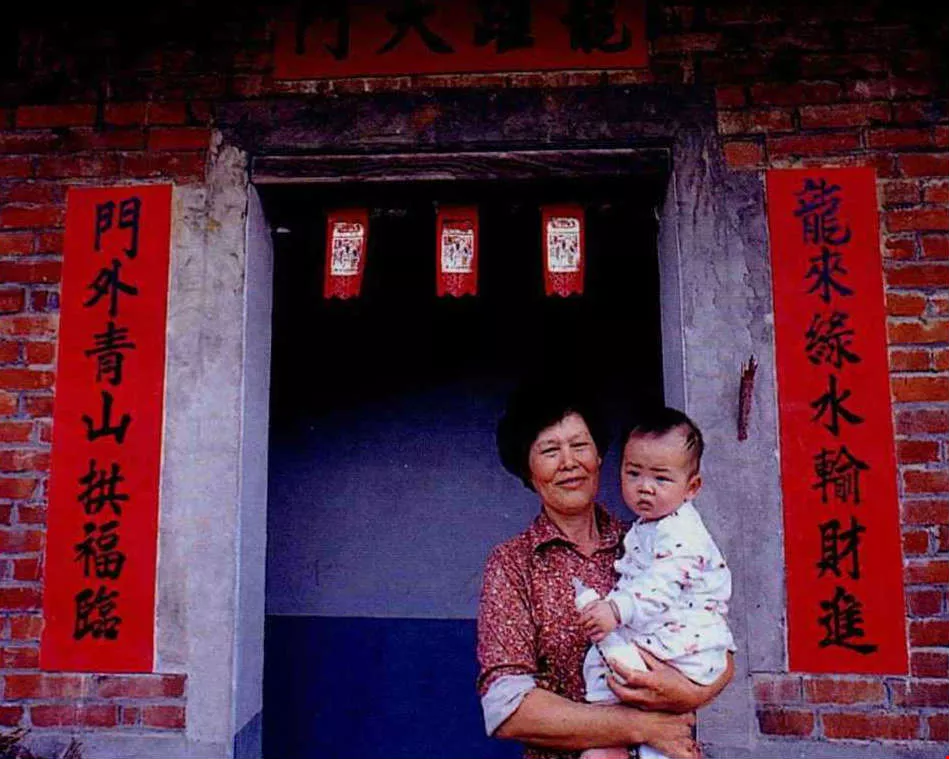
In Hakka homes, the Earth Dragon God dwells underneath the family altar in the main hall, from where he blesses the house with good fengshui, and ensures that successive generations enjoy well-being and brilliant achievements. Families that are especially serious about their observances also have a special "Dragon Door' at the rear of the hall, through which the god can enter and exit.
Lai Chih-chang notes that the lay-out of grave-sites, Hakka mound-shaped altars, and traditional Chinese houses, simulates the form of the human body, in line with the concepts of fengshui. "A pair of curved 'arms' reaches round on either side, like hands wrapped around the pregnant bulge of the huatai. As well as providing a firm backrest for the god's tablet, the huatai symbolizes a mother's womb, open to the essences of the universe and giving birth to all creation, and is the most important part of a traditional building." Community caretaker
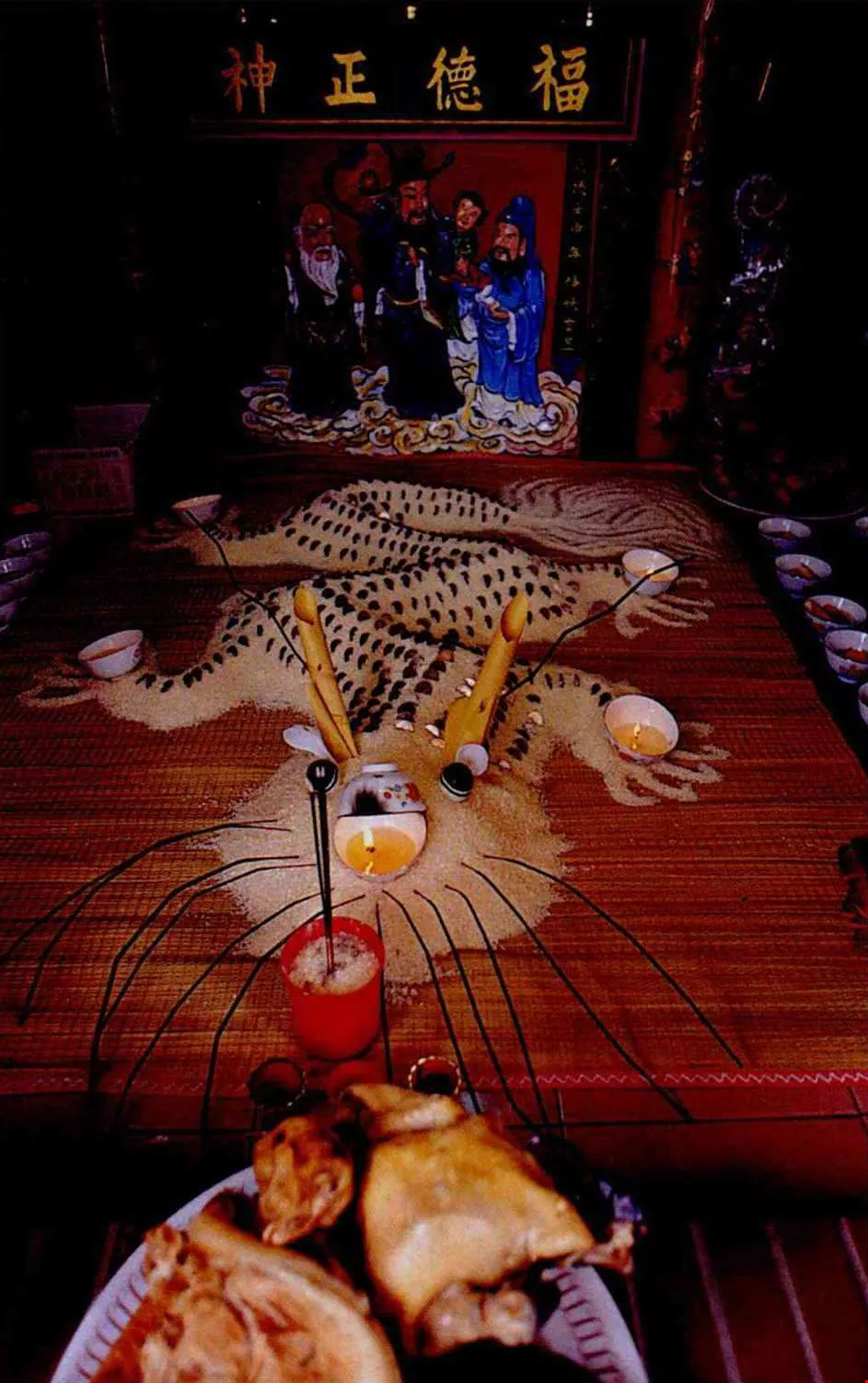
Before breaking ground for the construction of a new house, or when the locality is somehow unsettled, a Taoist priest is brought in to perform a ceremony, called "pacifying the dragon and thanking the earth," in order to restore harmony. The priest heaps dry rice on the ground and shapes it into the form of a dragon.
Unlike other gods that roam at will and exercise authority throughout the land, Earth Lord adheres firmly to his own turf, and is therefore particularly close to the local populace. When villagers give birth, the news is reported to Earth Lord, and when they pass away, it is Earth Lord who escorts them across the threshold into the nether world. In the village of Sheliao in Puli Township, the Earth Lord temple not only protects the district but also provides loans for families facing a crisis, like any rotating credit association. You can even request help from him, like the local "bobby," if your car gets stolen. And in Meinung, a red banner draped in front of the Founding Uncle altar at the East Gate, presented by a local believer, reads: "Praying for sons, for wealth and for honors; for academic success and for peaceful well-being." Chang An-sheng, a local senior who sweeps the altar at 4 a.m. every morning, remarks: "Old Uncle here grants whatever you request. He's especially effective with requests for examination success!" Once the divine protector of the land, Earth Lord has become protector of the whole community. Spring prayer and Autumn thanksgiving
The lunar New Year celebrations are over, and another year begins. By tradition this is the time of the "Spring Prayers," when rural people ask Earth Lord for a successful year on the farm, and for general peace and well-being. In the fall, once the harvest has been gathered in, they requite Earth Lord for his blessings with an "Autumn Thanksgiving," when many farmers erect "Earth Lord Staffs"-bamboo poles festooned with "lucky money"-beside their paddy-fields, both as an expression of gratitude to the god, and as an aid to him in his perambulations among the fields. Nowadays, the Spring prayers are observed on the second day of the second lunar month, which is Earth Lord's birthday, and Autumn thanksgiving is observed on the fifteenth day of the eighth month, the date that Earth Lord ascends to heaven. By tradition, there is always a rousing celebration, and a sumptuous feast shared by all.
It's late in the first lunar month in Meinung. The weather is getting warmer, the surrounding fields are already green, and the New Year Blessing ceremony is being held for Founding Uncle. At around five in the afternoon, amid the traditional sounds of Hakka bayin music, nine rites-masters headed by a Taoist priest appeal on behalf of Earth Lord for the gods to return from their "New Year vacation." One of the rites-masters, Lin Jung-an, says that more than 460 locals paid to take part in this year's ceremony. Later, at around eleven o'clock that night when the ceremonies are over, guests are invited to partake in a special dish, called "at-peace" congee.
This congee includes the stewed flesh from all the sheep and pigs used in the ceremony, along with special stir-fried Hakka dishes such as tripe with shredded ginger, and fermented soya beans in chopped organs. Hung Hsing-lan says that it is essential to stay till the end, both for the food and the atmosphere. When everyone is sitting together with their steaming bowls of congee, after a long day of ceremonies and having received the blessing of the gods, "it's like having the whole village get together for New Year's eve dinner." However, an even bigger feast takes place the following day, when over 400 people gather for lunch as guests of Old Uncle Earth.
Sure enough, shortly after eleven o'clock the next morning, there are 50 big round tables set out in front of Founding Uncle's altar, all fully seated with local people young and old. Everyone is relaxed and happy now that the official ceremonies are over, with people warmly calling to one another and playing with each other's kids. Li Feng-mao, researcher at the Academia Sinica's Institute of Chinese Literature and Philosophy, feels that what makes this occasion different from most other temple feasts is that it brings a whole community together to "share the good fortune," having jointly completed their rituals of prayer and received blessing from the gods.
After the first two or three dishes, the children get down from the table and begin to play, some sitting on the altar and eating the offerings of fruit that have been set out there, while others clamber about on Old Uncle's huatai under the big tree. Says Huang Hung-sung: "It's only at the Old Uncle altar that kids can climb onto the offerings table without getting told off." That's how close the god is to the Hakka people.
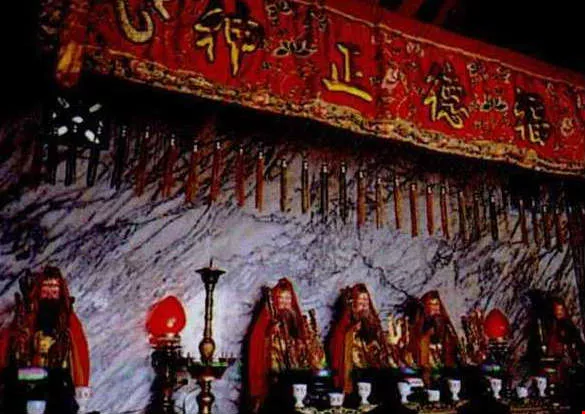
"The Earth Lords are all crowded onto the same bed!" With the exodus of people from rural villages, some residents, worried that Earth Lords were being left without any worshippers, have grouped their gods together at shared altars. (photo by Vincent Chang)
Viewed from afar, Old Uncle really does seem like a kindly old protector of the local folk, seated solidly on the ground, letting little children play about on top of him as he watches over his revelling people. A few lines by the Song dynasty poet Lu You come to mind: "Sacrificial meats all around, and rich sacrificial wines, local people all at worship, wishing for a year of abundance; For the picture of a universe all at peace, no better image do I know of than the rumbling drums of the earth god celebrations." Dispossessed of his land
During the last two years, researcher Lai Chih-chang has covered almost every inch of Taoyuan County, from country byways to city boulevards, searching out every single Earth Lord temple. Along the way he has witnessed much land development, with considerable consequences for the local Earth Lords. In many of the more remote mountain districts, the population drain has led to Earth Lords being consolidated together for joint worship, while in major industrial areas, and sites where large development projects are in progress, numerous Earth Lords, suddenly deprived of their own hideaways, now have to cram together at a single altar. Meanwhile, temples in areas with economic clout are repeatedly refurbished, and built ever larger than one another.
On the other hand, in the less-developed villages of Paiyu and Kuanghsing, in Taoyuan County's Kuanyin Rural Township, Lai was deeply struck by the presence of earth gods in some of the very smallest Earth Lord representations. He says that when he first arrived in these two villages, he found it strange that there were none of the usual Earth Lord shrines to be seen, and wondered if perhaps the locals didn't even worship the god. But when he asked one of the old inhabitants about this, the man exclaimed: "Of course we do! I'll show you where." It turned out that what the old people venerated as Earth Lord, "was actually just four large stones piled on the ground," says Lai.
An old lady in one of the villages also told him that there was an Earth Lord right next to her house, but Lai's first reaction on seeing the site was: "How come there's nothing here?" On closer inspection, all he saw was incense sticking out of the ground, and an offering of wine, sheltered by a little grove of bamboo. "Well what's Earth Lord supposed to look like?" remarks Lai, as he presses his palms together in an attitude of prayer. "That's exactly how Earth Lord appears in his most natural state!"
In Meinung, however, growing prosperity means that many such formerly "bodiless" Earth Lords have gradually evolved from stone tablets into human figurines, with altars before them and large temples for their homes. The intention is good, but who knows how well Earth Lord can withstand these developments? As Earth Lord moves ever further from nature, do people still remember his "down-to-earth" character, and the gentle interaction that there used to be between people and the earth?
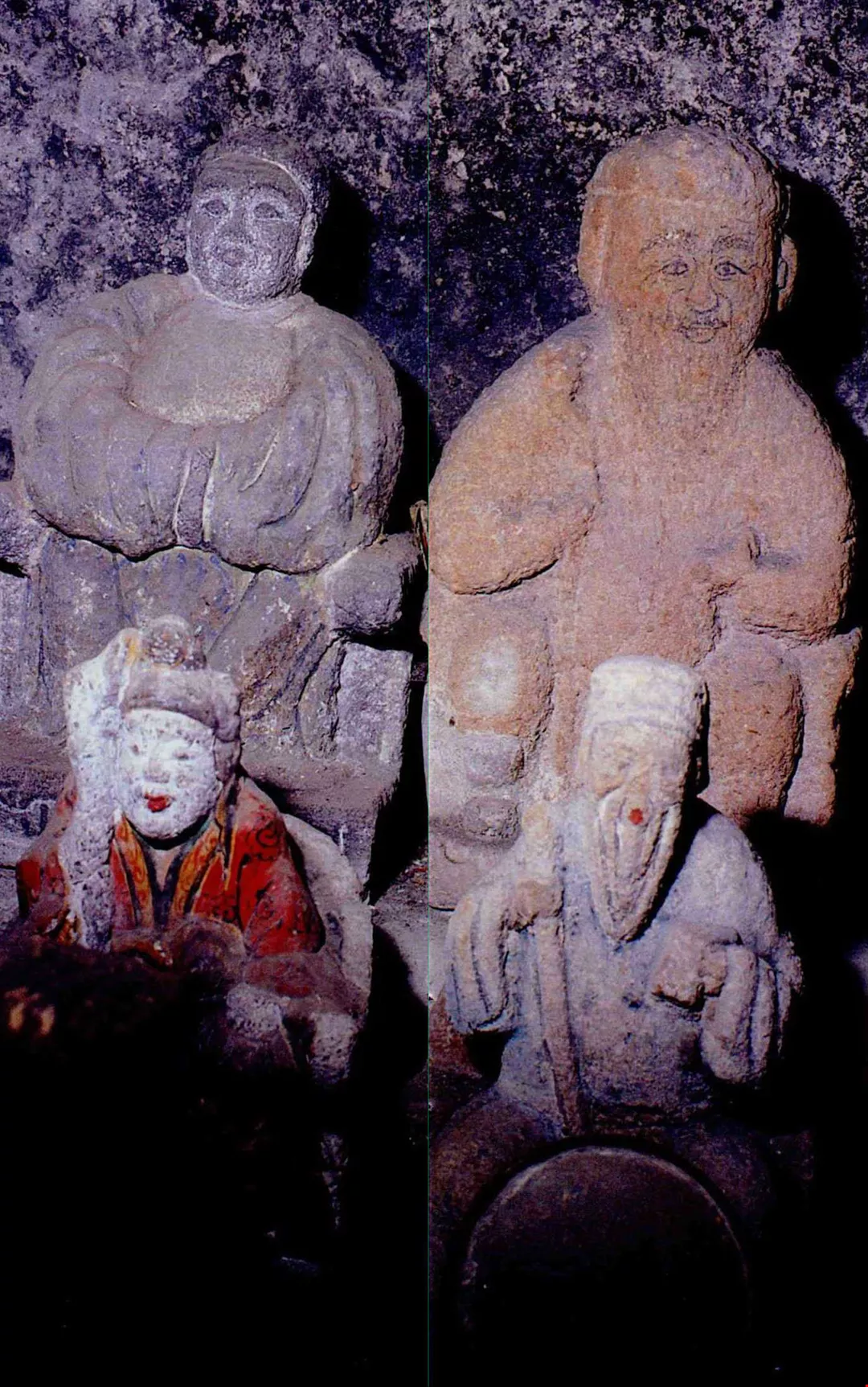
Earth Lord was originally a nature spirit who later took on human form. Considerate believers also produced a wife for him. The picture shows Fushan Temple's "Lord and Lady Earth" in the village of Chiufen, Taipei County. (photo by Vincent Chang)
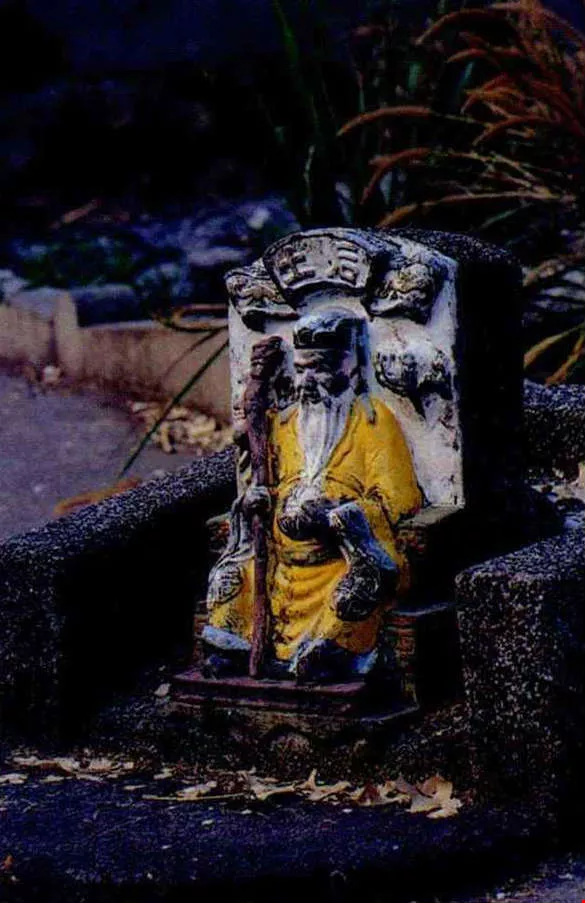
As well as managing the earth, Earth Lord is said to escort the dead into the next world, which is why he is on hand to watch over the graves of the departed.


