Wu Chien-shiung and Evelyn Hu: Two Chinese Women of Science
Sam Ju Li-chyun / photos Lan Chun-hsiao / tr. by Chris Nelson
October 2008


Nicknamed the "Madame Curie of China," Wu Chien-shiung (1912-1997) is one whose name is worthy of chronicling in the annals of Chinese science. Though she was passed over for the Nobel Prize, the achievements for which Wu is acknowledged worldwide have long surpassed any honors recognized by an award.
The Chinese-American scientist Evelyn Hu (born 1947), Wu's only female protege of Chinese origin in her latter years, is currently the sole woman of Chinese ancestry to be a fellow of both the US National Academy of Sciences and the National Academy of Engineering.
Furthermore, Wu and Hu are the only two women to have become fellows of Academia Sinica's Division of Mathematical and Physical Sciences. Wu passed away in the US in 1997 at the advanced age of 84, but 61-year-old Hu is now at the zenith of her academic career.
If not for her recent invitation to give a lecture on Wu, perhaps Hu never would have thought, after 33 years of a career in science, that she'd have a chance for a detailed look back at her relationship with her mentor.
As Chinese women in the US, these two scientists shared a special bond, intertwining two different life experiences from two different cultural backgrounds. Combing through her memory, Hu realizes that she had unwittingly internalized in her character Wu's persistence and passion for science, and like a daughter growing up and becoming a mother, she has now taken on the maternal role with her own students.
January 16, 1957, was a seminal day in the world of international physics. Early that morning, the front-page headline of the hot-off-the-press New York Times declared, "Basic Concept in Physics Reported Upset in Tests." The Law of Conservation of Parity-that the natural world, including the subatomic world, has a left-right symmetry like a mirror image-had been disproved at the end of 1956 by scientists at Columbia University and the American National Bureau of Standards. One of the key scientists was an experimental physicist who was a world authority on beta decay research in nuclear physics: Wu Chien-shiung.
The report stated that Wu, using cobalt-60 as a beta particle emission source and with the temperature controlled at an ultra-cold 0.003 Kelvin (approx. -273°C), corroborated the hypothesis of two other Chinese physicists, Yang Chen-ning and Lee Tsung-dao, proving that parity is not conserved in weak interaction, one of the four fundamental forces of the universe.
Bright and early that day, Evelyn Hu, then only ten years old, opened the newspaper and read each word in the article with excitement, her hands trembling as she clutched the paper. She elatedly read aloud the name of the scientist: Wu Chien-shiung, Madame Wu.
Hu's father, an engineer, told her: "She is the greatest physicist in all of China!"
Hu noticed that this "Madame Wu" was like her parents: both she and they had come to the US from Shanghai to build their careers. But what Hu at that time could not have known, and could never understand, was why Wu, a key researcher in the parity tests, was not on the roster of candidates for the 1957 Nobel Prize in Physics, which was awarded to Yang and Lee.
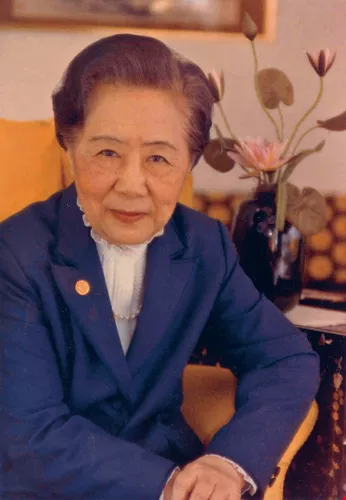
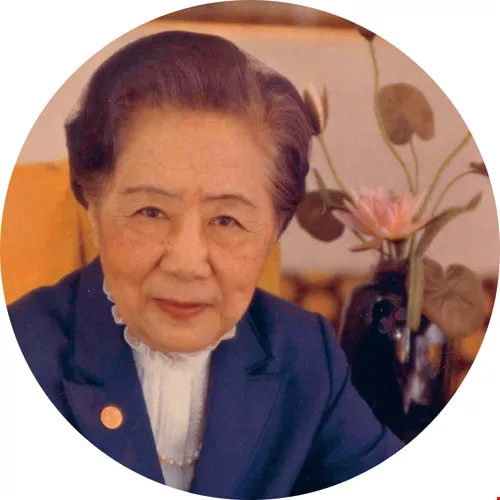
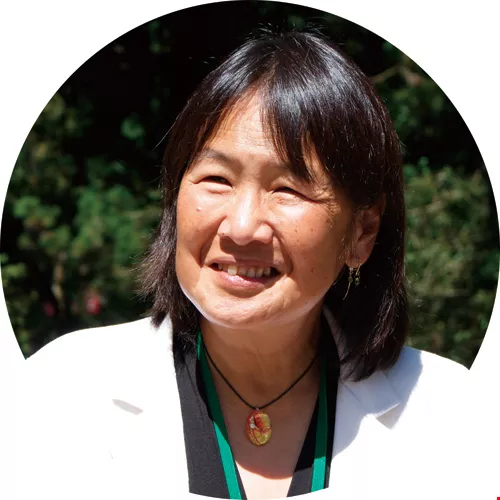
The men have met their match in these two women! UC Santa Barbara professor Evelyn Hu has inherited the scientific mantle of Wu Chien-shiung, the "Madame Curie of China" (left, courtesy of Wu Chien-shiung Education Foundation). And like a daughter growing up to become a mother, she has also taken on the maternal role with her own students.
Mentor and protege
Columbia University is an important institution in American physics, and the Hu family happened to live nearby. Under her father's influence, Hu showed an extraordinary gift for math and science in her youth. When in high school, Hu met Wu for the first time in science camp; perhaps the organizers introduced Hu to Wu because they were both Chinese. At that time, Hu was even able to understand a few words of Wu's Shanghai dialect.
In 1969, upon graduating summa cum laude in physics from Barnard College, Hu entered Columbia University to pursue graduate studies in physics, and in 1971, as she had hoped, started studying under Wu, researching particle and accelerator physics. At the time, Hu was 24 and Wu was 59.
Columbia University's physics department was located in Pupin Hall. This building, named for Columbia alumnus Michael Pupin, was a crucial research center for the Manhattan Project during World War II. At the invitation of J. Robert Oppenheimer, the father of the atomic bomb, Wu joined the project in 1944, and she remained at Columbia University thereafter.
After the publication of the parity experiment in 1957, the New York Times, Time magazine and other media outlets vied to report on Wu's scientific achievements. But they derided her treatment of students in the lab, dubbing her the "Dragon Lady."
A 24-hour lab
Noemie Koller, an early student of Wu's who became Rutgers University's first female professor, once described Wu thus: "She worked herself as hard as her students... very demanding... she wanted people to work late at night, early in the morning, all day Saturday, all day Sunday, to never take time off."
Wu was already 60 at the time, but she worked at least 12 hours a day in the lab, every day throughout the year. Hu, 24 when she joined Wu's lab, at first couldn't get used to Wu's workaholic ways.
Several times, she and her classmates arrived early at the lab only to find a note left by Wu on the desk, expressing her dissatisfaction with the students: "I came here at such-and-such a time; why weren't you here?"
Hu admits that at first she wasn't willing to go to the lab on weekends, and hoped that Wu wouldn't call her at home during vacation to check on her progress.
But Hu could understand why Wu made such efforts. She says, "Dr. Wu showed students by her own example that science is a lifelong devotion, so even if we complained we wouldn't dare slack off."
From 1971 to 1975, Hu did her doctoral research under Wu, who was working on two large-scale projects in addition to her particle accelerator experiments.
Hu recalls that Wu had great confidence in her own expertise and showed huge determination-once the goal was decided upon, she would not stop, forging ahead to the bitter end even when the experimentation had hit a dead end.
For instance, when conducting double beta decay tests, Wu was already an international authority on beta decay; thus, when designing experimental procedures and preparing lab apparatus, she would entrust others to handle them. When faced with tough problems, she would go back to familiar theoretical principles, adjust her approach, and start over, instead of giving up halfway or finding a new topic to work on.
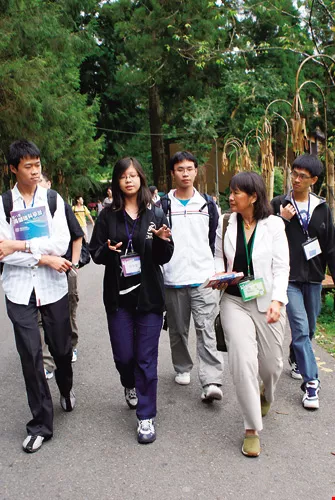
There is no end to passing on scientific knowledge! Students participating in the Wu Chien-shiung Science Camp ask questions of Hu (second right) after their classes.
See the whole picture
Five years later, Hu completed her doctoral dissertation, titled Mass and Magnetic Moment of the Antiproton. Wu then asked Hu what her plans were after receiving her degree.
Hu once read words that Emilio Segre, Wu's PhD advisor, had said as a reminder to Wu: "You have to stand back from things and see the whole picture." This statement inspired Hu to ask some questions of herself.
"What are the important problems to address? What talents and interests do I bring to those problems? What contributions do I want to make?" After deep reflection, Hu realized that she could not be like Wu, devoting her life to particle physics, because that wouldn't be right for her field, and it wasn't where her ultimate interests lay.
That was a time when superconductor technology and micro-fabrication were burgeoning fields, which the top labs in the US were eagerly working on. Hu says, "I 'innocently' told Dr. Wu that there was a vacancy at New Jersey's AT&T Bell Laboratories, and that I wanted to try out for it."
Wu harbored no resentment at Hu's choice to move from a theoretical field like particle physics to more practical areas like solid-state physics, surface physics and materials engineering, and did not blame Hu for leaving the fold. On the contrary, she saw it like marrying off a daughter, wishing Hu the best in following her own path.
At that time, Wu was chosen to serve as the first female chair of the American Physical Society, with a great many connections. By chance, Bell Labs was recruiting on the Columbia University campus, and Wu took it upon herself to recommend Hu to their higher-ups.
Just keep walking forward
Hu successfully landed a job at Bell Labs, but felt out of place. The fields she worked in-solid-state physics, superconductivity, semiconductors, micro-technology, nano-engineering and so forth-were entirely different from the particle and accelerator physics that she had studied under Wu. She had to learn new scientific jargon and familiarize herself with different scientific journals, passing her days in a hectic, arduous fashion.
At this time, she kept repeating these words her head: "Just keep your head down and keep walking forward."
She remembered how Wu used to encourage her students: "When you encounter challenges, when you encounter new ideas, when you feel that you are a stranger with a tremendous amount to learn, the only thing to do is put your head down and try to make progress."
"What I had learned at Pupin Hall was very different from the experiments I was doing at Bell Labs, but it helped to think of it as 'reaching the same goals by different means.' They were the same in spirit," says Hu.
In 1984, Hu came to a second defining moment in her scientific career, which was moving from her long-time East Coast stomping ground out to UC Santa Barbara, where she began her current teaching position for the Department of Electrical and Computer Engineering. And more recently, she became director of the California NanoSystems Institute.
In the past 24 years, Hu has conducted a great deal of cross-disciplinary research in fields such as materials science, nanoscience, optoelectronics and even biology, studying how to attach metals and semiconductors to virus nanostructures in order to build solar batteries. She has written numerous papers on these subjects, published in eminent international journals like Nature and Science.
After leaving Pupin Hall in 1975, Hu gradually drifted apart from Wu, especially after Hu's move from New York to California and her departure from particle physics into engineering. But she had blazed her own successful trail in science.
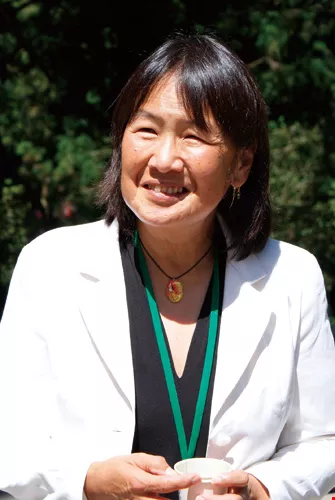
The men have met their match in these two women! UC Santa Barbara professor Evelyn Hu has inherited the scientific mantle of Wu Chien-shiung, the "Madame Curie of China" (left, courtesy of Wu Chien-shiung Education Foundation). And like a daughter growing up to become a mother, she has also taken on the maternal role with her own students.
Two generations, two roads
In 1936, Wu set sail from Shanghai, bidding farewell to her kith, kin and country as she departed for the US to study. Her career in science began in California and finished up in New York. Hu, a generation later, started studying under Wu in New York, and later built her academic career in California. These women of two generations traveled opposite roads in their scientific lives, and experienced different twists and turns.
Hu says that Wu started her career in scientific research in 1940, a time when "not one of the top 20 American universities had any female professors." Columbia University's physics department at first invited Wu to teach as a "senior scientist," but refused to grant her a professorship because she was a woman. It was only in 1958, two years after the revolutionary parity study was published, that Wu received her professorship at the age of 46, nine years older than did Hu at 37. The social restrictions faced by Wu and the pressures of competition for scientific resources were greater than those faced by her protege, Hu.
"How difficult!" says Hu as she describes the hardships of Wu as a pioneering woman of science. Even though Wu was in her 60s during the 1970s, she still had to foster her graduate students, set up her own lab apparatus, and even compete with male scientists for research funding. In Hu's view, this was not easy.
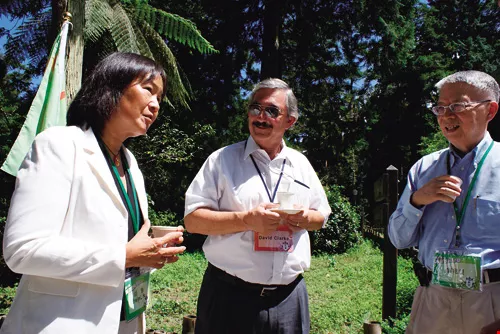
Hu (left), accompanied by her husband David R. Clarke (center), also a scientist, made her first special trip to Taiwan to speak at the Wu Chien-shiung Science Camp. At right is Liu Chao-han, chairman of the Wu Chien-shiung Education Foundation and vice president of Academia Sinica.
Two cultures, two personalities
For Wu, born and bred in China, homesickness was an anguish she kept ever in her heart. While in the US, she wrote a letter to her mentor Hu Shih, stating that she had originally planned to return to China after finishing her studies. But she could not have foreseen that the world situation would change so drastically, and this left her in a quandary about what course to take.
Even though she learned of the deaths of her brother and father in 1958 and 1959 while she was in the US, it wasn't until 1973, 37 years after leaving China, that she finally went back. But her nearest and dearest had all passed away, and their graves were destroyed during the Cultural Revolution, saddening Wu. Given her self-disciplined, resolute personality, she never talked about these circumstances in front of her students. Even Hu, who didn't know much Chinese and had never experienced the mayhem of war, would not be able to understand the heartbreaking experience of returning to a home long gone.
"Dr. Wu was very Chinese," Hu recollects. The most striking impression Wu gave people was her habit of wearing a traditional Chinese qipao with its collar fully buttoned up, plus her neatly combed hair tied tightly behind her head with nary a strand out of place.
And when Wu spoke English, she could not hide her Shanghainese accent, at times of crisis letting slip Sinicisms like "aiyo"!
"At that time, Chinese women living in the United States, even ones who had successful careers there, would live a lifestyle that made them feel free, such as wearing qipao or eating Chinese food." In Hu's eyes, Wu was like her mother.
But Hu affirms that Wu was truly internationalized in science: "Dr. Wu often traveled around the world to attend international conferences and corresponded with scientists from many countries, and thus in her scientific thinking and experience, she had broken free from the bounds of 'Chineseness' early on."
Thus, "Cultural 'Chineseness' and scientific 'internationalness' coexisted simultaneously in Dr. Wu," Hu avers.
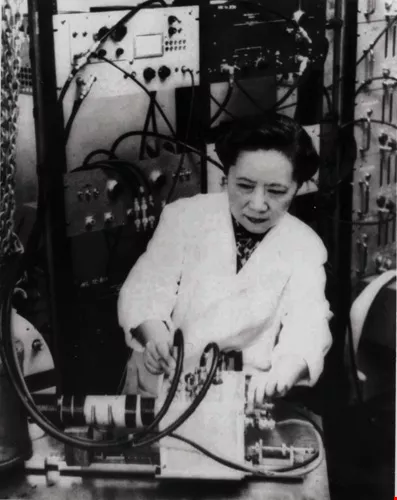
Teaching by example instead of by fiat, Wu maintained strict self-discipline in the lab, working daily for 12 hours or more and requiring her students to make a similar effort.
A daughter becomes a mother
"Unwittingly, Dr. Wu influenced my academic life, says Hu. Perhaps not until I became a professor did I understand what it was like to advise other students.... I did, and I truly remember."
Hu sometimes still thinks of that note Wu left in the lab for her students, and remembers Wu's 24-hour monitoring. She may once have complained and grumbled, but now she recalls a totally different experience.
"There are times when I get so excited about an idea that I have the urge to push my students to go into the lab right then and right there... not to take vacations, not to eat... can't they understand how important it is?" Thinking back to that complaining girl in the lab, Hu is astonished at how much she has changed.
"Can't they see the importance of the experiment? Don't they know that their efforts could change the world?"
Learning from a mentor
In mid-August 2008, at the invitation of the Wu Chien-shiung Education Foundation, Hu made her first special trip to Taiwan to take part in the Wu Chien-shiung Science Camp and share the apprenticeship experience she had had with Wu. Hu's husband, David R. Clarke, a professor of materials and mechanical engineering at the same school and a fellow of the National Academy of Engineering, sat listening before the dais.
Hu at last noticed in herself Wu's absolute love, passion and devotion for science. But Hu has this to say to every young, budding scientist: "This something, this drive, this love, this passion, I think has to come from each of you."
"You can look toward the examples from someone you admire, you trust... you can take their judgment and accept it... but ultimately, for you to give your time, your effort, your love, it has to come from you."
"You have to know what you can get out of the research..., whether it's the beauty of understanding physical phenomena that nobody else has appreciated, whether it's a new device that solves energy problems, whether it's something more modest that gives you a feeling of accomplishment, because it's something you thought about and you made it happen."
Watching the expressions of the 150 students seated before her in the audience, Hu thinks of a girl who, more than 40 years ago in New York, had the same dream for science and who had the same yearning expression when she saw Wu on the stage.
"Thank you, my teacher," says Hu to Wu as she concludes her lecture.


@List.jpg?w=522&h=410&mode=crop&format=webp&quality=80)


