From a Wild Fire's Torrid Heat to a Mother's Warm Embrace --Lung Ying-tai's Ten-Year Transformation
interview by Laureen Liu / photos Diago Chiu / tr. by Jonathan Barnard
May 1994


What does the name Lung Ying-tai bring to mind? An impassioned flag-waving heroine, shouting with indignation?
After a ten-year absence, Lung Ying-tai has returned to readers' notice here in Taiwan with three collections of essays, each with its own distinct style. The End of the Century coming at You enters the realm of historical investigation, serving as a record of this Taiwanese intellectual's understandings and intuitions about the world. Beautiful Rights is a brash and forked-tongued women's book, Children, Take Your Time a record of a mother's joy.
Wait a minute . . . . How is it that the two compilations of her more recent work, The End of the Century and Children, have none of her old confrontational, passionate, and sharply critical style. True, in The End of the Century she still shows an intellectual's contemplative acuity, but is that gentle and kind glowing mother of Children the same woman who wrote Wild Fire, a collection of critical political and social writings, ten years ago? When you see her face on the cover of Children, you're tempted to shout, "There must be some mistake!" How could this woman breastfeeding in the sunshine be Lung Ying-tai?
It's true; they're all Lung Ying-tai. It's just that after raising a child, that "brash youth" has become "a serene middle-aged woman." Coming back this time and publishing these three books has documented her development in various directions. There are the contradictions and struggle between being "an individual" and being "a mother." And there are also observations and questions she's made while visiting countries undergoing dramatic change. As in Wild Fire Collection, she invites readers to look at her writings and think with her.
Writer Hsiao Man has reviewed the three books, and Sinorama's Laureen Liu has conducted an interview with the author, which follows.
Q: Today, when no one cares about serious writing and when literary books are taking a beating in the market place, the hardest to digest of the three books, Looking at the End of the Century Coming at You, had a first printing of 5000 copies that surprisingly sold out in the first week. The two other books in fact sold much better. How do you explain this?
A: Truthfully, I'm not sure. Everyone often says that in Taiwan materialism runs rampant, that it's a nouveau riche country, spiritually dead and lacking in refinement, a society with no heroes--literary or otherwise. But if that's the case, why did these three books sell so well? What this tells me is that Taiwan may appear to be at a loss, just floating along aimlessly, but perhaps in its heart it craves things that go against the current. Maybe it wants something more than just the flatteringly gaudy, something that's more than just bubbles.
Is this explanation correct? I don't know. But the book sales sure have been comforting to me. Writing by myself in a foreign land is like knocking on the wall of a dark cave. I don't know if anyone's listening. Coming back this time, I heard a "Hey!" A reply. Somebody was listening. It was a really good feeling.
Q: The essays in Beautiful Rights all seem to have been written many years ago. Why did you wait until now to bring them together in a collection? Why did you stop writing?
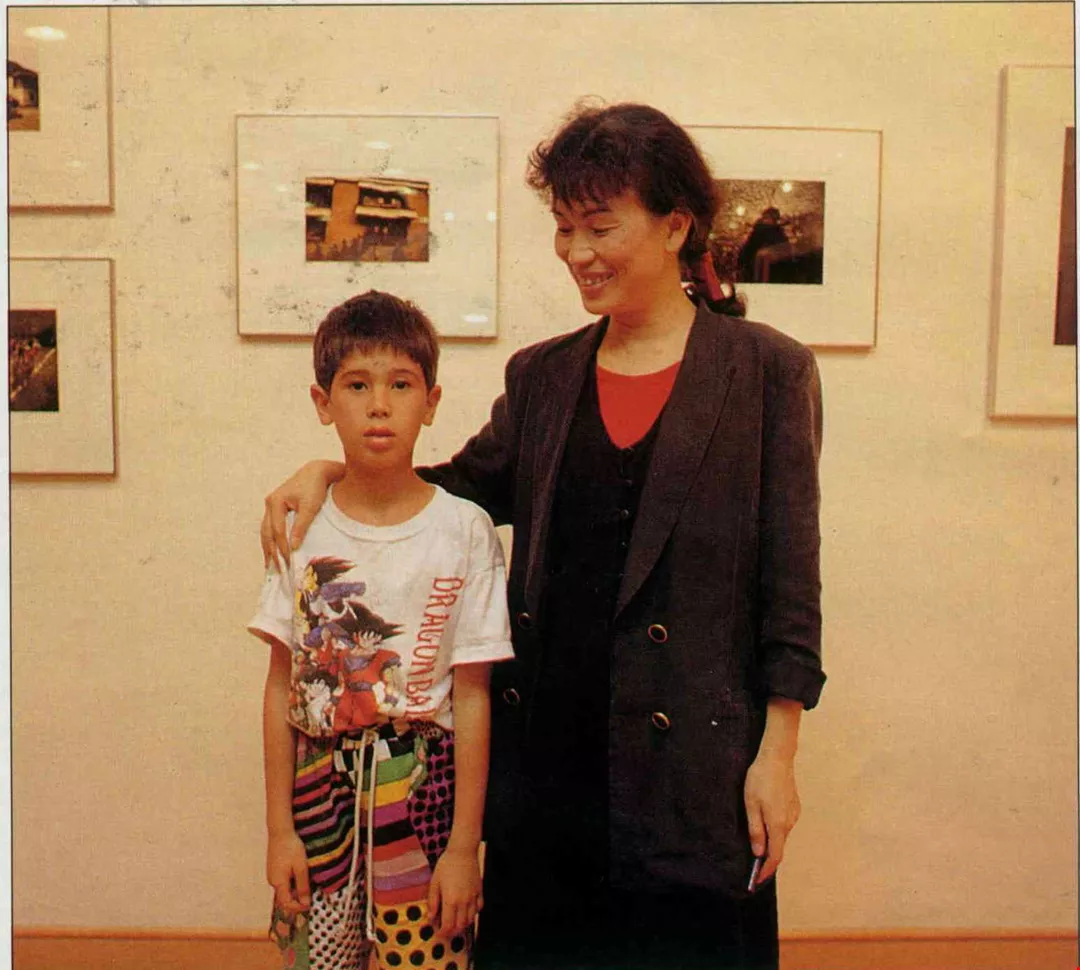
Lung's oldest son An-an. Loving her children deeply, Lung threw her body and soul into Children, Take Your Time.
Caught in a spider's web
A: Hu Mei-li (Lung's pen name) stopped writing eight years ago because she had children. These shook up her life, making her unable to write on. From being purely her own woman, she had suddenly become part of the social structure, a mother. It was like getting caught in a spider's web; there was no way to move. This huge and unreasonable social structure had her pinned down.
Of course, at this time, she tried to adjust herself, tried to find her way. It was a truly difficult process, something completely different from the joy of being a mother. Children, Take Your Time is full of the joy of motherhood, but a person isn't just a mother. The personal part of herself was in a quandary.
She discovered that all of the feminist theory she was aware of couldn't help her, that the maternal and personal sides of her character were locked in constant battle. She wanted to strike a balance but couldn't find one. And so on the back cover of Children is printed this question: "Feminists, if you haven't had the joys and pains of childbirth and motherhood, what do you have to tell me?" This isn't an expression of doubts about feminism but rather a cry for help.
I believe that what Hu Mei-li did eight years ago wasn't very difficult--that is, that it wasn't difficult for a women to fight for equality with a man. But once you are a mother, and you love your children very much, when you face a child who virtually has no capacity to defend itself, there's no way to fight for equality with him. When children are thrown into the equation, the problems between the sexes get very complicated. They went beyond what Hu Mei-li could handle at that time.
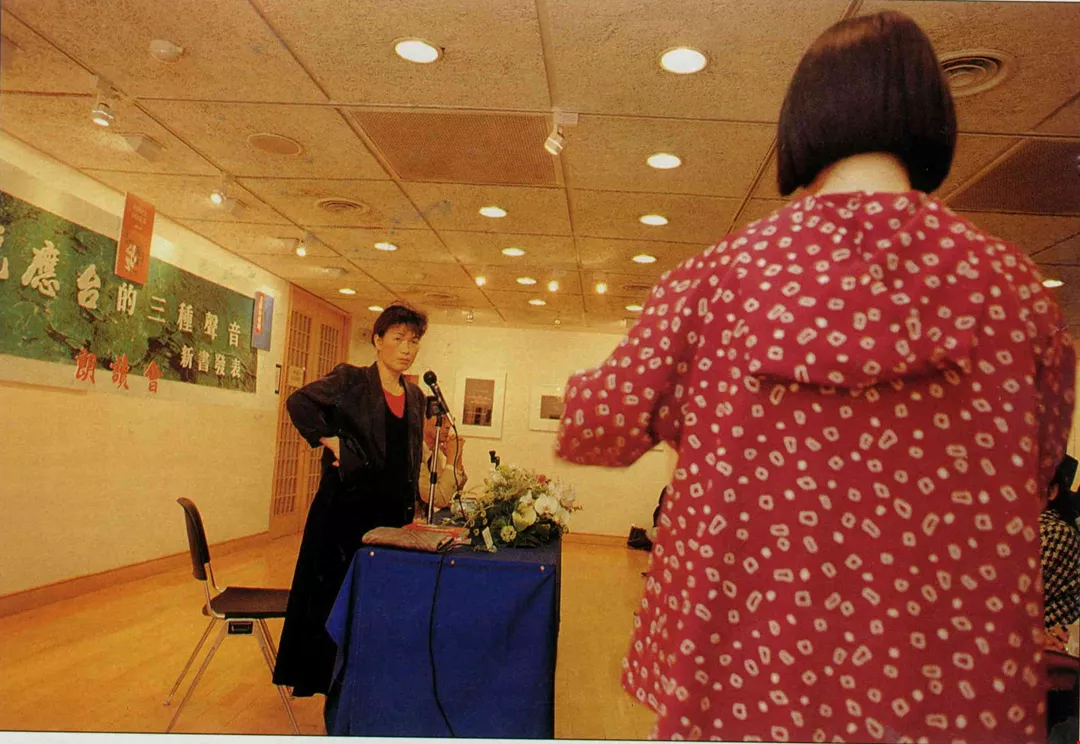
At a reading entitled "The Three Voices of Lung Ying-tai," Lung's readers--whether they were old, young or middle-aged--showed the sentiment of "waiting for a hero.".
Hu Mei-li will write again
When her own feminist thinking had come to a dead end--and at a time when feminism was offering no solution to the problems of her own life--what could she say to her readers? Anything she could say would be hypocritical.
Once I was tempted to throw this whole book in the garbage, and I declined to publish it. But on pure chance eight years later--just a few months ago--I saw a report in the paper about a woman working for a credit cooperative who was fired because she had married and gotten pregnant. I was shocked. How could Taiwan still be like this? It was like we had gone back in time. And so I thought that these essays might still be of value, and at the last minute decided to go ahead and publish the collection when I was already half way through the publication process for the other two books. The preface, which is in reality a confession of a failed feminist, is new. The message was: I've lost! I've lost to these unreasonable social structures!
To get the whole picture, look at the essays along with the preface--eight years ago with eight years later. It's one troubled book.
Q: In that case, is Hu Mei-li never to be heard from again?
A: I think that Hu Mei-li will definitely return but with a new method of presentation. Yet the topics will be the same, for they will just be extensions of those of the past.
Q: The father in Children seems to play only a supporting role. Why was this the case? Shouldn't raising children be a job for two?
The father as "a real man"?
A: Ideally, raising the children should be both parents' job, but what I'm dealing with now isn't an ideal situation. The father in our home is extremely successful in his career, and he is completely absorbed by his work. I have been continually emphasizing how unfair the structures of this society are, and it's the same for men. He is in fact a man who really likes children. But in this society he feels that to be a real man, he's got to bring home the bacon and be the good provider for his family. Once he got on his career track, he couldn't get off.
These unreasonable social structures limit the possibilities for a man to be close with his kids and limit the possibilities of a women's career. Particularly in Germany, as long as one salary can support a family, then usually the mother--even if she is a doctor or professor--will stop work and focus on the children. And she won't go back for many years. In women's rights, Germany is very backward. Correspondingly, men's social responsibilities are by necessity larger.
In this situation, my husband himself is frustrated. He can give very little time to the children. And so Children, Take Your Time--much to my regret--became a story of a mother and two children. This book is in fact a kind of living proof that the social structures are unreasonable.
Picking Germany's extreme
Q: Once you said if you had to set out your priorities in life, your first would be your children, followed by your writing. In the current situation in Taiwan, many professional women, knowing that they can't have it all, choose their career as most important even if they dearly love their children. How is it that you have made your choice so confidently, without looking back?
A: One aspect is that I love kids, these cute little creatures. Another aspect is that I see the situation in Taiwan, and I feel it's unfair for children. As parents, we bring children into this world without their permission. And once they're here, we go back to being busy with our careers. I feel that this is a kind of breach of faith. There are many women, especially well-educated women, who put themselves first. If you want to put yourself first, then why do you want to have children to begin with? Don't have kids!
Of course, I understand their pain. These structures of society don't support women playing the double role of professional woman and mother. Basically, the German system puts care for the child first and correspondingly sacrifices the potential development of women. In Taiwan, women sacrifice the happiness of their children in order to advance themselves. These are two extremes, neither of which I like. But if I had to choose between them, I'd pick the German one because young children, the most fragile of beings, have no way to defend themselves.
My children come first
Take that incident in Pingtung, where kids stuck in a kindergarten bus died. This showed just how thin is our care for children, the most tender of weak creatures.
First, why is it that infants have to ride a school bus? In a normal and healthy situation, you can walk, holding your four-year-old's hand, and reach the kindergarten within five minutes. I think the existence of these school buses for young children is frightening in and of itself.
Next, punishing children with isolation, by locking them in the bus, is a measure of shame. Sure, this kind of thing was common decades ago, but today? Haven't we changed at all?
Thirdly, it's a basic problem of safety. There's just one taboo for mother drivers: at no time leave small children in a car alone--because as soon as a child grabs the clutch, the car will start to move. Something that just isn't supposed to happen, happened.
If you think of me as a so-called model, then children in their infancy definitely come first for me, without complaints, without doubt--because I wanted them. Perhaps it just has to do with treating other people fairly.
Q: Your children are in Germany, but you always speak to them in Chinese. Do you have any intention of getting them to identify with Chinese culture?
Children identify with where they are
A: No. You can see that I talk to my sons about a lot of things Chinese. Their Chinese is also very good. But I am just opening up a cultural window for them. I've never said to them, "You are Chinese. You have the Chinese cultural tradition. You should identify with this or that. . . ." We live in Germany, and I want my children to identify with the land where they live. Let them be happy as Germans.
When the older one comes back to Taiwan, he plays with Taiwanese kids. Taiwanese kids don't know that he's a foreigner; he's also a happy Taiwanese kid. Our generation was taught to identify with the culture of the central Chinese plains, but our feet are planted in the soil of Taiwan. I had enough of this kind of education in alienation. I don't want it for my children. A child naturally identifies with wherever he lives.
Q: "The end of the century" --is usually used to describe cultural decadence. It also appears in one of your books. Could you explain?
A: The term "the end of the century" --or "fin de siecle" --is widely misused. Essentially it has a very narrow meaning, describing an aesthetic style in France at the end of the 19th century. Since it's only this, it doesn't have anything to do with cultural decadence. In the preface to the book, I point out that "the end of a century" is just an abstract construct in people's heads. What is an "end of a century"? Time is always going forward.
I use this phrase because it suggests that I've looked at the history of this century, that "I've seen it rise and seen it fall." As is written in the preface, I see an empire crumbling, beliefs collapsing, heroes falling, particularly in the great changes happening in Eastern Europe, the disintegration of the Soviet Empire, the coming down of the Berlin Wall. I was there. Feelings amid the ruins always run particularly deep. This is why I choose this title.
Q: Regarding the three books that you have just published, what the media have talked about most is that you've undergone great changes in style and image. The brashness of Wild Fire is nowhere to be seen. What's replaced it is more gentle criticism and a motherly tolerance. Why?
Ten years before, ten years later
A: If you compare Wild Fire Collection with The End of the Century Coming at You, which came ten years later, you can see that it's not just my thinking and perspective on things that have changed; my literary style has changed too. Many people have described it as "harmonious," and I think that's very appropriate. As for where this harmony has come from, I think there are several sources:
First, it has to do with how I've grown; it is closely tied up with my becoming a mother. All my knowledge and scholarship had come second hand. The only first-hand knowledge I've gained is through my children. I've gone through the process of giving birth, and that is about as first-hand as they get. At the same time, observing the process of growth after a person is born adds a startling new perspective to one's understanding of people. This is extremely important.
Secondly, it's also connected with entering middle age. Having entered middle age and seen a lot of the world, I have discovered that doing as I did in the Wild Fire days--using the coordinates of my experience and knowledge to explain the phenomena in front of me--is not enough. I've turned my gaze backward and started reading history. As soon as I started delving into history, it suddenly became clear that so much of what is happening now--the big and the little--is a repetition of history. Even people's reactions are a repetition. This knowledge is certain to give you a deeper understanding of the phenomena in front of you. And your perspective and process of understanding will be entirely changed.
In addition, the purpose of Wild Fire Collection was completely different from the current books. Wild Fire Collection was trying to cure an ill, and it was a bitter pill. The approach was confrontational, and the purpose was to reform society. My current works don't have its passion or stridency, but they have a deep and calm harmony. This is a writer's development. Taiwan doesn't need strident, direct and passionate criticism, but deeper, calmer and more distanced reflection.
Q: You say that after you turned 40, you stopped reading politics and only read history. From an historical perspective, what do you think of the current situation in Taiwan?
Crumbled myths, fallen heroes
A: The fact is that Taiwan is going through the process of heading toward ruin that I wrote of in The End of the Century Coming at You. Taiwan sees a disintegration of her political myths, its political regime has virtually collapsed, and you see the heroes fallen. The bronze statues have all been pulled down, haven't they? Hence, the crisis in Taiwan is different from the time of Wild Fire Collection.
Ten years ago, Taiwan's crisis was in the disintegration of its myths; it was pulling its icons off their pedestals. Now the problem is that society has to move forward, and after having pulled down its icons, we've got to establish new models. This new model is moral and orderly; it is social consensus and is what is essential for a civilized society. In this respect Taiwan is still a child taking its first steps. It can pull down its icons but doesn't know what to put up in their place. It's still stumbling, and so there are now lots of strange phenomena.
As for this chaos of all kinds, I understand life amid the Taiwan masses. Everyday one is irritated and feels angry and depressed. Being abroad has given me a little perspective. It's like in photography: the farther away, the broader one's perspective. What I see is not just Taiwan's problems; I also see the mainland's problems, Palestine's, and the problems in Eastern Europe.
But I'm still optimistic. As I see it, history develops along a curving line, with peaks and valleys. Or it's like a clock's pendulum, swinging back and forth. So when you hit the valleys, when there is a so-called bankruptcy of belief, the idealists will soon follow. The curve will rise because society can not be without models, and people cannot be long without beliefs. I believe that Taiwan's problems are related to its stage of development and not problems with its essential character.
History can't be pushed
But our opinion leaders must let the public understand the crisis of freedom and the necessity of rebuilding after destruction. This is very difficult work. In this day and age, such farsightedness isn't much in evidence. Chinese intellectuals, particularly in the media, swarm like hornets. There are too few independent and cool voices. Be that as it may, you can't be overanxious. Western Europe passed through 400 years of groping. And this four centuries of groping we want to buy from them in 40 years. What you get is the process in which the mass transit system has been built! You can't use money to buy the cultural accumulation of history. You've got to give it time.
Q: Finally, please tell us your feelings about returning this time.
A: I've gotten a lot from returning this time. I call myself "a writer in exile." Exiled to Germany, I'm very lonely when writing because I'm removed from a Chinese-language environment. As far as a writer is concerned, his language is his homeland. Often, alone in my study, doubts come rushing in: "Why are you writing these things? Do these things have any value? Is anyone going to read them?" Then when I come back and have contact with the reader, I feel very happy. "There really are people who care about what you're writing." This really keeps me going.
Q: Although this time you announced that you were tired of playing the role of social reformer, standing on the cutting edge and leading the people, the audience at readings diligently asked big questions about where Taiwan and the mainland are headed. Young people in particular wanted you to give them direction. Did this tell you anything?
Waiting for heroes
A: The truth is that I was a little scared. I always thought that I was growing and that Taiwan was growing too. But when I suddenly came back and saw the respectful welcome people gave me, I was a little terrified, feeling that I was still walking at the front of society. It made me feel a little lonely. I truly want a group of people to walk along with me, but I didn't feel that there was this time. And there was something else. I felt, "My God! I can't bear such high expectations."
I think that all societies desire heroes, not just Taiwan. The countries of Eastern Europe, which are now fretting about where their future lies, do also. Even a stable major country like West Germany was very confused after the reunification of Germany. They want a far-sighted hero who can take on great burdens. This desire for a hero is ubiquitous, but I don't feel I fit the bill. All I can say is that the hero Taiwan needs today is not that of the Wild Fire days, but a quiet, far-sighted intellectual who can also look back to the past. Steady amid the din of the crowd, he's got to be able to speak to society in a cool and collected voice. He can't flatter the vulgar and must be able to point to the future.
[Picture Caption]
p.83
Lung's oldest son An-an. Loving her children deeply, Lung threw her body and soul into Children, Take Your Time.
p.86
At a reading entitled "The Three Voices of Lung Ying-tai," Lung's readers--whether they were old, young or middle-aged--showed the sentiment of "waiting for a hero."


