Weaving the Past into the Present --Abin of the Bunun
Chang Chiung-fang / photos Lin Meng-san / tr. by Christopher MacDonald
January 1995


The Bunun village of Shuanglung in Nantou County is home to an old lady, in her eighties, who is the last expert in the traditional tribal craft of twelve-crossbar weaving. With her guidance and instruction, there are now good prospects that traditional Bunun weaving and dyeing skills will be passed on to future generations.
Setting out from Taipei we headed south to Ershui in Changhua County, then boarded the local train to Shuili where we wanted to catch a bus to Shuanglung. Reaching the village by public transport can be difficult, as the mini-bus only runs three times a day.
The scheduled departure time came and went, but there was still no sign of the bus. Sweating and cursing, the old chap who sold us the tickets rushed off on his bicycle to find the driver. We had been waiting for nearly an hour before the driver finally turned up, his face flushed and a reek of alcohol about him. The journey lasted around thirty or forty minutes, taking us up a winding mountain road past the villages of Jenho and Tili before arriving at the Bunun community of Shuanglung.
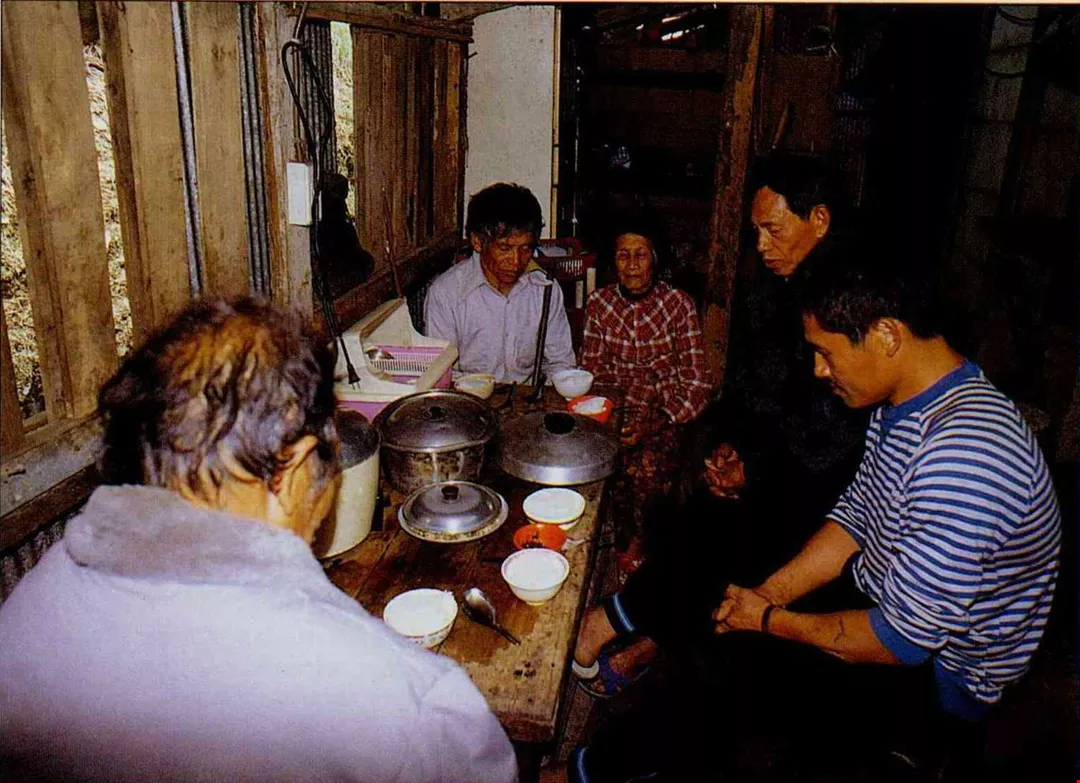
Religious faith is the most important aspect of their lives. Abin, her husband, and her son (first from right) pray before the meal begins.
A Bunun treasure
It was a bright Sunday and the sound of singing and laughter came from the village's two churches, one Catholic and one Protestant. We stopped some villagers and asked the way, but it turned out that people there are not familiar with each other's Chinese surnames, and we didn't yet know their Bunun names. Finally we had to locate the home of Sabom (Chinese name: Ku Hsiu-hung), daughter of the old weaving lady whom we had come to visit, by door numbers. We found the old lady sitting in the entrance of her daughter's house, weaving dexterously.
Seeing us arrive, the weaver smiled and nodded, greeting us with a string of Bunun phrases. The old lady does not speak Mandarin but her daughter told us that her name in Bunun is Abin. Her Chinese name is Ku Yueh-nu, and she is over eighty years of age.
Standing nearby, the old weaver's son-in-law, Laon (Chinese name: Sung Wan-chin), told us that Abin is now the oldest person in the village. "She is a treasure to the village."
Abin is a treasure not only to Shuanglung village, but to the Bunun people as a whole.
Abin's weaving has come first in three Bunun weaving competitions in the district, and items of clothing made by her have sold as far away as Japan.
Sabom tells how six or seven years ago a Japanese man came to Taiwan looking for traditional woven articles made by indigenous people. "He found my mother and asked her to weave Bunun clothes for NT$10,000 each. That was when I first began to learn weaving from Ma, to earn money." Later, however, the Japanese buyer was killed by a mugger, and the orders for clothes came to an end. Then her mother fell sick, so for a long period there was no weaving work.
Now, through the efforts of several dedicated teachers at Shuanglung primary school, Shuanglung village has set up a Bunun Cultural Development Association, and has launched a series of back-to-roots events, such as leading tribespeople on visits to the Bunun's original home, organizing a traditional "eight-part singing" group and opening a cultural resources office. The revival of traditional Bunun weaving crafts is an important part of the program, and thus Abin has become an instructor and "consultant" in the art of weaving.
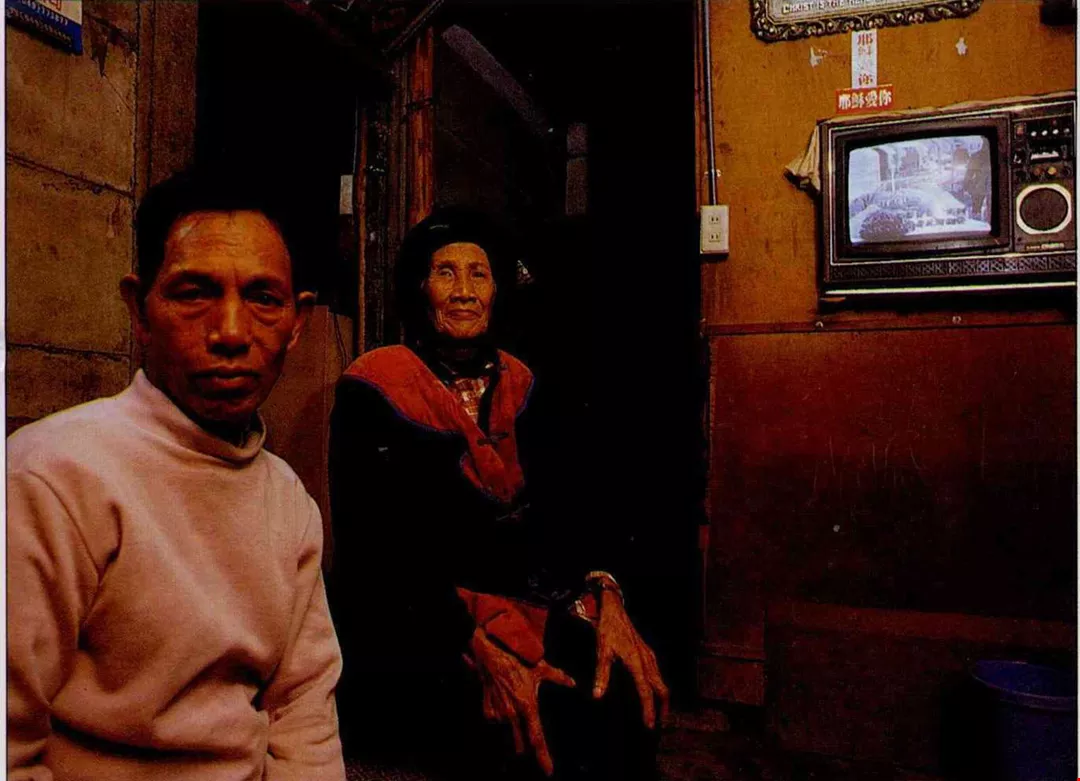
Abin's first husband died long ago. Her second husband is an expert basket-weaver.
A prayer before work
With a stick for support, Abin walks the several hundred meters to her daughter's house early in the morning. After breakfast, she opens out the plastic sheeting by the front door, makes ready her tools, and settles down with her daughter for a day of weaving. Several old ladies from nearby who are learning the craft arrive one by one and join in, starting to weave or twist thread.
In addition to voluntarily teaching women of the village who want to learn weaving, Abin has been recruited as a consultant for the weaving class at Shuanglung Primary School. The Saturday afternoon class for children is taught by Sabom and other village women who have already learned the traditional craft. Occasionally, Abin goes to the school herself to join in with the weaving.
The most marked characteristic of traditional Bunun garb is the pocket-like pouch worn at the chest by Bunun men, called a kulin. Men's clothes feature colored patterns on a white background, with the main patterns being on the back, whereas women's clothes are mainly black. According to custom, Bunun women cannot wear brightly colored clothing because of their "original sin."
The traditional Bunun method of making clothes is to weave the left and right halves separately, then sew them together up the back. The length of time needed to weave an article of clothing depends on the weaver. Fast weavers like Sabom can finish a piece in around a week, whereas Abin, who has to take frequent rest breaks, requires around two weeks.
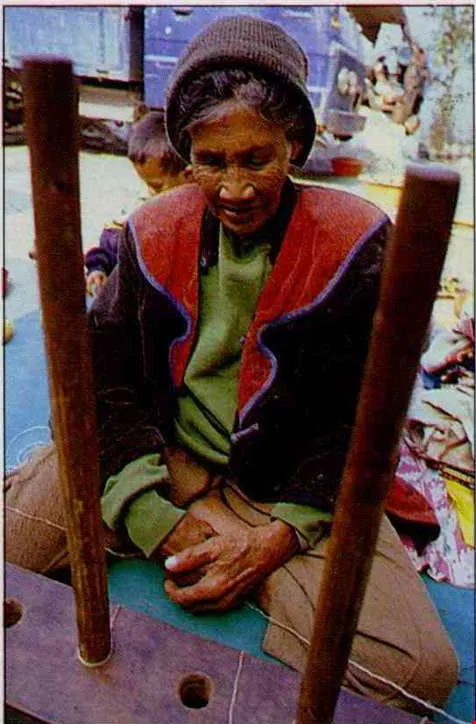
Traditional Bunun weaving involves two stages: winding the thread, and weaving it. First, it is necessary to set the length of the piece of fabric, which is done using a measuring tool with 13 holes. After measuring, wooden rods are inserted in the holes and colored threads are then wound around the rods in sequence.
After Abin has carefully measured out the length of the fabric and fixed the winding rods in place, she closes her eyes and begins to mutter a prayer. Laon explains that she prays each time before beginning, to seek God's blessing for a successful job.
After her prayer Abin begins to wind thread. With a smile she says that we are the luckiest of her visitors, because many of those who have come to learn weaving with her don't get the opportunity to see her start at the beginning, with the process of winding the threads. Watching her methodically winding thread, it is clear that she does not need to follow a design or make a trial piece. The pattern for the clothing is all in her head.
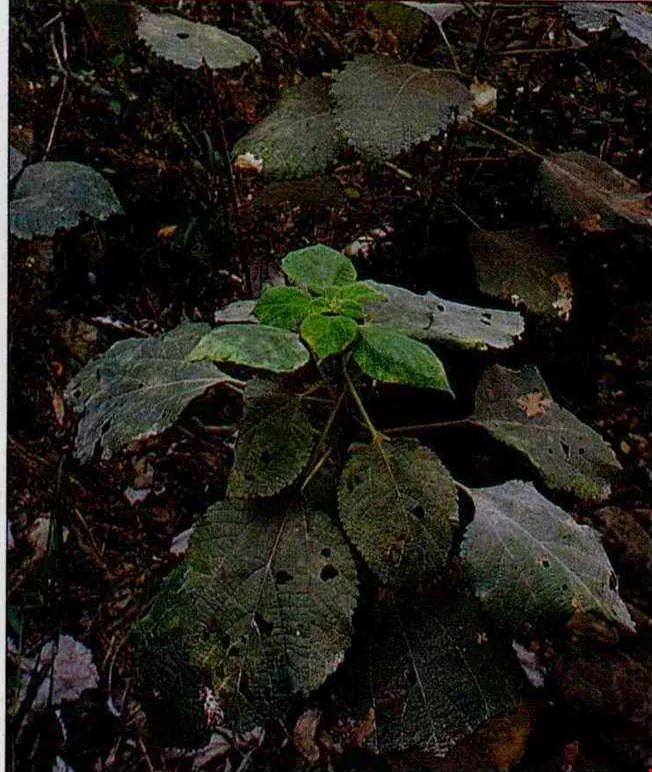
Abin's family returned to the original home of the Bunun and transplanted some ramie to the village, for use in making traditional weaving thread.
Hands and feet
Although her right eye was once injured by a branch while she was working, Abin's vision is still very sharp, and threading needles or counting threads presents no difficulty for the eighty-year-old lady.
Once thread-winding has been completed the warp of the fabric is in place, and the next task is to weave in the weft, using the Bunun loom. This traditional loom is made of firmiana wood, which is light and easy to handle. All it consists of is a wooden box with several wooden crossbars, a fixed belt and a shuttle. The weaver sits on the ground and operates the loom by hand and foot, producing clothes that are sturdy and durable.
Abin says that the hardest part of weaving is doing figures and patterns. The difficulty increases in direct proportion to the number of crossbars being used. Cloth woven with one crossbar is only one layer thick. With two crossbars you can weave inner and outer layers, but it takes four crossbars to weave a small pattern, eight for a medium-sized pattern and twelve for a large pattern.
Laon describes how a group of graduate students from Tunghai University once came to study with Abin. After learning four-crossbar weaving, they recorded the pattern on a computer, hoping to produce the same results with a machine, but with no success.
Under Abin's instruction, several women in Shuanglung village have learnt four and eight-crossbar weaving, but so far the only other person to have mastered twelve-crossbar weaving is her daughter Sabom.
Regrettably, almost all the clothing made by Shuanglung's "weaving family" has left the village. In addition to the pieces woven for the buyer from Japan, there have also been clothes made for collectors in Taitung and Taipei. The one piece of traditional Bunun clothing remaining in Sabom's home has been loaned by the village to the town of Puli, for use in wedding photography. In fact the only finished article that can now be seen in the village is the one on display in the Shuanglung Primary School cultural resources office.
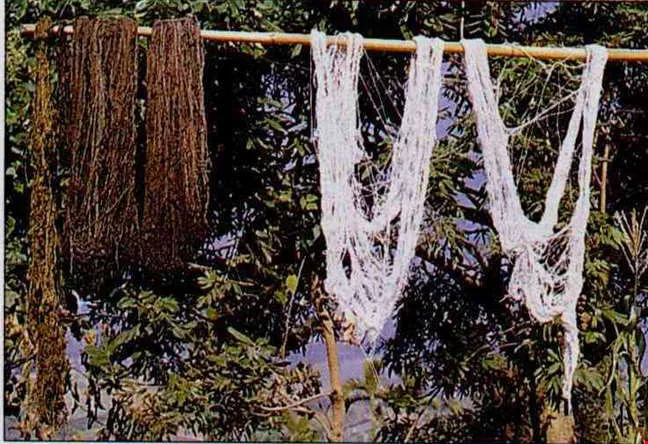
The raw thread (left) is boiled with charcoal made from tung wood for about an hour, to turn the thread white (right).
Reviving a tradition
Recently, in addition to keeping up with their weaving, Abin and her daughter have taken on a new task--recovering the traditional methods for making and dyeing the flaxen thread used in Bunun weaving.
With the widespread availability of chemical dyes and of different types of thread, the use of naturally dyed flaxen thread in Bunun weaving has long since been replaced by commercial thread.
According to Yang Yuan-hsiang, a teacher at Shuanglung Primary School who advocates "a return to old ways," the Bunun have become used to modern, multi-colored thread, and don't realize that thread made in the traditional way is more natural and actually looks better.
Abin still remembers the traditional Bunun methods for making and dyeing thread, but for many years she had no call to revive them. To her surprise, however, the traditional methods at last have an opportunity to prove their worth, now that the community is so enthusiastic about rediscovering its roots.
Following her mother's instructions, Sabom returned to the original home of the Bunun and transplanted some specimens of ramie, a flax-like plant, to the village. After three months they harvested the ramie, stripped and washed the light-green stems and then boiled them in a pot. "My mom showed me how to boil it with charcoal made from tung oil wood in order to get the thread white, otherwise it comes out yellowish," says Sabom. If her mother hadn't taught the technique to her, she adds, no one else would have known about it.
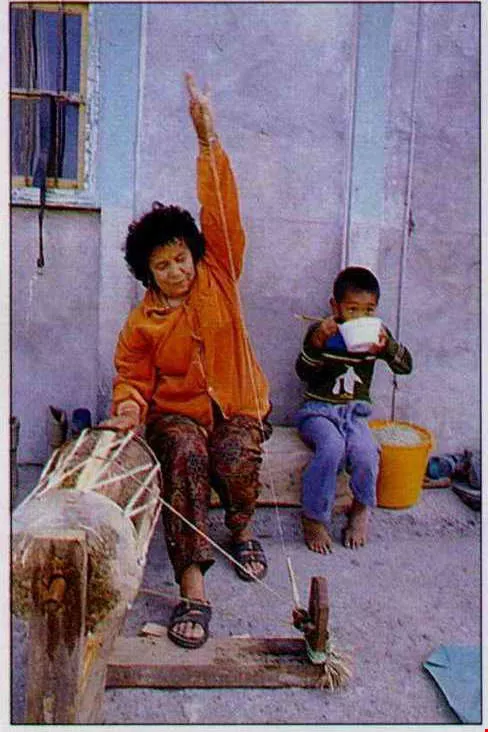
After boiling, the thread is laid out to dry. Then it is "twisted" in a process which involves drawing the clump of flax into shape, and then rolling several filaments together to make a tough thread. Only after this complicated procedure is the thread ready for dyeing.
The five main colors used in Bunun clothing are black, white, red, yellow and green. White is the color of the thread after boiling, whereas the other colors are all produced using natural pigments.
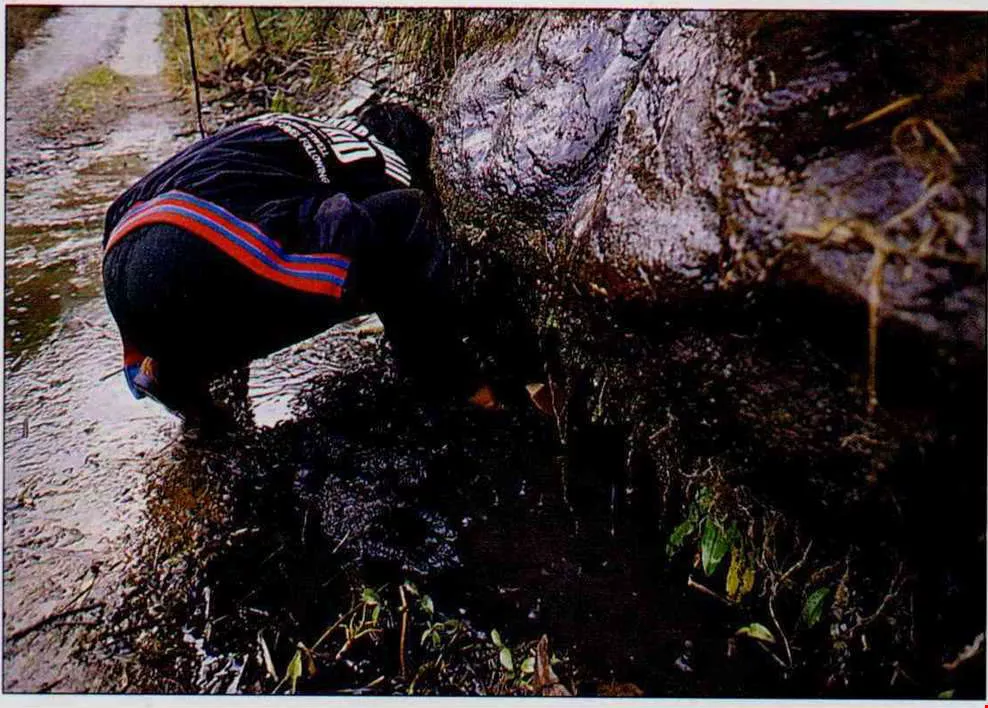
The rocks and mud in Black Valley are all black. Burying the thread here is the only way to dye it black.
Black Valley
To produce red thread, the thread is boiled with flakes of a red wood called suma; green dye is made from the leaf sap of the sulugor plant; and yellow dye comes from the pounded root of the saninag plant. In order to dye thread black, however, it must be buried in the soil of Black Valley with crushed leaves from the chiuchiung tree, and after two days and nights in the soil it is ready. Black Mountain and Black Valley are across from Shuanglung village, around half an hour away by car. Black Valley is perpetually damp, no matter what the weather is like.
"It's really strange," says Sabom, baffled. "It doesn't get properly black if you bury the thread anywhere else. It only works in Black Valley." Abin doesn't know how it works either. She just says that this is the way she was taught to do it by her predecessors.
Following directions given by her mother, Sabom successfully managed to dye the five colors of natural thread. Being more used to commercial dyes, she says a little uncertainly: "These colors look faded. Do you think they look okay?"
Abin's daughter-in-law stands nearby, closely watching her weaving. She says that she wasn't particularly interested when she saw the old lady weaving with woolen thread, but now that traditional thread is being used she really likes it: "Touching it for a day feels really good." Now she too is learning weaving with the others.
Winding the traditional Bunun thread in her hand, Abin's thoughts seem to wander back to the past...
She began learning weaving from her mother, when she was in the third or fourth grade, and she still uses the loom that her father made as part of her trousseau.
On the subject of the loom, she says the Bunun have a taboo. The loom cannot be touched by men or by children, because it would cause the men to fail when they go hunting, and harm the children's eyesight when they get older.
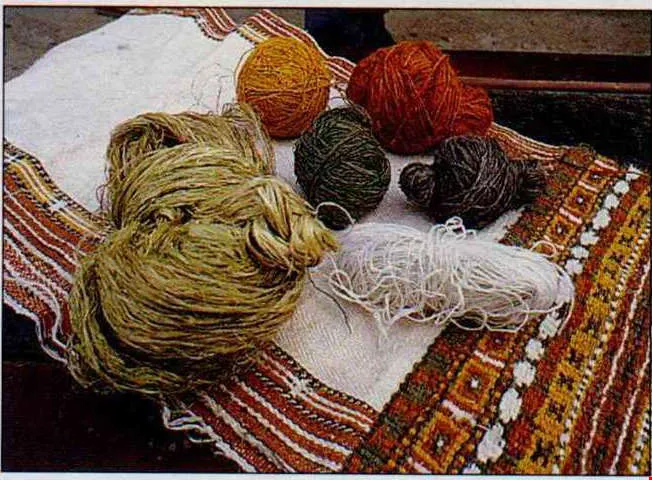
The main colors of Bunun clothing are black, white, red, yellow and green. Colors dyed in the traditional way look simple and natural.
Learning from a snake
Abin tells how Bunun clothes came to carry the pattern of the hundred-pace viper on them: "Our Bunun ancestors knew how to talk with snakes, and once they stole a baby hundred-pace viper and brought it home to rear. Copying the pattern on the snake, they began to weave. When people didn't know how to weave they didn't have any clothes to wear, but then they learnt weaving and from then on they had clothes! This was really something to celebrate. After that they killed a pig to thank their teacher.
"In the past, no one did weaving by daylight. Women had to work in the daytime, and did weaving by firelight in the evening. When the women went up the mountain to work in the daytime they draped thread around their necks, twining it as they walked along."
Like a living a dictionary of the Bunun, Abin talks willingly about Bunun traditions and the past. When she laughs, her face reveals the trademark of a now vanished Bunun custom from when she was young--two missing front teeth.
The Bunun custom of pulling two upper teeth from the front of the mouth was a kind of initiation rite for the tribe's fifteen and sixteen-year-olds, without which the young men would not be brave in war and the young women would not be able to weave clothes. The spread of Christianity among Bunun tribespeople gradually eliminated this custom.
Abin has sharp eyes and an acute mind. While she chats, she doesn't miss a single thread.
Unexpected reward
December is a busy month in Shuanglung village. The nearby village of Tili holds a large celebration in the middle of the month, soon after which comes Christmas, the biggest festival of the year for Shuanglung.
A group of youths are rehearsing a dance outside the church. Elsewhere, men of the village have gathered to practice "eight-part singing" and "pestle music" for which the Bunun are renowned. Meanwhile, women are hurrying to finish weaving their traditional costumes for the celebration.
Explains one young Bunun woman: "We'll all wear traditional Bunun clothes on Christmas Day. Those who don't have any will have to borrow some; otherwise they won't be able to take part in the celebration."
Among the "Nine Tribes" of Taiwan's indigenous population, the Bunun are not particularly known for having the brightest costumes or most sophisticated weaving techniques, but they are proud of their weaving tradition and clothing, which they consider unique. Most important of all, after so many years there is still a group of girls in Shuanglung village who are skilled in the craft of traditional weaving--an impressive achievement for the community.
That evening, Shen Wan-chu, a teacher at the primary school, made an announcement over the village public address system calling the adults together to give us a special performance, including "pestle music" and the singing of "The Drinking Song" and "The Pillar Raising Song." Dressed in their traditional costumes worn only for celebrations, the villagers swayed in time with the music, passing around the millet liquor as they sang.
Listening to their strong voices and seeing the pleasure on their faces, we could sense how confident and enthusiastic the Bunun feel about their own traditional culture. For us, this experience was the unexpected reward of the trip.
At present, Sabom is her mother's only successor in the craft of twelve crossbar weaving.
Keeping a safe distance
When it came time to leave, Laon, Abin's son-in-law, ferried us by motorbike to the bus-stop in Tili. When the bus failed to show up on time, we realized that the driver had stood us up once again. Finally we had no choice but to hitch a lift. Luckily we were picked up by a very friendly young driver.
On the way down the mountain we couldn't help complaining about the Shuanglung's public transport situation, and thought it little wonder that the villagers hardly ever come down from the mountain. But on reflection, perhaps the inadequacy of the transport link is what has enabled Shuanglung village to maintain a safe distance between itself and the modern world.
[Picture Caption]
p.114
Abin, already in her eighties, is a living record of Bunun history and tradition.
p.116
Religious faith is the most important aspect of their lives. Abin, her husband, and her son (first from right) pray before the meal begins.
p.117
Abin's first husband died long ago. Her second husband is an expert basket-weaver.
p.118
Abin's family returned to the original home of the Bunun and transplanted some ramie to the village, for use in making traditional weaving thread.
p.118
The raw thread (left) is boiled with charcoal made from tung wood for about an hour, to turn the thread white (right).
p.118
The rocks and mud in Black Valley are all black. Burying the thread here is the only way to dye it black.
p.118
The main colors of Bunun clothing are black, white, red, yellow and green. Colors dyed in the traditional way look simple and natural.
p.119
Abin has sharp eyes and an acute mind. While she chats, she doesn't miss a single thread.
p.119
At present, Sabom is her mother's only successor in the craft of twelve crossbar weaving.
p.119
Women from the village learn weaving with Abin. The woman in the picture is using a spinning tool to tighten the rolled thread.
p.119
In spite of her great expertise, Abin still says a prayer before beginning work to seek God's blessing for a successful job.
p.120
Traditional culture depends not only on the memory of the older generation, but also on the readiness of their successors to sustain it. Older members of the village in traditional dress perform Bunun "pestle music" for the visitors.
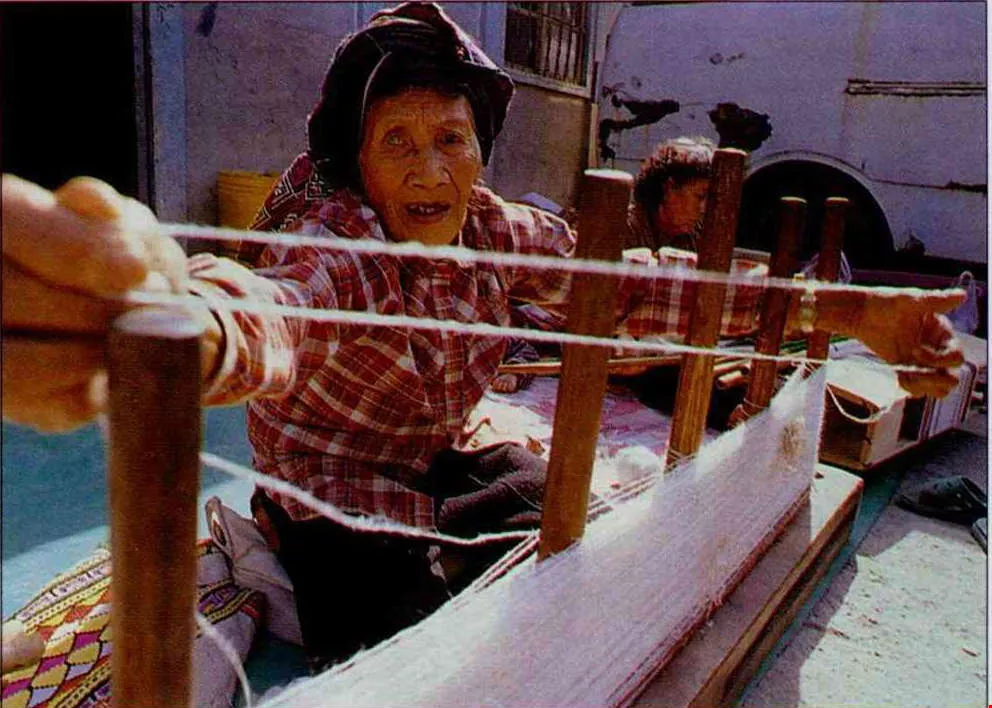
Women from the village learn weaving with Abin. The woman in the picture is using a spinning tool to tighten the rolled thread.
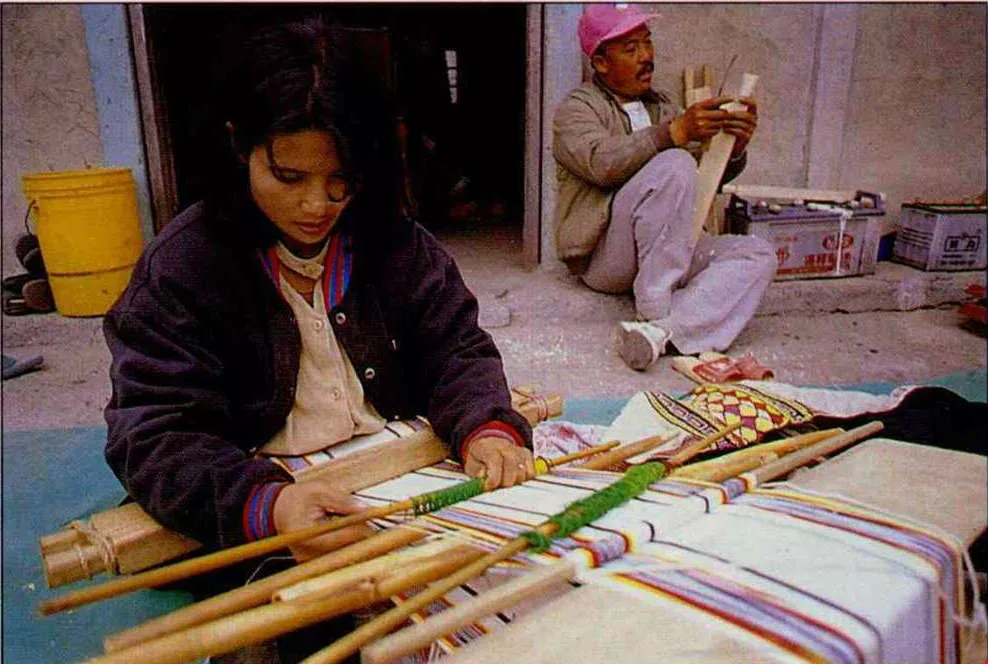
In spite of her great expertise, Abin still says a prayer before beginning work to seek God's blessing for a successful job.
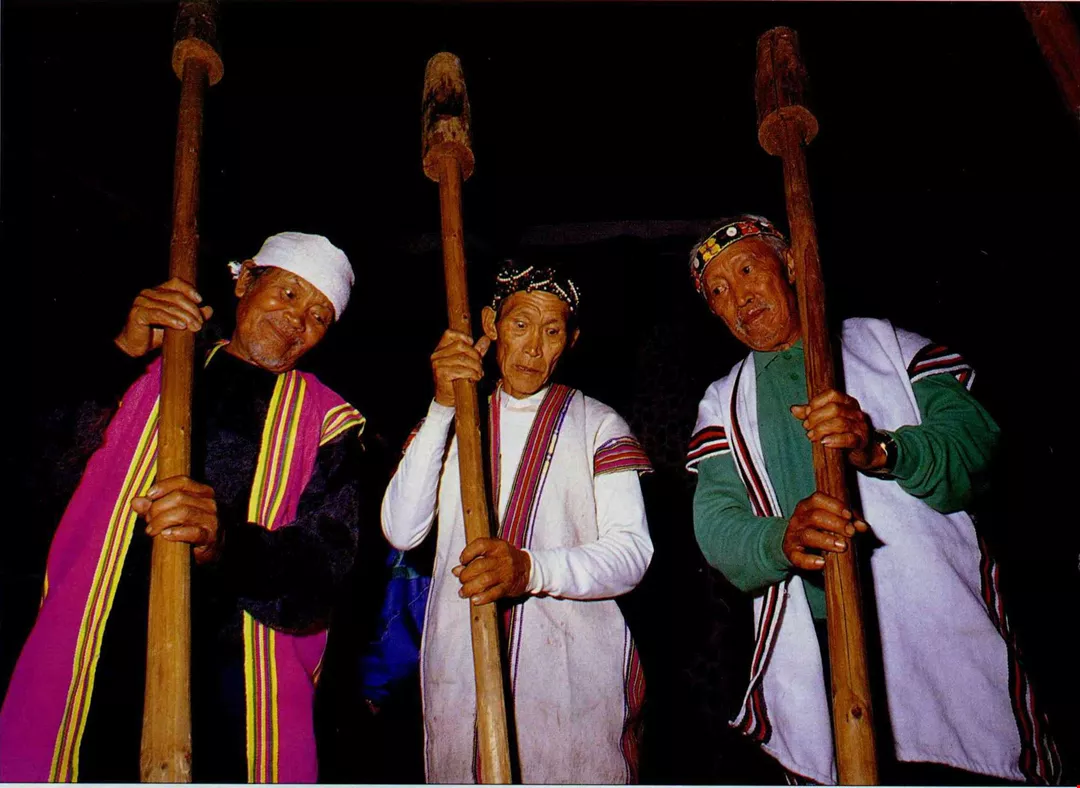
Traditional culture depends not only on the memory of the older generation, but also on the readiness of their successors to sustain it. Older members of the village in traditional dress perform Bunun "pestle music" for the visitors.


