Singled Out for Extra Concern-- A Look at One-Parent Homes
Chang Chiung-fang / photos Hsueh Chi-kuang / tr. by Jonathan Barnard
August 1995


Several famous women in Taiwan have elected to have children without getting married, and reaction in society has been split. Meanwhile, the divorce rate keeps rising, causing many to lose faith in the institution of marriage. And reports of youths from singleparent families committing crimes have also created great panic and commotion.
Has "the age of the single parent"already come to Taiwan? Are single-parent families harming society? How should we go about facing the consequences of this rise in single-parent families?
In the newspapers this kind of story gets big play: Two teenagers who have committed a string of convenience store hold-ups come from "single-parent homes." Another youth, who mugs a woman with an air gun, comes from a home broken by divorce.
Labeled as "problem families," single-parent families have somehow become regarded as a "public hazard."
One single mother writes in a newspaper, "Every time I read an article about how single-parent families are the source of social ills, I always feel uncomfortable, virtually regarding myself as a source of social disintegration. I feel both heavy-hearted and at a loss for what to do...."
Single-parent public hazard?
Is it true that the children of single parents get into trouble more easily? Before jumping to any conclusions, first take a look at a few statistics.
According to census statistics of the Executive Yuan, in 1992 there were over 535,000 single-parent families in Taiwan, accounting for 10.85% of all households.
But the truth is that Taiwan census statistics do not accurately reflect the actual situation. In order to get their children into a better school district, pay lower taxes or divide the assets of an estate, some families falsely declare that they have split into different households. In other words, many two-parent families appear as single-parent familes in their household registrations.
Based on population statistics and surveys he has taken at elementary and junior high schools, Lin Wan-yi, a professor in the graduate school of sociology at Taiwan University, estimates that single-parent families make up 4-5% of Taiwan's families and that children of single parents make up about 6% of all children. In Taipei, Taiwan's biggest city, children of single parents make up about 8% of all children.
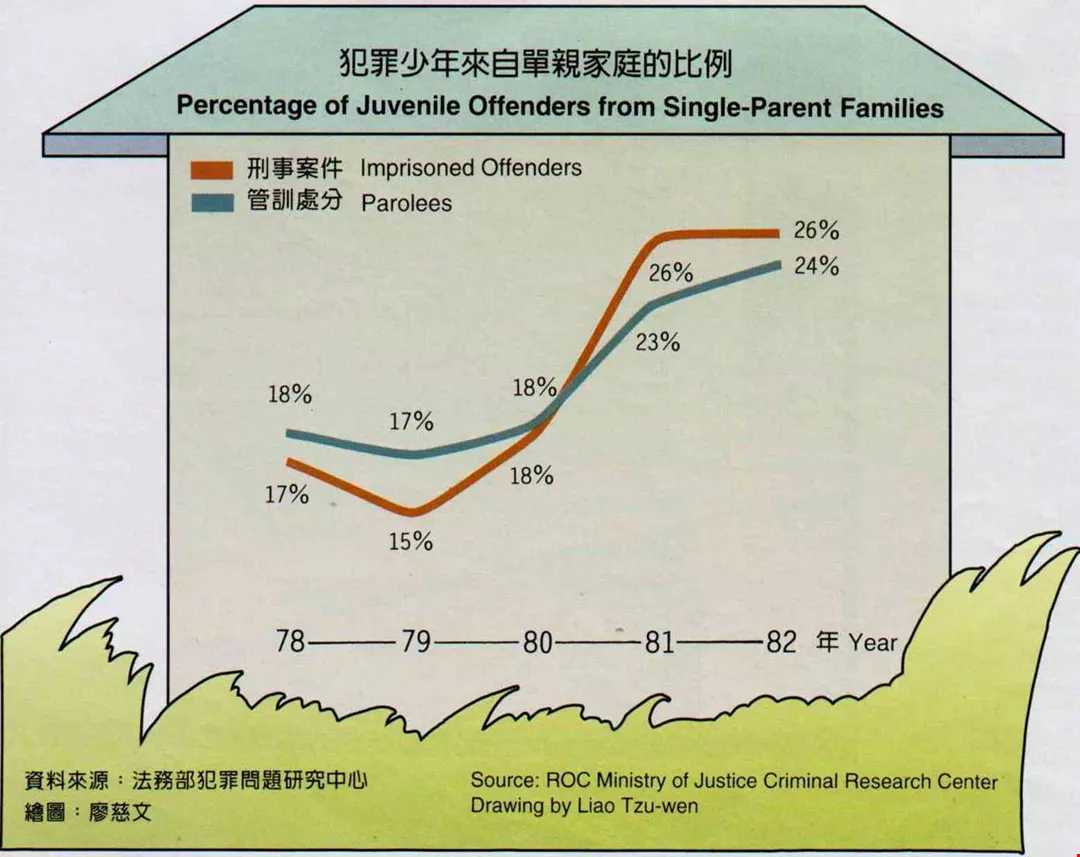
Statistics compiled over the years by the Ministry of Justice show that the proportion of juvenile offenders from single-parent homes is rising fast, and this holds true for felonies and misdemeanors. From 1991 to 1993, 18-26% of all juvenile offenders who were imprisoned came from single-parent families. Among those who only required parole, 18-24% were from single-parent homes.
Although most criminal youths come from two-parent homes, single-parent children have a much higher rate of crime.
Huang Yueh-sui, who counsels 500 single-parent families every year and who is herself a single parent, says, '"A single-parent family' does not equal 'a problem family,' but it cannot be denied that single-parent families are more fragile and their kids more apt to get hurt."
A single pillar
Of course the children of single-parent homes are not necessarily inferior to those from double-parent homes. "Confucius and Mencius, the great sages of classical China, were both from one-pillar homes," Huang notes, "as was Bill Clinton, the American president." But the "one-pillar" structure of single-family homes means that they are more likely to have money problems and difficulties providing the kids with proper guidance.
Single parents are much harder pressed to provide for the family economically. In particular, widows, who are powerless to stop their husband's death and overwhelmed by the change of circumstance, often see their financial situation grow precarious.
Kuo Yao-tung, director of the Taipei Family Helper Center, which helps low-income households, notes that of the 400 households the center is now helping, 60 percent are headed by single mothers, most of whom are widows.
Huang Fei-li, a social worker at the center, points out that poverty and single-parenthood often go hand in hand. Because the poor take dangerous jobs more often, the fathers more easily get hurt or die. When the family then becomes headed by a single mother, the financial difficulties are only that much greater. It's a vicious cycle.
One widow who receives assistance from the Taipei Family Helper Center reveals that she supports her two children on what she gets cleaning people's apartments. She often works as many as 13 or 14 hours a day, completely wearing herself out, and yet she often has nothing to eat except wild herbs she picks herself.
Even high-income mothers lack a feeling of security. "In making money, I don't know how much is enough," declares Tracy Yew, a secretary to the local manager of a foreign company. Her feeling of insecurity has prompted her to take out all sorts of insurance policies to make sure that her children will have food in their bellies and clothes on their backs while they grow up no matter what happens.
Engineering hope
Busy making ends meet, some single parents don't have the energy to discipline and care for their children, and the children become troubled as a result.
When giving sufficient attention to both work and family becomes too difficult, some single parents turn their focus to the home (as long as the family has clothes to wear and food in the fridge), putting top priority on raising the children.
One father, whose wife died in a car crash, says, "Now work comes second. Raising the children is what's most important." He has applied the intensity he used to give to his work to managing his family. Every so often he goes to the library to read about how to raise children. "If I stick it out through these difficult few years," he says, "it won't be too late for me to pursue a career when my children are older." Tien Tsai-hua, the president of the Pleione Formosana Society, greatly admires this father who is giving his all to his family. "His two daughters are always dressed up clean and fresh. In this respect he's the equal of the single mothers in our association."
Still, single parents often feel their abilities are not equal to their ambitions in raising and educating their children, and this affects parent-child relationships and the children's personalities.
According to research carried out by Huang Fei-li, children from single family homes are compelled to learn to take care of themselves at an earlier age, and they tend to be over-sensitive, relatively undifferentiated sexually, anxious and insecure. To some degree or another, these traits are related to the impact of someone close to the children leaving or having a changed attitude.
One divorced single mother recalls that after she and her husband agreed to split up, the husband tried to use their then-five-year-old daughter (who remained in his custody) to meet more often with her. But when he found he could not win her(his exwife) back, and he found a new girlfriend, he had little time to spend with his daughter. When the daughter was ten, she moved back with her mom. Unexpectedly, the daughter at that time returned to the "infancy" stage and refused to leave her mother's side. Every day when Mom sent her daughter to school she would have to spend a great deal of time reassuring her; otherwise the little girl would burst into tears as soon as her mother left, or even follow her mother to the school gate. Her daughter only began to calm down after three or four months of psychiatric care.
Crying to the ocean
A single parent must play two roles, trying to strike the difficult balance between being strict and tolerant. Some coddle their children for lacking a father or mother and thus spoil them. Others dump all of their hopes onto their children, asking too much of them.
Before the joint entrance exams for high schools and colleges, several members of the Pleione Formosana Society saw their children's grades drop suddenly. Tien Tsai-hua says that she often hears such tales, and it's all because the single parents put overly high expectations on their children.
"Every night I shed tears, praying that God will become the children's father and lead them on a righteous path," one widow reveals. For twelve years, her faith has been her greatest source of support.
A Mrs. Huang, whose husband died in a diving accident, says that when she feels lonely and helpless and in need of support, she goes to the sea and shouts her grievances to her husband, who lies on the ocean floor. "Wave after wave of the sea laps up against my feet, as if my husband is comforting and encouraging me," she says with tears in her eyes. She relies on the support she gets from this kind of romantic imagining to raise her children by herself.
Another choice
There are all sorts of difficult situations that confront a single-parent family, which make it more fragile. The growing number of these families worries people. Some are calling for reconstructing morality because modern people divorce too much.
And indeed much research points to the rising divorce rate as the main cause for the recent increase in single-parent families.
According to the most recent research, which was carried out by Chang Ching-fu, an associate professor of sociology at National Chung Hsing University, in 1993 57.7% of all single-parent families were caused by divorce, about one-third of them were the result of a spouse's death, and the rest were due to other reasons, such as childbirth outside of wedlock and abandonment.
Showing a trend toward voluntary single-parenthood, this research overturned the results of earlier research which showed the death of a spouse to be the primary cause. The increase in single-parent families was tied up closely with the self-assertiveness of women who have economic and personal independence after leaving the home and entering the labor market.
Of course the rising divorce rate is strongly related to the rise in the socio-economic position of women, but this is by no means the only factor. Therefore, it would be far more useful to think of ways to provide more support and care than to be blaming the increase in single parent families on growing autonomy for women.
Research shows that the children of single-parent homes will fare better if families are connected to support systems. The richer and better educated their parent, the easier a time they will have of it. To reduce the harm to children, Western nations provide various forms of assistance to the children of single-parent homes.
In Sweden the government provides subsidies and housing for the children of single-family households; West Germany provides family and housing subsidies; and the United States provides such measures as food stamps and assistance for children who have lost parents.
A generation without fathers
What about Taiwan? What should we be doing?
Chang Ying-chen, a professor of sociology at Soochow University, holds that there are different types of single-parent families and that governments, society, relatives and friends ought to tailor assistance according to these differences. "No matter what, single-parent families need society to provide more opportunities and choices, so that they won't feel trapped and abandoned."
According to Lin Wan-yi's analysis, beyond occurring less frequently here, there are other differences between single-parent families in Taiwan and elsewhere.
First of all, in Taiwan there are many fewer single-parent families headed by unmarried mothers. They account for only about 3-4% of single-parent families, as opposed to 20% or more of such families in England and America.
Next, because children usually go with the father after divorce in Taiwan, the number of single-parent families headed by a woman (60-65%) is lower than in the West (90%).
And for these two reasons, the incidence of poverty among single-parent families is lower in Taiwan than in the West. But from another standpoint, very few of Taiwan's single parents remarry, and after getting a divorce, there are few contacts with the former spouse's parents. These make the personal support given to children of single family homes much smaller here than abroad.
No way to change the past
It's so easy to cut ties to the in-laws here because Taiwanese society sees marriage as a contract between families. In the West, families are less likely to cut ties as soon as the husband and wife have problems.
Fortunately, for men or women, most blood relatives will offer financial or personal support and assistance. If grandparents live in the neighborhood or three generations live under one roof, this resolves the problem of having to find a sitter.
Tracy Yew originally still kept in contact with her in-laws, but their relationship soured because of problems regarding the inheritance of her former husband's assets. Now they don't see each other. Fortunately, her own parents give her support of all kind: They moved into the same building, and when the kids get out of school they first go to grandma's for dinner. This not only saves the trouble of cooking, but also Mom needn't worry there will be no one to look after her children if she has to work overtime.
Lin Wan-yi believes that we should perhaps provide assistance to the parents of the many single mothers returning to their nests, and we shouldn't overlook the nearly 40 percent of single-parent families headed by fathers.
But currently the ROC only provides assistance to low-income families, and single parents who don't meet the standards for being poor are not included.
Action better than concern
The organizations providing support are mostly private. These include the Pleione Formosana Society, which was organized by single parents who are widows and widowers; the Warm Life Association, which helps divorced women and women from shattered marriages to become independent and grow; and the Taipei Family Helper Center for low-income families.
The Pleione Formosana Society, which was just founded last year, is primarily aimed at single parents whose spouses have died. It helps them adjust to life and solve problems they encounter raising their kids.
For example, children may have anxieties caused by lacking a same-sex adult with whom to identify. Pleione Formosana director Tien Tsai-hua says that it is rare for widowers with daughters or widows with sons not to encounter such problems, especially during their children's adolescence. Such single parents are always full of anxieties themselves, and so the Pleione Formosana Society often holds activities involving adults and children, so that widows and widowers can help each other.
Tien says that when the foundation had just been founded, only women were accepted as members, and the activities welcoming new members would inevitably become gloomy affairs; her son would laugh and describe the organization as a "widow's club." "If the activity was three hours, crying would fill the room for three hours straight." But over time the women learned to share their problems, and they discussed issues like getting through the period of adjustment to tragedy, family relations, employment, and remarriage. After everyone had gotten their feelings off their chests, they could console and encourage one another. Now, people have gotten past their pain and learned to stand on their feet. "When the new members see how well others are doing, they too grow full of confidence!"
The Taipei Family Helper Center, besides offering financial support, also puts on "growth camps" for single parents and their children. During summer vacation, the center puts on children's English classes, art classes, and other courses. These are provided free to the children of impoverished single-parent families.
The Warm Life Association, which originally only provided women having marital problems with psychological counseling and legal advice, has been appointed by the Taipei City Bureau of Social Welfare to open a single-parent family service center in August of this year. At that time the center will expand its service targets, and open its services to single fathers, holding camps for single parents and children and organizing single-parent group therapy.
New family values
Most people can simply treat single-parent families as normal. Lin Wan-yi believes that single-parent families will live up to whatever image society holds of them. And so, in facing single-family homes, society ought to hold a "non-encouraging, non-discriminatory" attitude, viewing them simply as one of the common forms of family.
But society still has many stereotypes about single-parent families.
Huang Yueh-sui, a marriage counselor, points to cases of her own where people were hurt by prejudice. A third grader who tried to commit suicide gave this reason: "The teacher said that my father left me because I wasn't well behaved!"
A substitute teacher at a Hsinchu elementary school named Hsieh says that there was an incident of teachers and parents of other children rejecting a child from a single-parent family there. According to her understanding, the parents of this first grader had separated and the mother worked as a laborer at construction sites. She didn't have time to care for him, and he took to stealing things. In the eyes of the school's teachers and parents, he was an unforgivable "bad egg." In order to prevent this child from entering a class with their own children, parents even hired hoodlums to threaten the director of studies, who was left with no choice but to keep this child by his side and teach him one-on-one. "From first grade, this child was labeled," Hsieh recalls. "How could he not turn out bad!"
Lu Ming-huan, a professor of sociology at Tunghai University, points out that our society has lower acceptance of single-parent families, which results in a higher rate of crime among the children of these families. In Western countries, where there is a higher rate of acceptance of such families, recent research has shown that the children of single-parents have no more psychological problems or difficulties adapting socially than children of two-parent homes.
Sunflower season
"When all the beauty is gone from marriage, and all of one's memories are in the past, I still have you... The children of sunflowers are strong and independent, only leaning in the direction of the sun. Children, let out the blues in your heart during the season of the sunflower."
Songwriter Huang Ying-chuan wrote this as an anthem for the Problem Child's Educational Foundation, which is in the process of being founded. He uses sunflowers to represent single parents. The song gives single-parent families support and encouragement.
Let's hope that society will provide these single-parent families with ample sun and water, so that they can stand up straight and grow strong.
[Picture Caption]
p.107
Whether in the case of divorce or the death of a spouse, harm to the child can only be minimized if the adult can escape from pain and achieve emotional equilibrium.
p.109
Children are our burden, and also our hope. Single parent families often put their children under severe pressure from excessive expectations.
p.110
Many single parents are unable to both support the family financially and look after the children's lives and educations.
p.112
After having come through a painful experience, and faced with a long road ahead, single parents and their children must stick together and courageously move on.


