The Astonishing Life of Tan Kah Kee
Chen Yiming / photos courtesy of Tan Lai Hua / tr. by Geof Aberhart
November 2008


Over the last 200-300 years, the poverty China has suffered has given birth to a Chinese diaspora seeking a living in all corners of the globe. Wherever they may have ended up, though, their hearts are still with their ancestral homeland, and whenever China has faced difficulties, they have offered their support, creating no shortage of heartwarming tales. Of the many outstanding people in the diaspora, though, one is considered the standard-bearer for the overseas Chinese community-the former leader of the Singaporean Chinese community Tan Kah Kee.
In 1994 this magazine visited Tan's birthplace near Xiamen, where he virtually single-handedly created a modern wonder, "Jimei Schools Village," and brought back tales of overseas Chinese' affection for their homeland. This year, as the National Library of Singapore holds a special exhibition memorializing Tan, we turn to Singapore-born, Jimei-educated historian Chen Yiming, former deputy director of the Overseas Chinese Museum in Xiamen, to tell the tale of the early days of this remarkable leader of the Chinese community.
"Tan Kah Kee has returned to Singapore!"
How did Singaporeans of the time see this old Chinese leader who had made a fortune in the rubber industry, funded revolution, assisted in the fight against the Japanese, and made superlative contributions to education?
On September 10, 1961, tens of thousands of Singaporeans from all walks of life came together to mourn the death of Tan Kah Kee a month earlier. Ko Teck Kin, chairman of Singapore's Chinese Chamber of Commerce, described Tan as "the greatest of his generation," while banners either side of the memorial read "He spent the first half of his life promoting education, and the latter helping others," and "Conscience of his generation, paragon of virtue." These were not simply the pretty words one expects from a funeral, but rather the heartfelt feelings of Singapore's Chinese community toward Tan.
However, Tan in his later years became a long-time resident of "Red China" and played various important roles in the newly communist country, so the strong anti-communist atmosphere of Singapore at the time meant people were hesitant to publicly lionize Tan. As a result, decades later this once influential patriot had begun to fade from the collective memory.
In recent years, though, this has begun to change. On July 18, 2008, the National Library of Singapore launched an exhibition entitled "The Legacy of Tan Kah Kee and Lee Kong Chian," opened by Prime Minister Lee Hsien Loong with dedications in Mandarin and English praising Tan and Lee for their contributions to Singaporean society. This writer was also invited to the opening, and after the ceremony held a seminar on Tan's achievements and the factors behind his success.
Today's Singaporeans openly and freely discuss Tan in a respectful tone, and newspapers carry articles praising his achievements. People have begun to realize that Tan was not just a Chinese figure, but a Singaporean one as well, and that the cultural and material assets left by him do not just benefit the Chinese community, but the entire Singaporean community.
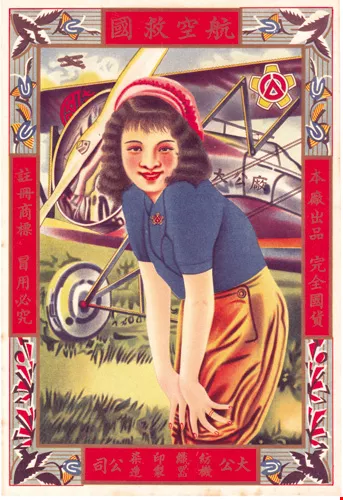
In 1936, in celebration of Generalissimo Chiang Kai-shek's 50th birthday, overseas Chinese around the world donated money to help the Republic of China purchase aircraft and strengthen its defenses. Initially fundraisers in Malaya hoped to collect enough to purchase a single aircraft, but with Tan's support and encouragement, they were ultimately able to fund 11 planes. Shown here is a flyer promoting the fundraising effort.
A foundation for success
Tan was born in a China in turmoil, where old and new, Western and Eastern, and traditional and modern were fighting for dominance. His grandfather had been a subsistence farmer and fisherman, but his father and two uncles had been swept up in the tide of internationalism, becoming part of the first wave of expatriate Chinese.
Tan's father went into business for himself in Singapore, and wanted to pass the business on to his son, so in 1890 a 16-year-old Tan left his home in Jimei, a village near Xiamen, for Singapore. He would not live in China again until 1950, six decades later. Over the course of his life, Tan spent 49 years living in Singapore, compared with only 38 in China.
Looking back, what Tan achieved during those years seems to have had a certain historical inevitability.
One factor in this is the long relationship between Singapore and the Hokkien people. The first ship to sail from Xiamen in January 1821 was bound for Singapore, and in the century that followed, droves of Hokkien moved to Singapore.
These Hokkien immigrants came in two main groups. One group comprised entrepreneurs originally from Zhangzhou and Quanzhou, who made their way to Singapore via British-controlled Malacca. These settlers arrived not long after the British took control of Singapore, and through hard work, over time they became a major economic force and were considered leaders in the growing Chinese community. The second group were farmers, artisans, the unemployed, and a handful of intellectuals. These people, having nothing to their name, ultimately built lives for themselves in Singapore.
While these immigrants, through elbow grease and intelligent entrepreneurship, built Singapore's economic miracle, they continued to build bridges between the local Chinese community and their old homeland, setting up frameworks for cooperation and contributing much to the modernization of both sides.
A second factor in Tan's success is the unique geographical location that Singapore enjoys, which has made it a modern hub for cultural interchange. Prior to its independence, Singapore was a major city of Britain's Straits Settlements and one of the largest trading hubs in Southeast Asia. It was also the economic, cultural, and patriotic heart of the Southeast Asian Chinese diaspora.
Of the five major cultural groups of overseas Chinese (Hokkien, Cantonese, Teochow, Hainanese, and Hakka), the Hokkien have the greatest economic savvy and soon settled into leadership positions in the Chinese community. Tan Kah Kee's father was a leader of a clan organization formed by Hokkien Chinese of the Tan clan, and served as the organization's chairman for 25 years. The stores Tan's father owned or co-owned generally used the Chinese characters an or cheng in their names, and according to Tan's nephew Tan Lin Kit, there were 18 of the an stores and 24 cheng stores scattered around Singapore. It was in the main store, Chop Soon Ann Rice Company, that a young Tan learned about business before setting out on his own in 1904.
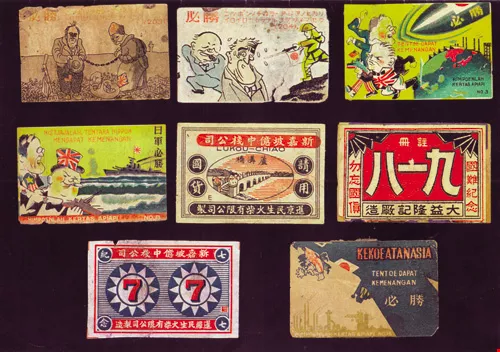
These matchbox labels from Southeast Asia around WWII bear names such as 918 and 77, reminders of dates of tragedies in China, as well as cartoons mocking the Japanese aggressors. They reveal the difficulties faced by the Chinese community in Singapore.
The brightest star
During his life in Singapore, Tan became a prominent Chinese businessman. His development toward this can be broken down into several stages.
First is the time he spent working in his father's business and helping his father repay his debts (1890-1907), which is when Tan learned the basics of business and how to handle himself in society. At first, he served dutifully as both a son and an employee, hoarding no money for himself and just working to build up his knowledge of business and to become an honest and persistent person. Later, the younger Tan returned to China to marry, mourn his mother, and complete his studies, but his father's business was the victim of embezzlement, so Tan began working to help his father repay his debt. Not only did he succeed in this, he also maintained the connections his father had built and the reputation of the store, laying a solid foundation for his future in business.
The second stage is choosing the right path and surpassing his competitors (1908-1917). Seeing a growing trend after World War I, Tan first rented, then bought boats and ran a shipping business, as well as converting his canneries and rice mills into rubber processing plants, optimizing operations by bringing everything together as Khiam Aik Co.
Third is the long climb to the top (1918-1928). It was during this time that Tan established Tan Kah Kee Co., with Khiam Aik serving as the primary segment of the business, which included rubber plantations, rubber manufacturing, and rubber curing, with products sold in overseas markets as far away as the United States.
Tan's son-in-law Lee Kong Chian was appointed general manager of Khiam Aik. It was at this time that conflicts between Tan and several older managers began to arise. After three years' hard effort, Tan's company was able to weather the storm, but when the global economy was hit hard in 1926, Tan Kah Kee Co. was hit with it, ultimately announcing its closure in 1934. Despite this, Tan had for ten years been a major economic star, with assets in 1925 valued at 12 million Straits dollars, and Khiam Aik Rubber had become the largest firm in Asia, achievements that had a lasting impact on the region. While a number of other major players fell by the wayside around 1923, and Tan's own company was critically injured, he stuck by his determination to use his factory as a school of sorts to train Singaporean Chinese in the rubber industry.
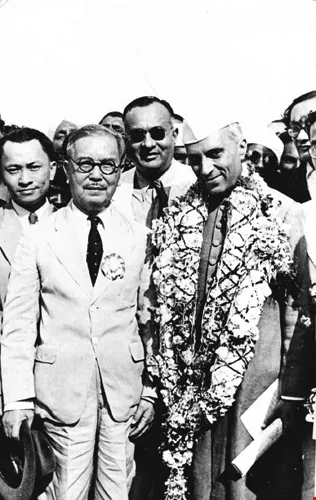
After World War II, Indian independence movement leader Jawaharlal Nehru (right) visited Singapore, and Tan Kah Kee was there to welcome him as a community representative.
Community leader
After starting his own business and paying off his father's debts, Tan began to make his name as a respected young entrepreneur in the Singaporean Hokkien community. Over the next ten years, Tan's skill and passion as a political figure and supporter of education gradually came to prominence. In 1910, Tan joined Sun Yat-sen's Tongmenghui, as well as becoming chairman of the board of governors of Tao Nan School and a director of the Chinese Chamber of Commerce, thus emerging as a leader of the Hokkien community. In 1911 Tan made his entry into Chinese politics as head of the Fujian Protection Fund in Singapore, putting his support behind Sun Yat-sen.
Tan became a British subject, participating in activities organized by the Straits Chinese British Association and chairing the Tianjin Flood Relief Fund. These activities elevated Tan to a leadership position in the Chinese community as a whole, regardless of place of origin. In 1919 he successfully founded the Singapore Chinese High School, for which he was head of the board of governors. He was the most important figure in the creation of this school, designed to serve the entire Chinese community rather than a given subset of it. Continuing in the same vein, Tan was able to build good relationships within the community, becoming one of its most important figures.
On two occasions-1923 and 1929-Tan served as chairman of the Ee Hoe Hean Club and the Hokkien Chinese Association. In the latter role, he became instrumental in bringing together the manpower, resources, and finances of the Hokkien community, increasing their influence. The hard core of the Hokkien community drew around Tan, while the Ee Hoe Hean Club gave him a place to hold interfactional activities. Under Tan's leadership, the organization was able to create greater unity between the leadership of each cultural faction, generating an exchange of business information and becoming a center for charity work and social and cultural reform. It would also become the heart of the anti-Japan China Salvation Movement in Southeast Asia and for the fight against fascism.
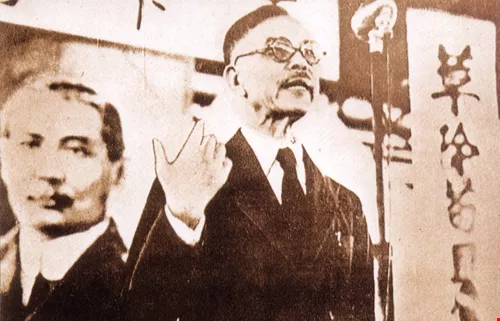
A follower of Sun Yat-sen, Tan Kah Kee not only contributed financially to the revolutionary cause, but also played an active part through widespread public speaking.
Chinese standard-bearer
After the Marco Polo Bridge Incident in July 1937, the Japanese moved troops into northern China, marking the beginning of an eight-year war between China and Japan. In Singapore, the Chinese Chamber of Commerce held a meeting of the community, with the British colonial authorities replacing the chamber's then-chairman with Tan Kah Kee as chair of the meeting. In line with the requests of the authorities, Tan brought the anti-Japanese activities of the Chinese community within the legal framework of Singapore.
In law-abiding Singapore, neither the Kuomintang nor the Communist Party of China could register as legally recognized organizations. As a non-partisan de facto leader, Tan-who held British citizenship and had been a member of a political advisory council composed of Chinese businessmen-had the support not only of the Chinese community but also of the British colonial authorities.
In 1938, the world's largest anti-Japanese Chinese group, the Nanyang Chinese Relief General Association, was established in Singapore, with Tan Kah Kee elected chairman. He brought together between 8 and 10 million ethnic Chinese in support of China's fight against the Japanese and of Allied forces in their global fight against fascism. It was at this point that Tan's position as a political leader of the global overseas Chinese community was cemented.
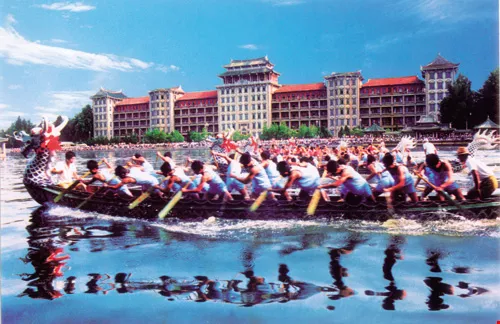
Jimei Schools Village spreads across a spectacular 2.83 square kilometers. In this picture, we see the Tao Nan Building, the main academic building in the village, which was designed by Tan Kah Kee himself. A mix of Chinese and Western-"wearing a suit and a bamboo hat"-it is considered an excellent representative of Tan's architectural choices. In the foreground, students engage in a tense dragonboat race.
Building civilization
As a child, Tan studied in a private village school, and the traditional aspects of his mindset created during this time lasted into his later years, including his insistence on using traditional bookkeeping notation. He was, however, also an innovator and someone willing to challenge the status quo, and despite being in geographically tiny Singapore, he always had his eyes on the global picture, always watching the colonial and global situations.
Tan spent the first five or six years of his time in the rubber industry investigating ways to lower the failure rates of his gumboots, raincoats, and gloves. Later, with American technology unavailable, he spent five years working to overcome all manner of technical difficulties, finally lowering the failure rate of his tires from 30% to 2%. Through advertising, Tan was able to build up sales channels and break the monopoly the British held on international trade in Singapore.
In the midst of this trade war, Tan saw how overseas industrialists and China itself were both the weaker parties amidst the struggles they faced, as well as the threats his homeland faced and the continuing strengthening of Western civilization. He came to see that the "civilized" nations, which had the eyes of the world upon them, made the best use of resources and were focused on quality in production, placing them in the stronger position in the international market and leading to an increase in their power. At the same time, they promoted education and the fostering of new talent. All of these factors combined to create a virtuous circle for the strong, in which they became ever stronger.
Tan compared China to other rich nations in areas like literacy, governmental focus on education, perspectives on wealth, sense of responsibility to the community, and the people's ambition, quality of character, and mental outlook. He noticed that Singapore's death rate was gradually dropping, and in 1945 published the book Home and Hygiene in the hopes that his homeland would place greater emphasis on these two during their post-war reconstruction efforts.
Lifting China through education
Tan also noticed that of the US' 300 universities at the time, over 280 were funded in part by donations from businessmen, while in China, the wealthy were either hedonistic wastrels or misers who hoarded their money for their children and grandchildren. Neither type spent a cent on charity, nor had any sense of selfless service.
He concluded that "education is the foundation of a nation, and promoting it is the solemn duty of all citizens."
Tan then began dedicating his life's wealth and energy to fulfilling this duty. He lived his own life thriftily, with his biggest extravagance the occasional oyster omelet, while at the same time spending tens of millions on education, establishing Xiamen University back in China, amongst other things. The organizations he established included kindergartens, elementary schools, middle schools, girls' schools, and even specialist schools teaching education, aquaculture, sailing, business, agriculture, forestry, and traditional Chinese studies that became "Jimei Schools Village," which boasted excellent facilities. Even during the chaotic warlord period, Sun Yat-sen expressed his admiration for Jimei, calling it a place of peace for China and exhorting the people of Fujian and Guangdong to take particular care of it.
But Tan was not only concerned with his homeland, nor only with China and Singapore, but with all the people of the world. In his autobiography Nan-Chiao Reminiscences he wrote with longing not only for his beloved homeland, but also for a world of equality and fairness under the leadership of the "victorious nations" in the wake of the ravages of war. He wrote of his hope that war would be stamped out, that inequality would be erased, and that the nations of the world would cease their harsh legal restriction of overseas Chinese so that they too could contribute to the improvement of the world.
Tan Kah Kee's life was a microcosm of the overseas Chinese experience over the past century, and Singapore was able to offer someone like Tan the opportunity, geography, and community to become great both as a businessman and as a man. Looking back on what this paragon of virtue achieved, Singapore should consider itself honored to have had him.


@List.jpg?w=522&h=410&mode=crop&format=webp&quality=80)
