Sketches of Dreams Amidst Generational Change
Eric Lin / photos Jimmy Lin / tr. by Phil Newell
January 2004


Over the last two years, the pub-lishing industry's stoking up of interest in Taiwan's "fifth generation" (meaning people born in the 1960s) has sparked a wider discourse on generations in Taiwan. (Current discourse on generations in Taiwan marks one generation each decade.) This attention is due not only to the fact that the fifth generation now occupies many key positions in society, but also to the fact that as a result of the achievements of that generation-also known as "the student movement generation"-in political and social reform, an age of "pluralism and affluence" is upon us, which is why the fifth generation is so clearly separated from the sixth (born in the 1970s) and the seventh (born in the 1980s) in discussions of the generations.
In contrast to the idealistic "student movement generation," the sixth and seventh generations are usually tagged with what amount to warning labels, such as "the strawberry set" (so soft they burst at the first pressure), "the back-to-the-nest set" (happy to stay at home being taken care of by their parents), or "the buy-now-pay-later set" (deep in credit card debt). These reflect not only subjective "establishment" opinions, but also indicate that Taiwan society has objectively changed as well: Democratization has been completed, society has become pluralized, economic growth has leveled off, high unemployment has become the norm, and excessive consumption is widely encouraged. These structural changes have profoundly affected the whole of society, including the values of the up-and-coming generation of young people.
And values are the foundation for every individual dream.
In this age of rapid change and confused values, what do the dreams of the younger generation look like? How do young people feel about and deal with the structural environment all around them? How are they different from past generations? At the crossroads of broad trends and individual lives, let us look into their palms and read the lines that lead toward the future....
At the end of November, the Legislative Yuan was buzzing as legislators rushed to get key bills affecting the nation's future and the economy passed. Legislative assistants (LAs), responsible for helping their respective party caucuses negotiate the content of legislation and then mobilize legislators to vote on it, lost track of time and many could be found wandering around enveloped in a haze of exhaustion. Interestingly, just by chatting with the LAs and observing their reactions to events, you could get a pretty good idea of which "generation" they belong to.
Hsu Hsiao-tsu, a senior Democratic Progressive Party LA at the "ripe old age" of 33, and therefore a member of the student movement generation, feels not only a professional responsibility for each and every bill, but also a sense of idealism. When provisions are significantly altered as a result of compromises among the political parties, "even though I've been working here for a long time, I still feel a sense of disappointment that is difficult to put into words," he says.
In contrast, newcomers fresh out of college have grown up with the notion that "the legislature is the platform for compromise in a democratic political system." They are more concerned with the progress of bills: "We don't do things like the people who used to work here, whose ideals haunted them like ghosts, always reminding them of their youthful faith and political conscience."
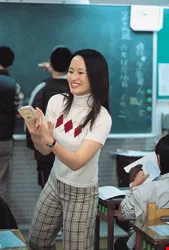
School teacher Lai Chia-chin, born in 1979, says: "When we had just recently graduated, most of us were filled with ideas about what we really wanted to do. Most of us felt like teaching was like being a beached whale-it was only something we could stand for a short time. But lately, with the global economic downturn, in only two or three years everyone's attitude has changed completely. Now they are perfectly satisfied because a career in teaching is stable, practical, and reliable."
Activism's out, staff work is in
"The student movement era is over, the staff era has arrived," says LA Tang Chih-mao, who was born in 1977 and graduated from the Department of Political Science at National Taiwan University.
Tang says that in college, most of his classmates were immersed in leftist thinking for a long time, and generally identified with the more "progressive" political party. But since the DPP won the presidential election in 2000, the nature of politics has changed, and people have scattered among the various political parties. Policy has become more important than party identification, and different people work for different parties often just because they support some very specific policies of a given party.
"The people who studied politics a decade ago all strove to achieve high-minded ideals, but now that it's the turn of our generation, we don't see the world in such black-and-white, good-and-evil terms. Given the existence of so many issue areas-democratization, globalization, cross-strait issues, intra-party factionalism, the economic downturn-which are interrelated in complex ways, its not easy to stick unswervingly to a set of abstract political ideals," he avers. The best option at times like these is just to focus on your work, save some money, and get some fun out of the "constituent service" part of the job that the higher-ranking assistants have no interest in.
"I just like to help others, and it makes me happy even if it's just some small matter," says Tang. As times have changed, there has been a "return to the inner individual." And there's nothing inherently wrong with that.
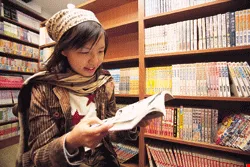
Chung Yu-ting, a third year student in agricultural economics at National Taiwan University, pays her own tuition and is economically independent. She says: "My dream is to get married to a Japanese man and move to Japan."
Full wallets, empty souls
Reflecting the larger background to Tang Chih-mao's new-generation outlook on politics and life, Taiwan's society most often points to political orientations and economic values as the main indicators of the gap between generations.
The third and fourth generations (born in the 1940s and 1950s) are the "post-war baby boomers." When they were young the country had nothing, and they were confined to small, pragmatic dreams. The main path for the children of working class families was to finish primary school and get a job in a factory. Even for those with higher education, the value of security-the "iron rice bowl"-was paramount, and becoming a civil servant was considered the best guarantee for the future. The few who aspired to broaden their horizons had to concentrate on passing the exam for one of the very limited number of government scholarships to study abroad, but even if they got one, possible fields of study were severely restricted, and many had to send some of their funding back home to help their families.
In that era of practicality before dreams, most people aimed for economic accomplishment and stability. Starting from nothing, these generations created Taiwan's small-enterprise miracle. "But when they reached middle age, and their material dreams were satisfied, they felt spiritual emptiness, as a result of which many turned to dissipated lifestyles, extramarital affairs, and religious escapism," says Wang Chung-kwei, chairman of the Department of Psychology at Soochow University, who is a long-time student of generational differences in Taiwan. This is one reason why spiritual and religious topics have garnered so much attention in Taiwan in recent years.
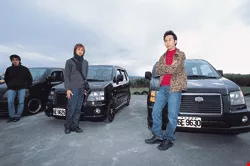
Chou Yi-kuang (at right), who does power and water maintenance work, was born in 1980 and studied electrical engineering at Tai Pei High School. He relates that last year he and his two closest friends Chi Mao-sung (left) and Hsu Chia-wei (center) bought identical black Solio vehicles, and now when they go out together are "most cool."
Opportunity vs. stability
While the "fifth generation" (born in the 1960s) was growing up, on the other hand, the economy was already in full flight, and social movements were gathering strength. Young people were no longer under intense pressure to contribute to the economic well-being of their families, and in fact the amazing booms in the stock market and the electronics sector made it appear that money was just lying around waiting to be picked up. Against this background of affluence, then-existing restrictions on political and social freedom became even more intolerable, and university students felt collective rage over such issues as the "10,000-year parliament" (in which the majority of legislators consisted of members elected in mainland China in the 1940s) and Article 100 of the Penal Code.
Campus activism culminated in the "March student movement" of 1989, demanding the retirement of the mainland-elected members of parliament. Thereafter, activists were absorbed into the mainstream political forces, and on both the political stage and in the business community they have played increasingly important roles. In these roles they have been given mixed reviews, being seen as "bold and idealistic" but also as naive "Boy Scouts."
The sixth and seventh generations-those aged 18-30 or so today, and thus the core group of interest to us here-are those of the age of mass university attendance. Whereas their predecessors' values were shaped most by great economic opportunity and the experience of collective action for political and social change, many different elements have affected the values of these generations. Besides larger structural factors, educational reform has also been important. The reforms introduced by the government in the late 1990s increased the number of universities and graduate programs significantly, so that many more young people have access to higher education than did their predecessors.
With the opportunities and circumstances offered by society so different, naturally the dreams of young people and the methods by which they pursue them are quite different as well.
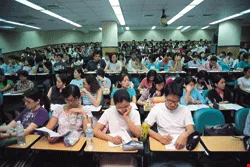
Compared to the past, young people going abroad for study are more daring in pursuing their dreams, studying in many more fields than before. But are these "interests" simply interests that conform to social values, or are they genuine personal interests? This is an unresolved problem with education in Taiwan. The photo shows students attending a cram school to prepare for the TOEFL test.
Broad vs. narrow
The establishment of many new universities is significant in two ways: It has greatly increased the number of people with advanced degrees, and it allows the system as a whole to offer a much wider variety of programs and subjects. According to government statistics, in 2002 there were over 1.1 million students in institutions of tertiary education, 540,000 more than in 1992.
The increase in the university population has not only postponed the career paths of entire generations, but in addition, as the famous social commentator Nanfang Shuo points out, an explosive increase in the number of highly educated people in one generation will affect the entire structure and generational outlook of society.
"The creation of many universities means that people's life choices become more uniform, and university students today commonly think, 'we're different from people who are not well-educated.' For instance, they are not willing to take jobs that are not suited to their new status. The result is that the choices of the whole of society become narrowed," says Nanfang Shuo. Naturally, he continues, the dreams of university graduates will be different from those of high school graduates. But many people ignore the fact that developed countries all move in the direction of "high levels of education alongside high levels of unemployment." Taiwan's jobless rate is already creeping up, which will create problems of adjustment to an increasing gap between dreams and reality for the new generations.
In response to the trend toward leveling in education, the media has been repeatedly sending out warning signals that young people must think more about "competitiveness," about "making themselves capable to carry the baton being passed on by their predecessor generations," and about the challenging nature of the current job market and of making a good career. The media is not only pointing out the competition in Taiwan, but is also reminding us that these days competition extends worldwide, and is emphasizing themes like the need for independent skills and working ability, how to build economic security, and uncertainty in an age of rapid change.
"How can you make NT$10 million by age 30?" "Do you need to have at least NT$100 million for a good life?" "What age do you want to retire at?" If one were to believe the public discourse whose agenda is defined by the media, we are seeing a kind of return to the instrumental values-"how to succeed in business" and the like-that predominated in the pre-student movement generation.
Wang Chung-kwei points out that Taiwan, like Singapore and Hong Kong, is a small-sized economic entity with a small domestic market. All three rely on selling their labor and talent to the world, so when physicists were in demand in the world, a large group of people made physics departments their first choice, and now the same thing is happening with electrical engineering, information sciences, and biotechnology.
"Selling your skills to others requires very strong competitiveness. If Taiwan's economy cannot succeed against intense competition, it will be washed out. But 'specialized knowledge' is not like property, which you can directly leave to the next generation. So parents demand of their children, and society demands of young people, that they train themselves night and day to compete," observes Wang.
However, it is necessary to keep in mind that the top-of-the-economic-pyramid lifestyles and ambitions that are overwhelmingly emphasized by the commercial media are by no means suited to the majority of lives.
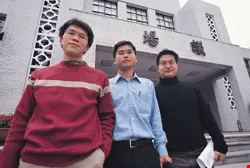
Legislative assistant (LA) Tang Chih-mao (left), was born in 1977 and studied political science at National Taiwan University. The peaceful transfer of power in 2000 means that the world is not so good-and-evil, us-and-them anymore. At right are two "sixth generation" LAs, Huang Shao-ming and Hsu Min-hung.
Dreams are somewhere else
What should be the definition of "success"? Today, the uniform model of "success" is leaving more and more young people confused when it comes to career planning. In particular, the overemphasis on the value of money causes young people's consumption habits and dreams to be ever more materialistic.
Chung Yu-ting, currently a junior in the Department of Agricultural Economics at National Taiwan University, feels that she is very much in this situation.
Chung says that every time the media raises the alarm warning young people to think carefully about their futures, she gets depressed for a good long while, then goes along with everyone else choosing a large number of instrumental courses. But she doesn't really know what she wants herself, and doesn't know in which direction she will go after school: "When people ask me, 'What do you want to do in the future?,' though I can always come up with some cock-and-bull answer for them, inside I am really thinking, 'Hell! I haven't the slightest idea!'"
Sitting in a coffee shop near her university, it is only after chatting for a long time that Chung's eyes start to get a little dreamy. She says that if she could really have one wish come true, she wants to get married to a Japanese man and move to Japan. It's not that she's especially in love with Japanese guys, but that she feels very attracted to the kind of law-abiding, well-regulated, stable lifestyle depicted in Japanese television serials.
"I like the idea of a stable social structure, where in terms of education, employment, and even marriage, all you have to do is go along and you can fit in, where I wouldn't have to ponder over issues involving the larger social structure or worry about instability in life, but where I could still have space to seriously think about other problems of life that affect me and to enjoy my life." It seems like Chung has rehearsed these words over in her head countless times before, for as soon as she begins talking about her dream, her manner of speaking becomes very calm, coherent, and eloquent.

The vitality of youth is the power that allows dreams to take flight. The photo shows students and alumni gathered for the 100th anniversary of the founding of Taipei First Girls High School.
Buy now, pay later
Hesitation and uncertainty about planning for the future are internalized. There is no uncertainty, however, about the external face of the culture of the younger generation: Consume!
In August of 2003, the TVBS television network conducted a survey of attitudes toward money among members of the seventh generation. Twenty-three percent of these 1980s-baby respondents approved of borrowing money on their credit or cash cards, while as many as 35% had used rollover credit. "So you don't have enough money to pay the bill, so what? When something appeals to your tastes, you can't resist putting it on the plastic," says the TVBS report in describing the attitudes of respondents. In terms of what the money goes on, the survey shows that guys prefer drinking and entertainment, while girls invest it in their personal appearance.
Complementing this picture, according to statistics compiled around the same time by the Union Bank, among holders of credit cards aged 20 to 30, each card had an average rolled-over debt (on which the holder was only paying off the interest) of NT$47,000, the highest of any age bracket studied.
Chou Yi-kuang, born in 1980, who just last year took out a loan to buy a Solio mini-RV, is "beginning to regret a little bit" being in such debt. When you tell him the numbers that come up in public opinion surveys and studies, he says that they are consistent with the consumption habits of the people around him, and he's happy to discover that he is perfectly normal and part of the mainstream.
He relates: "I started taking part-time jobs as soon as I got into high school. I've done everything from messenger and waiter to installation worker for high-tech electronics companies." He was earning more than NT$30,000 a month just working part-time in high school. He figures he is still young, and as long as he isn't picky about the work, it isn't hard to earn money. He has a good natural singing voice, and likes to perform. If he had his life to live over, he says that he would go to a school of the arts and try to get into the film and theater industry. But right now he has no special ambitions for his future.
"My dream? I want to get some more money and buy a new car, which of course is just to look cooler so it will be easier to pick up girls," says Chou. He and his two best friends all bought identical black Solio vehicles at the same time, and when they cruise together they look "most cool." Make money, pick up girls, hang out free of cares with his buddies, and once a while go to a night club.... "If I was just a little better looking, then I wouldn't be far from my dream of a good life," he says.
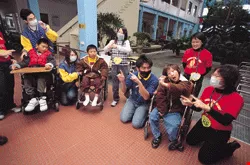
School teacher Lai Chia-chin, born in 1979, says: "When we had just recently graduated, most of us were filled with ideas about what we really wanted to do. Most of us felt like teaching was like being a beached whale-it was only something we could stand for a short time. But lately, with the global economic downturn, in only two or three years everyone's attitude has changed completely. Now they are perfectly satisfied because a career in teaching is stable, practical, and reliable."
Diverse dreams
Professor Wu Ching-chi made quite a mark in the Chinese-speaking world 20 years ago with the publication of his book The Four Dreams of Young People. He has recently been updating the book for a new edition. He observes that compared to 20 years ago, there are a lot more options open to young people today. People are wealthy, and lives everywhere have been changed by the Internet and mobile phones. But the small variety of "ideal lives" that are portrayed so shallowly in the media can easily make people obsessed with those lifestyles and lose their bearings. In an age like this, it is much more difficult to plan one's career than it was in the past.
Wu, who formerly was executive director of the Sino-US Academic Exchange Foundation, takes as an example overseas study, the area with which he is most familiar. These days most parents are willing to accept the child's decision on what to study, and the kids are daring to pursue their own individual interests. But are these interests simply interests that conform to social values, or are they the genuine interests of the individual? Young people are still not encouraged to let their imaginations run wild. At a time when most people still define the models of "success" as businesspeople and politicians, "it is very difficult to tell them that there are many different kinds of success in life."
Yueh Ping-chiu, born in 1976, who earned a double BA in Chinese and journalism at National Chengchi University, worked very hard to pack in all the needed credits in five years. But when he graduated, he found himself strongly at odds with the values he encountered in society. Out of school for two years now, he has never been really fully employed. He finds it hard to make the necessary compromises to bridge the gap between what he was taught at school and the reality of the workplace.
"I still live with my parents, and do freelance work. I did once apply for a job as a television reporter, and in fact was offered the job by the station, but I just couldn't make myself do the typical reports on 'blood, sex, and the stench of corruption,'" says Yueh. He figures either that his professors must be incredibly detached from reality to spend so much time on extolling journalistic ethics, or else they must have schizophrenic personalities and can entirely separate what they say at school from what is done in the media.
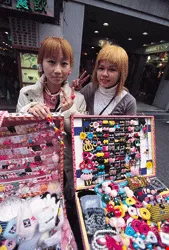
Buy trinkets that you like and do what you feel... Hanging around the streets of Hsimenting, the carefree attitude toward life of many young people is no different from that in the world's leading cities like Tokyo and New York.
Practical dreaming
Yueh spends most of his time these days doing volunteer work for public interest groups, which gives him a great feeling of accomplishment. "It's strange that although you hear people always talking about the value of 'helping others,' when I devote my time fully to others, it seems like the people around me consider me an example of 'highly educated manpower gone to waste.'" He finds it very difficult to communicate his thinking, which does not conform to the values of mainstream society, to his family and former classmates.
Huang Chung, the author of the book The Five Great Waves in Life and assistant director of the specialist financial-planning newspaper Fortune Daily, points out that the era in which one could stand out from the crowd just by relying on one's educational background is over. Taiwan society should do more to encourage the idea that people be recognized for their accomplishments in all fields, not just the academic. There is no difference in the effort and commitment involved, after all, and this will allow people to define their happiness by the inner satisfaction they get from what they do.
"Between a person who spends all day hanging around securities firms trading on the stock market with a worried expression on their face and a lifelong volunteer who hasn't a penny but is happy, which of the two is more profoundly successful, and whose happiness is more pure?" asks Huang Chung. Society should not only encourage young people to have more diversified dreams, it should let them see behind truly successful people-and especially those who have devoted genuine effort to their dreams and stuck to their guns, or those who have had the courage to change their ways when they discovered that they had mistaken the illusory for the real.
"In every era, when dealing with dreams, there's always one unchanging principle: build your dreams on realistic foundations," says Huang Chung. The problem that most kids in the new generation face is value confusion, but if they can find a good direction, they will actually be more practical and more flexible in pursuing it in comparison with people in the past, who only knew how to go straight ahead with their nose to the grindstone.
Chao Cheng-ming, born in 1977 and a graduate of the graduate institute of electrical engineering at National Taiwan University, passed up high-paying job opportunities in the high-tech sector to choose a route very different from that of his classmates: taking a job in a movie company doing market research and marketing planning.
"After getting to university, I discovered that I really loved film. Film enables one to fantasize and create countless lives, countless dreams," says Chao. He did have the idea to go study filmmaking, but that struck him as "just too impractical." He knew that he didn't have the necessary storytelling ability, so he shifted his dream to "opening my own movie theater." He plans to use his own sound system (another field in which he is very interested) and will be able to show the films that he personally thinks will sell tickets. Best of all, his good friends will be able to see "special screenings" just for them in his personal movie theater.
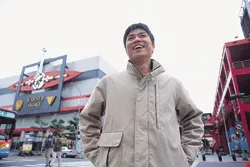
Chao Cheng-ming (born 1977) graduated from the prestigious graduate institute of electrical engineering at National Taiwan University, yet elected to become a market researcher at a movie company. He says, "Film has always been my dream, but it was just too impractical to transfer over to study filmmaking. I would prefer to save some money and open my own movie theater, with my own sound system in it, where I can show the films that I think will sell tickets. This is a more practical approach to my dream." (photo by Chuang Kung-ju)
Right in the palm of your hands
Globalization has tied together the entire global village in a more complex and confusing way, and many people share in common the feeling that time is moving faster and faster. When you talked about generational gaps in the past, one generation was about one lifetime. But in recent years the time frame sociologists have been using to define a generation has been shrunk down to ten years, then five, and now three. It is even possible that there is a "generation gap" between brothers and sisters in the same family, something that previously only happened between parents and children.
Yet, no matter how times may change, one cannot help but be moved by every pair of youthful arms stretched out toward the distance.
Primary-school teacher Lai Chia-chin, born in 1979, began dreaming in high school of one day becoming a diplomat. But her university entrance exam results were less than ideal, and her mother recommended that she study at a teachers college instead. But she has never given up her dream. In her first and second years in university she tried to transfer to the department of foreign languages. In her senior year she began taking courses at a supplementary school to prepare for the exam to enter graduate school to study foreign relations. Although she was thwarted in each of these three attempts to advance toward her dream, she is still working hard now to save money to go abroad to approach it from a fresh angle.
"When we had just recently graduated, most of us were filled with ideas about what we really wanted to do. Most of us felt like teaching was like being a beached whale-it was only something we could stand for a short time. But lately, with the global economic downturn, in only two or three years everyone's attitude has changed completely. Now they feel that their jobs are really much better than they thought, and they are perfectly satisfied because a career in teaching is stable, practical, and reliable," says Lai. But she doesn't see eye to eye with her classmates on this point. She feels that if one's dreams can be so easily determined by changing times and washed away by practical considerations, what is there to really hold fast to in this world? Is this not a betrayal of all the hope and faith they accumulated in the world as they grew up?
Lai Chia-chin likes one metaphor in particular: A dream is a confused, kaleidoscopic vision, but each time you describe it or talk about it, it becomes more and more concrete, until finally one day it takes real shape with real weight, and falls into the palm of your hand.
So open your hands-perhaps your dream is not so far away.


@List.jpg?w=522&h=410&mode=crop&format=webp&quality=80)


