Matzu's Right-Hand Man--Chen Yu-feng
Michelle Sung Ing / photos Jimmy Lin / tr. by David Mayer
March 2004


A wise man once wrote: "It is bet-ter to light a candle than to curse the darkness." How true! After night falls, just light a candle and you'll be able to see your surroundings. But if you have no money to buy a candle, or pay the electric bill, you'll just have to feel your way in the dark. Money is thus one of the factors that determine whether we travel through life in darkness or in light. But in human society, we help each other out. By sharing public resources, we can help light a candle for the disadvantaged in our midst.
As the old Chinese saying goes, "weather has unexpected twists; fortunes can turn in a day." Just one example: A man living in Taipei City's Anping Borough who supported his family by cleaning building exteriors lost his footing in January and fell to his death, leaving behind a disabled wife and three young children. There wasn't even enough money for the funeral, and the fatherless family suddenly found itself in the direst of straits. Borough chief Chang Mao-nan reported the situation to Chen Yu-feng, president of the Temple of Merciful Blessing in Sungshan District. Chen immediately visited the man's wife, Mrs. Yu, and gave her NT$30,000 in emergency assistance. The temple handles some 300 or 400 such cases each year.
Most people are aware that they can go to the government's social service agencies when they're down on their luck, but assistance from such quarters is generally too little, too late. Few people know, on the other hand, that a small number of temples in Taiwan also provide emergency assistance, where verification procedures go quickly and the amount forthcoming is greater. As Mrs. Yu's experience shows, the Temple of Merciful Blessing offers more than just spiritual sustenance to the faithful. It also takes their donations and distributes the money to those who need it most.
The Temple of Merciful Blessing, located on Pate Road in Taipei, was built in 1753 and dedicated to the goddess Matzu. It is the main center of religious worship for local residents in the Sungshan area. In keeping with the merciful nature of Matzu, the temple looks after the welfare of area residents in many different ways. Working together with a number of agencies and organizations, it provides joint services, emergency assistance, and holiday cash for low-income households. In addition, the temple has also established a library and a children's comic book library.
But with so many needy people in society and so many tasks that must be done, where should the temple direct its resources? Those running the temple play a key role in making such decisions. At the Temple of Merciful Blessing, this heavy responsibility falls on Chen Yu-feng, who acts as temple head and sits on its board of trustees. In addition to attending to countless administrative details, he must also pay attention to the needs of local people, remaining always observant and ready to respond when urgent needs arise.
During last year's SARS outbreak, doctors fighting on the front lines without proper protective equipment died after contracting the disease. When Chen learned about the problem from television news reports, he immediately contacted the temple board and proposed a purchase of protective suits, masks, and the like. The board released NT$5 million for the purchase right away. Going through special channels, Chen quickly procured protective suits and got them to where they were most needed, including Hoping Hospital, Chunghsiao Hospital, Sungshan Hospital, and Tri-Service General Hospital.
After Typhoon Toraji hit Taiwan in 2001, Chen just happened to be in Nantou County to take part in a temple festival organized by the City God Temple in Chushan. There he saw a lot of people making temporary homes in the temple, and asked temple chairman Liu what the problem was. Liu explained that a nearby town was completely under water. Many homes had collapsed, leaving their occupants homeless. Chen checked it out and found conditions horrendous. He immediately reported the situation to the chairman of his temple and set up an assistance team to distribute emergency supplies and draw up procedures for handing out financial assistance. Chen further suggested that the same level of assistance should also be provided to the people of hard-hit Fenglin Township in Hualien County. The suggestion was approved by the board, and Chen personally delivered supplies and money to those affected by the typhoon.
The destruction of Typhoon Toraji was followed soon by massive flooding in Taipei brought by Typhoon Nari. The inundation was especially severe in Sungshan District, with water reaching three feet at the Temple of Merciful Blessing. The flood left the temple deep in silt, but all the temple's volunteers had also seen flooding at home. With no tap water or electricity, they were unable to help out at the temple. The people of Chushan, not ones to forget the help they had received from the Temple of Merciful Blessing, dispatched a group of 70 or 80 volunteers to Taipei with electric generators, motors, cooking utensils, and enough rice, vegetables, and fruit to feed over a hundred people. They helped clean up the temple and cooked meals for temple staff. The Chushan volunteers said: "We're still rebuilding our homes, so we don't have any money to give, but we'll sure do what we can."
After the 9-21 Earthquake of 1999, the Temple of Merciful Blessing donated NT$20 million to the government to help with disaster response, but not knowing how the government used the money made them uneasy. After Chen became the head of the temple in 2001, he made it his policy to go and investigate personally every time the temple received a request for assistance. He sees for himself what is needed and personally makes all distributions of supplies and money. When a hospital says it's short on wheelchairs, Chen asks them to tell him the quantity and specifications, then he buys them himself. Last year the temple donated some 500 wheelchairs to various hospitals around Taipei.
Chen has a big title and heavy responsibilities at the Temple of Merciful Blessing, but it's actually an unpaid job. That's no problem for Chen, who cares little for fame or fortune. All his waking hours and energy are devoted to his volunteer work at the temple. He feels a particular sense of mission about representing the temple in giving back to society, mainly because his father Chen Chun-chiu served four terms as chairman of the temple's board of trustees. Watching his father give selflessly for over 20 years had a big impact on Chen.
Chen recalls with emotion how hard-working, kind, and conscientious his father was.
"My father worked extremely hard. Back during the Japanese occupation he did manual labor under a Japanese boss, then after the Nationalists recovered Taiwan he started a construction firm. He handled some really big projects, including Roosevelt Road and the power station in Wulai. He was chairman of the builders' association, and served on the city council. But his biggest success was not in business, but in his tremendous human decency. He's been gone for 23 years, but he's still missed." Following in his father's footsteps, Chen Yu-feng finds that the heaviest pressure of all is making sure he doesn't sully his father's good name. He considers it the best way of all to show his filial devotion to his father.
Chen's most moving memory connected with his father came on the day he went off do his military service: "I took off from Taipei Train Station to do my training in Huwei Township, down in Yunlin County. When I got to Huwei, I found that my father had taken another train down there so that after I changed clothes he could take the stuff I wore on the trip back home to Taipei. My dad was usually very serious, and hardly ever talked to me, but he showed through his actions that day just how much he cared. It was just like the scene where the father sees his son off at the train station in Zhu Ziqing's story Retreating Silhouette."
The economic recession of recent years has prompted Chen to make plans to bring more people onto the emergency assistance team so that it can respond immediately to pleas for help. Says Chen: "Saving lives is what matters most. If help arrives too late, it's meaningless no matter how much is available. Our energy and donations have to go to the people and projects where they are most needed."
Anping Borough chief Chang Mao-nan directs emergency assistance applications to the Temple of Merciful Blessing all the time, and describes Chen as a selfless man who is able to handle property in a totally fair and impartial manner. Chen, however, just considers himself "somebody who works for Matzu." The only thing he wants is to spread happiness. If everyone is happy, that is Chen's greatest happiness.
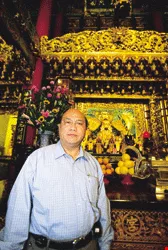
(facing page) In three years as head of the Temple of Heavenly Blessing, Chen Yu-feng has attended to countless administrative details and paid close attention to the needs of local people in hopes of distributing the compassion of the goddess Matzu to everyone in the community.


@List.jpg?w=522&h=410&mode=crop&format=webp&quality=80)


