

Jimei, about half an hour's drive northwest of Xiamen, is not just a 'campus village,' but also a window on overseas Chinese education. From its past and present, we can learn a little about the study opportunities available to overseas Chinese in their motherland.
Jimei was once known as the "cradle of overseas Chinese students," and its alumni can be found around the world. Jimei has a special meaning both for Southeast Asia and for Taiwan, just across the Taiwan Strait.
Lu Junqin, office director at the Committee of Jimei Schools, told us that after the defeat of Japan in the 2nd World War, the entire teaching staff and students of Jimei Agricultural College, led by the College's principal, Zhuang Shu, were responsible for making an inventory of farmland all over Taiwan and for taking charge of land expropriated from the Japanese. Tan Kah Kee, who only spoke the Southern Fukienese dialect all his life, had a special affection for Taiwan with its Southern Fukienese population. After Taiwan's return from Japanese to Chinese rule, students at Jimei Agricultural college all had to do a month's practical training on farms in Taiwan before graduating, and many took back with them happy memories of the island.
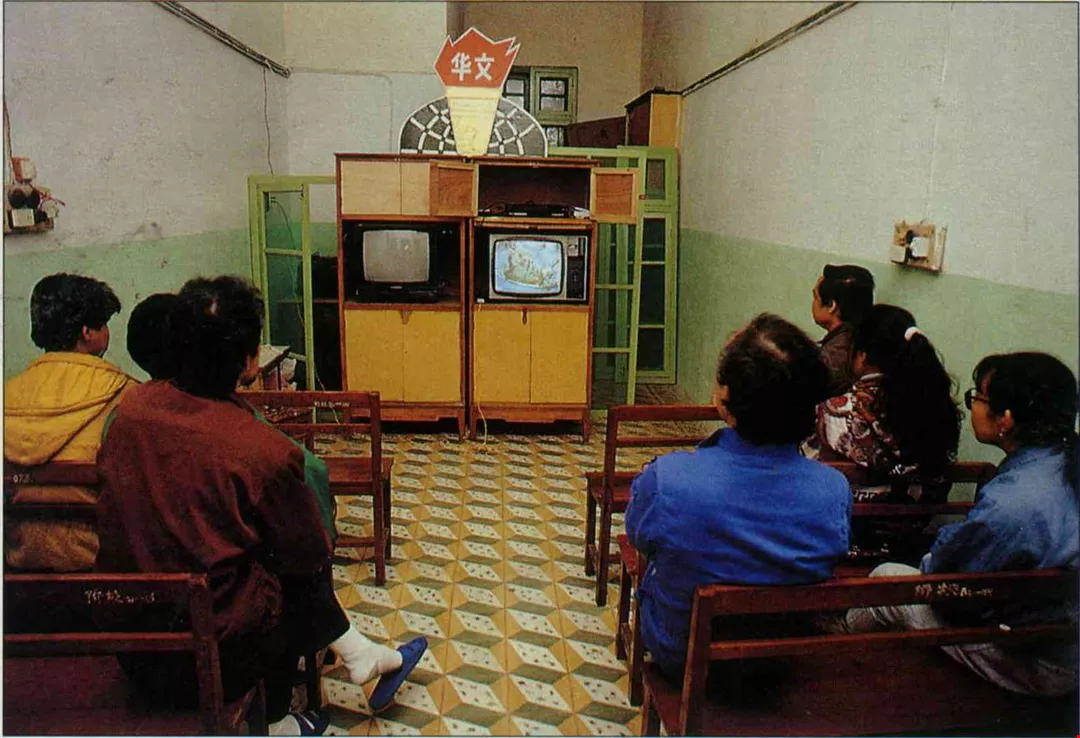
For a time Jimei, which stands in an area which is the ancestral homeland of many overseas Chinese, was cut off from the outside world. But since the mainland embarked on its policies of reform and opening, Jimei has once again been able to look to the overseas Chinese of Southeast Asia for its students. Pictured here is a class at the Jimei Supplementary School for Overseas Chinese Students.
A distinctive overseas Chinese character
Tan Kah Kee's intention in setting up the schools at Jimei was not only to make a contribution to his native area. He was always even more concerned with China's relationship with Southeast Asia. For instance, when Jimei Teacher Training College accepted students from poor families free of charge, this was not only to train teachers for Jimei, but also for overseas Chinese schools throughout Southeast Asia, in order to promote Chinese culture overseas. This is where some of the teaching staff at Singapore's Chinese High School and Tao Nan School were trained.
The establishment of Jimei's colleges of Navigation and Fisheries, the first of their kind in China, was also motivated by the fact that despite China's long coastline, its fisheries were not very productive and its seafarers had little in the way of navigational skills. Tan Kah Kee had lived many years in Singapore, and was impressed by the maritime might of the British colonial rulers. He specially ordered equipment from Europe to build two fishing vessels, Jimei No. 1 and Jimei No. 2, to give students practical training. Jimei No. 2 was a large trawler, which was something very rare in China at that time.
Similarly, Tan set up Jimei Finance College after seeing the efficient organization of Western businesses. He hoped to introduce new methods of commercial accounting to China, and train personnel to assist overseas Chinese business people in Southeast Asia. Jimei's sister institution, Xiamen University, paid high salaries to recruit many foreign teachers, along with Chinese teachers who had just returned from studying overseas, hoping that they would broaden students' horizons. Tan Kah Kee had spent much of his life abroad, and had a very international view of education.
In its first two decades from 1913, when the elementary school was set up, until the outbreak of war with Japan, Jimei laid down solid foundations. But in 1938, when Xiamen fell to the Japanese, Jimei began almost a decade of upheaval. The campus was bombed heavily, the schools moved several times, and they could only continue teaching with the greatest of difficulty. But to have remained open at all was a considerable achievement for a private establishment.
After the war finished, the schools returned to the Jimei campus. When the communists seized power in 1949, they called on young people to return from overseas to build the "New China." The schools' founder Tan Kah Kee also returned to live in his native area, and Jimei entered a boom period.
To take Jimei High School as an example, in the mid-1950s it once reached over 3900 pupils, taught in 76 classes. More than 40% of the pupils were overseas Chinese, and there were also many relatives of overseas Chinese. Only one third were local pupils. Chen Yongshui, a grandson of one of Tan Kah Kee's cousins, remembers how when he graduated from Jimei Middle school in 1960, almost all the other pupils in his class were overseas Chinese.
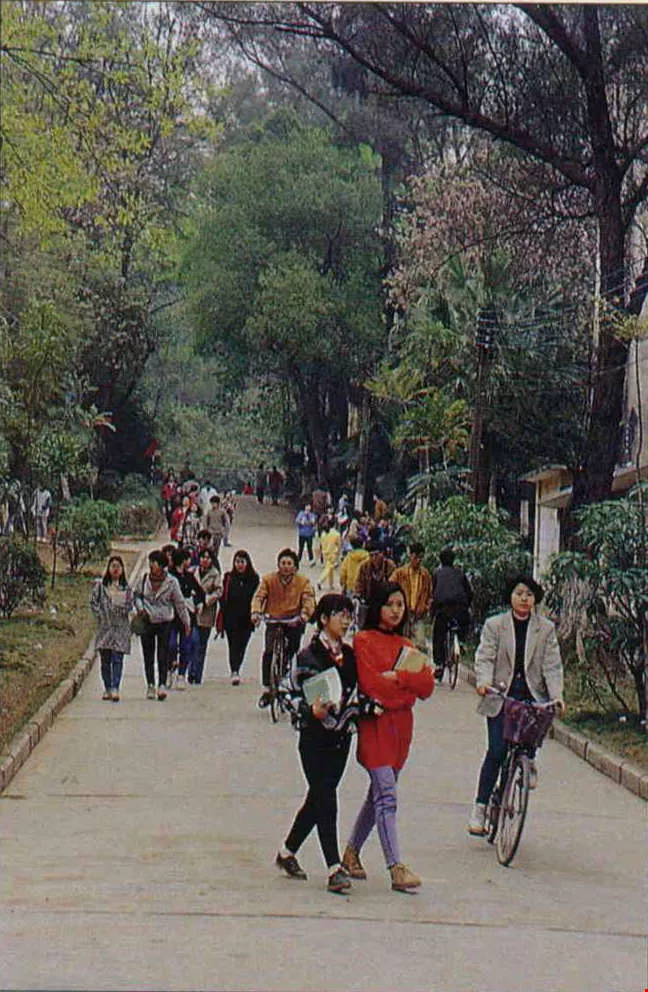
Jimei, Xiamen University, Quanzhou Overseas Chinese University and Jinan University in Guangzhou, all in coastal areas, are well known as institutions which cater to overseas Chinese students. Pictured here is part of the Jinan University campus.
A "hornet's nest"
But at the same time as this large influx of overseas Chinese students was taking place, the Chinese Communists were pursuing a "reform" campaign in which higher education was called upon to "emulate the Soviet Union and reorganize departments and faculties." Jimei found itself in a renewed state of turmoil, and the schools' administration was in thorough disorder. In 1956, Jimei was formally taken over by the state, and soon afterwards the Fisheries College was placed under the Ministry of Fisheries, the Navigation College was placed under the Ministry of Navigation, the Finance College was placed under Fujian Province's Industry Department, the Supplementary School for Overseas Chinese Students was placed under the Overseas Chinese Affairs Commission, and so on. Originally the schools on the campus had formed an integral whole, but now this structure was completely dismembered and each followed its own separate course.
During the Cultural Revolution, schools, colleges and universities were the focus of the Red Guards' violence, destruction and looting, and overseas Chinese were declared "bad elements." Thus it is not hard to imagine how Jimei, as an educational campus located in an area which was home to many overseas Chinese, was seized upon as a "hornets' nest" to be cleaned out. The famous stone carvings around Tan Kah Kee's tomb, the Sea Turtle Garden (Aoyuan), were deliberately smashed by students from other areas, who nearly came into armed conflict with local members of the Chen clan who "swore to defend the Sea Turtle Garden with their lives." The tomb was only saved after a personal intervention by Zhou Enlai.
As the Cultural Revolution's "reforms" reached their peak, most of the schools on Jimei campus closed their doors one after another, until "all the equipment was reallocated, all the staff transferred away, and all the buildings reoccupied." The few schools which did manage to keep some lessons going were so afraid of committing any "errors" in their teaching that they could only study passages from Quotes from Chairman Mao or sing revolutionary songs.
As Lu Junqin of the Committee of Jimei Schools points out, at that time schools and universities all over the country were turned upside down. But the most worrying aspect for Jimei was that as a place whose activities had always centered on overseas Chinese students, if it was no longer to be able to "look overseas" for its students, then where did its future lie? Without its "overseas Chinese" character, could Jimei still be Jimei?
This question is still difficult to answer today. Xu zhongjing, principal of Jimei Supplementary School for Overseas Chinese Students, observes that after the Cultural Revolution ended overseas Chinese were no longer vilified, yet it was hard to repair the damage already done. "If the overseas Chinese students couldn't come, then we couldn't keep going." It was not until 1982, after the Jimei School of Chinese Language and Culture was set up, that Jimei once again began inviting applications from students overseas, to let second-generation ethnic Chinese who have lost contact with their ancestral homeland to get to know it again through language and culture.
Rebuilding Jimei with its founder's spirit
At present the two Jimei overseas Chinese schools have around 400 overseas Chinese students, most of whom are the children of expatriates who have returned to live in China. Those students who have actually come from abroad are mainly attending short Chinese language courses. Because most of them are not used to simplified characters (Chinese schools in Southeast Asia use teaching materials from Taiwan, which are written in traditional "complex" characters), and are not willing to attend communist political classes, it was necessary to design special courses for them, such as the interesting and practical summer camps where one can "learn 300 sentence patterns in a month."
"This way, the students have a sense of achievement, and when parents see that their children can greet people in Chinese and can write their own names, they feel that sending them here has been worthwhile," says Xu Zhongjing, who thoroughly understands the overseas parents' psychology.
The overseas students come and go, but after completing their courses a small number of them go on to sit the entrance exams for Quanzhou's Overseas Chinese University or Guangzhou's Jinan University--two institutions which specially stress their openness to overseas students, particularly those from Southeast Asia. They aim to recruit students mainly from among the overseas Chinese and from Hong Kong, Macao and Taiwan. Students are recruited through the universities' own examinations, separately from the national university admissions procedure.
In its early years Jimei was called the "cradle of overseas Chinese students," but nowadays most overseas Chinese who return to China to study, whichever part of the country their ancestors came from, try to get into the Beijing Chinese Language and Culture School.
"People's feelings for their ancestral area are much weaker than they used to be, and their desire to go back to their roots takes second place to more practical considerations," observes Xu Zhongjing. It would appear that unless the greatness of spirit of Tan Kah Kee's days can be revived, and funds found to recruit able teachers and purchase modern equipment, out-of-the-way Jimei will be destined to play second fiddle to the big cities with their abundance of talented people.
Although Tan Kah Kee has been dead these 34 years, his power to inspire remains one of Jimei's assets. In recent years, members of his clan have returned one after another to visit family and friends in their ancestral homeland, bringing with them promises of all kinds of donations. The "Tan Kah Kee International Society," chaired by Li Yuan-che, the President of the ROC's Academia Sinica, is currently directing funds and efforts towards repairing the campus buildings at Jimei, which have been neglected for many years and several of which are in a dangerous condition. The Society also hopes that the administrations of Jimei's various schools can be reintegrated instead of pulling in different directions as at present; the final goal is to create a Jimei University.
Tan Kah Kee's Jimei campus has already written an indelible page in the history of the overseas Chinese. With assistance from inside and outside China, will the Jimei of the future be able to open new horizons? We will be watching with interest.
[Picture Caption]
P.54
Seen across the bay from the Sea Turtle Garden, Jimei's wooded campus is an impressive sight in its seaside setting.
P.55
For a time Jimei, which stands in an area which is the ancestral homeland of many overseas Chinese, was cut off from the outside world. But since the mainland embarked on its policies of reform and opening, Jimei has once again been able to look to the overseas Chinese of Southeast Asia for its students. Pictured here is a class at the Jimei Supplementary School for Overseas Chinese Students.
P.56
Jimei, Xiamen University, Quanzhou Overseas Chinese University and Jinan University in Guangzhou, all in coastal areas, are well known as institutions which cater to overseas Chinese students. Pictured here is part of the Jinan University campus.


@List.jpg?w=522&h=410&mode=crop&format=webp&quality=80)
