Home, Sweet Home--A "Happy" Tale of Urban Aborigines
Sam Ju / photos Chuang Kung-ju / tr. by Scott Williams
April 2009


The blood of the "people of the moun-tain and the sea" still flows in the veins of Taiwan's Aborigines. Ask one who has spent years roaming the island, "Where is your home?" and you're likely to hear that it's wherever there are mountains, water, the chattering of birds, and the scent of flowers. While perhaps not strictly true, the thought brings back memories of their old hearths and homes, warming them as they make their way through the weary world.
"The trees ended at the headwaters of the spring where he came upon a mountain. In it, he glimpsed a small opening through which light seemed to shine." Thus did Jin-Dynasty poet Tao Yuanming describe the approach to "Peach Blossom Spring," his legendary utopia to which no one could ever return. Today, many of Taiwan's urban Aborigines retain memories of a similar place.
We set out from Keelung one afternoon before the Lunar New Year, driving up Taiwan's northeast coast along Provincial Highway No. 2 in the stiff ocean breeze. We're headed for Shuinandong in Taipei County's Ruifang Township, the boundless blue expanse of the Pacific to our left, the dense green vegetation of Keelung Mountain to our right. Just past Yinyang Hai, where mine runoff turns the sea two colors, we spot a boulder inscribed with "Gengziliao-Good Land, Good Water" and the signatures of local representatives and officials. Turning right onto the narrow road, we climb then round a 60-degree bend only to be stunned by the natural beauty of the vista before us.
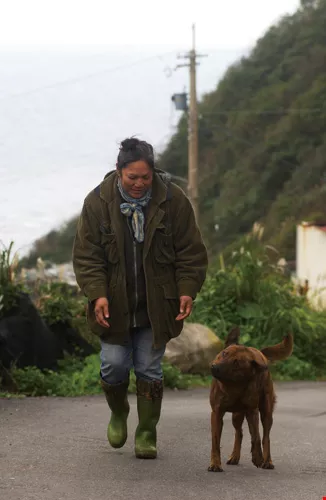
"Heh. I live with you in Happy Village, don't I?"
A hidden paradise
Both sides of the concrete-paved road are spotted with low wooden shacks every ten meters or so, and every bend in the road reveals new structures: wooden, brick, earthen, and corrugated steel. There are also several unfinished homes framed in bamboo. All told, we see 30 or 40 homes, each roughly 350 square feet in size.
Perhaps as a result of the forest cover, when seen from below the homes appear to sit scattershot on the mountain. Yet when viewed from above, the colorful rows of short houses snake around the slope like terraced paddies.
The winter wind at nearly 200 meters above sea level is biting as it blows past that afternoon. Only the dogs are outside, barking at the visitors to the homes they guard.
We wonder where everyone is, then hear a woman's voice calling warmly from further up the road, "Welcome to Happy Village!" The matronly figure who steps out of a house high above has a basket in her hand and black plastic galoshes on her feet. After reassuring herself that we aren't there to make trouble, she waves us over with a smile.
"We're all Amis here in Happy Village," she says, her rustic pronunciation of "Amis" unmistakably that of a Taiwanese Aborigine.
Setting her basket on the ground, she bends down to pet two small dogs, one brown, the other black. Lifting her head again, she tells us, "There's no one here right now. They're all out working."
The woman with the basket is Zhang Meixiang, a 53-year-old Amis native of Hualien's Guangfu Township. Zhang, a grandmother with middle-school-aged grandchildren, moved to Happy Village from Ruifang Township 15 years ago. "Here, we've got the mountains behind us and the sea in front of us, just like in my hometown," she explains with a smile.
"There's an air of homeyness and human kindness here," says Lengos, a 60-year-old Amis originally from Hualien's Ruisui Township. Lengos, who goes by Lin Xiuying in Mandarin, is the executive director of the Aboriginal Association of Ruifang Township. She then calls out to the neighbors to come share the basket of oranges, box of watermelon seeds, and plate of raw ginger salad she has with her.
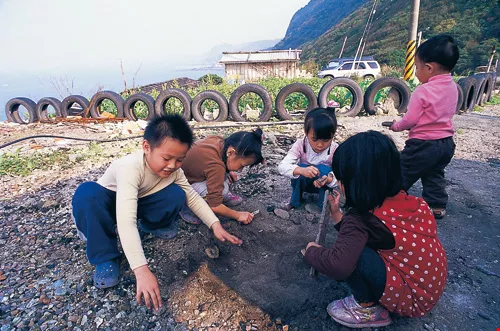
(facing page) The children of Happy Village live amongst the mountains and play in the fields. Do the earth and stones beneath their feet remind them of the shingles on the seashore of their parents' hometowns?
Cheerless words
The "happiness" doesn't end at the name of the village; the community also refers to Keelung Mountain as Happy Mountain. Don't they ever get fed up with the word "happy?" It was Wayam, a 50-year-old Amis from Hualien's Fengbin Township, who christened the place "happy." Having left her hometown while still in her twenties, Wayam (Lin Jingfang in Mandarin) moved to Ruifang some 14 years ago after five years working in Banqiao.
Struck by the joy on the faces of the Amis who had built houses for themselves on the mountain, she is said to have exclaimed, "Well, if everybody is this happy, why don't we just call it Happy Village!" Since then, the name has become as well known as those of Ruifang's other two Amis communities-Amis Home and Golden Village. All the cabbies in Ruifang itself know exactly where the "happy" Aborigines live.
But, when you talk to folks in a bit more depth, you learn that the name represents a brave face put on a difficult situation. Like most urban Aborigines, their biggest problem is a lack of steady work.
Incon, a 65-year-old community member who goes by Liu Qingfu in Mandarin, tells us that the community actually formed more than 40 years ago when tribespeople who had come north to work in Jinguashi's goldmines set up housekeeping on "Happy Mountain." In those days, Incon himself worked in Ruifang's Jianji Coal Mine and lived in company housing, earning about NT$100 per day-roughly the same as an elementary school teacher-from mining and odd jobs.
Incon worked in the mines for 15 years, until 1985. Though his daily pay eventually rose to about NT$1,500, Taiwan's mining industry was approaching the end of the line. Incon had to find a new career, and ended up working on ships out of Keelung and Kaohsiung for five years.
In 1990, he built himself a home on "Happy Mountain" made from wood and corrugated steel, and began doing carpentry in Keelung, Taipei, Taoyuan, and Hsinchu, wherever the work happened to take him. Real-estate prices were soaring at the time, and Incon says he made a good living, earning NT$2,000 per day working about five days a week.
"The good times lasted only four or five years," he says. "Things have been much tougher lately." Now, in addition to building concrete forms, he spends about six days a month doing janitorial work at the refuse incinerator in Taipei's Muzha area for about NT$1,500 per day.
Incon's family lost its paddies in Fengtian Village, located in Hualien County's Shoufeng Township, to floods long ago. Hearing about mining jobs from a relative, he came to Ruifang. Though these days he's just getting by, he says that sitting under the eaves while the mountain breezes blow, eating ginger he grew himself and drinking a little Paolyta-spiked rice wine with tribespeople of his own age reminds him of being back in his valley home in the Hualien-Taitung area.
But what is "home?" Lengos' response cuts right to the quick: "With no fields, no land, and no family property, 'home' is wherever you happen to hang your hat."
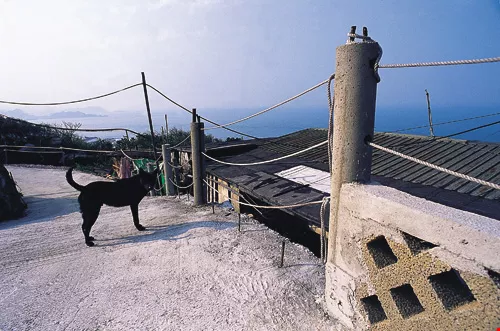
(above) While the Amis of Happy Village are out at work, their dogs and cats stand guard over the community.
A port in a storm
Thus this Happy Village nestled between mountain and sea really has come to feel something like home to many urban Amis.
But just how many Amis live here? Lengos says that there are about 21 households with actual street addresses, and another 30 or so without. Figuring an average of about three people to a household, there are about 150 people in the community.
According to the Ruifang Township Administration, five of those with actual addresses are located on slopeland owned by the national government. The Taipei County Indigenous People's Bureau is currently working with the National Property Bureau of the Ministry of Finance to explore the feasibility of offering legal leases on this land.
The IPB has refrained from mediating lease deals on the remainder of the homes, most of which are sited on private property with the tacit consent of the landowners. This being so, the homes are unlikely to face demolition in the near term.
Lengos says that Happy Village has been demolished three times: in 1994, 1996, and 2002. Though the last time completely leveled the village, the first two involved only "tidying up" small areas. Having seen what has happened elsewhere in Taipei County-to the Sanying Community on the Dahan River and the Xizhou Community on the Xindian River-the Amis here worry about the future of their homes. "Even places with street addresses, running water, and power were demolished!"
Tao Yuanming's "Peach Blossom Spring" depicts a group of people who left the chaos of the world behind and formed their own isolated community where "young and old alike were happy and content." Many of the Amis on Happy Mountain have likewise come seeking refuge, typically arriving from nearby Ruifang or Keelung after finding themselves unable to make their mortgage payments or seeing their former homes seized. Life is simpler on the mountain, where their only expense is NT$500-600 per month for their power bill.
Masaw, who goes by Chen Zhengxiong in Mandarin and is chairman of the Keelung City Indigenous Peoples' Commission, says that between the Gregorian New Year and the Lunar New Year, some 20 to 30 Keelung-area Aboriginal homes were subject to foreclosure and auction, roughly 10 in the Heping Island area alone. "Many of these families have come to Happy Village and built themselves new homes from corrugated steel," says Masaw.
Lengos says that five or six new homes have been built on Happy Mountain in the last six months. These victims of foreclosure simply had nowhere else to go.
"More and more Aborigines are finding themselves unable to pay their mortgages," says Lengos. "There have even been a couple of foreclosures in Amis Home and Golden Village in recent months, which are just a couple mountains over from Happy Village."
Happy Village's 30-odd "no-address" houses are more like "country homes" that Aborigines who still have the means to live in the city use for weekend getaways.
Five or six Aborigines in their 50s are sitting together on a small as-yet unpaved track in the village, close by a kitchen chimney from which cooking smoke rises. Chatting in the Amis language, they enjoy some daikon freshly pulled from a nearby field, then peeled and marinated.
"We grow vegetables here, and do it without pesticides and without cutting down trees. So don't blame the landslides on us," says an elderly matron, deriding urbanites who point fingers without knowing what they're talking about.
Village residents have built house after house from scrap wood, doors, and windows gathered from all over, and have furnished them with broken sofas, chairs, and other scrap furniture.
"Daytime work is getting harder and harder to find, and hanging around government housing is no fun, so people are coming up the mountain to find other tribespeople with whom to chat, drink a bit, and take in the scenery," says a male Amis seated nearby. "It makes you feel better."
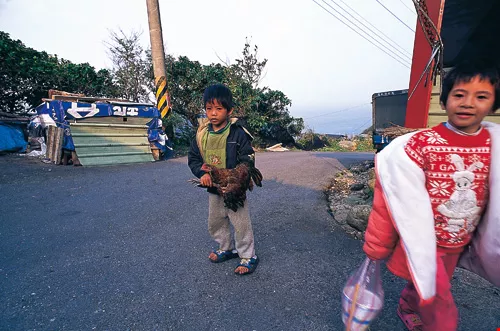
(facing page) Everyone who comes to Happy Village is treated as a guest. When someone arrives, the Amis call out to their kids to come and help them kill a chicken and prepare a feast.
Enjoying the idyllic life
Low green clumps of blooming bird's nest fern cover the mountain. Known as lokot in Amis, it is an economic staple for villagers who sell it in the parking areas along the Shuinandong stretch of the coastal highway in the evening.
"NT$50 a bunch!" shouts Wayam, holding up a fresh-cut bunch of jade-green fern 20 centimeters in diameter. Squatting by the road, she sells her first eight bunches in less than 15 minutes to visitors who've come to the coast to fish.
"You're making money on the deal. If you got a plate at a mountain restaurant, it'd cost you at least 100 bucks for just a few leaves," she says, teasing her customer in Amis fashion.
Just a stone's throw away, the Pacific Ocean provides residents with another source of income-the seaweed that grows at the base of the cliffs below the road. Villagers sell it to restaurants and karaoke bars, which use it to make a type of dumpling currently popular at Aboriginal eateries.
On a normal weekend, more than a dozen cars will take a wrong turn and head up the mountain. When these misdirected visitors find out Amis live on the mountain, they typically get out to chat and buy a few bunches of ferns, seaweed, hearts of rattan palms, and chilies. Both hosts and guests thoroughly enjoy the visits.
As the evening turns to dusk, we stand on the mountain looking out at the sea. The lights from the fishing boats sparkle like diamonds on the dark surface of the water. It's almost as if we've fallen into Zhang Ji's famous poem: "From beyond Gusu, where the Hanshan Temple stands / The tolling of the midnight bell reaches my boat."
The marvelous scenery has also drawn renowned architect Hsieh Li-hsiang to the area. Some years ago, she built a studio for herself here in the Amis village as a place to seek inspiration.
The poet Chiang Hsun has written that nostalgia and elegies are for those with no home and those who choose not to go home. Nestled between mountain and sea, the urban Aborigines of Happy Village are neither nostalgic nor in need of elegies.
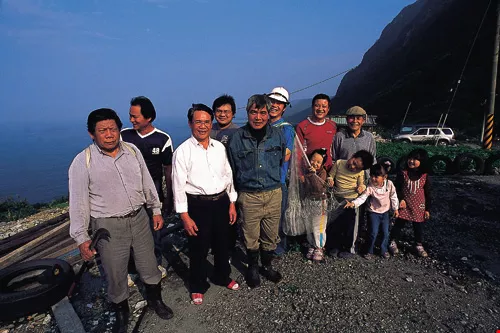
(facing page) As far as the residents of Happy Village are concerned, "home" is both wherever they hang their hats, and the distant Hualien-Taitung coast.
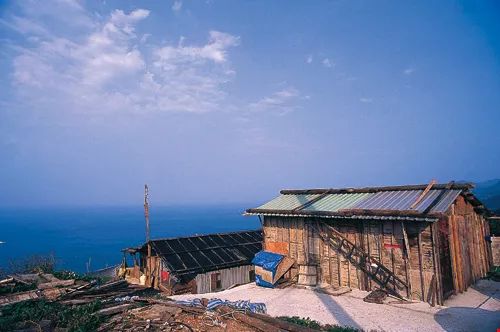
(above) A mountain needn't be tall to be famous, so long as an immortal lives there. A river needn't be deep to make its presence felt, so long as it has a dragon. Who says the humblest of abodes can't be "home?"


@List.jpg?w=522&h=410&mode=crop&format=webp&quality=80)
